
Last month I posted an article about my favourite words and it triggered a comment from Sarah Freligh about the words we have as writers to describe our writing processes, not the “official” words for things, but the “bespoke” words we come up with ourselves, the ways we think about idea formation or narrative shape or guiding our reader through our story-telling worlds.
Having followed this up by asking a question on social media, I was intrigued by the answers that came back. Bespoke images. Bespoke analogies. A wonderful vivacity to the language on show. An interesting sense of echo and connection between one writer’s terms and the terms of another. There’s a richness to all of this, and while we don’t necessarily need the terms to go about our art, I think that having access to them can strengthen our thoughts and open up new avenues.
That’s why I’m using this month’s article to showcase some of those answers as well as to add in a few words I use myself.
A Snow Globe on an Iceberg: World-building in short fiction
With so little space to play with, how do we effectively bring a story’s world to life? How do we best evoke place, time, and wider context without it overwhelming the story?
Tuesday 7th July 2026 (19:00-20:30 BST) OR Saturday 11th July 2026 (09:00-10:30 BST)
What is Learnt in the Cradle: How our childhoods affect our adult selves
How do a character’s early influences affect who they become in later life? What do they inherit? What do they learn? And how do we use all of this within our writing to create character depth?
Tuesday 4th August 2026 (19:00-20:30 BST) OR Saturday 8th August 2026 (09:00-10:30 BST)
Glorious Words
How do we choose the right words to sharpen up our prose? How do we make our writing unique without it becoming obscure? Is the road to hell really paved with adverbs? This flash fiction course explores language in all its guts and glory, focussing on unique images, concision versus specificity and how to create original tone.
3rd - 16th August
***LAST CHANCE TO SIGN UP***
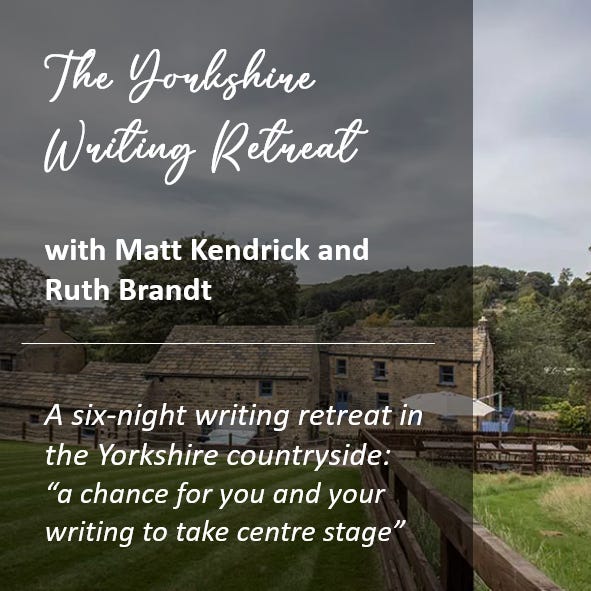
Monday 14th - Sunday 20th September 2026 in Thurlstone (Holme Valley)
Join us in the idyllic landscape of the Holme Valley for a six-night writing retreat where you’ll learn from two widely experienced creative writing teachers through a series of workshops, feedback sessions and one-to-one chats. You’ll also have plenty of unstructured time dedicated to putting new words on the page.
5th - 25th October
You’ve come up with your idea. You’ve put that idea down on the page. But how do you take that first draft and make it the best version of itself it can possibly be? How do you create enough psychological distance from your work so you can read it like a reader would? How do you identify what is and isn’t working? And how do you fix the possible issues you pick out?
The Editorial Funnel is a two-part editing course that explores the concept of an “editorial funnel”, working through the editing process from zoomed-out to zoomed-in. Part 1 explores how we might effectively edit for narrative focus, narrative structure, originality, emotional build and structural form, considering editing as both a thing we do for our own writing and as a thing we might do for others.
Before we start writing, we generally need some sort of idea. What are we going to write about? I often compare this spark of inspiration to the turning on of a lightbulb💡but I suppose we could also think in terms of a match being lit 🪄or an engine starting 🚒 or a tap being turned on 🚿. What all these things have in common is that they emphasise the start of something. They also contain that idea of heat or energy, and I feel that’s maybe a useful image to bear in mind. We want that energy, we want something that can be turned up to full blast.
Next, it’s about getting the idea down on the page and I love the terms that different writers have for this. On Bluesky, Erin Bondo suggested the term “trash draft” 🗑️ while Jay Parr suggested “vomit draft” 🤮 and Cole Beauchamp talked about “flinging a story out”, a bit like pitching the ball in baseball ⚾. Sarah Freligh then chimed in with “shit draft” 💩 and how “shit makes flowers grow” 🌷. What I love about all these terms is that they take the pressure off. The expectation is that what we’re writing is trash or vomit or shit. The flowers, or the gold, or the polishing of the turd - that comes at a later date.
In a similar vein, Jacqueline Doyle on Facebook mentioned the term “messay” 🌀 for the first draft of writing an essay, and again I think this is so wonderful in how it takes the pressure off. I also love how it can be broken down into “me” + “essay” and how that might help a writer keep in mind the subjective / first-person nature of writing in this form.
Once you have that first draft on the page, I always think a good question to ask yourself is around originality. Is your idea unique enough? Have you made the most of those unique elements? Or could the piece do with something more to make it stand out from the crowd? I like to think of this in terms of a pink flamingo on the rush hour commute 🦩. We want our piece to be fully visible against the “businessmen” pieces in their grey and black suits. This isn’t necessarily through lurching into the bizarre or the extreme, but through picking out the specifics of what makes this scenario interesting, what makes this character interesting, how our chosen perspective or voice or form finds a new angle 📐 to a story that’s been told many times before.
Another thing it’s generally useful to think about between first and second drafts is “focus” 📷, and a word that seems quite widespread to describe this is “distillation” 🧪 (thanks to Bev Adams on Facebook for prompting me to include it). Is our idea distilled down to its purest essence? A different way of thinking about this came from Suzanne Greene on Bluesky. She talks about “skimming the cream from the top of the milk” 🥛 and I love that as an image, how it leans into the idea of taking the “rich” cream and discarding the more “ordinary” milk - isn’t that exactly what we want for our stories?
Another image I absolute love is the idea of “following the flow of the river” 🌊. This is how Karen Pierce Gonzalez expanded on that image when I asked her about it:
“writing is a hearty river that circumnavigates beaver dams, heavy boulders, and litter. Waterway cycles (sky to sea to sky etc) remind me that water adapts to move around what's in the way. Sometimes a poem becomes flash fiction, a story works best as a short play.”
Sometimes, as writers, we can be very resistant to reconfiguring an idea once it’s down on the page but often the first draft doesn’t quite come out in the right form or the right shape. When I think about story shape, I often use the image of a “fish” 🐟 (an idea I first came across in an essay from Elaine Chiew in the wonderful craft book Short Circuit). A story starts at the fish’s mouth. It then expands outwards through the body before pinching in towards its narrative zenith. Then it spreads outwards again in the ‘ending’ tail.
Another analogy I often make regarding story shape is how a story’s journey is similar to that of a “trainline” 🚂. We start at a starting platform. The train sets off and gathers speed through an altering landscape towards a moment of climax where the “story train” switches tracks (something changes) before arriving at an ending platform which is different and contrasting from the platform at the start.
One of the challenges with writing is that it’s like “spinning plates” 🍽️. We have to keep the “originality plate” spinning at the same time as the “focus plate” at the same time as the “shape plate” and sometimes we make a decision with one of those things that causes one of the other things to topple and break. For example, we might resolve the issue of “not enough originality” by mashing our story together with a previous / other idea in a process Elissa Field (and others) calls “Frankensteining” 🧌. Sometimes this works, but sometimes we end up with an end product that’s slightly “ugly” in the way we’ve stitched together different parts that don’t quite go.
What “Frankensteining” foregrounds as a term is how we, as writers, are in control of our stories. It’s up to us to be the mad scientists. It’s up to us to turn our puppet-stories into “real boys” rather than “gruesome monsters.” And this, of course, also applies to the individual elements within a story. We control the setting. We control the weather. We control the passing of time. We control the characters. I love the way Claudia Monpere thinks about our control over our characters, reminding herself to “make the dolls do something” 🪆. Active characters generally make for more interesting and resonant work.
I think we can also adapt this into: “Make the dolls WANT something” and “Make the DOLLS’ LIVES DIFFICULT”. If we give a character something they want, it gives a reader something to care about; and if we put barriers in the character’s path, it infuses the emotions of the story with a greater sense of resonance.
We want that resonance. We want the things that make a story sing. And there are so many terms that writers use to describe this. Peter Devonald (on Bluesky) talks of “finding the wonder” ✨; Suzanne Greene talks of “finding the gold”👑. I’ve also heard writers talk about “finding the heat” 🔥 and I love how that links back to the “spark of inspiration” of turning on a lightbulb or lighting a match.
Thinking a little further about that wonder / gold / heat, the wonderful Kathy Fish talks about “uncovering the depths” and this chimes with my own thoughts on “excavating the story-garden" ⛏️. What I mean by this is that once we have our first draft, it’s worth digging into it to reveal what’s buried underneath. This might be a message, it might be a slice of universal truth; or it might be things that you know about a character (perhaps about their backstory or what is heading in their direction) that aren’t loud and clear on the surface of the piece.
Sometimes, to add that in, we have to be bold and write the piece in a whole different way. But sometimes, it’s just about making small additions. I love how Dave Alcock on Facebook talks about “insertions” 📎(tiny moments added in) and “interstices” 🗜️(tiny moments that go unmentioned, making use of the breaths between sentences, the white space).
Mostly I feel as though those hidden layers only come to us when we’ve let the story sit for a while. Many writers, I think, can be far too impatient to mark a story as “done” whereas if you take time away from it, often you see new opportunities or hidden layers. Think of it like leaving tea to “brew” 🫖 or leaving a loaf of bread to “rise" 🍞. These things can’t be rushed.
I often go through five or six iterations of this. As I talk about on my course, The Editorial Funnel, I think about the process of editing as several stages from zoomed-out to zoomed-in, which I explain by the following video:
We have the structural stuff first, then we get to the more zoomed-in level of sentences and words. As Catherine Weiss brilliantly put it, this is where we go about “Garamonding our prose” 🐩. Or maybe you prefer Patricia Q Bidar’s analogy of “combing through” 🪮, the idea of approaching the prose with a fine-toothed comb.
One of the things that’s often needed at this level of editing is stronger flow. As I talk about on my “Go With The Flow” course, flow is in my opinion one of the hardest skills to master as a writer. It’s so multi-faceted. In involves things like “anchoring” ⚓ our reader in a scene. It involves building “bridges” 🌉 through our ideas in a way that makes both logical and rhythmical sense. “Bridges” is my terms, but I also love how Sarvin Parviz talks about “glue" 🫧. With all of these terms, I think the ones that make the process sound more easily achievable are the ones to go with. “Gluing” sounds much more accessible than “building bridges” so perhaps I should start using that?
Another thing I generally think about at the sentence-level of editing is “cutting out the fat” ✂️, making sure that every word is doing something, and getting rid of those that don’t, also getting rid of “weasel words” 🦦 and awkward repetitions. On the flipside of this, I like to think about creating “highlights”, moments of “sparkle” 🌟, linguistic pyrotechnics that make a reader go wow. If you’re interesting in delving into this a little more, we do both these things on my “Glorious Words” course which is running for possibly the final time next month.
Of course, it’s hard to know how far to push things with our language. I generally think we want the language we use to be in service of the story. But sometimes we choose to steer completely the other way. George Saunders talks about something he terms as “freakification" 🤡:
“In this mode, we’re showing off, making a bit of a scene, purposely departing from the normative, in order to get some damn attention.”
I’ve not come across the term before and I’m grateful to Lucinda Kempe for bringing it to my attention. While I often preach the idea of making language serve the story, most of my own writing is “guilty” of the exact opposite. So, it’s nice to have an “excuse” to justify my revelry in words, pushing things to their limits as I’ve done here and here and here.
That’s the thing about these terms. They help us better understand what we’re trying to do. They makes things easier to grapple with. And they give us new ways of thinking about our art. Sometimes, they even given us “excuses” for doing what we do.
And I’m sure there are plenty more words which might be suggested by the readers of these monthly articles. If you have any you particularly use, I’d love to hear about them. Feel free to drop these into the comments:
If you enjoy reading this newsletter, could you do me a favour and share it with all your writing friends using the “share” button below? Word of mouth is so important to a freelancer like myself.
And if you’re able to spare a couple of pennies, I’m very grateful to those of you who choose to buy me a virtual coffee each month. It allows me to keep this newsletter free and accessible to all.
Comments
Nothing yet. Say the first thing.
Sign in to join the conversation.