
Whoops! I Feel Foolish
This is the second article you’re getting in the same day. I’ve been restructuring these first two posts and in doing so I have managed to schedule them in the wrong order 🤦♀️ “Attuning” (which went out this morning) is the second in the series, not the first. Ugh. So, I have taken it down (but it’s likely still in your inbox) and it will show up again next week (but new and improved, with a video!). This is the first article in the series that should have gone out this morning instead. My apologies…sigh…
Prayer isn’t usually taught the way other skills are. We’re handed words — a psalm, a liturgy, a list of requests — and left to find our own way into presence, as if attention were instinctive rather than learned. Over the next three weeks, I want to walk us through some different practices — each one a whole on its own, each one built around a five-hundred-year-old tool called the Hand Psalter, made by a quiet Augustinian canon named Jan Mombaer. It maps prayer onto something you’re already carrying: your own hand. This is just a taste of it. The full walkthrough lives in the book, if you want to go further. You don’t need any of it to pray. But once you’ve met it, it’s hard to forget it’s there.
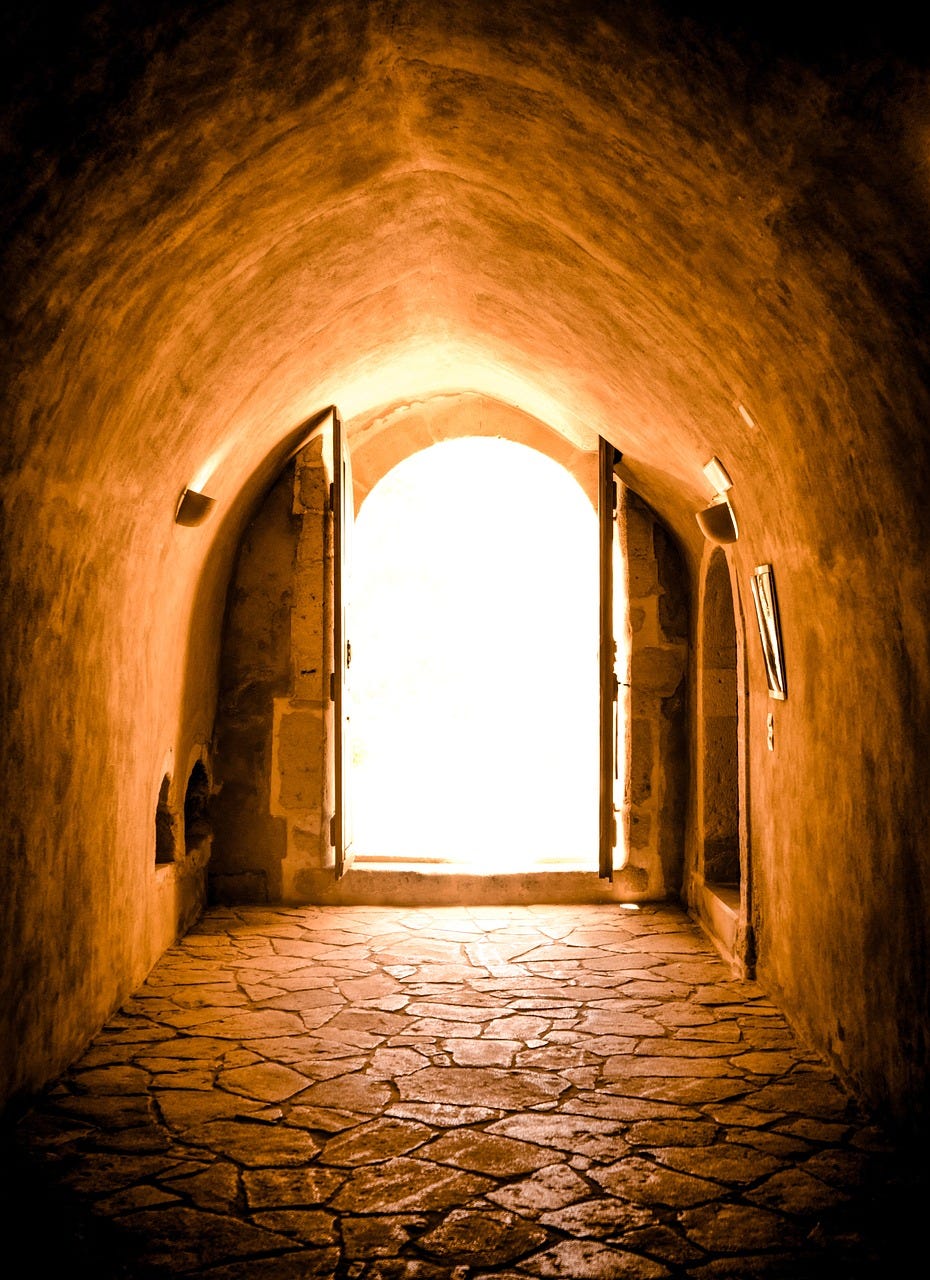
There is a moment, just before a monk enters the chapel, when he stops walking. One breath. A hand touches the cold stone of the doorframe. Then he steps through.
That pause is not incidental. It is the whole point.
Most of us skip it. We fold our hands, close our eyes, and start speaking to God while our minds are still three tasks behind, still replaying the last conversation, still calculating tomorrow’s schedule. We call this prayer. But we have not arrived anywhere. We are simply talking, out loud or silently, from the same scattered place we occupied a minute before.
The desert fathers knew this problem intimately. John Cassian, writing in the fifth century, recorded Abba Isaac’s teaching on the vagus animus — the wandering mind — and the need for a single repeated anchor to gather it: O God, come to my assistance; O Lord, make haste to help me. Not because God needed reminding. Because the one praying did.
The Celtic tradition built this instinct into stone. Thresholds mattered — doorways, fords, the lip of a well — because these were the places where the ordinary and the holy stood close enough to touch. You didn’t rush through a threshold. You paused at it, because something changed on the other side.
Arrival, then, is not a preamble to prayer. It is the first act of prayer. God is not waiting for us to find the right words. He is already present. What is missing is us — our attention, our bodies, our scattered selves gathering into one place, standing still long enough to notice we are being looked at.
This is why arrival matters more than most teaching on prayer admits. Skip it, and everything that follows — praise, petition, lament — is built on sand. Practice it, and the rest of prayer has somewhere solid to stand.
Here’s where it gets interesting.
In the late 1400s, an Augustinian canon named Jan Mombaer watched his brothers move through the Divine Office at Mount Saint Agnes — lips forming the Psalms, minds somewhere else entirely. He didn’t scold them for it. He’d been there himself. Instead, he looked down at his own hand and saw something worth pausing over: a wrist with a pulse, a palm with depth, fingers with joints — a body already built, quietly, for exactly this.
He called what he built from that observation a portable sanctuary. Not a technique to master. A place you could actually go. The first stop on it — the doorway into all the rest — is the Gate, and it lives at your wrist. Mombaer called the moment of arriving there Holy Arrest — the deliberate stopping of the world’s momentum, right there at the wrist.
Here’s the part that still surprises people. Mombaer had no concept of neuroscience — none of this language existed for him. And yet what he built, five centuries early, describes with real precision how the nervous system actually settles. The pulse point at your wrist is dense with sensory nerve endings; pressing there wakes up interoception, the brain’s felt sense of its own body. The long exhale reaches the vagus nerve, which quietly tells the amygdala: no threat here. The body arrives first. The mind, grateful, follows it in.
A single arrival doesn’t change much on its own. That’s not a failure — it’s just how bodies learn anything. But the same small gesture, returned to daily, starts to change you in a way worth getting curious about.
This is neuroplasticity, doing its quiet, unglamorous work underneath everything. Each time you pair the touch at your wrist with the settling that follows, the pathway gets a little stronger — the neural route thickens, fires a little faster, asks a little less of you next time. Eventually, touch alone is enough to open the door. The sanctuary stops being something you have to build from scratch each time and becomes somewhere your body already knows how to go to — in a waiting room, a hallway, the five minutes before a hard conversation, anywhere at all.
It’s the quiet promise worth naming honestly: not a shortcut past showing up daily, but a body being slowly, gently retrained toward arrival. Give it three days and see what you notice.
Watch it here:
What would it take, today, to actually arrive — before you ask God for anything at all?
✨If these words have helped you draw nearer to God, consider joining the Sacred Hearth—a circle of women who help sustain the ministry of PraiseWalker and make space for others to discover a deeper life with God.💖
Darlene Hull is a Certified Mental Health, Human Flourishing, and Insight Coach, currently training as a Spiritual Director, who guides Christian women to structural peace. Drawing on years of contemplative practice, Spiritual Formation coaching, and the rich heritage of Celtic Christian wisdom and ancient practices of the church, Darlene’s focus is simple: dismantling the exhaustion of spiritual performance and leading clients into the stable rest (Menuchah) secured by Christ’s finished work.
Darlene is a novitiate in the Order of Imago Christi (OIC) and a vowed member of the Order of the Mustard Seed (OMS). She works as a Spiritual Formation Coach and Christian Life Coach from her home in Calgary, Alberta. When not writing or coaching, Darlene rounds out her life with long walks, voracious reading, endless cups of strong tea, and a ridiculous amount of laughter.
Note that Darlene is NOT a therapist, counselor, or psychologist. PraiseWalker coaching and resources are designed for spiritual and emotional support and are not a substitute for professional clinical therapy or medical care.
Find out more about Darlene here: PraiseWalker.com
Image by Leonhard Niederwimmer on Pixabay
All Biblical quotations are taken from The Holy Bible, New Living Translation, Copyright © 1996, 2004, 2015 by Tyndale House Foundation. Used by permission of Tyndale House Publishers, Inc., Carol Stream, Illinois 60188. All rights reserved.
Comments
Nothing yet. Say the first thing.
Sign in to join the conversation.