

👋 Welcome to a 🔒 subscriber-only edition🔒 People’s Art of War. Thank you for being a paid subscriber to The People’s Art of War. What follows is the info war playbook for an age of AI-powered disinformation.
Scrolling social media is a nightmare since the Iran War kicked off, as I talked about in a observations I made about this war.
A typical pattern:
Someone is certain Iran struck first, another is quite certain they didn’t. A third account has satellite images proving both. A fourth is calling the third a bot.
You’ve been doom scrolling for 40 minutes. You know less than when you started, and your brain is starting to get a headache. You read all of it and understood none of it.
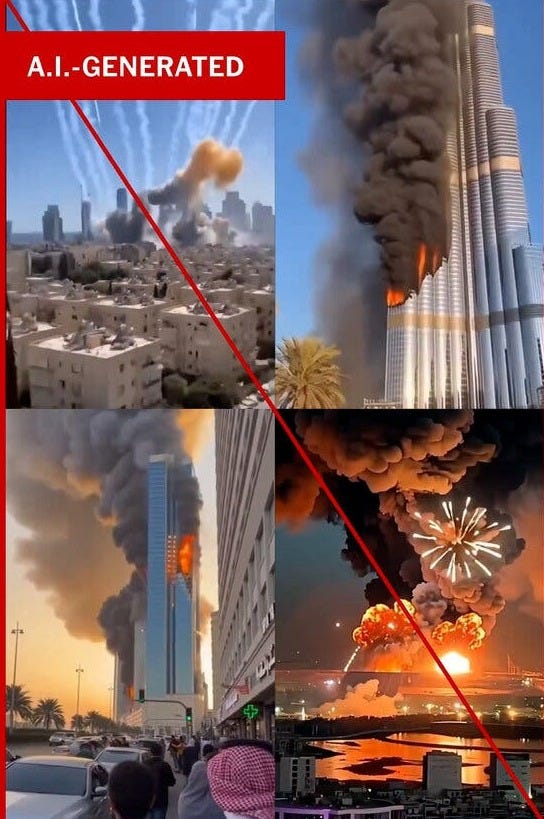
For strategists, analysts, or people who want real news, this can be incredibly frustrating and anxiety inducing. Your brain is screaming everything is wrong, but you’re not sure how to handle it. But you need information.
But the real question is whether you understand how and how you can fight back against it.
That’s what we are going to look at today.
The bottom of this article could be cut off in some email clients. Read the full article, unbroken here.
There’s a framework from the world of data called the Five V’s.
Originally, it described the properties of big data:
Volume
Velocity
Variety
Veracity
Value
The definitions for big data and data science are radically different. But the idea behind these also applies to info war, as I’ll soon show you.

In the hands of a state actor, a coordinated network of accounts, or a platform optimized for engagement, these five properties become five attack vectors . Multiplke system for disabling your judgment before you even realize it’s happening.
All five are being used against you. Let me show you how each one works.
The first weapon is abundance. I talked about this briefly in other articles.
Ten years ago, running a credible influence operation was genuinely expensive. You needed resources, coordination, institutional cover. Nation-states could do it, but it required real infrastructure to make a fabricated narrative land convincingly at scale.
That ceiling is gone
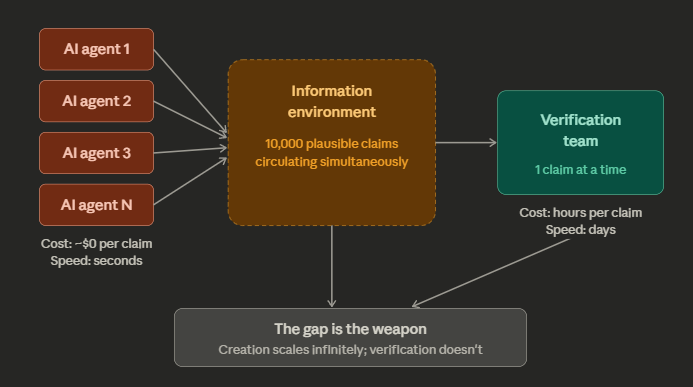
[Illustration: A single person at a laptop on the left, with an arrow pointing to a mountain of documents. On the other side, a large team of people with magnifying glasses examining just one document from that mountain.]
The gap between how cheaply someone can fabricate content and how expensively someone else can disprove it is the weapon.
Fabrications outnumber verifications by orders of magnitude. Debunks never catch up. By the time a correction lands, the false version has circulated long enough to feel like established fact to everyone who saw it first.
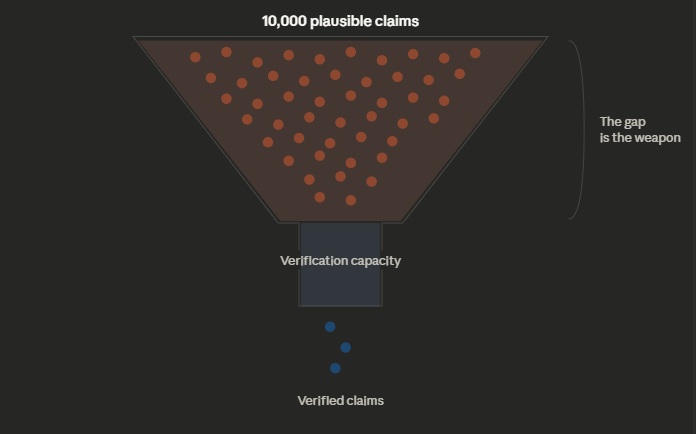
This is why volume-based attacks don’t need to convince anyone of anything specific. The goal isn’t to win the argument. Its to flood the zone, making the space so crowded with competing claims that no single version, true or false, can be evaluated on its merits.
Strategic ambiguity used to be something military planners labored to manufacture. Now it arrives on its own, generated by rumor, bots, and the financial incentives of cheap content at scale.
Truth is slow and is revealed in time. Lies move at algorithm speed.
A gap between the speed at which a fabricated claim spreads and the speed at which someone corrects it has existed for as long as propaganda has existed.
What's changed is that the gap is now permanent within the timeframe that matters for how people form beliefs about a fast-moving event.
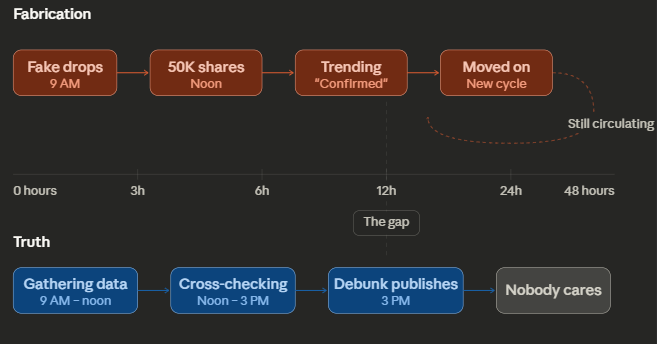
Here’s what the lifecycle of a single fabricated image actually looked like during this conflict:
Comments
Nothing yet. Say the first thing.
Sign in to join the conversation.