
There is a moment at the end of almost every community consultation when the facilitators thank everyone for their generosity. People begin closing their laptops or gathering their things. The butchers paper or online whiteboard is filled with notes. The project team stays behind, pleased with the richness of the discussion and already beginning to talk about what they have learned.
I have been in versions of this room many times throughout my career. Sometimes I have been facilitating. Sometimes I have been advising the organisation that commissioned the work. Sometimes I have been the person trying to make sense of everything that was shared and turn it into findings, recommendations or a practical way forward.
Most of the professionals in the room are there as part of their paid work. The facilitator is paid to guide the conversation. The program staff are paid to attend. The consultant will be paid to analyse the findings and write the report. Later, someone may be paid to design the report, communicate the outcomes or turn the recommendations into a new program. But often, the people whose knowledge the entire process depends upon are simply called participants.
They may have travelled across town, taken time away from paid work or arranged for someone to care for their children. They may be joining online through a phone, sitting somewhere without privacy or trying to participate in a language that is not their first. They may have been asked to revisit experiences of exclusion, discrimination, violence or institutional failure so that the rest of us can understand the problem more clearly.
During the consultation, they do much more than tell their stories. They explain relationships and histories that are invisible to outsiders. They identify why a service that appears accessible on paper is difficult or unsafe to use in practice. They explain how a proposed message will actually be understood within their community. They warn us about risks we have not considered and tell us which organisations or leaders people trust. Sometimes they repair the gaps in our analysis before we have even recognised that the gaps are there. Then the workshop ends. We thank people for sharing, and the professionals return to work.
The community’s words are transferred from the paper and sticky notes, or online whiteboard into a spreadsheet. They are coded, grouped and distilled into themes. Those themes become findings, recommendations, strategies and program designs. The organisation may use them to improve its services, strengthen its reputation, demonstrate its commitment to participation or secure further funding. Community knowledge has become an organisational asset. Yet the labour that produced it can disappear almost completely.
It would be easy to treat this as a problem with how the consultation was facilitated. Perhaps the participants should have been paid, the questions designed differently or the findings returned to the community for validation. These changes matter, but they do not fully explain why the same pattern appears across so many organisations and sectors. To understand that, we have to look beyond the workshop and into the organisational system surrounding it.
The project budget may have been approved months before community engagement began. Procurement processes may allow the organisation to contract a consultant but have no straightforward way to pay community members. Reporting templates may ask how many people participated but say nothing about who analysed the findings or influenced the final decisions. Communications teams may need stories to demonstrate impact. Funding agreements may reward projects for delivering predetermined outputs, leaving little room for community knowledge to alter the direction of the work.

No single person needs to intend harm for the system to produce an extractive result. Staff may recognise the problem and still find themselves working within budgets, roles, timelines, approval processes and institutional expectations that reproduce it.
This is where power becomes an organisational development issue.
Power is held in leadership positions and formal decisions, but it is also built into less obvious places. It is in the structure of a budget, the timing of community engagement, the wording of a position description, the categories in a reporting template and the people authorised to approve a change. It operates through what organisations reward, what they measure, which risks they take seriously and which forms of knowledge they recognise as credible.
An organisation may be deeply committed to participation while its systems continue to concentrate authority internally. Its values may speak about community leadership while its contracts require decisions to remain with the organisation. Its staff may want to work collaboratively while performance measures reward speed, delivery and control.
These are not simply gaps between values and behaviour. They are patterns produced by organisational systems.
This is one of the reasons I keep returning to the question, “Who does what?” It comes from Batliwala’s framework for understanding power through four connected questions: who gets what, who does what, who decides what and who sets the agenda. At first, “Who does what?” can sound like a simple question about roles. But it leads us into the much more difficult territory of labour, value and recognition.
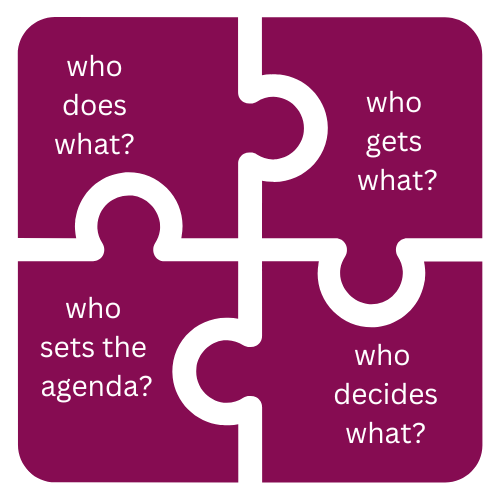
Whose time, knowledge and relationships make our work possible? Whose contribution is recognised as professional expertise, and whose is treated as simply sharing? Who is paid to interpret the experience, and who is expected to provide the experience itself?
From a systems perspective, we can also ask what organisational arrangements keep producing these roles. Why is analysis located inside the organisation while experience is located outside it? Why are consultants contracted as experts while community members are recruited as participants? Which policies, budgets and professional norms make this division appear reasonable and inevitable?
A community member may describe what happened, while a consultant is paid to explain what it means. A person with lived experience may identify a pattern across multiple systems, but their contribution is recorded as a personal story. The professional interpretation becomes analysis, while the community member’s analysis remains “input”.
That distinction carries power. Stories may be thanked and acknowledged, but analysis creates authority. Analysis shapes recommendations. It determines which issues are treated as systemic, which are reduced to individual experiences and which are left out of the final report. It is also the work that tends to attract payment, authorship and professional recognition.
Lived experience is frequently discussed as though it is something a person possesses. In practice, people develop significant expertise through navigating systems that were not designed for them. They learn where formal policy differs from lived reality. They recognise risk, read institutional behaviour, build informal networks, find workarounds and develop strategies for survival and change. This is not only experience. It is knowledge and analysis.
Payment is one part of recognising that contribution. People should not have to subsidise an organisation’s learning by providing unpaid time, expertise and emotional labour. But payment alone does not resolve the deeper questions. A person can be paid for attending and still have no influence over what is written, how their knowledge is interpreted or which recommendations are adopted.
If we treat this only as a participation problem, we may improve the next workshop. If we treat it as an organisational and systemic pattern, we begin asking different questions.
We begin examining who controls budgets, information and institutional relationships. We look at how decisions travel through the organisation and where community influence stops. We consider whether governance, procurement, human resources, monitoring and evaluation, risk management and communications systems reinforce or constrain the organisation’s commitments to participation.
The shift I am interested in is from inviting people to contribute to recognising that they are helping produce the work. That means involving people in making sense of what has been shared, not only collecting their experiences. It means discussing ownership, privacy, attribution and payment before the consultation begins. It also means changing the organisational conditions around participation so that community knowledge can influence priorities, resources and decisions.
This is bigger than redesigning a workshop. It is organisational development grounded in an analysis of power.
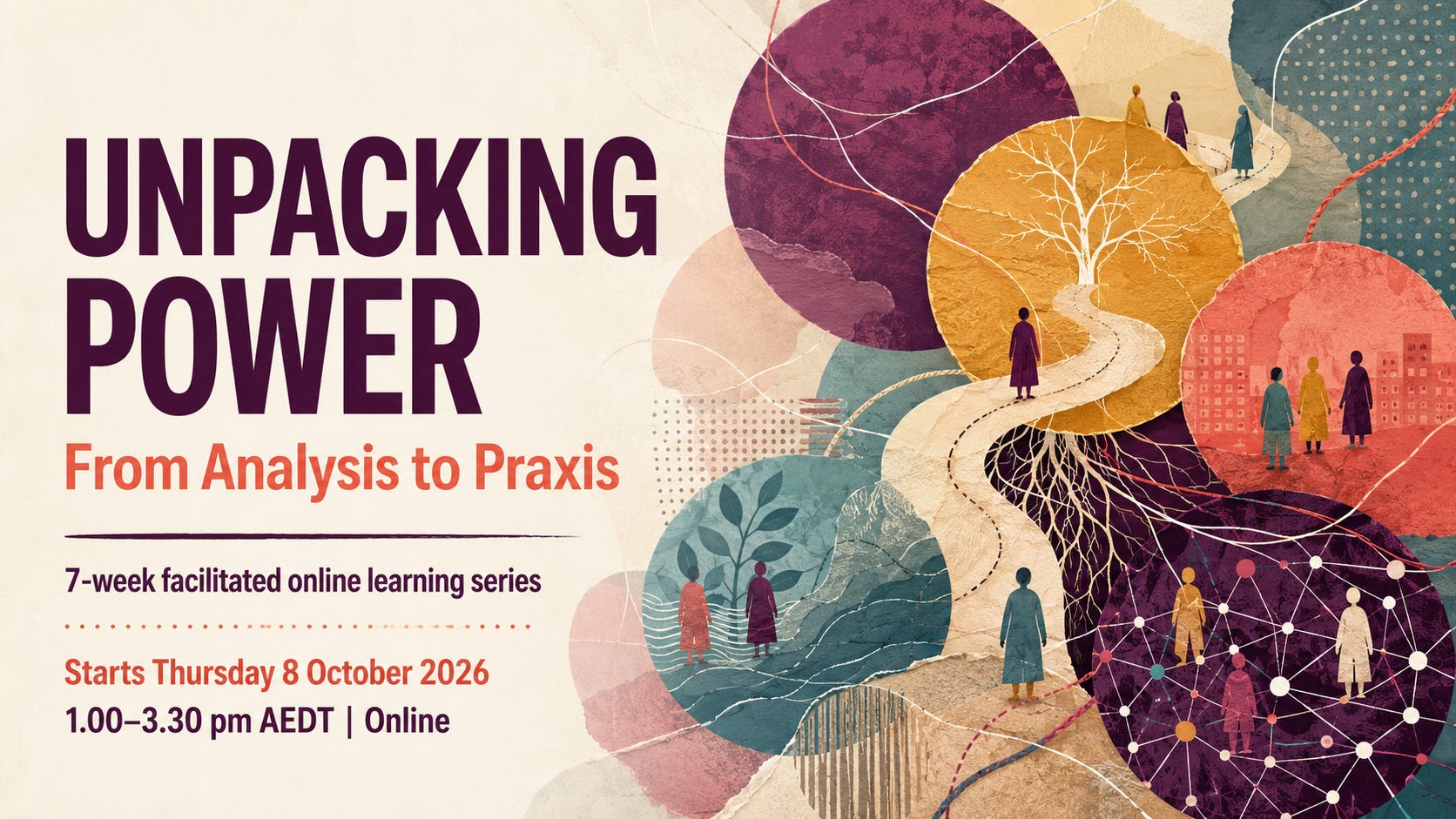
Questions like these are at the heart of Unpacking Power: From Analysis to Praxis, a facilitated learning series I developed to support practitioners and organisations to understand how power operates and translate that understanding into practice.
I delivered the first iteration of Unpacking Power as an intensive two-day workshop in 2024. It has been updated and It is available as tailored in-house training for organisations and will also be offered as a public learning series each year.
The next public series begins on Thursday 8 October 2026, bringing participants together online for seven weekly sessions of learning, discussion, reflection, journalling and practical application.
Where Power to Praxis workshops use the Power to Praxis Reflection Cards to examine a particular project, Unpacking Power widens the lens. It develops a deeper foundation for understanding how power operates across people, relationships, organisations, institutions and wider political, economic and social systems.
Over seven weeks, we will explore where power is located, the resources from which it comes, its visible, hidden and invisible forms, and the ways it becomes embedded in organisational cultures, norms and institutional arrangements. Participants will apply these frameworks to real situations from their own work, tracing what appears to be an isolated practice problem back through the structures and systems that keep producing it.
Seven weeks gives us time to move beyond talking about power as an abstract idea. It also creates space to consider what organisational change might require.
The series runs online from 1.00 pm to 3.30 pm Melbourne time each Thursday, from 8 October to 19 November 2026. Participants will work through activities, facilitated discussions, personal reflection and journalling using an interactive online whiteboard, supported by a comprehensive guidance material.
If your organisation relies on community knowledge or lived experience, I invite you to look beyond the moment of participation and examine the system around it.
When the consultation ends, who gets to turn what was shared into knowledge, influence and opportunity? And what would need to change within the organisation for that power to be shared?
Explore my other facilitated learning opportunities, including Power to Praxis workshops, Power to Praxis Practice Circles, and Intersectionality in Practice: Understanding Power, Lived Experience and Designing Change. Each offers a different way to deepen reflection, analyse power and strengthen participatory, inclusive and accountable practice.
If these questions resonate with you, subscribe to Power to Praxis on Substack for ongoing reflections, practical frameworks and invitations to deepen reflexive practice.
You can subscribe for free, or consider becoming a paid subscriber. Paid subscriptions support the time and care involved in developing this work and help keep Power to Praxis writing and resources openly accessible to everyone.
No posts
Comments
Nothing yet. Say the first thing.
Sign in to join the conversation.