
Over the weekend, I found myself sitting in a weaving workshop with renowned senior Mualgal artist, Paula Savage from Moa Island in the Torres Strait. Weaving feels deceptively simple while you are in it. Sitting, fingers moving, twisting materials slowly taking shape. There was no urgency. No pressure to produce something polished or even particularly good. Just repetition, attention, and a quiet kind of learning that happens mostly through doing than through instruction. I noticed, almost immediately, how unfamiliar that pace felt.
I occasionally go to weaving workshops, but I am not a weaver of material objects. My work is different. I find myself weaving knowledge, skills, and ways of seeing together, often across contexts that do not easily sit side by side.
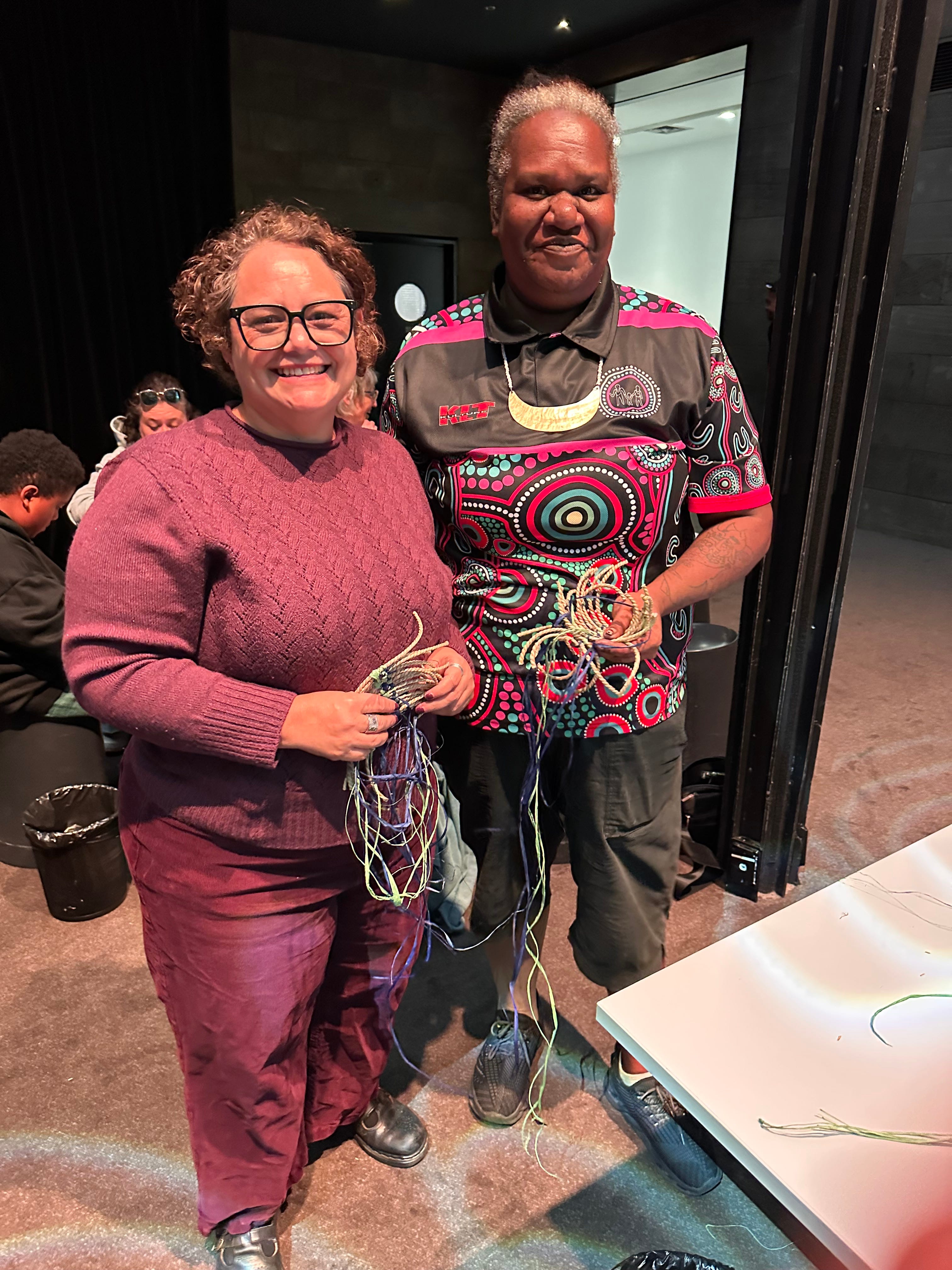
In my work, I am often moving between deadlines, deliverables, complex questions, and systems that are always asking for something faster, clearer, more resolved. But here, the work resisted that. You could not rush it. You could not skip steps. If you pulled too tightly, the shape distorted. If you left too much slack, the structure weakened. Everything depended on the balance of tension, and on the relationship between each strand and the next.
I found myself watching not just what I was making, but how it was being made. And then, as often happens, my mind began to drift back to my own work. Because what I was seeing in front of me did not feel separate from it at all. It felt like a mirror.
There is a tendency in development and humanitarian work to reach for metaphor as a way of making things more accessible, or more grounded. But often, those metaphors remain surface-level. They decorate rather than transform how we think. for me, weaving does something different. When you spend even a short amount of time with it, you begin to understand that it is not just a craft. It is a structure. A logic. A way of organising material, tension, and relationship over time. Nothing about it is accidental. The spacing between strands, the direction of the weave, the points at which it tightens or loosens, all of these decisions shape what the structure can hold and what it cannot. And perhaps most importantly, no single strand determines the outcome. It is the pattern, the repetition, the accumulation of small, consistent movements that gives the structure its form and its strength.
This is something I have been working with for a while, particularly through the metaphor of the fish trap in my facilitation and research in the Pacific. What has always struck me about the fish trap is that it does not rely on force. It does not trap by closing suddenly or violently. It works through design. Through an opening that appears wide, but narrows gradually. Through a structure that guides movement without making that guidance immediately visible. The outcome is shaped long before anything enters it.
The more I sat with the weaving, the more I kept returning to this question of structure. Because it is the same question that sits underneath so much of the work I do around inclusion, particularly in relation to women and girls, people with disabilities and people with diverse Sexual Orientations, Gender Identities, Expressions and Sex Characteristics (SOGIESC).
We often approach Gender Equality, Disability and Social Inclusion (GEDSI) as if it is about individuals. Individual attitudes, individual awareness, individual behaviour. We ask how to train people, how to shift mindsets, how to build capacity. And while those things are not irrelevant, they are rarely sufficient. Because culture is not held at the level of the individual. It is woven. It is produced through repetition. Through everyday interactions. Through what is rewarded, what is ignored, what is quietly discouraged. It is shaped by policies, yes, but also by tone, by silence, by who is listened to and who is not. Over time, these patterns settle into something that feels natural, even inevitable, even when it is anything but - like any weave, it has openings.
Some people move through easily. Their ways of speaking, behaving, presenting themselves align with what the structure expects. Others find that same opening gradually narrowing around them. Not always through explicit exclusion, but through a series of small signals that accumulate. This is not how we do things here. This is not professional. This is not appropriate. This is not safe. No one strand is responsible. But the pattern is.
This is where I find myself increasingly uncomfortable with how we talk about cultural sensitivity in our sector. Cultural sensitivity is often framed as something inherently positive. It suggests respect, attentiveness, a willingness to listen. But it can also function as a way of avoiding more difficult questions. Because culture itself is not neutral. Culture is already shaped by power, by history, by colonial legacies, by gender norms, by religious frameworks, by economic pressures. Within any given context, there are always multiple, competing strands. Some that hold dominant norms in place, and others that are actively pushing against them. When we defer to “culture” without examining these dynamics, we are not stepping outside of power. We are aligning ourselves with a particular configuration of it. We are choosing to maintain the existing weave.
And that weave may already be doing very specific things. It may be distributing risk unevenly. It may be narrowing participation in ways that are not immediately visible. It may be holding some people securely, while allowing others to slip through or be pushed out entirely. So the question is not simply whether we are being culturally sensitive. It is what we are being sensitive to, and whose interests that sensitivity ultimately serves.
This is where decolonisation begins to take on a different meaning for me. Not as a set of principles to be applied, or language to be adopted, but as a practice of paying attention to the weave itself. To how it has been formed, whose knowledge has shaped it, whose labour maintains it, and who it was never designed to hold. Because you cannot decolonise a system by adding new strands into an unchanged structure.
You have to be willing to rework the pattern, and that is slower. More complex. Often more uncomfortable. It requires sitting with tension rather than smoothing it over. It requires recognising that some strands are carrying far more weight than others, and that redistribution is not just a technical exercise but a political one.
This is where Power to Praxis sits for me, not as a neat framework, but as a way of staying with that complexity. It asks us to notice before we act. To understand before we intervene. To reflect not just on what we are doing, but on the conditions that make certain actions possible and others unthinkable. It invites us to move iteratively, knowing that we are always working within a structure that we are also trying to change.
Perhaps most importantly, it reminds us that we are not outside of the weave. We are part of it. We contribute to it through our decisions, our silences, our compromises, our moments of courage. We carry tension, sometimes more than we realise. And we also have the capacity, collectively, to shift how that tension is distributed over time.
What stayed with me most from the workshop was not just the act of weaving, but the patience it required. There was no shortcut to getting it right. No way to impose speed onto a process that depends on rhythm and attention. When something went wrong, you did not discard the whole piece. You adjusted. You loosened here, tightened there, worked back through what you had already done. Repair was part of the practice.
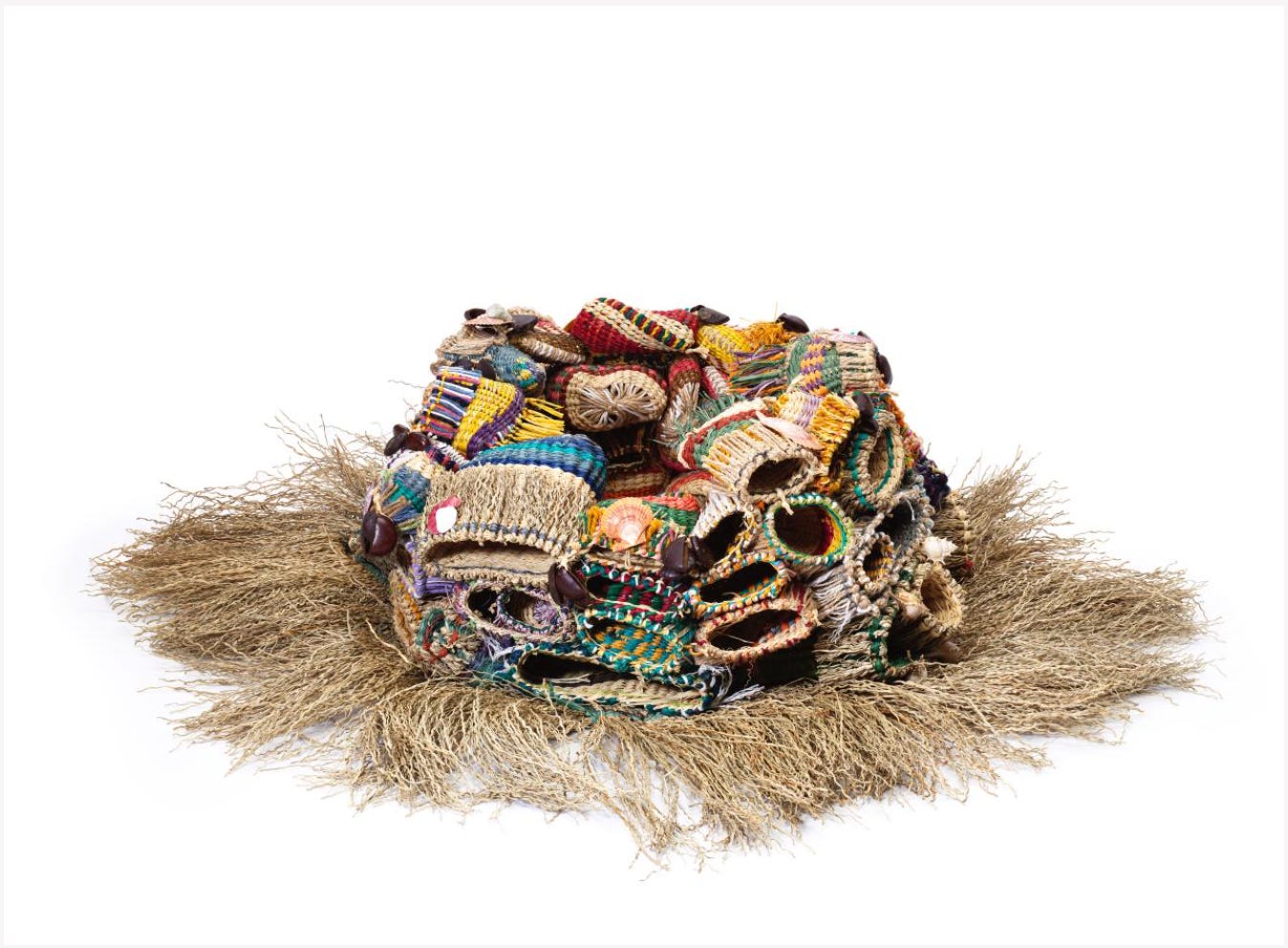
And that feels like something we rarely allow for in our work. We are so focused on outcomes, on getting things right the first time, on demonstrating success, that we struggle to create space for adjustment, for learning, for reworking the structure as we go. But if we take the metaphor seriously, that is exactly what the work requires.
So I have been sitting with this set of questions since Saturday’s workshop. These questions are not about how do we make our work more inclusive, though that still matters. But what are we already weaving, collectively, through our everyday practice? What patterns are we reinforcing without noticing? Where does the structure narrow, and for whom? And what would it take to begin reweaving it, not alone, but together, with enough care and attention to create something that can actually hold more of us within it?
The answers are not immediate. But then again, neither is a weave.
Power to Praxis Practice Circle
A space to reflect, question, and stay with practice together.
Tuesday 14 April, 1:00pm – 2:00pm AEST
Online (Zoom)
Power to Praxis: A Reflexive Practice Workshop for Decolonial Design
A space to pause, reflect, and rework how we practice.
Tuesday 26 May, 1:30pm – 4:00pm AEST
Naarm / Melbourne
Sliding scale: $30–$60 + booking fee
Purchase the Power to Praxis: Reflection Cards for Decolonial Design and Companion Guide - designed to support ongoing reflection, accountability, and more intentional practice across the project cycle.
No posts
Comments
Nothing yet. Say the first thing.
Sign in to join the conversation.