
As 10,000 boomers become eligible for Social Security every day, our Social Security Trust Fund has a negative cash flow and is headed for a negative balance by 2032.
When President Franklin D. Roosevelt signed the Social Security Act in 1935 (fully implemented in 1945), Americans became eligible for benefits at age 65 and the average life expectancy was 62. Today, the average life expectancy is 82.
In 1945, there were nearly 42 workers for one beneficiary but there are now only 2.8 workers per beneficiary.
Social Security needs urgent reform, and the longer Washington waits to solve this emerging cash flow problem, the easier it will be to fix it. So why do politicians continue to kick the can down the road? Because if either Democrats or Republicans even propose a Social Security reform bill, it is easy for the other party to oppose and distort it for political advantage. Because Social Security reform demands tough political choices - it must be bipartisan and there is precious little of this in Washington.
In the latest fiscal year, the program paid $1.6 trillion in Social Security benefits, which is 22% of federal spending and almost double the military budget.
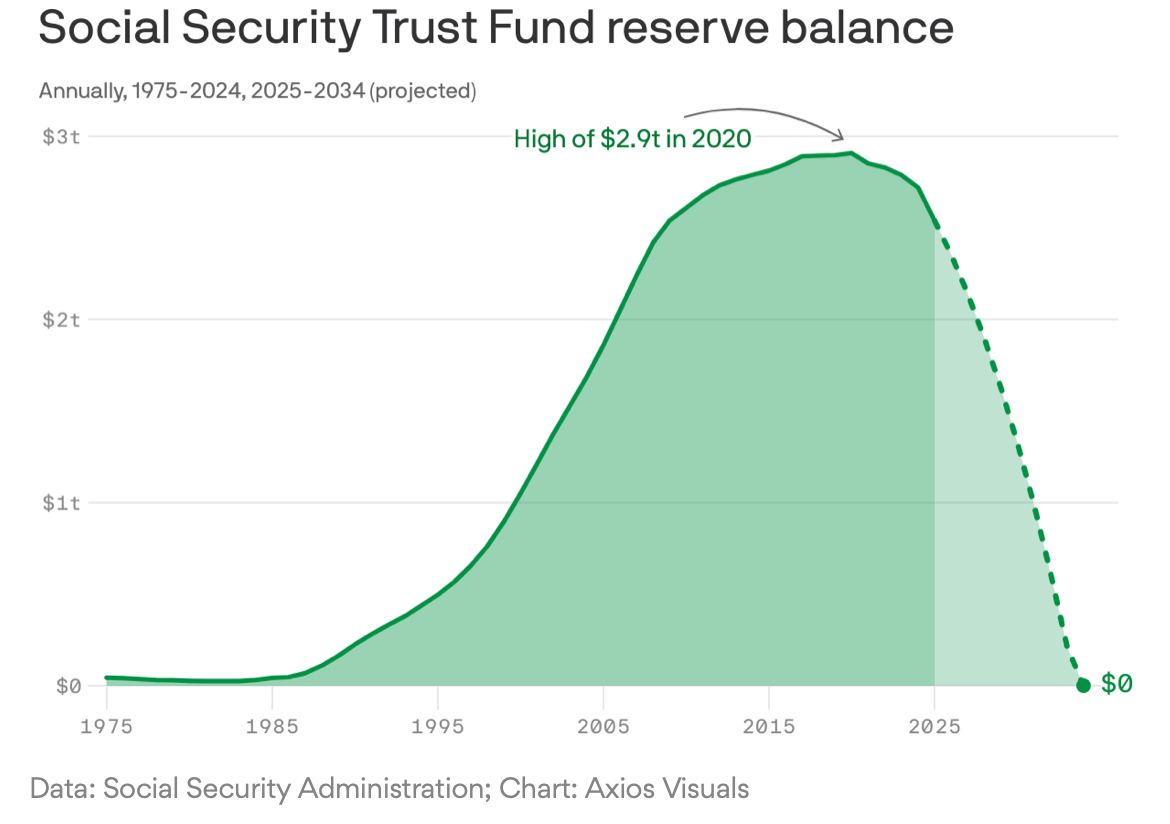
The above chart highlights the biggest Congressional blunder of all time.
The 2020 $2.9 trillion Social Security Trust Fund surplus will go to zero in 2032.
Unless action is taken, cash flow will then go negative forcing cuts in Social Security benefits.
Time is running out. Social Security will be insolvent in six years if nothing is done. As required by law, solvency must be restored by benefit cuts, in this case, about a 24% benefit cut. This will double poverty among the elderly. Alternatively, Congress could increase the payroll tax by 27% to avoid cutting benefits. The employee and employer combined current payroll tax is already 12.4%.
Of course, the easy way out would be to just borrow the money to meet the annual shortfalls which would go on forever. This could lead to a giant 75-year unfunded accrued liability that would swell to a nominal $560 trillion. This should be a nonstarter.
Aside from some reform and some revenue, I have long advocated having a portion of the Social Security Trust Fund to incrementally invest in a broad index of U.S. stocks held in escrow for 70 years to take advantage of compounding.
This would help restore confidence amongst younger generations that benefits will be there through the power of time and compounding. If this had been done say in 1980, the debate right now in Washington could well have been about how much we could raise benefits and cut FICA taxes.
America is a stock superpower, but we squander this tremendous advantage when it comes to long-term economic security for our workers.
There is precedent. President George W. Bush and Congress allowed Railroad Trust Fund (FRRS) investments to diversify from Treasuries. Since then, the portfolio’s returns have averaged 8.9% annually and the fund now has a surplus. There are many successful state and national pension programs such as the Wisconsin Retirement System and the Canada Pension Plan that invest in stocks. According to the National Institute for Retirement Security, about 63% of receipts from these funds come from investment earnings alone.
Even’s China’s national pension fund invests in stocks.
Any university endowment, pension fund, or sovereign wealth fund would have invested a portion of the assets in stocks. Then why is the Social Security Trust Fund wholly invested in U.S. Treasury bonds?
Australia’s government pension fund has appreciated to $4.5 trillion buoyed by a balanced diversified investment strategy. Australia’s national system has amassed a $4.5 trillion complex of mostly stocks and property which translates to an astounding $300,000 per worker. The U.S. Social Security Trust Fund strategy currently has about $10,000 per worker which will be zero in 2032.
What a missed opportunity. If just 20% or $600 billion of the Social Security Trust Fund surplus of 2000 had been invested in the S&P 500, it would have appreciated to $4.7 trillion today.
It is up to all Americans to pressure Congress to take action to put our Social Security Trust Fund, and other trust funds such as the Medicare Trust Fund, on a sounder foundation with a diversified strategy worthy of a financial superpower.
No posts
Comments
Nothing yet. Say the first thing.
Sign in to join the conversation.