
Before I started Powered by People, I ran a product brand. I know what it feels like to pour everything into a collection, build a beautiful online store, and then realize the hardest part isn’t making something great. It’s getting anyone to find it.
For years, the answer was paid ads and SEO. Spend enough on Meta and Google ads, and you could buy your way into discovery. That playbook is breaking. Customer acquisition costs keep climbing, organic social reach keeps declining, and the brands that built entirely on DTC are feeling it.
But something else is happening at the same time, and it changes the equation entirely.
AI agents are becoming the way consumers discover products. Not ads. Not browsing. Not searching. Asking. A shopper tells Claude or ChatGPT or Google Gemini exactly what they need, and an AI agent scans thousands of products, evaluates structured data, checks trust signals, and returns a recommendation. No one visited a homepage. No one saw an ad. The product catalog was the entire pitch.
Take a simple search: “Find me the best 30 SPF suncare, paraben free, women-owned clean beauty brand, delivers in 1 week to New York.” The agent matches on verified product attributes, real customer reviews, and service guarantees like shipping speed, then surfaces the best result across multiple retailers where the shopper can buy it immediately.
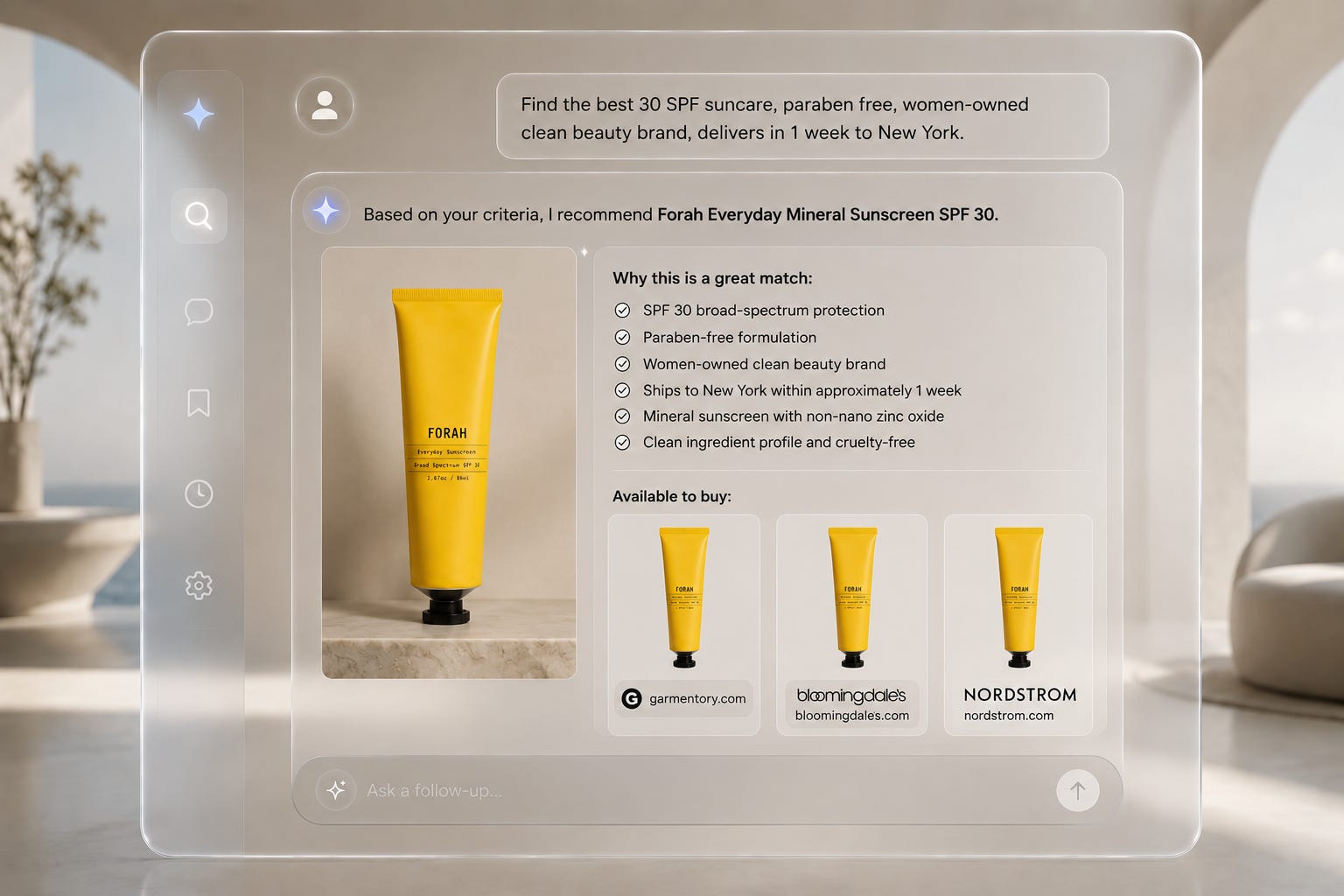
This is agentic shopping. And the numbers say it is not a future trend.
Consumer adoption of agentic shopping is expected to jump from 19% to 46% by the end of 2026. AI-driven retail traffic in the US grew up to 4,700% year-over-year. And AI-referred shoppers convert at rates 31% higher than traffic from traditional channels.
Sources: Braze 2026 Retail CER · Adobe Digital Insights via Envive
Here is the part that matters most for independent brands: AI agents do not care about your marketing budget or even what you claim about your brand. They evaluate product data, verified claims, fulfillment performance, and real customer feedback. Generic AI-generated descriptions carry no weight. In fact, 64% of consumers are already skeptical of AI-generated product content. The AI systems themselves are learning to discount it.
What agents reward is trustworthy, structured, verified catalog data. Material, origin, dimensions, use cases, certifications, real customer reviews, inventory accuracy. If your catalog is built for humans only, with attributes buried in paragraph-form marketing copy and no third-party verification, you are invisible to the fastest-growing discovery channel in commerce.
This is actually good news for independent brands. For the first time, the playing field is not determined by ad spend. It is determined by the quality of your product data. The brands that invest now in structuring, enriching, and verifying their catalogs will have a structural advantage as agentic commerce scales. Morgan Stanley estimates roughly 23% of Americans already bought something via AI in the past month, and the market could reach $300-500 billion by 2030.
The question is whether your catalog is ready for how products get found next.
Catalog agents are being built across the industry. We built one into your workflow.
CatalogAgent™ by Powered by People ingests your catalog, enriches it with real user-generated and retailer-derived data, and scores it for agentic readiness across retail channels and AI surfaces. Free for active PBP subscribers for a limited time.
Created by a human, with AI editing support.
No posts
Comments
Nothing yet. Say the first thing.
Sign in to join the conversation.