
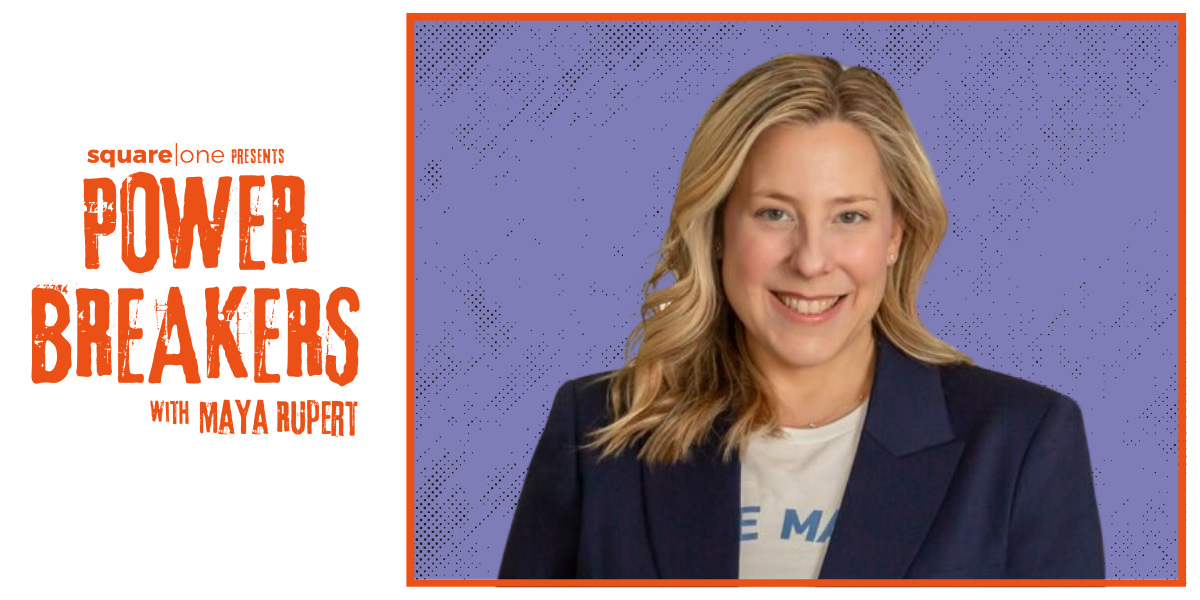
Welcome back to Power Breakers from Square One, the interview series where every other week, we’ll bring you a conversation on the people and ideas that matter in this election cycle and beyond. We’ll make you think. We’ll make you question. We’ll make you hope.
The decision to become a mother or not is an inherently political act.
And this election cycle has placed a sharper focus on exactly why that is. After Roe v. Wade was struck down, and we lost the constitutional right to abortion access, there has been increased focus at every level of government on reproductive rights and, more broadly, engaging women politically. In this cycle, the use of motherhood as a political wedge has been particularly pronounced.
Despite a policy insistence that all women should be mothers, Republican leaders have made it clear they have no interest in government making childcare more affordable or practical for people. Project 2025 lays out an agenda that would simultaneously make it impossible for women to control if or when they get pregnant, and makes it harder than ever for working families to raise kids. States across the country are considering ballot measures that would expand or restrict access to abortion and other issues of reproductive healthcare.
Women are punished for not being mothers, for being the wrong kind of mothers, for not wanting to be mothers yet, for not wanting to be mothers at all. We are told it’s the most important job there is, but we do not have a policy agenda that values the labor they provide or a social safety net designed to make it any easier.
And mothers still face considerable barriers to running for office.
Liuba Grechen Shirley is trying to change that. In 2019, after ending her own campaign for Congress (which Square One was one of the first organizations to endorse), Liuba created Vote Mama PAC and Vote Mama Foundation. The goal of these organizations is to increase opportunities for mothers to run for office at every level, connect those who do to create a network of elected moms, and provide ongoing support for mothers in office. Because, as she put it, “If you want something done? Give it to a busy mother.” There’s a lot we want done, so it’s time to get some more moms elected.
Maya Rupert: I'd love to start by understanding your story and what prompted you to start the organization. Because if I understand correctly, before you were the CEO of Vote Mama, you were a mama running for office! Can you tell us what that experience was like and why you decided that you wanted to do this work?
Liuba Grechen Shirley: Yeah, so to start, I was not planning on running for Congress. I always figured I'd run for office one day when my kids were older, not when I had two babies. They weren’t even toddlers — they were both nursing.
I moved back to Long Island, which is where I grew up. It was at the height of Donald Trump's campaign, and there was really vicious and violent anti-Hillary campaign merch everywhere, and it was really eye-opening to see. And that was my experience moving back to Long Island with these two small children. I remember sitting there watching Donald Trump get elected, and I had my daughter, who had just fallen asleep, and I was nursing her. And I just couldn't comprehend that I was going to raise these kids in this country with that man as President. Meanwhile in my district, Peter King had been in office for almost 30 years, and he voted to defund Planned Parenthood 17 times, and I was just a really angry mom. I started organizing and ultimately decided I wanted to run against him.
And I remember saying to my own mom, “I don’t know how to do this with two small children.” And she said, “You’re gonna run. And you're gonna do it your way.” So I did. And I was taking my kids everywhere because I didn’t have childcare and I was nursing.
In fact, the first political speech I gave, I was terrified until my daughter, who was three at the time, stood up and started to circle me. And in that moment all of my nerves left my body, and I remembered, this is who I am.
MR: Let’s talk for a minute because I want people who are reading this who don’t know what it takes to run a campaign to understand when you say you were bringing your kids everywhere, what exactly were you doing — what was your day-to-day like?
LGS: Right, there's only so much you can “do your way” when you run for Congress, because you have to raise millions of dollars, so they were with me for call time. People don't realize how much call time is necessary, but it becomes your full time. So you're literally sitting there dialing for dollars, which is cold calling people and asking them to invest in your campaign — to believe in what you're trying to do and to support you. And it’s really difficult to do that for eight hours straight when you have two tiny children running around. Or figuring out how to make four fundraising evening events in a row, because you’re missing bedtime every single night. Or on your weekends, you have to beg for a Sunday morning off because you have to be at every pancake breakfast, every town hall, and you have to go out and out and knock on doors.
I brought them to every political speech I gave. In fact, the first political speech I gave, I was terrified until my daughter, who was three at the time, stood up and started to circle me. And in that moment all of my nerves left my body, and I remembered, this is who I am. I'm Mila’s mama. I’m Nicholas’ — and now Andrew’s mama. And I was running for Congress because of them.
But even so, we’re always told to hide motherhood. Anytime I talked about childcare or paid family leave, every single time, someone would say, “Ignore the women's issues and stick to the bread and butter issues.” This would infuriate me because we lose 120 billion dollars a year because of the lack of childcare. There is no more basic bread and butter issue. And moms get that.
But I got attacked a lot for it. There were literally leaders of my own party who would call my kids political props, and they would say, “I've never seen anybody use their children as much.” The first question anybody will ask you, if you are a mom who is running, “But who will watch your kids while you campaign?” And I want the first question to be, “Why are you running? And how can I help?”
MR: Right, I can’t imagine the judgment and attacks that came because of the implication that you’re not taking care of your children.
LGS: Yeah, in fact, my son actually broke his leg about two months into my campaign. He ended up in a body cast and was only a year old, and I thought I was going to quit. I remember them taking him into the operating room [at the hopsital], and they let me go in with him until he was under anesthesia. And when they took me out, I was hysterical and just not okay. And they immediately started to talk to me about what insurance was going to cover, what insurance wasn't going to cover, and things like that.
And I had been planning on quitting the race when he got hurt, but then I remember saying to my husband, at that moment, that this is why we need universal healthcare, because now instead of worrying about my child who's currently under anesthesia, I'm now thinking about what bills we're gonna have. And the nurse said, “Well, if you had Medicare, this would be one call.” And I remember thinking we need universal healthcare, because nobody should be thinking about the cost of the healthcare that their child is receiving in that moment. And I knew then I wasn't going to quit.
But I got so attacked for this because I talked about it publicly, and how I was fighting with my insurance company. And the attacks were so painful, that when he ended up breaking his leg a second time a week before I won the primary, and he was diagnosed with osteogenesis imperfecta, I never mentioned it publicly because I was afraid after the response I got the first time.
MR: I’m so sorry that happened. Can you talk about the decision to petition the FEC because that was a real turning point.
LGS: Yes, so, about five months into the campaign, I put a request into the Federal Election Commission, and I asked if I could use some of the funds that I was raising for my campaign for childcare. And everyone said it was political suicide. I was going to be attacked for being a woman, for being a mother. And shockingly, it was a bipartisan, unanimous decision [to approve the use of federal campaign funds for childcare]. Hillary Clinton and twenty-five members of Congress supported it, they wrote in letters to support it, and it changed the way that federal candidates run for office.
And, you know, the old boys network is alive and well. I wanted to build the mamas’ network. And I had $10,000 left in my campaign account, and I launched Vote Mama.
MR: So after your race, how did you decide to transition into this work?
LGS: After my election, honestly, I cried for a day, and then the next day all I kept thinking was all of the people who had been the most supportive were the moms who had done it before. I remember when I was thinking of running, I kept trying to find information on how many moms there were in office, and what it would be like to actually run. And there was no information. I remember finding quotes from Grace Meng or Kirsten Gillibrand, and thinking, if they can give birth in office somehow, I can run with two young kids.
And it was the moms who ended up being the most supportive. It was Kirsten Gillibrand, and Grace Meng, and Elizabeth Warren, and Hillary Clinton, and Kathy Hochul, who gave me the most support, who were such great mentors during my campaign. And I wanted to provide that support for other moms. And, you know, the old boys network is alive and well. I wanted to build the mamas’ network. And I had $10,000 left in my campaign account, and I launched Vote Mama. And here we are five years later, and we've raised more than 10 million dollars for our movement. We've supported over 500 Democratic mamas running from School Board to Senate in 38 States.
MR: Wow! When did it really hit you that you were tapping into something that wasn’t a unique thing you were dealing with in your race but rather was something bigger that could change how people are running?
LGS: So we have put out a number of research reports and the moment where I really realized this is definitely not a unique problem was when we looked at the increase in the usage of campaign funds for childcare from 2018 to 2022. The percentage increase at the state level was 2,156. And that blew my mind because I was told it was going to be political suicide and warned not to do it. We've now seen more than a million dollars of campaign funds that have been spent on childcare. And we're talking moms, dads, Democrats and Republicans. But the vast majority of that has been spent by women and the majority of the funds spent by women has been spent by women of color.
It sounds like a very small structural change. It has the ability to completely transform the political landscape. Most people don't realize you cannot work a job for a salary and run for Congress successfully at the same time, so people are without a salary while they run. Those are the reasons there are more millionaires in Congress than there are mothers. There are three times more men named John in the Senate than there are moms of minor children.
Our policies have been failing women and children for generations because legislators legislate on their lived experience. And we're missing critical lived experience at the decision-making table.
MR: And why is it so important that we can elect mothers?
LGS: Our policies have been failing women and children for generations because legislators legislate on their lived experience. And we're missing critical lived experience at the decision-making table. We're 27th in education and in healthcare globally. Childcare costs more than college in many states. We are the only industrialized nation without paid family leave. We also have the worst maternal mortality rate in the industrialized world. We have these policies that are so backwards that are harming women and children because we don't have enough moms at the decision making table. There's actually research that has proven that when moms get into office, they will introduce five more pieces of legislation in their tenure than their counterparts, and it has to do with reproductive rights, education, healthcare, common sense, gun reform. That’s what happens when you elect moms. You want something done? You give it to a busy mother.
MR: Let’s talk about elections at the state and local level, because I know that’s a big part of your work. A lot of the barriers for mothers running for state and local office get invisibilized. Can you talk a little bit about that, and what issues you all are prioritizing to make that more accessible.
LGS: Yes, I am so glad that you brought this up. This is where I get really excited about our work. Last year, 19,000 bills were passed by state legislatures. Most people do not understand how important state legislatures are. They pass so many more bills that affect people’s everyday lives than Congress does, and most people couldn't tell you who their state representatives are.
Most people also don't realize that there are only four states that pay their state legislators a livable wage. In Virginia, the salary is $17,000 a year. In New Mexico, state legislators don’t get paid anything. In New Hampshire, they get paid $200 for a two-year session. So our state legislatures were designed for wealthy, older, white, land-owning men because they were designed by them, and we haven't modernized them since. So we have been working to pass campaign funds for childcare at the state level for state and local candidates. We actually just hit 35 States plus DC, so this makes a huge difference on who gets to run.
But now we're taking it a step further. And we're partnering with other organizations to work on state legislature modernization like The States Project and Represent Women. We have to change the way that salaries work, because we have so many incredible moms that we've helped get into office that we've supported, and they're doing such great work. And then they realize: you know what, I can't support my family on this salary. And a lot of them will step down and run for a city council seat or mayoral seat, or a local town council seat, because they're paid more of a livable wage, and they don't have to commute back and forth to the capital. So we have to pay our legislators a living wage in more than just four states.
We also need things like paid family leave for state legislators right now. Colorado is the only state that has passed paid family leave for state legislators, and it was led by Brittany Petterson when she was a state senator. Now she's a Congress Mama, but she got that done in Colorado. We also need virtual proxy voting, because technically, if you're a state legislator, you can take time off with a new baby, but if you don't have proxy voting, or virtual voting, you will get attacked for not doing your job. And you'll lose your next election. So we need to make it so that you can actually continue to vote and participate in committee hearings, if you would like to, while you're home.
We also need things like on-site childcare. Anyone who's ever tried to find childcare in this country knows that it's nearly impossible to get off that waitlist. Now, imagine you have to get off a waitlist in your home district and in the state capital if you want to bring your baby back and forth with you. Otherwise you're not going to see your child because you're at the capitol for weeks on end. Or even infrastructure modernization in the states is critical. Think about something as simple as having a changing table — and a changing table in a pumping room. I've talked to moms who have tried to change their babies in the bathroom and literally drop their baby into the sink because they were trying to juggle everything, and there was no changing table in the building.
We are going to continue to break down these structural barriers, so that more and more moms run for office, so that more working people step up to run.
MR: So what are the next steps for anyone who is passionate about this? What can we be thinking about for our own state and local officials?
LGS: We are going to continue to break down these structural barriers, so that more and more moms run for office, so that more working people step up to run. So our priorities will be modernizing state legislatures, continuing our research that looks at the political participation of both moms and dads so we know where the problems are.
We just released a new Politics of Parenthood report, and only 7.9% of our state legislators are moms of minor children. So to give you a reference, 18% of the adult population are moms of minor children, and only 7.9% of our state legislators are. Only 2% are women of color who are moms of minor children. These numbers sound terrible. But this is what gives me hope: this is a 49% increase since our report in 2022. And more than 20% of the new 896 moms that we elected are moms that Vote Mama endorsed and supported. So it shows that it's working. Our theory of change is working.
You know, on the day that I launched Vote Mama, someone asked me, “How many moms do you need to get elected to feel successful?” And I said, “It's not the number of moms. It's the normalization of what it looks like to run and serve.” And that's what we have been doing. And that's what we're going to continue doing. And that's what gives me hope.
This interview has been condensed and edited for clarity.
Power Breakers is fueled by Square One, the national non-profit dedicated to electing women, people of color and LGBTQ+ candidates. Help us elect breakthrough leaders and shine a light on inspiring stories with a contribution.

No posts
Comments
Nothing yet. Say the first thing.
Sign in to join the conversation.