
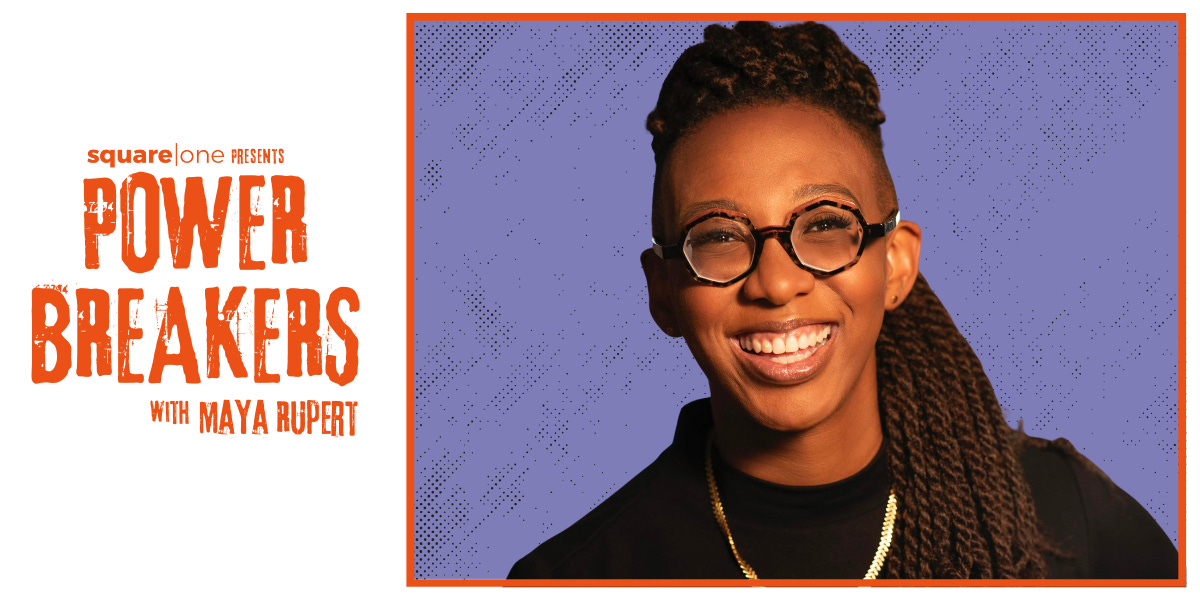
Welcome back to Power Breakers from Square One, a new interview series where every other week, we’ll bring you a conversation on the people and ideas that matter in this election cycle and beyond. We’ll make you think. We’ll make you question. We’ll make you hope.
Elections have consequences.
We hear this one a lot. Usually with a wistful tone reminding us that whatever problem we’re dealing with today could have been fixed if people had just voted differently. Or with a foreboding note that warns that we may not be thinking about all the potential ramifications of a particular race.
I don’t mean it as a reminder or a warning. I mean it as a promise.
Elections have consequences. And those consequences can go beyond who wins and loses. They can remind us what we have to fight for, and what happens when we fight. They can reverberate out and motivate new people to volunteer, to work on campaigns, and to run for office themselves. Elections have consequences. And those consequences can be game changers.
When I think about the stakes of the 2024 election, I think of the LGBTQ community. Not only because of the devastating potential to have hard fought victories rolled back if Republicans can execute their policy agenda, but because of the enormous potential to gain for queer and trans people across this country.
The LGBTQ community has faced a number of attacks in recent years, and in response to those attacks, we have seen expressions of political power.
The Supreme Court not-so-subtly threatened marriage equality in the Dobbs decision, the same case that overturned Roe v. Wade. The Biden-Harris administration responded by signing into law the Respect for Marriage Act, which will protect federal government recognition of same-sex marriages regardless of whether the Supreme Court reverses itself.
The LGBTQ community has faced another year of relentless legislative attacks. In 2024, 651 anti-trans bills were introduced in states across the country. These included medical bans, sports bans, bathroom bans, pronoun bills, and “don’t say gay or trans” bills.
These are attacks on young people who simply want to go to school and play sports without facing discrimination and abuse. They are attacks on the ability to provide medically necessary care to people. They are attacks on the ability for teachers and students to be who they are at schools across the country. These are efforts to remove trans folks from public life and to erase LGBTQ people from textbooks.
But in the face of those attacks, we have openly transgender people running for and holding office across the country, serving as living proof that they will not be erased. People like Delaware State Senator Sarah McBride who, if she wins her election for the U.S. House of Representatives in November, will become the first transgender member of Congress.
Because when they threaten to remove LGBTQ people from history books, what better response is there than to go out and make some history?
LGBTQ people across the country are responding to this moment in history by running for office, to make change and to change the game.
This week, I wanted to understand why this election will matter for the LGBTQ community, and why LGBTQ and all pro-equality voters will matter for this election. So I went to President of the Human Rights Campaign, Kelley Robinson, to talk about this whirlwind of a political moment, and everything at stake for the LGBTQ community in 2024.
Love Power Breakers? Consider supporting this work with a contribution.
Maya Rupert: Alright. So let's go ahead and get started. I still can’t believe it's only been two weeks that we have a completely new campaign in 2024. But now that Kamala Harris is officially the Democratic nominee, I wonder if you could just start with reflecting a little bit on really what that means, both for the LGBTQ community, but also you personally — if you're willing to talk about it — as a Black woman what it means to have her be our nominee.
Kelley Robinson: Yeah, this is powerful. I think even before this big change, this was such an important election. That was about responsibility and about duty and about democracy, which is all important.
But now it's something else. It's not just about protecting what we have. It's actually hopeful and aspirational about what could be, “unburdened by what has been,” as our good Madam Vice President often says. As for me personally, I'm Black. I grew up Black and queer on the South Side of Chicago. My wife is a first generation daughter of Indian ancestry, and so her whole representation — we never thought that we would see something like that in our lifetimes. It means a lot to us as people and it means a lot to us, thinking about ourselves as parents. Because it's not just who she is that's important. It's the policies that she supports. She's been part of probably the most pro-equality administration our country has ever seen. She made the call to tell them to start issuing marriage licenses in California! She walks it like she talks it. This is a really kind of important moment, I think, for so many of us to really experience what it means again to feel hope in our bones, and to also be ready for the task of governance, which I'm really excited about.
MR: So it feels like every election we get the same sort of refrain that “this is the most consequential election of our lifetime.” But really the stakes are very high, and the stakes, I think, are especially high for marginalized communities, especially the LGBTQ community in this election. Can you talk a little bit about why that is?
KR: Elections are important all the time. I think we just have to come to terms with that, especially when you're at the margins, especially when you're trying to alter a system that wasn't created for you to gain more access and rights for you and for your kids and for your families — every election is gonna count. I think this is one of those times where it feels like the values of our country are being called into question. It's really one of those turning points where you have forces that are asking us directly and straight on:
“Do you care about people having full bodily autonomy, or do you not?”
“Do you believe that people should actually get to learn accurate and fair information in the classroom, or do you not?”
Those are the questions in front of us. And this election cycle, I think, represents a time for us to not only think about advocating for candidates, but to also be thinking about advocating for the version of the future for our country that we want and we actually need.
Right now, when you think about the state fights that we've been experiencing across the country, and especially when you look at Project 2025, their regressive plan for what the Trump-Vance administration would do, it is so clear that this is going to be pivotal. We're not just talking about the kind of the things that they're saying out loud and how gross they are. We're talking about whether or not they believe that we should have unions as workers. We're talking about whether or not they believe that people whose families live and love like mine should have access to federal benefits in this country. That's the scope and scale of what we're wrestling with right now.
MR: Right. Thank you, you brought up Project 2025. It feels like we still haven't focused on that as much as we should. There are victories that we feel like we've won, that they're talking about rolling back in very significant ways. Are there issues like that for the LGBTQ community that you're thinking about and want to raise the alarm about?
KR: Yeah. There's a lot of pieces of it that are really insidious and scary. They're talking about nationalizing some of the policies that they've already beta tested in places like Texas and Florida. So if you didn't like the book bans that they were talking about in classrooms, that's gonna be on your doorstep. They're talking about nationalizing abortion bans, which, of course, impacts my community. They’re talking about nationalizing restrictions on access to healthcare even broader than that, particularly for trans folks. And this is one of the really creepy parts to me: They're actually trying to redefine the Department of Health and Human Services as a Department of Life, and charge it with promoting and enforcing heterosexual identity in this country. They want to actually define the “ideal family structure” as being a married man, a married woman, and children. So if you are LGBTQ, if you are a trans person, if you're unmarried, if you're divorced — they're saying you actually don't have a family structure that should qualify for federal benefits in this country. That is massive. That is The Handmaid's Tale in the making.
MR: So that is utterly horrifying. What’s interesting is that in recent weeks we have seen Trump and a number of Republicans start trying to distance themselves from Project 2025. We've seen the project director of Project 2025 at the Heritage Foundation step down. Does this mean that that policy agenda is no longer a threat? And more broadly, what does that tell us about the political strength of their policy agenda?
KR: I think that what you're actually seeing is them being surprised by us being outraged and shocked by Project 2025. They seemed to think “wait a minute. We've been doing this already in the states, and people have been voting for us. What happened here?”
But they still have the intention of doing exactly what they planned to do — what they wrote out in 900 pages that the Heritage Foundation and at least 140 members of Donald Trump's former team have been working on for years. That's still the plan. But now they're trying to kind of cover it up and have us take it down with a cup of sugar. It's not going to happen.
But if there is one thing that we learned about Donald Trump it is that we have to take him at his word. He said that he was going to be the President to overturn Roe v. Wade, and he did it, and is taking credit for it. He said that he would place Supreme Court Justices on the bench that would roll back our rights. Not only did they overturn Roe v. Wade, but they said out loud: They're coming for Windsor and Obergefell and Lawrence next. These are cases that fundamentally protected so many of us and our lives in this country. This would be an administration that is not only poised to do these horrible things, but they actually are ready to do it from day one. They've done work to establish a list of foot soldiers that they would put in to execute their plans. They have done the work of actually not only dreaming up what it would look like, but finding out how they would operationalize it, and they've gone so far as to have Donald Trump say out of his mouth that he would be a “dictator on day one,” that if you vote in this election it could be the last one that you need to vote for.
Y'all, we better pay attention. This is an important election year.
MR: So since we have people paying attention, who are the candidates and what are the races that you're watching that you think should be more on people's radars?
KR: I am really pumped up about the House. If Democrats and a pro-equality majority wants to take control again in the next legislative cycle, we have to flip four seats and to do that, two of them could be flipped by out gay men. How cool is that?
You’ve got Mondaire Jones in New York, and Will Rollins in California. That's so awesome to me. Not only that, there are some historic races like Sarah McBride. She's running to become the first trans woman in the United States Congress. You’ve got Julie Johnson in Texas who's running to become the first out lesbian in the South in the United States Congress. This is amazing to me that we could have a Congress that actually starts to look and feel like America in so many ways. And not only are we talking about breaking glass ceilings here, but we're talking about LGBTQ+ people being the difference-makers in ensuring that we have the power that we need in the federal government to actually implement change. I'm excited about that.
MR: That's awesome. Can you just talk a little bit about why that representation is so important, and especially at this political moment.
KR: Yeah. And I also want to talk about how far we've come. Tammy Baldwin from Wisconsin was the first out lesbian in the United States Senate, and that wasn't that long ago. That’s been in my lifetime. Not only that, think about the progress the community has made. I think sometimes we take for granted how swift that progress has been, but also how fragile it is.
The Human Rights Campaign has been around for about 40 years, and 40 years ago, if you were out at work you could be fired on the spot. So to think that we now have out LGBTQ people and allies that are leading corporations. That matters. And 40 years ago, we were losing generations of our community to the HIV/AIDS epidemic. And now, we're really within arm's reach of ending the epidemic and stopping the proliferation of the virus.
These changes didn't happen by accident. They happened because we showed up. And to now be at this point where we're not only talking about surviving as a community, but we're talking about having transformative power, not only for ourselves, but for our democracy. You know, the whole story of America kind of sounds like a fantasy tale when you're growing up as a Black, queer kid. And to think that the people that actually get to make America live up to its promise to all of us could be people that look and love like me. There's something about that that is just truly inspired, and is only possible in these sorts of places and these kinds of moments.
MR: I love that. Thank you, that is incredibly beautiful. So you just named some really incredible change makers who are running, and I know facing some barriers. And hopefully, we're going to see them surpass those barriers. But what are some of those barriers to running for office as openly LGBTQ people? And how do we do the work to break down those barriers and make sure that they don’t hold people back.
KR: We’ve gotta be real about the fact that it's not easy for people that take up the call to be leaders, especially right now, when there's so much hate and vitriol happening all over the country. And it's not just in the South. Let's remember it was New York, where there was the murder of O'Shea Sibley. It was California where Lauri Carlton was viciously murdered as well. Like this is happening all over the country. So we have to be real about confronting homophobia and transphobia as it shows up. And I think that we are seeing candidates that still say — not even in spite of that, but almost because of it — that they've got to run. They've got to show this visibility and representation, and when they run they so often win.
One of the examples I think about often is Danica Rome, who ran for and won a State Senate seat in Virginia. And her campaign was subject to all sorts of anti-trans attacks, but she confronted them head on and went on to victory. And now we have a majority in the Virginia Assembly. And not only that, you have a Black man holding the Speaker's gavel in the former capital of the Confederacy. Change can happen, but it is not easy for those that choose to kind of take up that charge to lead.
So I think that means that we’ve gotta make sure that when LGBTQ+ folks — especially queer folks of color, especially trans folks — run for office, that we surround them with support. That we make sure they have the money to run for office, we make sure they have the supporters around them, we make sure that they've got a megaphone that's pushing back against all those homophobic and transphobic attacks that will come, because we know that they will. And when we do that, I think we not only make it possible for these candidates to win, but you actually open the door for more people to see themselves as likely to run. And that right there is the game changer.
This interview has been condensed and edited for clarity.
Power Breakers is fueled by Square One, the national non-profit dedicated to electing women, people of color and LGBTQ+ candidates. Help us elect breakthrough leaders and shine a light on inspiring stories with a contribution.

No posts
Comments
Nothing yet. Say the first thing.
Sign in to join the conversation.