
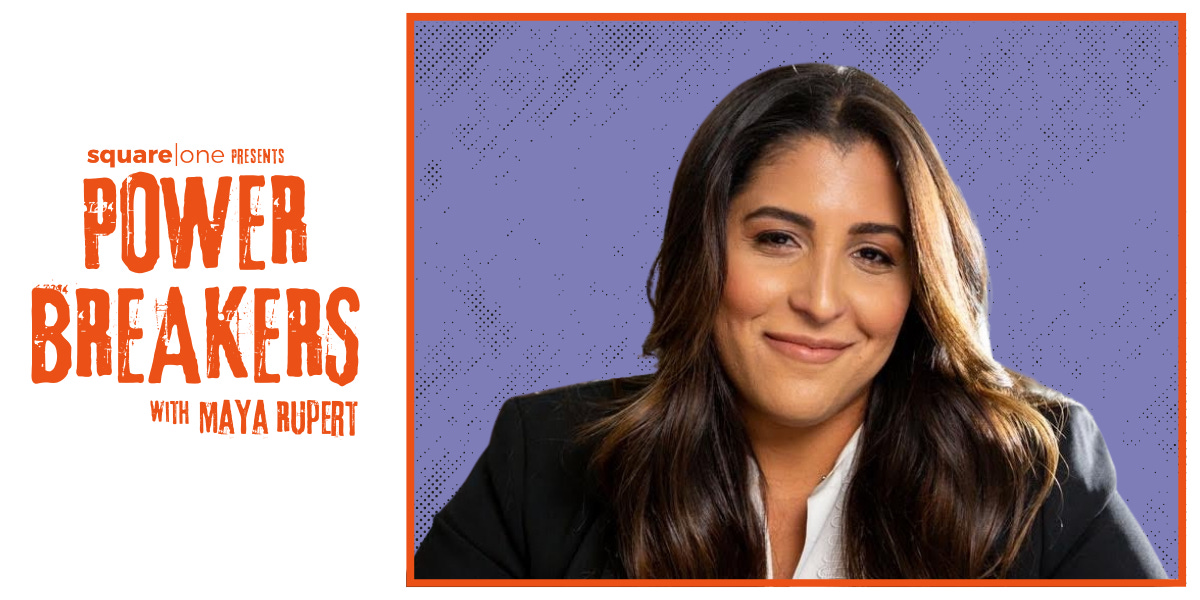
Welcome back to Power Breakers from Square One, the interview series where every other week, we’ll bring you a conversation on the people and ideas that matter in this election cycle and beyond. We’ll make you think. We’ll make you question. We’ll make you hope.
We need more queer women running for office.
Why? Janelle Perez, Executive Director of LPAC, sums it up simply.
“When women run, we win. And the same holds true for queer women. When queer women run, we win. And it's important to have us at the table where they are making decisions, because now, more than ever, our issues are on the line. Abortion is on the line. Families are on the line.”
But how do we get more queer women running for office? Perez has an answer for that, too, and it’s the work LPAC is doing in this cycle and beyond. Founded in 2012 to support LGBTQ women candidates as well as allies, LPAC now only endorses LGBTQ women and nonbinary candidates. And it has more than enough to choose from.
In 2022, a record-breaking 1,065 openly LGBTQ candidates ran for office. However, LGBTQ women continue to be underrepresented, making up only 39.1% of openly LGBTQ elected officials.
Earlier this year, the Victory Institute, in partnership with Loyola Marymount University’s LGBTQ+ Politics Research Initiative, released a survey detailing the experiences of LGBTQ women candidates in 2022 and shedding light on some of the barriers that stop women and nonbinary folks from seeking office. The survey reported 27.2% of LGBTQ+ women candidates were discouraged from running because of their gender, while only 7.1% of gay and bisexual men reported that experience. And trans women were about 10% more likely than cisgender queer women to be discouraged from becoming a candidate.
LPAC is trying to bridge this gap. By focusing specifically on cultivating, supporting, and electing LGBTQ women and nonbinary candidates, LPAC is countering those voices of discouragement and making sure that the next generation of game changing candidates have the support they need to run and win.
Perez took the helm of the organization in early 2024. But before joining LPAC, she started as an LPAC-endorsed candidate for Florida State Senate when she was part of the record-breaking slate of LGBTQ candidates running for office in 2022.
Love Power Breakers? Consider supporting this work with a contribution.
Maya Rupert: Let’s start by talking about your path into politics. What led you here?
Janelle Perez: I was born and raised here in Miami, Florida, from Cuban-American parents, and I had a very typical Cuban-American upbringing. My parents are conservative, registered Republicans. I initially registered as a Republican and worked for my member of Congress throughout college. I studied political science and went to school here in Miami.
My member of Congress at the time was Congresswoman Ileana Ros-Lehtinen, who was one of the founders of the LGBTQ Caucus. My example of a Republican was a Republican who worked across the aisle a lot and worked with so many of her colleagues. So for me, growing up, it felt natural to register as a Republican because it was all I knew.
Fast forward a couple of years I moved to DC and continued working for her, which was absolutely incredible. She was a fair, honest, and incredible boss. We disagreed on some issues, but at that time, I didn't really know who I was. I was young. And my plan was to get my master’s degree, then an MBA, and, ultimately, get back to Miami and find a way to bridge my love and passion for access to healthcare, business, and foreign relations.
But then, I went to see a doctor for a lump behind my ear, and I was diagnosed with stage IV — what was supposed to be an incurable cancer — at the age of 28.
That very same day I came out to my conservative mom and dad and told them that I was gay. I had been living a double life for almost ten years. And a couple of weeks after that, I finally introduced them to my then-girlfriend, who is now my wife. And my parents did a complete 180. My wife and I were married on their front lawn. My dad gave the most amazing speech.
MR: Wow. So a lot of the issues that you ran on in 2022 — and a lot of what we are facing in this cycle — were things that directly touched you and your family in various ways? Is that what made you know you were ready to run?
JP: Yes. The day we got married, my wife was five months pregnant with our first baby — a baby that I was not supposed to have, because it was after cancer, and they told me I'd never be able to have a genetic baby, and I did because my wife carried my genetic baby. We used IVF, which is obviously another issue on the ballot this cycle. It was just a week before my daughter was born that I was given the right to sign her birth certificate in Florida.
My daughter was born in 2017, so it was right after the election. I remember watching Hillary lose and seeing Donald Trump win. I remember seeing my member of Congress at the time and just thinking how none of these people aligned with who I was. All these people were representing me, but they weren't representing me. They weren't even close.
I always knew I wanted to run for office, but I always thought that I needed to have a full career first, and that I needed to do all of these things, and check off all of these boxes, in order to be qualified enough to ask people for their vote.
MR: You know, I only ever hear that from women.
JP: Exactly! It’s odd because men don't ever think that. So I decided that year, after talking to my wife and to my dad. I talked to my dad, and he asked me, “After everything that you've gone through, why do you have to wait? If this is what you want to do, if this is what's gonna make you happy?” So he said, as the super Republican man that he is, that he would fully support me running as a Democrat.
And then I talked to my wife. Obviously, that was the most important conversation because we had just had our daughter, and we were trying to have another baby. I talked to her about it. And she 100% stepped up and said, “You need to follow your dreams, and I'm here for whatever that is. I've got your back, and we can do this together as a family.” And so I did.
Perez initially entered the Democratic primary for Florida’s 27th congressional district, but ultimately decided to run for Florida State Senate to represent District 38. In addition to her family, she had one backer almost immediately.
JP: LPAC was the first organization that came out and endorsed me. They encouraged me to stay in the congressional race when many other people were trying to push me out. And when I decided to move to the [state] senate race, they said, “We’re going to stick with you. We’re going to fight with you.”
Mine was one of the most competitive races. It was a hard, hard race, but LPAC was with me the whole time, and when you run for office, there aren't a lot of people that are your “ride or die.” And LPAC was that for me. So when my campaign ended, it was folks at LPAC who picked up the phone and called me and said, “How do we keep you engaged? Do you want to join our board? Because we love your voice and we need you.” So I joined the board, and I loved it, and eventually, it led me to this role leading the organization.
Perez’s story isn’t unique. In fact, many candidates — especially women, LGBTQ folks, people of color, and young people — are unsuccessful with their first race. Institutional support from PACs and other political organizations often only come once a candidate can prove their viability. This creates a double-bind for underrepresented candidates. To show viability, they often need the money and credibility that comes from institutional support. But they can’t gain that support without showing those things first. Like Square One, this is one of the dynamics that LPAC is focused on changing.
JP: We have really, really cool queer women and nonbinary folks running this year. Some of them might not win, but they are trailblazers for so many people that will come behind them. And their stories need to be elevated because we — queer women and nonbinary folks — need to see that there's folks out there that are running and putting themselves out there to fight for them, even if it is a losing battle. Because that’s how we will make change, inch by inch.
MR: I think that's such a good point. You seem to have a different theory of change, that there are races that are worth getting involved in even understanding it isn’t winnable this cycle. What is the value of getting involved in races like that?
JP: Everyone's always talking about an organization’s win rate, and the win rate is important. It absolutely is, especially when you're going out there and asking for donors to support you. But for us, when we are considering candidates, there is more to our equation than that. There are certain criteria. A candidate has to be a woman or nonbinary person and identify as LGBTQ. And they have to have been good on LGBTQ issues. Beyond that, we don’t have many requirements to qualify for our process. We're nonpartisan and we are fighting for representation in government in all levels of government.
When we make our decision about endorsing, we don’t just look at the likelihood to win this cycle. So today, what we might have is a queer woman running in a district she can’t win. But in that district, there can be anywhere from a handful, if not hundreds of young, queer folks that are seeing that queer woman take that step, take that risk, and put her foot forward. Now we're planting it in these young folks minds hey, that can be you. And that's important. It’s important for so many reasons. And it's okay to lose! I lost, but look at what I've gained. I’m now running a national LGBTQ organization.
And there's a lot of people that I talked to after running and losing that just feel more emboldened and more encouraged to help us recruit, to help us find other people, to support and to elevate other people's stories.
At Square One, we also believe that there are metrics beyond win rate that determine how successful our work is. It’s a lesson that’s especially important for organizations like LPAC and Square One that are involved in long-term, fundamental change to our political system. We’re asking folks to reimagine who can and should hold power in this country, and that can’t be summed up in a single win number. Here at Square One, we call it “winning beyond winning.”
MR: So how do we design a win rate that reflects all of that? Because that would be really powerful.
JP: Yeah, we talk about this all the time. When LPAC was founded in 2012, it endorsed men. It endorsed allies. It endorsed everybody who was good on LGBTQ issues. And now here we are twelve years later and so many more LGBTQ women and nonbinary candidates are running. We have 207 candidates endorsed this cycle alone, and they are only LGBTQ women and nonbinary folks. We don’t endorse allies, and we still have so many candidates we can support. So when we talk about our win rate, I constantly share that, because it’s a huge part of our win rate.
It’s incredibly inspiring progress, but we also know there continue to be barriers that these candidates face. In an increasingly dangerous political climate, many candidates fear being targeted for violence, harassment, and mis/disinformation, and this fear is heightened for candidates with marginalized identities. In fact, according to the Victory Institute survey, 83.7% of respondents reported fearing harassment and other attacks if they ran, which creates a significant barrier to even entering a race. Unfortunately, those fears are too often founded. According to Perez, during her campaign, she was doxxed, and she experienced threats to her and her family’s safety. She isn’t alone. According to the survey, 5.4% of LGBTQ women experienced gender-based violence. For comparison, 1.9% of gay and bisexual men reported the same. An alarming 7.1% of trans women reported experiencing this violence on the campaign trail, compared to 5% of cisgender queer women.
In order to truly address these issues, legislation and regulation targeting online violence and harassment, and mis/disinformation, is needed. But in the meantime, Perez feels encouraged by LPAC’s ability to connect candidates who are going through similar issues and, at least, make them feel like they are not alone, and can inspire and encourage each other in these hard moments.
JP: When it happens, we try to surround our candidates with a coalition of supporters and other candidates who have, unfortunately, gone through similar situations so they know they are not alone and people have survived it. I tell my story so they know I survived it. And we try to make sure they know that to us at LPAC, their safety is a priority.
We are also working on a new vehicle to help support and connect candidates that we will be announcing in the new year, so stay tuned for that. Overall, I feel like when we work together as a community, we can accomplish so much more. And that’s what we’re going to be looking for in the future: more chances to do just that.
This interview has been condensed and edited for clarity.
Power Breakers is fueled by Square One, the national non-profit dedicated to electing women, people of color and LGBTQ+ candidates. Help us elect breakthrough leaders and shine a light on inspiring stories with a contribution.

No posts
Comments
Nothing yet. Say the first thing.
Sign in to join the conversation.