
You wake up with a dry mouth, sore throat, and foggy brain, again.
Your partner says you snore. Your dentist says you grind your teeth. Your trainer wonders why your recovery is so slow despite good programming.
You’ve tried mouth tape. You’ve practiced nasal breathing during the day. You’ve elevated your pillow, cleared your sinuses, and forced yourself to sleep on your side.
But the moment you fall asleep, your mouth drops open.
Here’s what nobody tells you:
Mouth breathing at night isn’t a discipline problem. It’s not about trying harder or being more conscious.
It’s a tongue position problem.
And your tongue position is controlled by something you can’t override with willpower—especially while you’re unconscious.
Before we cover solutions, you need to understand what’s actually happening.
Your tongue is supposed to rest at the roof of your mouth—not at the bottom. When it does, three things happen:
Your airway stays open - The tongue position naturally creates space in your throat
Your jaw stays closed - Proper tongue posture provides structural support
You breathe nasally - Your mouth stays sealed without conscious effort
But when your tongue rests at the bottom of your mouth (or falls backward), your airway narrows. Your brain detects this restriction and forces your mouth open to get more air.
You’re not mouth breathing by choice. You’re mouth breathing because your brain is trying to keep you alive.
The question isn’t “How do I force my mouth closed?” The question is “Why is my tongue in the wrong position?”

What it does: Forces your lips together during sleep
The theory: If your mouth can’t open, you’ll be forced to breathe through your nose
The limitation:
Mouth tape treats the symptom (open mouth) without addressing the cause (tongue position).
If your tongue is resting at the bottom of your mouth, your airway is still restricted—whether your lips are taped or not. You’re just creating resistance against your body’s attempt to get more oxygen.
Some people report better sleep with mouth tape. But many wake up gasping, rip the tape off in the middle of the night, or develop anxiety around sleep because they feel like they can’t breathe.
The real issue: Your tongue position hasn’t changed. You’ve just blocked your body’s compensation mechanism.
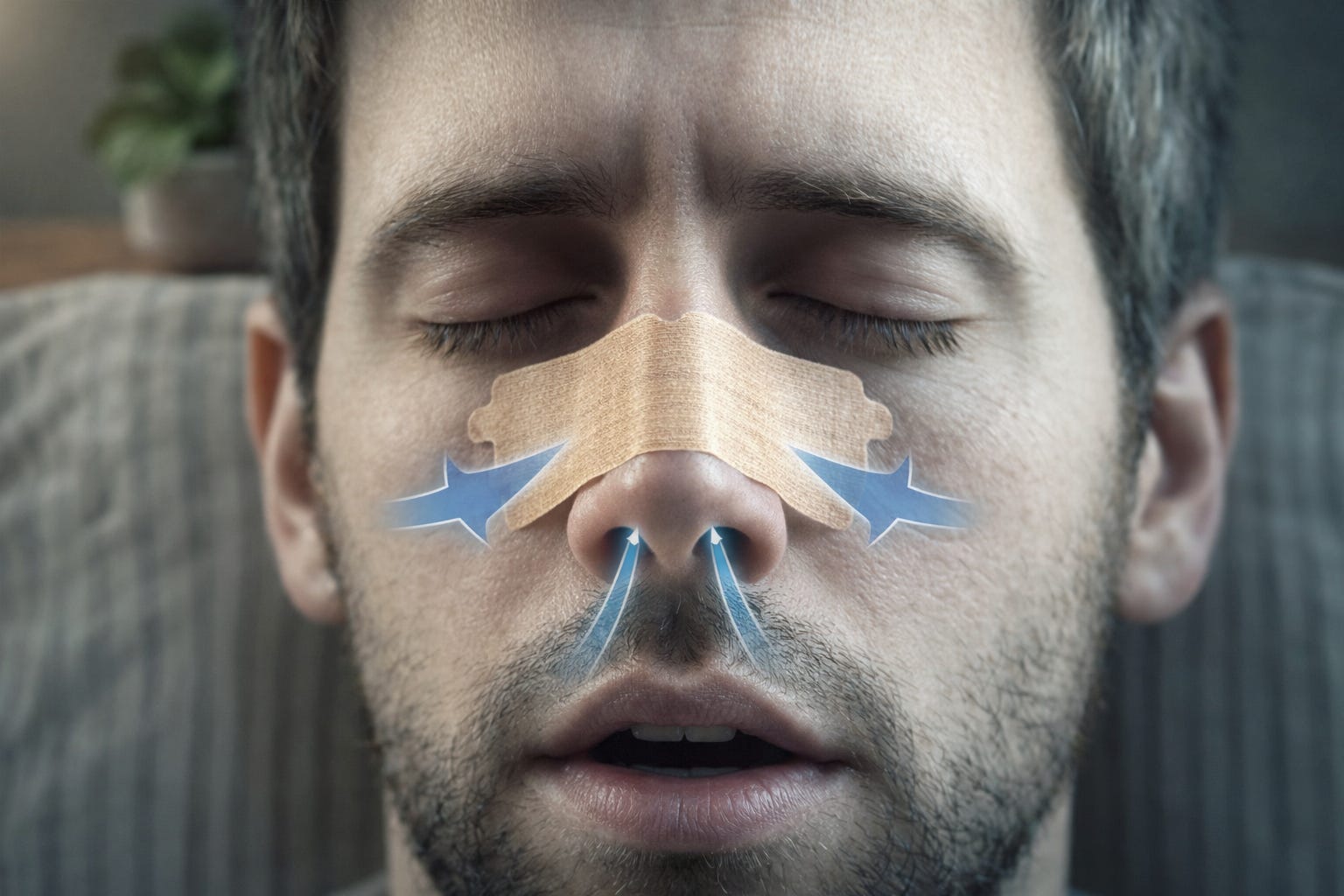
What it does: Opens nasal passages mechanically
The theory: If your nose is more open, you’ll breathe through it instead of your mouth
The limitation:
Nasal strips only address one potential bottleneck: nasal congestion.
If your nose is genuinely blocked due to a deviated septum, allergies, or inflammation, nasal strips can help. But if your mouth breathing is caused by low tongue posture (which it usually is), opening your nose wider won’t fix anything.
The test: Try breathing through your nose right now with your tongue at the bottom of your mouth. Notice how restricted your airway feels? Now place your tongue on the roof of your mouth and breathe. Notice the difference?
That’s tongue position controlling your airway—not your nasal passages.
The real issue: Most people who mouth breathe at night have perfectly functional noses. The problem is the tongue isn’t creating space in the throat.
Comments
Nothing yet. Say the first thing.
Sign in to join the conversation.