
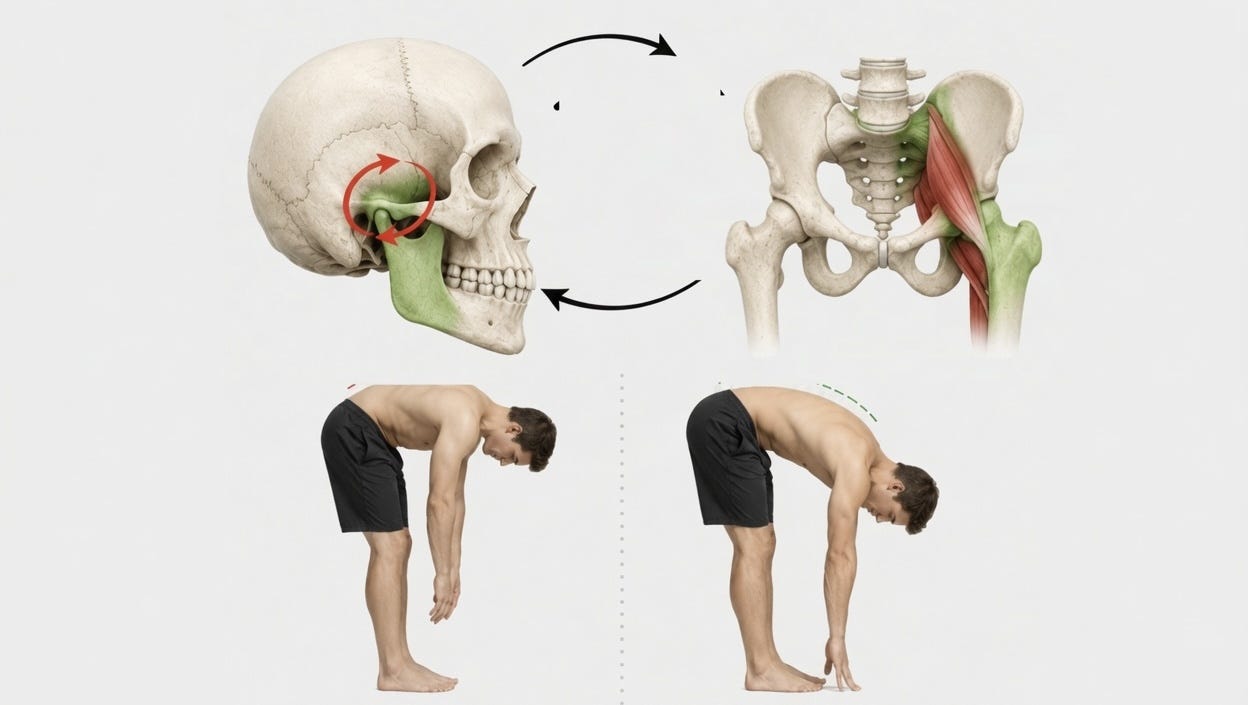
Most people think of the pelvis as a single bone, but it is really connects the upper body to the lower body, making it one of the most important transition zones in human movement.
Press your teeth together. Bite down. Hold it for five seconds.
Before you clench, gently rotate your head to the right and left. Notice how far you can turn and how much effort it takes.
Now clench your teeth for five seconds, then release.
Immediately try rotating your head again in the same directions.
Do you feel more freedom? Less restriction? Or does it feel tighter?
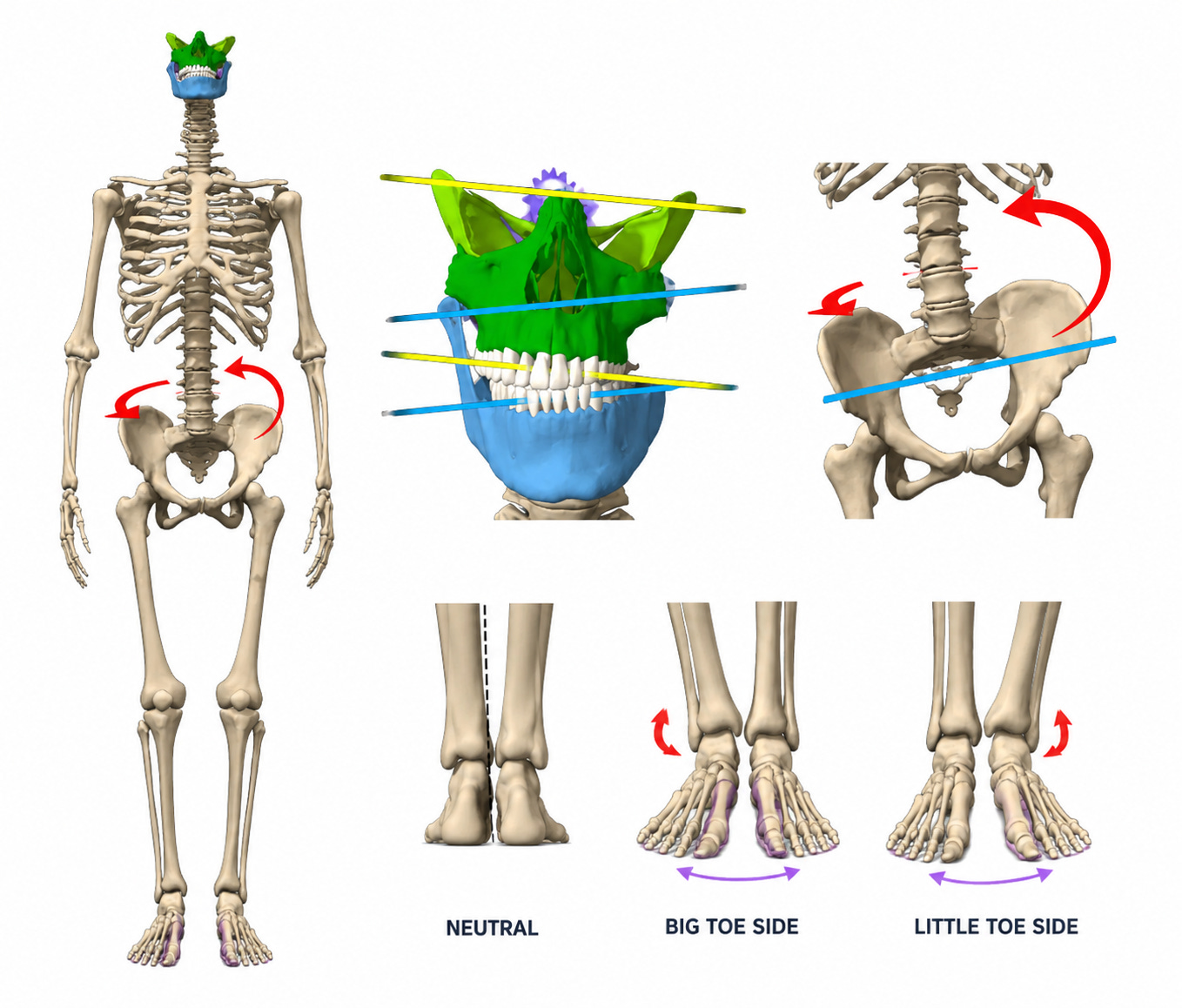
The self-tests above proved the connection is real. You felt it. But they don’t show you the order needed to fix it—because the order matters more than the fix itself.
If you work on the jaw before the feet, you lock in a new compensation. If you address the pelvis before the jaw, you just create another workaround your body has to manage.
Your jaw and your hip may be having the same conversation.
If one side of your jaw clicks, cranks, or feels off, pay attention to the opposite hip. For a lot of people, that side feels tighter, heavier, or harder to open up. The body loves diagonal compensation patterns, so the tension rarely stays in one place for long.
That’s why a hip adjustment or stretch can feel amazing at first, then fade fast. The hip wasn’t the whole story — it was just where the pattern showed up. If the driver is still there, the body will often rebuild the same restriction again and again.
The jaw can influence posture through head position, muscle tone, and the way the nervous system organizes balance. When the jaw is working asymmetrically, the rest of the body may quietly adapt all the way down to the pelvis.
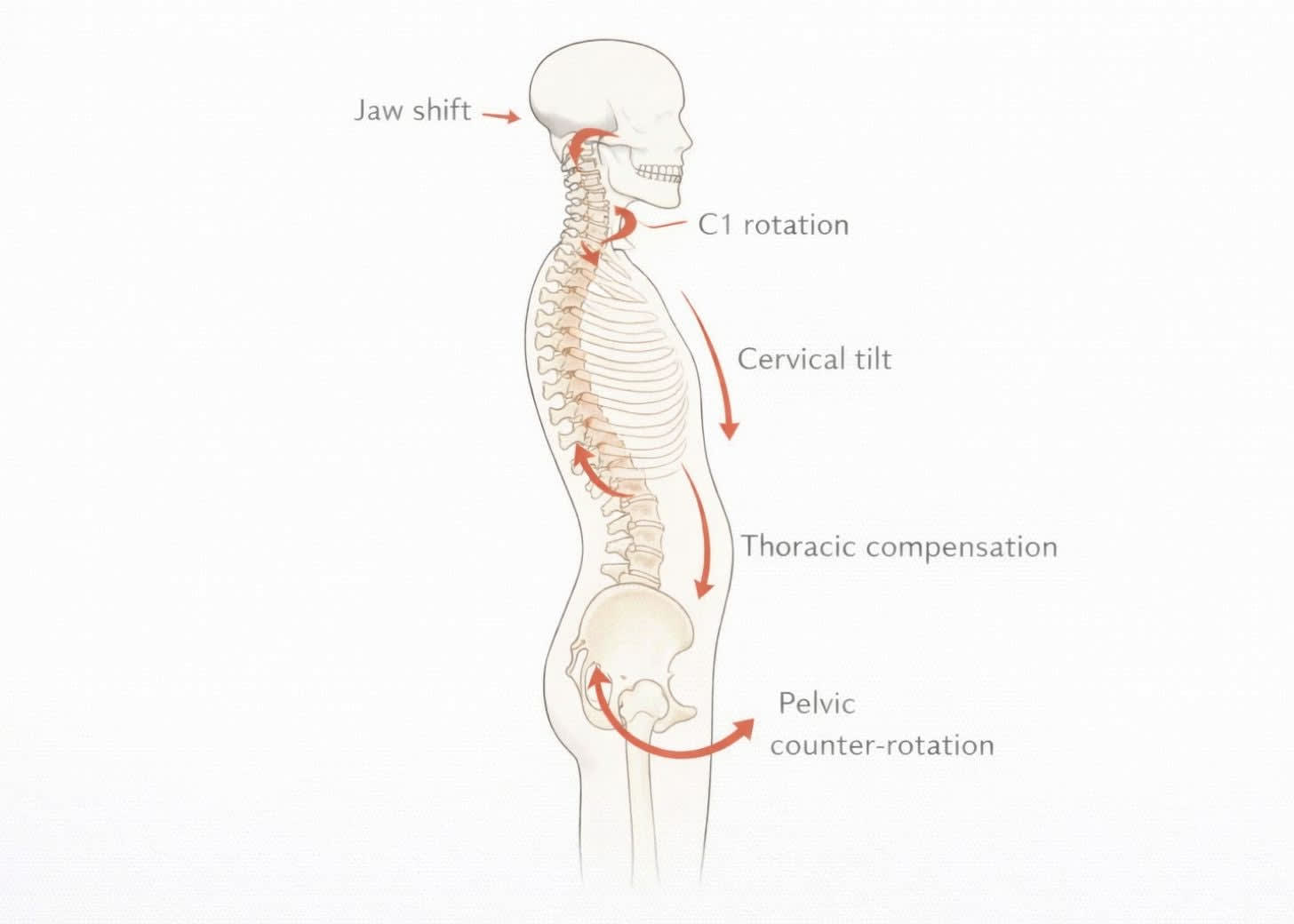
The body does not like instability. When something changes in the jaw, the neck often adjusts. When the neck adjusts, the spine compensates. When the spine compensates, the pelvis usually has to follow.
That is why pain or tightness in the hip is sometimes a downstream result, not the original problem.
Here’s the chain in simple terms:
Jaw tension changes head position.
Head position changes neck and spinal mechanics.
Spinal mechanics influence pelvic orientation.
Pelvic orientation changes how the hip loads.
So the “tight hip” may be the body’s final response to a problem that started much higher up.
This five-step protocol is designed to improve how the jaw, pelvis, and feet work together. Each step gives the nervous system a new signal, helping the body organize posture more efficiently and reduce unnecessary compensation.
Comments
Nothing yet. Say the first thing.
Sign in to join the conversation.