
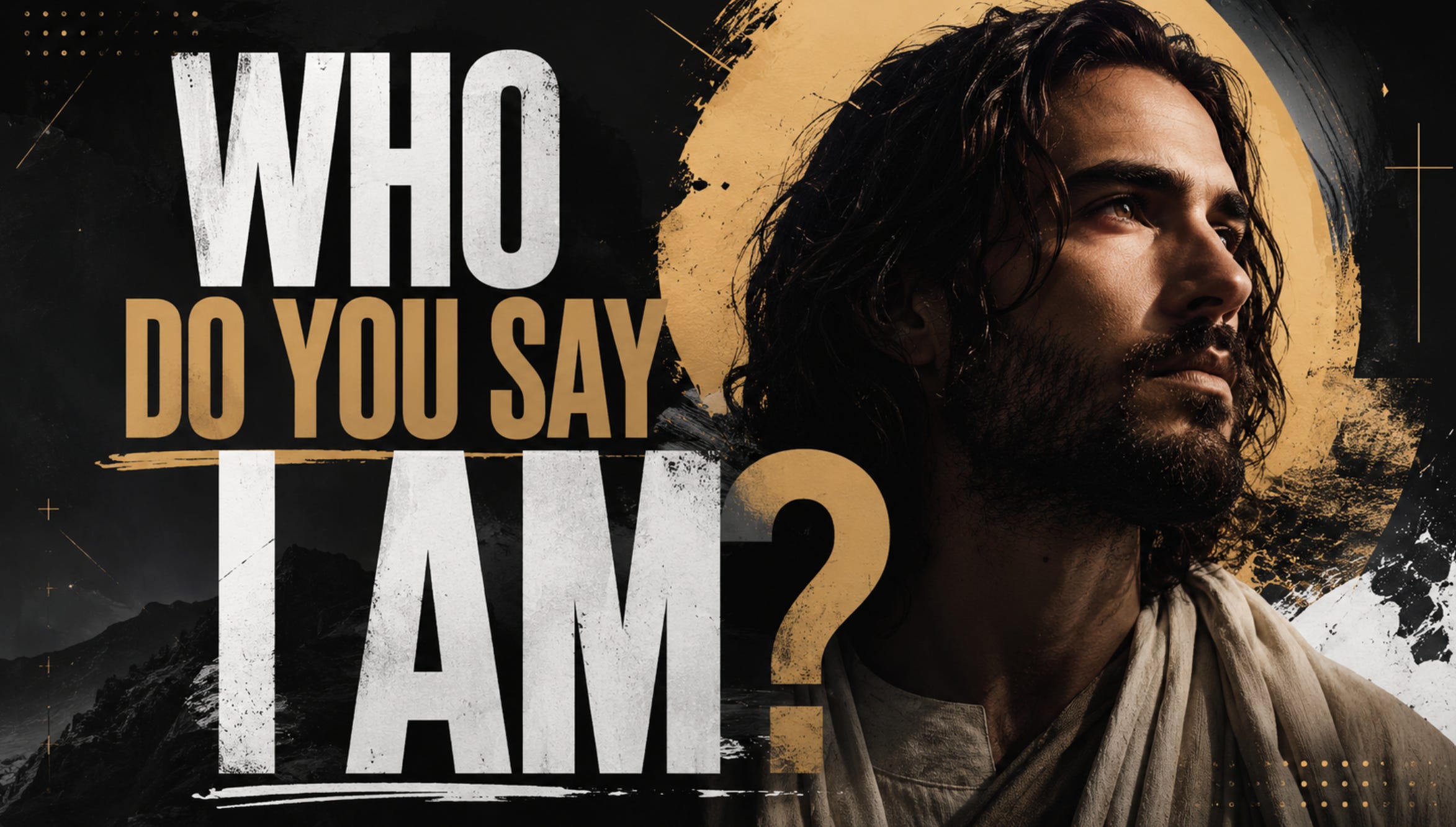
Continuing with the theme of the last few weeks, of Jesus deliberately crossing social boundaries, confusing the disciples in his increasingly counter-religious behaviour, Jesus is quite provocative to the disciples in the next Sunday lectionary text of Matthew 16.13–20. Here Jesus, being in another non-jewish place, this time Caesarea Philippi, a very gentile place, Jesus begins with a question. Not holding anything back, Jesus says, “Who do people say that the Son of Man is?”
The location matters. Caesarea Philippi was a place you would not expect a Jewish Messiah to visit, let alone the place for the first utterance by the disciples of Jesus being the Messiah. Caesarea Philippi stood for everything that was considered wrong by the Jews of the time. The town was previously a Greek settlement established for the pagan worship of the Greek God Pan. There was a large cave and rock which were the centre of a pagan worship cult which was also the source of the river Jordan. So it was considered desecrated place by the Jews as it was associated with pagan practices. We remember that the Greeks were hated by the Jews. In167 BCE under King Antiochus IV Epiphanes, one of the post Alexander the Great Greek rulers of Judea, this Greek King attempted to impose Macedonian/Greek religion and culture on Judea banning Jewish worship and circumcision and desecrated the temple in Jerusalem by building a massive statue of the God Zeus in the Holy of Holies, and where the temple was rededicated to Zeus rather than Yhweh. This led to a violent revolt. In the time of Jesus, Caesarea Philippi reflected a small remnant greek population in Judea and also the Roman-Jewish community and the puppet kings of Herod and Philip. The area was directly ruled by King Herod at the time, as part of the Roman Empire - a tactic used by the Romans to try and use local ethnic leadership to maintain order. So these pagan communities and both the puppet Herodian Kings and the Greeks were loathed by the Jewish inhabitants of Judea. In fact the name Caesarea was named in honour of Emperor Caesar and Philippi after Philip a previous King of the Herodian puppet line.
So by the time of Jesus, the memory of foreign rulers imposing pagan power on Jewish sacred land was very much part of the historical and religious consciousness of first century Judaism.
It is even more astonishing that in such a place of the gentiles, international foreign powers and pagan worship, that Jesus raises the question with the disciples of who he was. Jesus doesn’t take the disciples somewhere religiously safe and ask them who he is. He takes them to the edge. The question remains deeply challenging and almost like a test for his followers to discern who Jesus is within a plural and contested world. It is as if Jesus is deliberating setting up a contrast between himself the true Messiah and the imperial Emperor Caesar as a false Messiah, between himself as the humble Hebrew God-Messiah in the line of King David and the false kingship of the Herodians. In a world full of competing claims about God, power, identity and salvation, Jesus is really challenging the disciples.
Jesus refers to himself as the Son of Man. In Greek, the expression is ho huios tou anthrōpou. Literally, it means the son of the human being, though in ordinary biblical usage it can simply mean a human being or mortal. Its Hebrew and Aramaic background is important. In the book of Ezekiel, God repeatedly addresses the prophet as son of man, ben adam: mortal one, son of Adam, human being, creature of the earth. The phrase reminds Ezekiel of his humanity before the majesty of God.
But there is another and deeper scriptural resonance. In Daniel chapter 7, Daniel sees one like a son of man coming with the clouds of heaven. This figure is given dominion, glory, and kingship by the Ancient One. His kingdom is described as an everlasting kingdom that shall not pass away. The Aramaic phrase in Daniel is bar enash, one like a human being. In contrast to the violent and beast-like empires of Daniel’s vision, this figure appears in human form and receives authority from God.
Thanks for reading Contemplative Christian in a PostSecular Culture of Collapse! This post is public so feel free to share it.
Share Contemplative Christian in a PostSecular Culture of Collapse
When Jesus calls himself the Son of Man, he seems deliberately to gather these resonances together. He is truly human: vulnerable, travelling, teaching, suffering, and eventually dying. Yet he is also the one through whom God’s missional restorative purposes and sovereignty are revealed and established. In Matthew’s Gospel, the Son of Man has authority to forgive sins; he will suffer; he will be raised; and he will come in glory. The phrase allows Jesus to reveal himself gradually. He is not a Messiah made in the image of human ambition or political power. He is the human one who bears God’s authority, enters suffering, and finally receives the kingdom.
The disciples answer Jesus’ first question with the names that others have suggested: John the Baptist, Elijah, Jeremiah, or one of the prophets. Each answer recognises something significant. Jesus does indeed stand within the Jewish prophetic story. He speaks God’s word, calls people to repentance, confronts injustice, and announces the nearness of God’s reign. Yet none of these answers is sufficient.
Then Jesus brings the question closer: “But who do you say that I am?” In Greek Hymeis de tina me legete einai?
There are moments in prayer when this question becomes personal. We may have inherited Christian language. We may know the Creed, the hymns, the Gospel stories, and the theological answers. These are precious gifts. Yet Christ still asks each of us, “Who do you say that I am?” Not as an examination, but as an invitation into deeper relationship.
Simon Peter answers: “You are the Messiah, the Son of the living God.”
The word “Messiah” in Greek Christos, from which we get the word Christ. It translates the Hebrew word Mashiach, meaning “anointed one.” In the Jewish Scriptures, kings, priests, and sometimes prophets were anointed for God’s service. Over time, the hope grew for God’s anointed king: one who would fulfil God’s promises, restore justice, shepherd God’s people, and reveal the reign of God.
Peter’s confession is therefore bold. Jesus is not merely another teacher or prophet. He is the Messiah, the one in whom the hopes of the Jewish people find their fulfilment. Yet Matthew immediately deepens the confession: Jesus is “the Son of the living God.”
The phrase “living God” matters. It contrasts the God of Israel with lifeless idols and with every false power that claims ultimate loyalty. In the presence of empire, religion, wealth, fear, and human ambition, Peter names Jesus as the Son of the living God. His confession declares that the living God is not distant from the world but has come near in this particular person: Jesus of Nazareth.
Jesus responds, “Blessed are you, Simon son of Jonah.” The Greek word for blessed is makarios. It does not mean simply happy or fortunate. It speaks of a deep condition of being held within the life and favour of God. Peter is blessed, not because he has worked out the answer by intellectual effort, but because this truth has been revealed to him through the Spirit of God.
Jesus says, “Flesh and blood has not revealed this to you, but my Father in heaven.” The word for revelation is connected with apokalypsis: an uncovering, an unveiling, the drawing back of a curtain. Peter has not invented Christ’s identity. He has received a glimpse of it.
This is one of the great contemplative movements in the passage. Faith is not primarily something we manufacture. We do not reason our way into possession of the knowledge of God. We become receptive of God’s presence. We learn to be still enough to notice what God the Father the Creator is revealing. We allow the image of Jesus given to us by fear, habit, ideology, or wishful thinking to fall away. Then, slowly, the true Jesus the Emmanuel comes into view.
But then Peter blows it, because he himself has not understood the contrast between Jesus the Messiah and the false claims of the Messiah coming in power and majesty, and hence his line ‘get behind me satan’. Clearly Jesus is frustrated that Peter has not understood what type of Messiah Jesus will be. He will not be another Judas Maccabeus, who literally raised armies agains the Gentiles to use might and violence to bring political change. Instead he will be the suffering servant Messiah who goes towards the cross. The true Messiah will be the one who truly reveals God’s rule is the emperor enthroned in glory, but instead, the suffering servant God.
Jesus then says to Simon, “You are Peter, and on this rock I will build my church.” In Greek there is a clear wordplay: su ei Petros, kai epi tautē tē petra oikodomēsō mou tēn ekklēsian.
“You are Petros, and upon this petra I will build my ekklēsia.”
Petros means stone or rock, and petra means rock or rocky foundation. Christians have reflected on this verse in different ways. It is reasonable to hear Jesus affirming Peter personally and giving him a distinctive role among the disciples. It is also reasonable to see the rock as Peter’s confession: the Church is built upon the recognition that Jesus is the Messiah, the Son of the living God. These two meanings do not need to be separated sharply. Peter is given a role precisely as the one who confesses Christ; his strength does not lie in self-importance, but in the truth to which he points.
Yet at the same time, Jesus might even be again making a contrast between the rock of the disciples come Apostles and the massive rock at the entrance to the cave as the site of pagan worship. Maybe the rock of the Christian faith is a sure foundation that even speaks to places of false worship and false faith. This could be so, but we do not know.
Further, in a rare situation in this Gospel, is the word translated “church”, ekklēsia. It does not mean a building, a denomination, or an institution in the modern sense. It means an assembly or gathered people. In the Greek translation of the Hebrew Scriptures, ekklēsia was often used for the assembly of Israel, the people gathered before God. Jesus is therefore speaking of a people called together around himself: a community formed by confession, worship, discipleship, mercy, forgiveness, and mission. It is again a deeply provocative word pointing out difference. The aetiology of this word was the name of the town councils of rich Greek ports - and who were on these rich greek speaking Roman port councils. No surprise, rich men. So who will be part of these new Christian ekklēsias? Women, children, slaves, the poor and a host of people excluded and marginalised in the Roman Empire, who become a visible expression of the invisible Kin-dom of God. It seems that Jesus again continues to use the context of this city to express contrast between the myth of redemptive power and violence and the ways of the Kin-dom and mission of God.
Matthew is the only Gospel writer to use the word ekklēsia, and he uses it only twice: here and later in Matthew 18, in a passage about reconciliation and communal responsibility. That is significant. The Church is not named as a private spiritual experience. It is a radical gathered body. It is the people who learn to belong to Jesus, and through him, belong to one another.
Yet the Church must never confuse itself with the Kingdom of Heaven. The Kingdom of Heaven, or basileia tōn ouranōn, is the reign or sovereign rule of God. It is not primarily a place we go after death. It is the active, restoring, liberating, and reconciling rule of God breaking into the world through Jesus.
The Church is not the Kin-dom in its fullness. The Church does not own the Kin-dom or control it. Rather, the Church is called to be a sign, servant, and foretaste of God’s Kin-dom. It is called to point beyond itself to the sovereignty of Jesus the Christ. When the Church welcomes the stranger, seeks justice, forgives, worships truthfully, cares for the poor, and lives in love, it bears witness to the Kin-dom. When it becomes preoccupied with status, control, exclusion, or self-preservation, it forgets the true Messiah on whose confession it stands.
Jesus promises that “the gates of Hades will not prevail against it.” Hades is the realm of death. The image is not necessarily one of the Church aggressively attacking the world, but of death itself being unable finally to overcome the people gathered around the risen Christ. The Church is founded upon the Messiah who will pass through death and be raised. It is also the Messiah who is sovereign even in cities like Caesarea Philippi.
This promise is especially important because the passage is immediately followed by Jesus beginning to speak of his suffering and death. Peter’s confession is true, but it is not yet complete in his understanding. Jesus is Messiah, but not in the way many expected. His kingship or rather kin-ship will be revealed through self-giving love. His victory over evil will not be achieved through domination, but through the cross and resurrection.
That is also why the Church’s life must take the shape of Christ. The Church is most faithful not when it seeks to be powerful in the world’s terms, but when it becomes a community of humble service, courageous truthfulness, costly love, and resurrection hope.
Jesus gives Peter “the keys of the kingdom of heaven.” Keys are symbols of stewardship and responsibility. They are not given for exclusion or private control. They are given to open what belongs to God. The language of binding and loosing had a recognised Jewish background, referring to discerning how God’s people should live: what should be permitted or forbidden, released or held. In Matthew 18, this responsibility is extended to the wider community in the context of forgiveness, reconciliation, and care.
The Church is therefore entrusted with a serious task: to discern, under Christ, what leads towards life and what binds people in death; what opens the way of the Kin-dom and what closes it; what needs forgiving, healing, challenging, or releasing. This authority is never detached from the character of Jesus. It is exercised faithfully only when it remains close to the crucified and risen Messiah.
There is a deeply contemplative invitation here. Before Peter is told what he will do, he is invited to see who Jesus is. Before the Church is named, Christ is confessed. Before the keys are given, revelation is received.
In a culture that often measures worth by activity, visibility, and achievement, this order matters. The Church begins not with a strategy but with contemplation: with attending to Christ. The question “Who do you say that I am?” comes before the question, “What shall we do?”
Perhaps, then, this passage invites us into a holy stillness. We can sit with Jesus at Caesarea Philippi. We can let the crowd’s answers fall away: prophet, teacher, moral example, spiritual guide, political symbol, cultural memory. We can listen again for the question addressed personally to us: “But who do you say that I am?”
We may not always have Peter’s clarity. There may be seasons when our answer is hesitant, partial, or burdened by doubt. Yet even then, we can remain before Christ. We can ask God the Father the Creator to reveal God the Son the Redeemer to us afresh. We can let the confession rise slowly from within us: “You are the Messiah, the Son of the living God.”
And we can ask what it means to belong to the Church not merely as an institution, but as a people gathered around that confession. We are called to be living stones, not enclosed walls; a community that opens the doors of the Kin-dom rather than guarding them anxiously; a people whose common life makes visible the mercy, justice, and reconciling love of Christ.
The question at the heart of the Church is therefore not ultimately about the Church. It is about Jesus. Who do you say that I am?
May we have the wisdom to listen. May we receive the revelation rather than try to control it. May we confess Christ with Peter. And may we become, by the power of the Spirit, a people through whom the living God’s Kin-dom of heaven becomes more visible in the world.
Share Contemplative Christian in a PostSecular Culture of Collapse
Comments
Nothing yet. Say the first thing.
Sign in to join the conversation.