
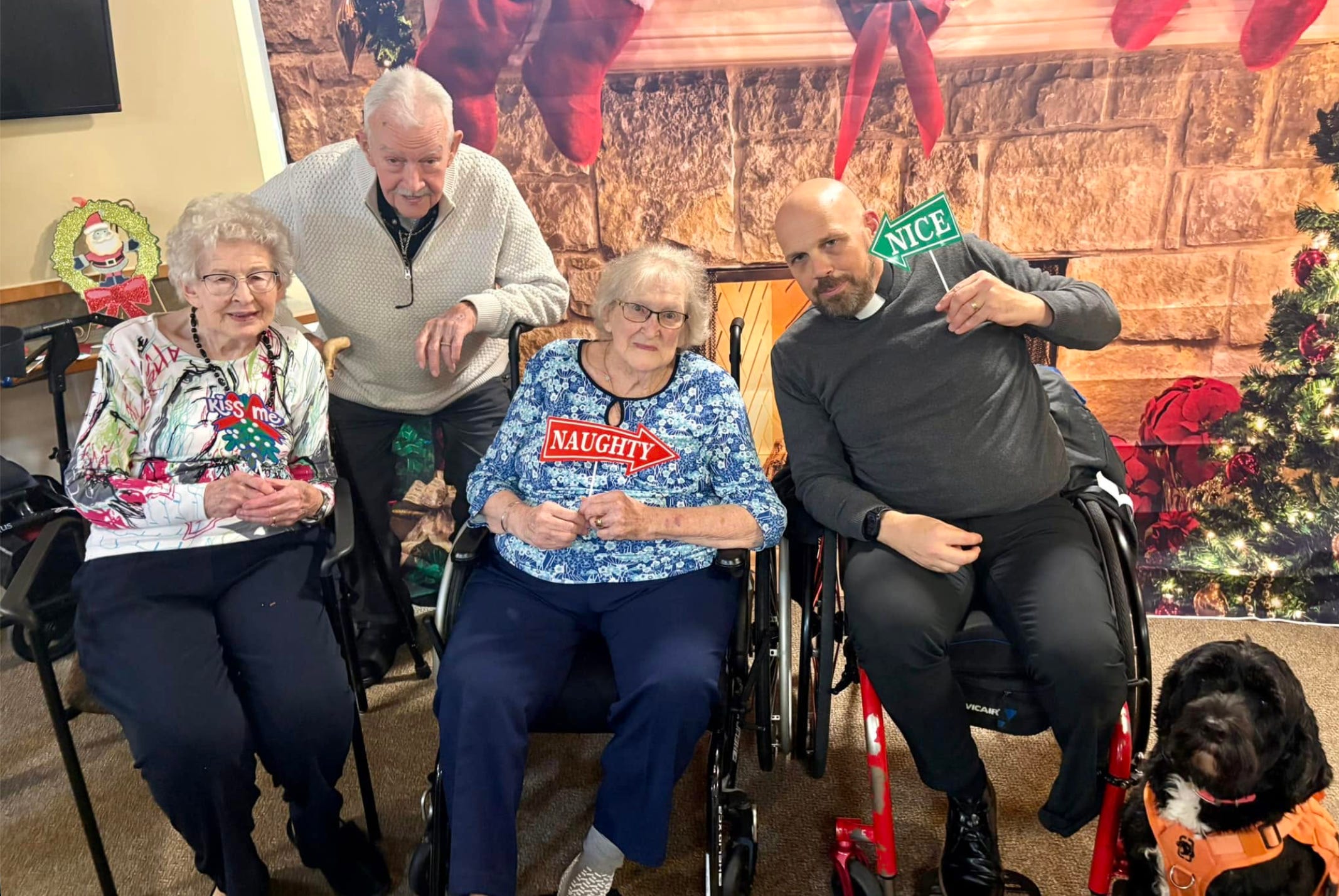
Picture of the Revd Deacon Stephen La Salle who as a distinctive deacon inspires me in the way he lives out this vocation very deeply in presence to Smithville, Ontario in the Anglican Diocese of Niagara where I work. Picture includes some members of the Parish Church.
There is nothing like a crisis that forces people to get back to the heart of things. I believe sometimes cultural changes brings opportunities or recoveries. Like all religious traditions facing the reality of the contemporary world now dictated by a particular all-embracing form of capitalistic market societies, the Anglican Church stands at a pivotal moment in its history. We are living through the death blows of Christendom, the collapse of inherited assumptions about Christian belief and belonging, and the emergence of an increasingly post-Christian and post-secular culture. Many of the patterns of ministry that served the Church well for centuries are proving less effective in a world where most people no longer possess even a basic understanding of Christianity, and where many hold negative assumptions about the Church shaped by history, culture and personal experience.
This changing context calls for more than a form of new managerialism or new programmes or better strategies. It calls for the recovery of forgotten gifts that have always belonged to the Church. Among the most important of these I believe is the distinctive vocation of the permanent or distinctive deacon.
The Anglican Church has never abandoned the ancient threefold order of ministry. We continue to affirm the apostolic ordering of bishops, priests and deacons. Yet while we have preserved the order, we have often lost sight of the distinctive vocation of the diaconate and its missional orientation. In many places the deacon has become little more than a transitional stage before ordained priesthood or a liturgical assistant whose ministry is largely exercised within the sanctuary. The tragedy is not simply that we have too few permanent deacons who understand what being a deacon is about. The deeper tragedy is that we have forgotten why the Church has always needed them.
Share Contemplative Christian in a PostSecular Culture of Collapse
If the Church is serious about renewal in a post-Christendom context, then reclaiming the missionally orientated permanent diaconate is not an optional extra. It is an essential part of recovering the missional identity of the whole Church.
The biblical foundations for this vocation are compelling. While scholars continue to debate the precise origins of the diaconate, Acts 6 provides an important picture of the Church recognising the need for leaders who could ensure that the Gospel was embodied in practical, relational and missional ways. The appointment of the Seven was not simply about administration but about enabling the Church to flourish in both contextual mission and loving service as outreach. Stephen and Philip, often associated with this early ministry, were not merely organisers of charitable work. They preached Christ, crossed cultural boundaries, exercised missional ministries and became bridge-builders between the Church and those beyond its immediate community, locality or parish neighbourhood
The New Testament also speaks of deacons in Philippians 1 and 1 Timothy 3 as a recognised and valued order of ministry within the early Church. Increasingly, biblical scholarship has challenged the assumption that the Greek word diakonossimply means “servant.” Rather, it carries the sense of one who acts as an authorised vocational ministry. This is significant. It suggests that the deacon is not simply called to humble loving service - although service remains central - but to represent Christ and the Church faithfully within the world by being relationally immersed in the world.
This image beautifully captures the distinctive vocation of the deacon. The deacon stands at the threshold between Church and the local community or neighbourhood. The deacon gathers the needs, hopes and questions of the community or neighhourhood and brings them before the praying Church. At the same time, the deacon carries the Gospel of Christ beyond the gathered congregation into the places where people live, work, struggle and search for meaning. The deacon inhabits the boundary, constantly moving between worship and missional witness, between altar and local marketplace, between the life of the Church and the life of the community.
Sadly, this rich vocation became increasingly obscured during the long centuries of Christendom.
As Christianity became culturally dominant, the Church no longer understood itself primarily as a missional community living relationally among people unfamiliar with the Gospel. Parish life increasingly revolved around caring for an already Christian society. The priest naturally became the dominant model of ministry because the central task was pastoral oversight of a largely Christian population. Within this context the deacon gradually lost a distinctive identity. Rather than remaining a missional bridge between Church and the local community or neighbhourhood, the deacon became either an apprentice priest or a permanent worship liturgical assistant. The ministry of the threshold slowly disappeared because, within Christendom, the threshold itself had largely disappeared.
Many Anglican churches still carry this inheritance. Permanent deacons are often poorly understood because the Church continues to imagine ministry through a Christendom lens. We ask how deacons can assist priests rather than asking what a distinctive missional vocation God has given to the diaconate. As a result, we often end up creating what might be called a “pseudo-priest” - someone who performs selected liturgical functions but whose unique charism remains underdeveloped. I see the debates going on in the Anglican Church of Canada and they play out exactly this problem.
Yet history has shifted once again.
The collapse of Christendom means that the Church now finds itself in a missional context remarkably similar in many respects to that of the pre-Christendom early Church. In most places now, contemporary multicultural society can no longer be assumed to possess any Christian memory. Many people have never entered a church. Others have consciously left. Still others carry painful memories of the Church and understandably approach Christianity with caution or suspicion. The contextual of a threshold then has returned.
This is precisely why the distinctive diaconate matters once more.
The renewal of a more missional parish life increasingly depends upon becoming what has been described as a mixed ecology Church - one that values inherited congregations whilst also cultivating new Christian communities through contextual mission. Such a Church recognises that there is no single pathway into Christian faith, some people remain open to exploring Christianity through existing parish communities, others require entirely new forms of Christian community that emerge through long-term contextual mission within their own cultures and networks.
Within this mixed ecology, the permanent deacon has a uniquely important vocation.
I have increasingly come to distinguish between two complementary forms of missional engagement. The first is what I describe as healthy relational outreach. This is the ministry of building genuine relationships within the local community with those who remain open to Christianity or to exploring church life. These are often people who are spiritually curious, the open de-churched, or those who have never belonged to a church but do not regard Christianity as alien or threatening. Through friendship, hospitality, listening and compassionate service, they can be gently invited to discover the life of the worshipping community.
The second form of missional engagement is contextual mission among those who are largely unbridgeable through inherited parish life. These are people whose cultural assumptions, life experiences or social locations mean that traditional church is not a meaningful point of engagement. Here the task is not simply outreach but the patient and humble work of accompanying people over many years as entirely new ecclesial communities emerges out of contextual mission within their own contexts.
Both forms of missional activity are essential, but they are not the same thing.
The very real danger of Christendom is that many parish churches remain ‘attractional’ and then do ‘disconnected’ or ‘manipulative’ outreach as the ONLY missional activity they understand which will not work because such parish churches do not understand that such approaches are controlling. In fact such activities can do more harm than good because they do not listen or engage with local people outside of church.
But, getting back to the distinction, a healthy missional parish church will need a balance of missional activity - healthy outreach and contextual mission. Neither approach is sufficient on its own.
Priests, missioners, lay leaders and deacons all have vital contributions to make. Yet I believe healthy relational outreach lies at the very heart of the distinctive diaconate.
The permanent deacon is uniquely placed to help the parish church to become attentive to its neighbourhood. The deacon equips congregations to notice where God is already at work beyond church walls. The deacon cultivates relationships, encourages hospitality, forms partnerships within the community, accompanies those exploring faith, and helps create natural bridges between everyday life and the worshipping community. This is not simply loving service, nor is it a recruitment programme for church attendance. It is the ministry of recognising that the Holy Spirit is already present and active within the life of the community and helping the Church participate faithfully in God’s loving mission.
This understanding of the diaconate also challenges the whole Church to recover a deeper theology of mission. Mission does not begin with our activity. It begins with God’s activity. The Father God the Creator continues to send the Son God the Redeemer, and the Father and the Son continue to send the Holy Spirit, God the Life Sustainer and Unsettler, into the world. The Church is invited to participate in that divine movement. The deacon reminds the whole Church that we do not carry God into the world. Rather, we discover the God who has already gone before us.
For this reason, the renewal of the permanent diaconate is not simply about filling another ecclesiastical office. It is about recovering a way of seeing. Deacons help the Church lift its eyes beyond its own concerns and rediscover the missional horizon that has always been part of its identity. They remind ordained priests that the altar points towards the world and the Eucharist is the missional feast that commissions the entire body of Christ into missional engagement into the world before it regathered next Sunday as well as the call to a missional rhythm of life for the week ahead. Deacons remind congregations that worship flows naturally into missional engagement and living. Deacons and missioners remind bishops that the health of the Church is measured not only by what happens within our buildings but also by how faithfully we participate in God’s mission beyond them.
We desperately need such leaders, both deacons and missioners in this work.
We need women and men of deep prayer, contemplative attentiveness and theological maturity. We need leaders who can discern where the Holy Spirit is already moving within neighbourhoods, schools, workplaces and communities. We need people who are naturally relational, gifted at building trust, able to accompany those exploring faith, and committed to helping parishes become outward-looking communities rooted in hope rather than fear. We need deacons who are neither frustrated ‘pseudo-priests’ nor liturgical assistants, but joyful ministers of thresholds between Church and Parish Neighbourhoods.
I do believe, that the future renewal of the Anglican Church will not come through recovering forms of Christendom and the delusion that still holds in larger Anglican parish Churches that they can make Christendom informed Churches continue to work in this mode of being. Nor will it come simply through reorganising parish structures or introducing new programmes particularly the harmful obsession with detached outreach. It will come through rediscovering our identity as a people sent by the Triune God into the world. Bishops, priests and deacons each have a distinctive contribution to make to that missional vocation.
Perhaps the time has come for the Anglican Church in its various national and provincial forms, to rediscover that the ancient order of deacons was never a historical accident or merely a stepping stone to ordained priesthood. It was, and remains, one of God’s gifts to the Church for precisely the kind of missional age in which we now find ourselves.
If we are serious about renewing the Church for a post-Christendom world, then we must once again discern, form, deploy and celebrate the permanent diaconate - not as a diminished priesthood, but as the Church’s distinctive ministry of the threshold, calling the whole people of God to participate more deeply in the mission of Christ.
Share Contemplative Christian in a PostSecular Culture of Collapse
Comments
Nothing yet. Say the first thing.
Sign in to join the conversation.