
My Orthodox parish church has a few people of Scottish ancestry. There is always talk of the Scottish Orthodox Club. Even our Archbishop is a member. We have embarked on having a traditional Scottish “Burns Supper” fundraising event every year - a celebration of poet Robert Burns on or around January 25th. This year, I was asked to give the “Immortal Memory”, the traditional speech in honor of the bard. This is what emerged…
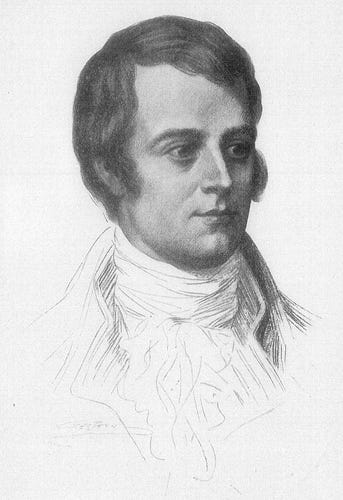
I stand here to commemorate the Bard, Robert Burns....in the hall of an Orthodox Church. This juxtaposition may cause puzzlement to some. Wasn’t Burns a Mason who decried religious hypocrisy and pursued a life that was less than...shall we say...chaste? What on earth is the connection? Burns is obsessed with nature, eros, and beauty.
In the minds of many Americans, when you say Orthodox, it is assumed that it is preceded by an Eastern ethnic tag like Russian or Greek, or if you watch Seinfeld, perhaps Latvian. The idea that Orthodoxy and Scotland have anything to do with each other may seem puzzling if that is your only association.
So the first connection is that not only are several people in this parish of Scottish ancestry, but Orthodox Historiography considered the church in Scotland to be Orthodox until at least 1066, with some elements continuing to flavor the culture. And now, Orthodox monasticism has returned to Iona and Mull. I’ll leave off the details because this toast is already too long. Suffice it to say, Orthodoxy is as Scottish as anything else.
I am someone used to odd juxtapositions. I run a Facebook group called “Orthodox Beats.” I am a poet who studied at the Jack Kerouac School of Disembodied Poetics, studying with the Beat Poets who were still living then. Like the Bard, the Beats combined intense spiritual seeking with a sensual love of nature, experience, and.....well, other sensual pursuits and desires. I had to add the following disclaimer to my group page:
This group is for those who find themselves in the seemingly contradictory position of being Orthodox Christians and Beat Poets...but who know that the seeming contradiction, is in fact, a dialectic which yields a greater synthesis of poetic understanding.
Western Culture, especially post-Freudian Western culture, has difficulty juxtaposing the spiritual and the sensual. Either we suppose that we must become distressed inauthentic spiritual prudes like the Bard describes in “Holy Willie’s Prayer“ or “The Holy Fair”:
A robe of seeming truth and trust
Hid crafty Observation;
And secret hung, with poison'd crust,
The dirk of Defamation:
A mask that like the gorget show'd,
Dye-varying on the pigeon;
And for a mantle large and broad,
He wrapt him in Religion.
Hypocrisy A-La-Mode
Or we must seemingly elevate the grossest sensual impressions to an encompassing spirituality, as with many “spiritual paths” that are offered today. The Beats started down this path by stating that EVERYTHING is holy. The problem with this is that if everything is Holy, nothing is set apart or kept in honor, which is what holy really means, and by elevating everything equally, it is all lowered to the level of dung. We might notice that the Bard himself fell into neither of these traps but kept his authenticity, however much tension the juxtaposition implied. But a Scotsman might ask if there is another way.
The way lies in going back further, past 1066. There is something very different in the monastics of Scotland and the surrounding lands. In our postmodern sophistication, we suppose that it is all mythical and, therefore, demythologized. The problem is when you meet a modern saint, and there are some, the demythologization falls apart, as we see that the contemporary saint and the ancient Scottish one are the same type of folk.
And what is the secret that these saints know? How do they strive in forlorn sea caves and isles, even forgoing the pleasure of the lassies!?!
The first secret is that EROS is actually a divine spark. The eros that we think we know, which Freud taught us to blush about, is much more than the familiar carnal longing. There is a surprising amount written about eros by monks! Eros, trained by spiritual experience, can rise to unimagined heights. It begins by transforming the sensual honeytraps of longing into the death of selfishness in married people, where eros rises to higher and even martyric love. Then, in monks and nuns, it rises to even greater heights of divine knowledge. Eros gives way to transcendent love and profound transformation in the one seeking the highest of its forms. Human fallenness and the alienation between people and God and people and nature are healed. This is why we see the harmony with nature in Celtic monasticism. There is a book by a monastic abbot called “The Eros of Repentance." You can also find a book for free online called “The Theology of Eros.” I’ll stop belaboring this point now, as well. Suffice it to say, the knowledge of how this all works, forgotten in the West, is still available.
The Bard knew nothing of this; we can only conjecture what might be different if he did.
But one quote by contemporary Saint Porphyrios goes like this:
” Whoever wants to become a Christian must first become a poet. That's what it is! You must suffer. You must love and suffer--suffer for the one you love. Love makes effort for the loved one. She runs all through the night; she stays awake; she stains her feet with blood in order to meet her beloved. She makes sacrifices and disregards all impediments, threats, and difficulties for the sake of the loved one. Love towards Christ is something even higher, infinitely higher."
--Elder Porphyrios
So we see that eros, in even its purest form, requires sensitivity, beauty and poetry. We easily see that Burns has these qualities in spades.
In an article for our church newsletter on poetry, I added a few quotes:
“In the sensual (or feeling) part of the soul, there appears a yearning and love for the beautiful. The eye does not want to tear itself away from the flower and the ear does not want to tear itself away from the song, only because the one and the other are beautiful. We go for a walk and select a place for the single reason that it is beautiful. Above this is the enjoyment received from paintings, works of sculpture, music and singing, and even higher than this, the enjoyment received from poetry."
―St. Theophan the Recluse
“Literature is news that stays news”
―Ezra Pound, founder of the “Imagist” school of poetry
“Beauty will save the world”
―Fyodor Dostoyevsky, The Idiot
It is no accident that the highest spiritual teachings in the Orthodox church are contained in the Philokalia, or “Love of the Beautiful."
Our Bard loved beauty, poetry, eros (at least in some dimension), and nature in spades. But what of his faith? He railed against the hypocrisy of his youth and in others, to be sure. Here, we see another trait in common with the saints: the rejection of cruel heresy!
As Burns wrote to Dr. Moore: “Polemical divinity about this time was putting the country half-mad; and I used to puzzle Calvinism with so much heat and indiscretion that I raised a hue and cry of heresy against me, which has not ceased to this hour.” The “hue and cry of heresy” has continued, and to it has been added the charge of “agnostic.” Yet Burns was neither heretic nor agnostic.
--from Scot on the Rock? The Faithful Poetry of Robert Burns by Ian Hunter
The closest thing to a creed that he ever expressed:
He, who is our Author and Preserver, and will one day be our Judge, must be (not for his sake in the way of duty, but from the native impulse of our hearts), the object of our reverential awe and grateful adoration: He is almighty and all-bounteous, we are weak and dependent; hence prayer and every other sort of devotion.—“He is not willing that any should perish, but that all should come to everlasting life”; consequently it must be in every one’s power to embrace His offer of “everlasting life”; otherwise he could not, in justice, condemn those who did not.
His “Address to the Deil” shows where he stands with that foul creature.
His poems are filled with humble prayers,
O Thou, Unknown, Almighty Cause
Of all my hopes and fear,
In whose dread presence ere an hour
Perhaps I must appear.
If I have wandered in those paths
Of life I ought to shun,
As something loudly in my breast
Remonstrates I have done.
Thou know’st that Thou hast formed me
With passions wild and strong,
And listening to their witching voice
Has often led me wrong.
When human weakness has come short,
Or frailty stept aside;
Do Thou, All-Good, for such Thou art,
In shades of darkness hide.
Upon the death of his child Elizabeth he wrote:
My child, thou are gone to the home of thy rest,
Where suffering no longer can harm thee:
Where the songs of the Good, where the hymns of the Blest
Through an endless existence shall charm thee!
His dying poem, “Prayer in the Prospect of Death,” reveals the state of his soul as it faced eternity:
Where with intention I have err’d,
No other plea I have,
But Thou art Good; and Goodness still
Delighteth to forgive.
I think that we can find a sympathetic heart in Dostoyevsky, who gave this speech to the drunk Marmeladov in “Crime and Punishment”:
“And He will say, ‘Come to me! I have already forgiven thee once…Thy sins which are many are forgiven thee for thou hast loved much’ […] And when He has done with all of them, then He will summon us. ‘You too come forth,’ He will say, ‘Come forth ye drunkards, come forth, ye weak ones, come forth, ye children of shame!’ […] And the wise ones and those of understanding will say, ‘Oh Lord, why dost Thou receive these men?’ And He will say, ‘This is why I receive them, oh ye wise, this is why I receive them, oh ye of understanding, that not one of them believed himself to be worthy of this.'”
Jack Kerouac expressed the life of Wild Passions this way:
“[...]the only people for me are the mad ones, the ones who are mad to live, mad to talk, mad to be saved, desirous of everything at the same time, the ones who never yawn or say a commonplace thing, but burn, burn, burn like fabulous yellow roman candles exploding like spiders across the stars and in the middle you see the blue centerlight pop and everybody goes “Awww!”
And so let me close with a poem of my own:
We be with Passions Wild and Strong,
We may, the lesser places haunt,
Enticed by beauty all day long,
It is the poet’s heart we want.
We may be drawn alway to seek,
the sweet hour among the lassies O.
but that path leads to a martyr’s crown,
If that path we truly know.
To rage against hypocrisy,
against heresy and cruel sin
We may well do as long as we
aim that rage to ourselves within.
We Scots who wish old Scotland well,
must always seek a deeper way,
beneath mere culture that we know,
lest “Scottish” becomes mere cosplay.
O Bard, I know your passions wild,
love of whisky, lassies, and song,
are but shadows from a mighty love,
The love and beauty that makes us strong.
Ladies and Gentlemen, please rise, fill your glasses, raise them high, as I give you, the Immortal Memory of Robert Burns!
No posts
Comments
Nothing yet. Say the first thing.
Sign in to join the conversation.