Ae nicht I saw the braw lads o’ my age, Wi’ wits sae wild an’ hearts unstaid, Wha roamed the mirk o’ city lanes, Wi’ sangs o’ freedom loud display’d.
Their souls were brunt wi’ holy fire, Their een wi’ visions fair did blaze, The warld ca’d them daft or liars, But they sought Truth through drunken ways.
What was that? It was not Burns, but an incredible simulation! it was how Rabbie Burns might have written the first few lines of Howl by Allen Ginsberg. This is how THAT poem actually begins:
I saw the best minds of my generation destroyed by madness, starving hysterical naked, dragging themselves through the negro streets at dawn looking for an angry fix, angelheaded hipsters burning for the ancient heavenly connection to the starry dynamo in the machinery of night, who poverty and tatters and hollow-eyed and high sat up smoking in the supernatural darkness of cold-water flats floating across the tops of cities contemplating jazz, who bared their brains to Heaven under the El and saw Mohammedan angels staggering on tenement roofs illuminated, who passed through universities with radiant cool eyes hallucinating Arkansas and Blake-light tragedy among the scholars of war,
So what was the point of that exercise? It is to illustrate that the Bard and the Beats have more in common than one might suppose. I hinted at this last year, but now I intend to go a bit deeper. I would say that the Beat Poet that Burns has the most in common with is Jack Kerouac.
Listen here, to a fragment of Kerouac, celebrating our own local region with some Jazz piano provided by Steve Allen (I only played the first few minutes)
So what, exactly, does our bard have in common with Jack Kerouac? Here are 8 points.
Like Kerouac’s focus on hitchhikers, jazz players, and everyday wanderers, Burns gave voice to farmers, laborers, and tavern folk.
“Is there for honest Poverty That hings his head, an’ a’ that; The coward slave-we pass him by, We dare be poor for a’ that! For a’ that, an’ a’ that. Our toils obscure an’ a’ that, The rank is but the guinea’s stamp, The Man’s the gowd for a’ that.
Kerouac (from On the Road, prose rhythm) often treats every drifter as a saint in denim—both share what could be called “the democratic spirit.”
Burns wrote in Scots dialect, capturing raw speech much as Kerouac used spontaneous prose. Both reject polished artifice.
“Wee, sleekit, cow’rin, tim’rous beastie, O, what a panic’s in thy breastie! Thou need na start awa sae hasty, Wi’ bickering brattle! I wad be laith to rin an’ chase thee, Wi’ murd’ring pattle!”“
This immediacy feels like Kerouac’s unedited typewriter runs—emotion straight to the page. Kerouac created his own list of 30 essential attributes of spontaneous prose:
Scribbled secret notebooks, and wild typewritten pages, for yr own joy
Submissive to everything, open, listening
Try never get drunk outside yr own house
Be in love with yr life
Something that you feel will find its own form
Be crazy dumbsaint of the mind
Blow as deep as you want to blow
Write what you want bottomless from bottom of the mind
The unspeakable visions of the individual
No time for poetry but exactly what is
Visionary tics shivering in the chest
In tranced fixation dreaming upon object before you
Remove literary, grammatical and syntactical inhibition
Like Proust be an old teahead of time
Telling the true story of the world in interior monologue
The jewel center of interest is the eye within the eye
Write in recollection and amazement for yourself
Work from pithy middle eye out, swimming in language sea
Accept loss forever
Believe in the holy contour of life
Struggle to sketch the flow that already exists intact in mind
Dont think of words when you stop but to see picture better
Keep track of every day the date emblazoned in yr morning
No fear or shame in the dignity of yr experience, language & knowledge
Write for the world to read and see yr exact pictures of it
Bookmovie is the movie in words, the visual American form
In praise of Character in the Bleak inhuman Loneliness
Composing wild, undisciplined, pure, coming in from under, crazier the better
You’re a Genius all the time
Writer-Director of Earthly movies Sponsored & Angeled in Heaven
The essential summary of Kerouac’s Writing technique is expressed in the sentence: “First thought, Best thought.”
Both poets experience the natural world as mystic energy rather than scenic background.
“Now westlin winds and slaught’ring guns Bring Autumn’s pleasant weather; The moorcock springs on whirring wings Amang the blooming heather: Now waving grain, wide o’er the plain, Delights the weary farmer; And the moon shines bright, when I rove at night, To muse upon my charmer.
Kerouac’s mountain meditations in The Dharma Bums echo the same rustic awe and awareness of nature and impermanence.
I will add, as we are in an Orthodox parish, that the view of nature as connected to divine energy rather than the soulless mechanical world of Western philosophers finds much agreement amongst the poets.
Burns challenged moral and religious hypocrisy; the Beats attacked cultural conformity.
Burns (from “Holy Willie’s Prayer”) satirizes a self‑righteous church elder—just as Kerouac and Ginsberg attacked middle‑class piety.
Each poet turns art into protest through voice and attitude, not political dogma.
Burns desired personal liberty—creative, sensual, and social—mirroring Kerouac’s restless spirituality.
Burns (from “Epistle to Davie”):
“A heart-felt joy and gladness, That’s worth to me mair pride o’ state Than ought the world’s great gladness.”
This yearning for inner authenticity could sit comfortably beside the Beats’ road‑trip revelations.
Both poets’ work swings with rhythm—the sound of voice, song, and movement. Burns wrote for song; Kerouac wrote as if improvising over jazz.
Burns’s “A Red, Red Rose” flows in musical quatrains;
Kerouac read his poems to jazz accompaniment—their art depends on sound, not static print.
Neither man hid pleasure behind propriety. Their frank celebrations of love and desire defied prudish norms.
Burns (from “Green Grow the Rashes, O”):
“The sweetest hours that e’er I spent Were spent amang the lasses, O.”
This uninhibited joy in human connection prefigures the Beat sensual candor in works like Mexico City Blues.
As I mentioned last year, according to Orthodox Holy Fathers, EROS is a divine spark, meant to reach higher than sensual pleasures.
Both perceive divinity in ordinary life—Burns through humanist compassion, Kerouac through Christian mysticism, tinged with Buddhist apophaticism.
“O wad some Power the giftie gie us To see oursels as ithers see us! It wad frae mony a blunder free us, An’ foolish notion: What airs in dress an’ gait wad lea’e us, An’ ev’n devotion!
That humility and empathy reflect a Beat sense of enlightenment through awareness. And let me say again, that I find a sympathetic vein in Orthodoxy.
In essence:
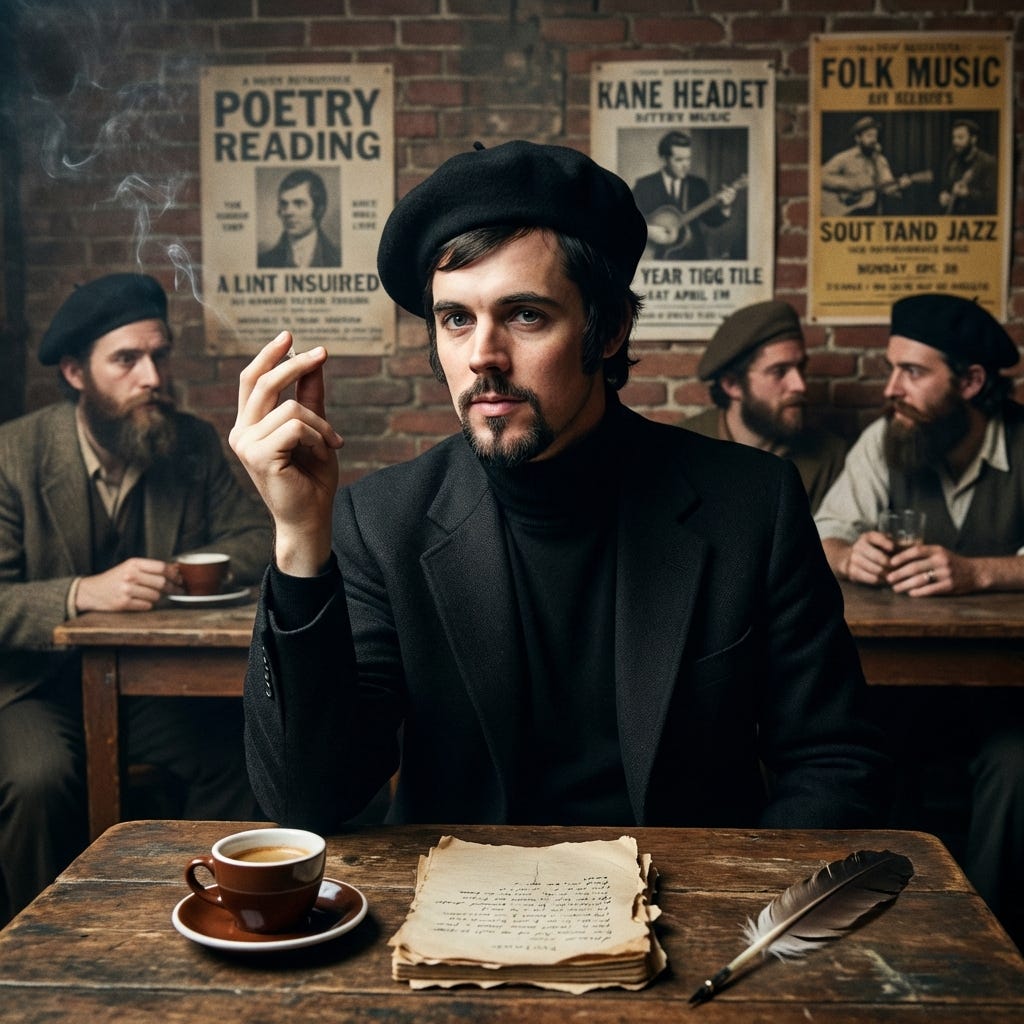
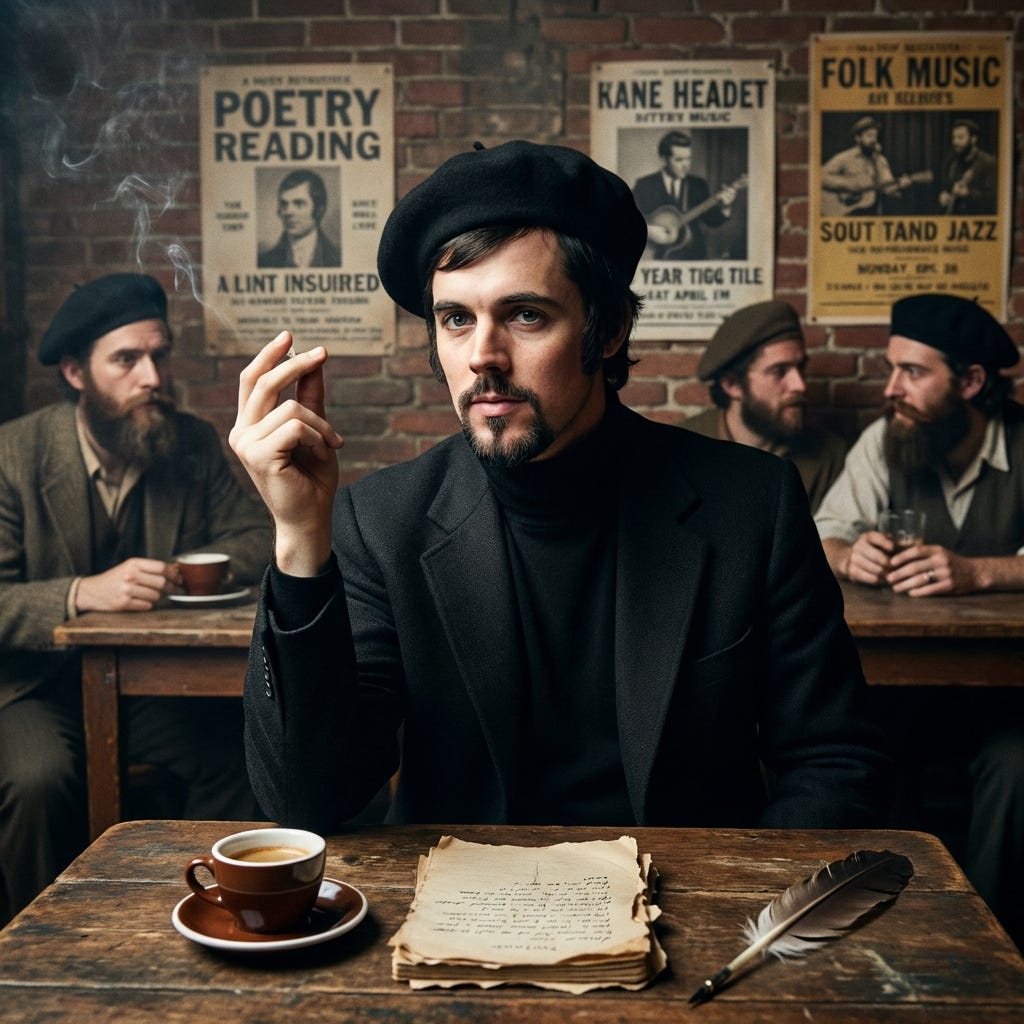
Robert Burns, if transported to 1950s America, might have joined the Beats around a smoky café table—singing folk verse while Kerouac riffed prose—united by rebellion, rhythm, and the sanctity of lived experience.
I think our bard could have been in sympathy with Jack in this expression:
“The only people for me are the mad ones, the ones who are mad to live, mad to talk, mad to be saved, desirous of everything at the same time, the ones who never yawn or say a commonplace thing, but burn, burn, burn, like fabulous yellow roman candles exploding like spiders across the stars and in the middle you see the blue centerlight pop and everybody goes "Awww!”
Here is poem I wrote for Jack Kerouac:
I listened to Jack scat poetry for the umpteenth time, And felt the tear in his soul, where his saintly Gerard Always made him remember his death, a good practice. But in industrial plastic post-existential America, devoid Of Hesychastic, noetic penetration into silent unknowing, A Catholic boy had to sit with Buddha, just to get past The endless parade of imaginary contemplation, Exteriorized religious rules and batty theology To try and find the connection beyond the starry Dynamo, Where you can feel the eternal uncreated in your bones.
The Athonite saints who glowed with uncreated light Felt eternity in their bones unto coloring them golden. Bones of eternity, bathed in grace and venerated, signs Of blessedness, the uncreated energy beyond mind or thought.
Jack’s prose saw the open gaze of natural light, The blue sky of perfect lost purity, a wakeful celebration Of every moment and note from the blown horn of creation. But I know that his bones ached for the uncreated, for that Connection denied to him by Barlaam and Buddha.
No wonder he went looking for kicks. No wonder his liver couldn’t take the American Way That people used to shut up their brain.
And here is the last stanza of a too-long poem I wrote for my teacher, Allen Ginsberg, commemorating the 50th anniversary of his poem “Howl,” which has just passed its 60th anniversary.
You left, muttering Zen death poems. I spent far too long howling spontaneous prose in the company of dying bohemians. So thanks for everything, but I finally discovered the truth for myself: Spontaneity is the lover of discipline, I am as allergic to revolutions as I am to hay flowers and sometimes, the second thought is best.
“So in America when the sun goes down and I sit on the old broken-down river pier watching the long, long skies over New Jersey and sense all that raw land that rolls in one unbelievable huge bulge over to the West Coast, and all that road going, and all the people dreaming in the immensity of it, and in Iowa I know by now the children must be crying in the land where they let the children cry, and tonight the stars'll be out, and don't you know that God is Pooh Bear? the evening star must be drooping and shedding her sparkler dims on the prairie, which is just before the coming of complete night that blesses the earth, darkens all the rivers, cups the peaks and folds the final shore in, and nobody, nobody knows what's going to happen to anybody besides the forlorn rags of growing old, I think of Dean Moriarty, I even think of Old Dean Moriarty the father we never found, I think of Dean Moriarty."

Comments
Nothing yet. Say the first thing.
Sign in to join the conversation.