
A man named John Smyrl whose real name is John Simmons (more about why, later) began to sail the ship of his awareness and island hop those islands in his sea of mental fog that represented the acquisition of learning and "life experiences". Many of these experiences were unsettling to the equilibrium that is considered desirable for what is called "normal life". As he moved further from the settled culture of his childhood into realms that were strange and unrecognizable to most people of his upbringing, he recognized that these experiences had, in many ways, made him an outlier or outsider to said "normal life".
At the same time, he acquired what he thought were valuable treasures in the various places that his awareness traveled. Now he, in advanced age, has come to the end of most of his wide-ranging journeys and is taking stock of the treasures and experiences he has acquired. Since such treasures cannot be transferred or shared via the normal routes of financial wires and other methods reserved for physical treasures, he will attempt to convey them instead with what is usually called "writing".
This substack is the place where these treasures will be deposited. The reader must beware that the treasures will inevitably be buried among other deposits of what might be called "flotsam, jetsam, or junk".
The format will often resemble a journal of the arts, consisting of essays, short stories, and pieces of longer fiction, art, poems, and other such artifacts. Many of the articles will be free, but I will also be serializing chapters of various books I am writing, and access to those will require a minimal sacrifice from the reader.
I write about what interests me: Machines, Music, Monasticism, and Everything in Between!
“For some use UNIX for the sake of the Kingdom”
10 PRINT “I’m watching you!"
20 GOTO 10
That was the first program I ever wrote on a TRS-80. I put it on any BASIC computer on display in any store where I found one. I had a TRS-80 Model 100 (Still do!), and connected to Compuserve and many BBSes. More advanced computing remained in the realm of futuristic and science fiction imagination.
These experiences did a few things for me. First of all, machines were mirrors of my own mind, except that they imposed logical order, whereas my mind was a land of misty uncertainties. My thoughts became more ordered as a result of interacting with machines. The file and folder metaphor became an organizing principle for my life. Secondly, except for the most initial experiences, my computers were networked (even at 300 baud!) almost immediately. Computers were a doorway to a larger world and communities of people. When I heard the phrase at Sun Microsystems that “The Network is the Computer”, it made sense immediately. I experienced the joy of community that was not based on immediate first physical impressions, nor the constraints of location, but on shared interests. Thirdly, I discovered the aesthetic joys of the range of creating I could do on a machine, whether programs or arts. Those joys continue to grow as possibilities grow.
Computer Science is also a philosophical realm with interesting implications. If you read my posts here, you will learn that I divide reality into everything that is computable and everything that is not, with the latter being the most important parts of life.
So I’ll be writing about computing and machines.
I grew up in a musical family. I played the clarinet through high school, when I abandoned it for the recorder (easier on the mouth) and the guitar. I have played piano on and off, with no particular skill, as the outdoor world lured me more than sitting down to practice.
My mother, who is 90 as I write this, has been playing the organ in the same church for 70 years! My father was the tenor soloist for as long as he lived and had a voice. I did some music in that church and other various ones, until my spiritual journeys took me away for a while.
I thought “it’s nice for them to be church musicians, but I’ll never do that”. Despite my resolve not to follow them into being a church musician, I have been an Orthodox Choir Director for over 20 years. My first love is still classical and church music/chant.
But being a wild child of folk, rock, punk and dance music, I am also a DJ, and working doing some recording in that realm as well. The Kliros (chanter stand) at my church has 4 stands for music, that turns from the center so that other stands can quickly be accessed. My DJ deck has turntables for DJ functions. I’m spinning tunes no matter what!
So I’ll be writing about music of many forms.
The first time I heard Gregorian chant, it blew me away. That was my initial awareness that time and space were different in a monastery. I had a crisis of faith in the Protestant world I grew up in (blame Henry VIII for chasing monasticism away), and so I entered a time of spiritual wandering, experiencing the monastic disciplines of Zen, Tibetan Buddhism, Roman Catholicism or Anglican varieties, Hassidic or Sufi practices, Vedanta, etc. All that wandering made me appreciate what these various traditions had or did not have. Having separated my spiritual search from all of the cultural or political baggage, I sensed that Christ at the core of faith was real, even if some of the particular expressions of it was not. So I continued to search for where I found faith being the most real. I sat with the Quakers for a year (my year of being a “fundaminimalist”), but eventually, one has to read history, remember the better monuments of Europe, and find the authentic thread of history. I read Catholic Monastics like Thomas Merton. Merton I read in backwards order, starting with the Asian Journals when I was at the Tibetan Naropa Institute in Boulder (Merton has met Chogyam Trungpa who founded Naropa). I ended with the 7 Story Mountain as I was talking to Anglican monastics.
Early on I had discovered the Philokalia, in a fairly miraculous way (more about that later), and had read “The Way of a Pilgrim”. I had visited some Orthodox churches, but I finally visited one that was in English, so I could see what was going on. I was floored by the experience, but not ready to do anything about it. But I found the bigraphy of Fr. Seraphim Rose, a former Buddhist and Beat, who had founded a monastery in Northern California. My mind was able to follow his journey, and I was at the same time, being beat over the head by a gentle forceful suggestion that I better pay attention to this. I’ve been Orthodox for nearly 30 years now. I attempted to enter a monastery, but my body, with its collection of health issues, wouldn’t have it. I instead applied myself to the study of “monastic technology“, and eventually became an Oblate - the closest I could come to being a monk.
I will write a lot about these topics and my journey in general.
Philosophy, especially Epistemology
Psychology
Medicine, especially Neuroendocrinology
What is called Symbolic Systems at Stanford University (which gets alternately labeled as Cognitive Science or Computation Linguistics) including:
Computer Science
Linguistics
Mathematics
Philosophy
Psychology
Statistics
This approach is meant to be broader than typical Cognitive Science, but I still like this configuration better:
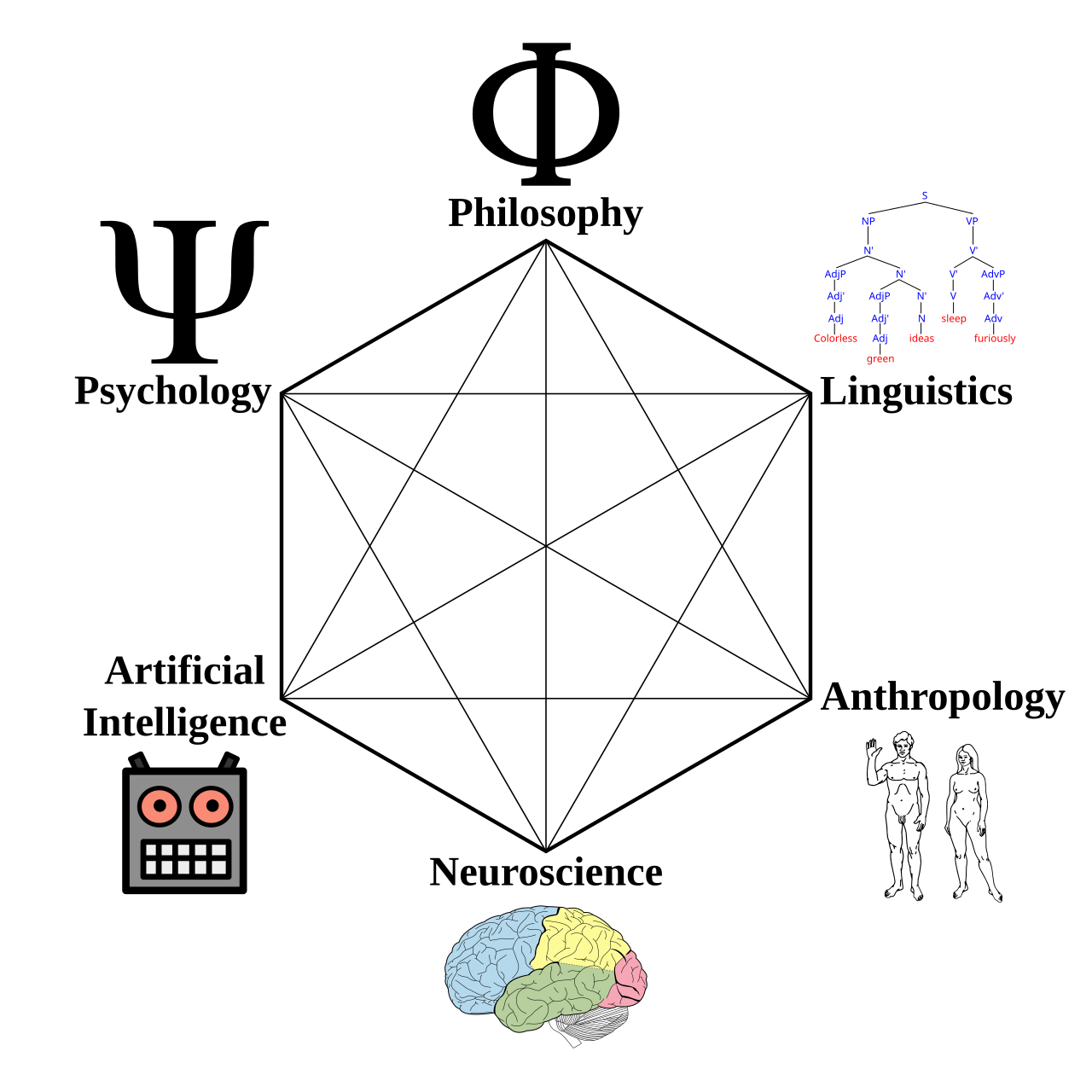
I also like the idea of the “Great Books” as a way of being instructed by great minds of the past in classical liberal arts and other topics. I can conceive of a scheme by which “Symbolic Systems” can function as a modern take on the classical Trivium and Quadrivium.
I am the principal at John Simmons HyperText, where I do marketing strategy, content marketing, websites, and various other types of support, consulting and add-on products. If you are involved in marketing and sales in any way, you owe it to yourself to get my checklist!.. I will no doubt be writing about different topics on doing business in Silicon Valley.
Literature, especially fiction, and poetry of various types
Art(s)
Theater and Film (expect questionable film reviews)
Technomadic concepts in Travel by Bike, RV, Boat, and Walking.
The martial arts, tea ceremony, and other disciplines of Wudang Mountain
No posts
Comments
Nothing yet. Say the first thing.
Sign in to join the conversation.