
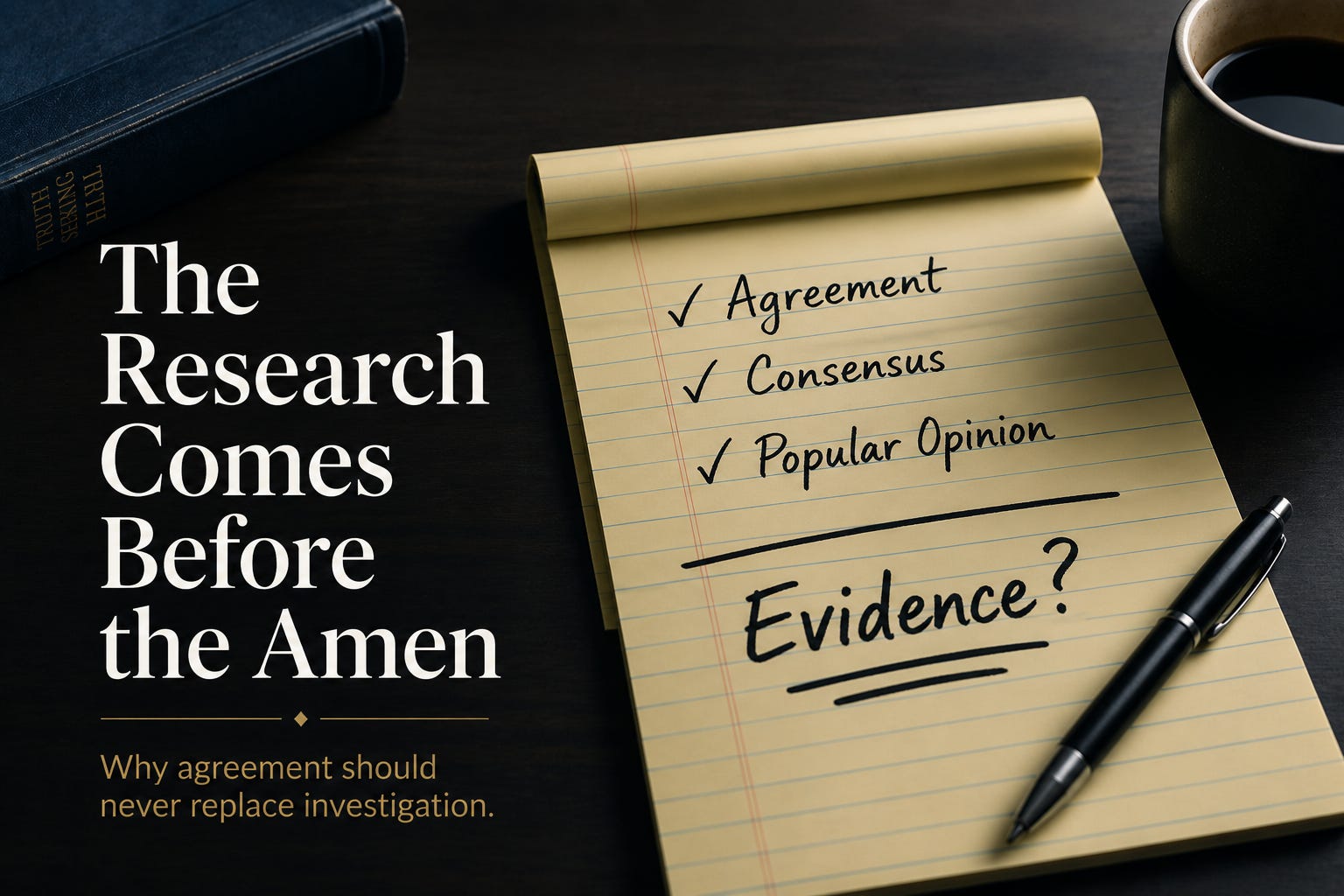
One of the challenges of living in the information age is that we are constantly being presented with conclusions.
Every day we are exposed to opinions, interpretations, headlines, social media posts, videos, podcasts, and articles that ask us—either explicitly or implicitly—to agree with something. Most of us would like to think that we carefully evaluate the information we consume before deciding whether it is true. In reality, agreement often happens much faster than investigation.
Sometimes a statement sounds reasonable. Sometimes it aligns with what we already believe. Sometimes it comes from a source we trust. Whatever the reason, we can find ourselves nodding in agreement before we have done the work necessary to determine whether that agreement is warranted.
I was reminded of this recently while reading a social media discussion involving a point of Greek grammar and its implications for a well-known theological debate. The discussion centered on whether a particular grammatical construction in Ephesians 4:11 supports a four-fold or five-fold ministry model.
The post was thoughtful, well presented, and initially struck me as persuasive. Because I am generally the kind of person who tries to bless what I can agree with, I responded favorably.
Then I did something that I should have done before responding.
I started researching.
As I read further, consulted additional sources, and looked at perspectives from scholars on both sides of the discussion, I discovered that the issue was far less settled than the original post suggested. What initially appeared to be a grammatical slam dunk became much less obvious the deeper I dug.
The issue wasn’t whether the person making the argument was sincere. The issue was that I had reached an agreement before I had completed my investigation.
So I deleted my comment.
Not because I had necessarily arrived at the opposite conclusion, but because I realized I had not done enough work to have a settled opinion in the first place. Opinions matter. When we fail to do our due diligence, we risk unintentionally leading others to conclusions that may not be as certain as we believe.
That experience stayed with me because it highlighted a much larger issue that extends far beyond theology.
The more I reflected on the situation, the more I realized that this is not merely a theological problem. It is a human problem.
We live in a culture where information arrives prepackaged with conclusions. Someone has already interpreted the data. Someone has already decided what it means. Someone has already told us what position we should take. In many cases, all that remains for us to do is decide whether we agree.
Over time, that can create a subtle but dangerous habit.
We begin trusting summaries more than sources.
We begin to trust confidence more than evidence.
We begin trusting popularity more than truth.
Before long, we find ourselves borrowing certainty rather than developing understanding.
I don’t believe most people do this because they are lazy or intellectually dishonest. I think many of us are simply overwhelmed. There is more information available today than at any other point in human history, and no one has the capacity to investigate everything.
Yet that reality makes discernment more important, not less.
The question is not whether we can research everything. The question is whether we are willing to research what matters.
This becomes especially important when leadership enters the equation.
Leaders rarely influence only themselves. Whether we lead an organization, a ministry, a classroom, a business, a team, or a family, our conclusions often affect other people.
That means our responsibility extends beyond simply having opinions. We have a responsibility to examine the foundations upon which those opinions are built.
Some of the most costly mistakes in leadership occur because assumptions go unchallenged. A respected voice says something. Others repeat it. Eventually, the idea becomes accepted wisdom despite the fact that very few people have actually examined it for themselves.
The strongest leaders I know possess an interesting combination of confidence and curiosity.
They are willing to take positions.
But they are also willing to test those positions.
They understand that certainty and wisdom are not always the same thing.
As a seminary student, I have come to appreciate that some of the most meaningful discoveries occur when we move beyond surface-level answers and wrestle honestly with difficult questions.
Unfortunately, there can sometimes be a tendency within faith communities to view questioning as a threat to belief.
I would argue the opposite.
Truth has never been threatened by honest investigation.
If an idea is true, careful examination will eventually strengthen it.
If an idea is false, careful examination will eventually expose it.
Either way, truth benefits from scrutiny.
One of the reasons I appreciate serious biblical scholarship is that it often reveals complexity where popular discussions promise simplicity. That can feel uncomfortable at times, but discomfort is not always a sign that something is wrong. Sometimes it is simply evidence that we are moving beyond assumptions and into understanding.
When people hear the word resilience, they usually think of perseverance in the face of adversity.
That is certainly part of it.
But resilience also involves resisting intellectual shortcuts.
Resilient people learn how to sit with uncertainty long enough to gather evidence. They develop the discipline to pause before reacting and investigate before concluding. They understand that emotions, assumptions, and popular opinion can all influence perception. I'll be the first to admit that this tension can feel taut. Most of us prefer certainty. We like answers. We like closure. Yet learning to sit with uncertainty long enough to pursue truth is a skill, and one that can be built and strengthened with practice.
One of the most powerful questions a resilient person can ask is not, “What do I believe?”
It is, “What evidence would cause me to reconsider what I believe?”
That question requires humility.
It requires courage.
And it requires a genuine commitment to truth.
The lesson I carried away from this experience had very little to do with Greek grammar and everything to do with intellectual humility.
The goal of learning is not to prove ourselves right. The goal of learning is to discover what is true.
That requires patience. It requires curiosity. And occasionally, it requires enough humility to admit that our first reaction was premature.
In a world that rewards instant opinions and immediate conclusions, perhaps one of the most valuable habits we can develop is the willingness to investigate before we affirm.
Before we repost.
Before we comment.
Before we adopt someone else’s conclusion as our own.
Before the amen.
Because truth is rarely threatened by investigation.
More often than not, investigation is the pathway that leads us there.
What is a belief, opinion, or assumption that became more nuanced the deeper you investigated it? I'd enjoy hearing your perspective in the comments.
Thanks for reading The Positive Perspectives Blog! This post is public, so feel free to share it.
No posts
Comments
Nothing yet. Say the first thing.
Sign in to join the conversation.