
How American Presidents Tried to Warn Donald Trump
Special to Portside by Chris J. Magoc
Buried beneath Donald Trump’s catastrophic war of choice in Iran is a tale of five American presidents dating back 75 years whose decisions—with one notable exception—attempted to lead the United States toward some form of accommodation with Iran. Trump’s ignorance and contempt for history is a given. For the rest of us trying to understand the roots of the current crisis, a brief review of U.S.-Iran relations is essential.
In the spring of 1951, Iran’s democratically elected parliament, led by Prime Minister Dr. Mohammad Mosaddegh, moved to nationalize their country’s oil industry—then in the grip of the British-owned Anglo-Iranian Oil Company. Mosaddegh determined to end the AIOC’s exploitation and harness lucrative oil sales to advance Iran’s social and economic development.
TIME’s Man of the Year, 1951, Mohammad Mosaddegh
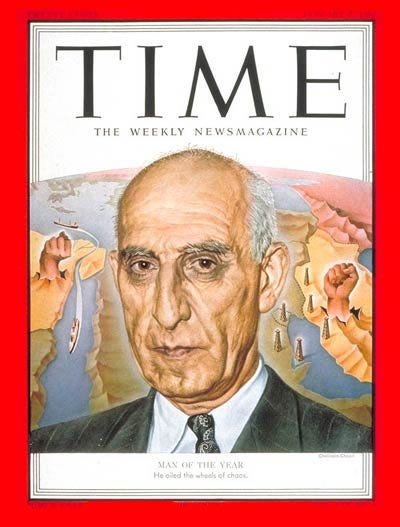
The British government proposed a coup of Mosaddegh’s government to be orchestrated by British intelligence and the U.S. Central Intelligence Agency. U.S. President Truman, despite having signed the law establishing the CIA, fiercely opposed the idea of the agency engaging in covert operations.
But the 1952 presidential election brought Dwight D. Eisenhower to the White House changed everything, setting in motion events that would change the U.S.-Iran relationship forever. Eisenhower brought Cold War zealots Allen and John Foster Dulles to head the CIA and State Department. Allen Dulles would unleash the CIA against perceived U.S. enemies around the globe. In March 1953, Dulles wired $1 million to CIA officers in Tehran with instructions to carry out Mosaddegh’s overthrow. Soon a storm of disinformation about Mosaddegh was painting him as a dangerous communist. Bags of cash went to journalists, members of the parliament and the military to buy their support for the coup. On August 19, Mosaddegh was deposed.
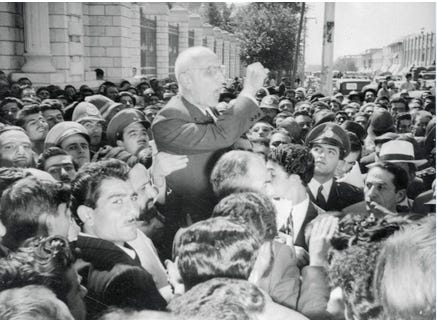
Prime Minister Mosaddegh addressing a crowd amid the coup of his government, summer 1953
Installed as the new leader was reliable U.S. ally, Shah Reza Pahlavi. Backed by U.S. weapons and a CIA-trained secret police, the SAVAK, the Shah’s despotic rule lasted a quarter-century. Iran become a strategically important outpost of operations for the growing U.S. military footprint in the Middle East, as well as a consortium of U.S. oil companies.
By 1977, the Shah held what Amnesty International called the worst human rights record in the world. Yet, the SAVAK’s use of torture and political assassination were indicators that the Shah’s grip on power had grown tenuous. The U.S. administration of Jimmy Carter, advancing a foreign policy the president declared to be grounded in human rights, advised Tehran that continued U.S. arms sales were contingent on liberal reform of its government.
Meanwhile, the theocratic rhetoric and promises of Ayatollah Ruhollah Khomeini, then living in exile, was winning Iranian hearts and minds. On January 16, 1979, the Shah was toppled by the Islamic Revolution, a stunning event the CIA never saw coming. The fall of the well-armed Shah was simply unthinkable.
As Jimmy Carter declared events in the country to be “in the hands of the Iranian people,” the Ayatollah returned to Tehran from exile, greeted by millions of supporters. Facing the specter of a longstanding American ally forced from power, President Carter was pressed about whether America might have done something to “save” the Iranian dictator:
“Certainly we have no desire nor ability to intrude massive forces into Iran or any other country to determine the outcome of domestic political issues. This is something that we have no intention of ever doing in another country. We tried this once in Vietnam. It didn’t work well, as you know.”
Following Carter’s decision to admit the Shah to the U.S. for cancer treatment, on November 4, 1979 Iranian revolutionary students seized the American embassy in Tehran, triggering the 444-day “Hostage Crisis.” The holding of 52 Americans consolidated Khomeini’s power and strengthened the move toward a hardline theocracy. At home, Americans grew enraged at ignominious images of burning U.S. flags and shouts of “Death to the Great Satan” as their shackled countrymen were paraded through the streets of Tehran. In Iran, the “Conquest of the American Spy Den” served as comeuppance for the 1953 coup and preemptive defense against any attempt to reverse the revolution.
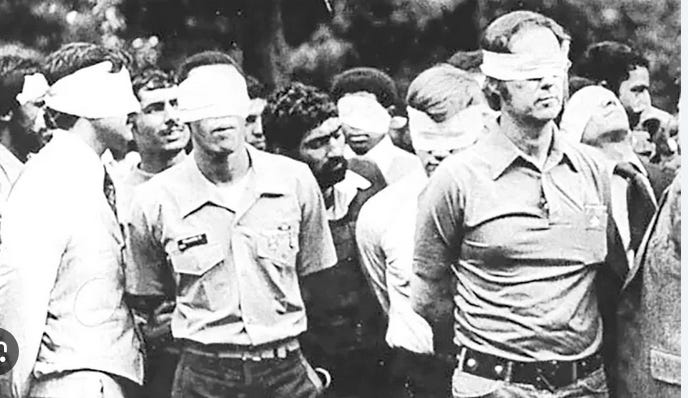
Images of blindfolded, shackled hostages enraged Americans in the streets of Tehran, November 1979
With some critics blaming President Carter for abandoning “our friend,” an embattled White House resisted Tehran’s demands for the Shah’s extradition and the return of Iranian assets from U.S. banks. Facing an uphill reelection fight, in April 1980 Carter authorized an ill-fated rescue mission that ended with eight dead Americans and the resignation of his Secretary of State. That disastrous low point of the Carter presidency was followed by the Shah’s death in July and the invasion of Iran by Saddam Hussein’s Iraq. These events expedited negotiations that ultimately ended with the hostages being freed, in exchange for a U.S. pledge to return frozen Iranian assets—and to respect the nation’s sovereignty.
Although relations remained antagonistic at best over the next 47 years, the United States held to that pledge. Restraint prevailed even for George W. Bush, whose neoconservative administration launched the Iraq war in March 2003. Within weeks of the invasion, “MISSION ACCOMPLISHED” delusions were fueling neoconservative fantasies of an Iran operation that could advance their larger project of American military dominion over the entire Middle East. Coincident with these events were the increasingly insistent warnings of Israeli Prime Minister Benjamin Netanyahu of an “imminent” nuclear-armed Iran. Yet the Bush administration, already exposed for having lied about “WMD” in Iraq, had enough sense to know that war in Iran would likely be far more challenging than the Iraq conflict, which was already devolving into a calamitous misadventure.
Negotiated over an 18-month period by the Obama administration and signed by Iran, the U.S., China, Russia, France, and the United Kingdom—the 2015 multilateral Joint Comprehensive Plan of Action (JCPOA) aimed to prevent Iran from ever securing a nuclear weapon. The JCPOA restricted Iran’s ability to enrich uranium for 15 years, required intensive inspections of Iranian facilities, limited its ability to produced advanced uranium-enriched centrifuges necessary for the production of a weapon, and included snapback provisions in the event of violations—all in exchange for the lifting of sanctions against Iran. It was hailed as an historic achievement when it took effect in 2016. The agreement was working—until 2018 when Donald Trump tore it up.
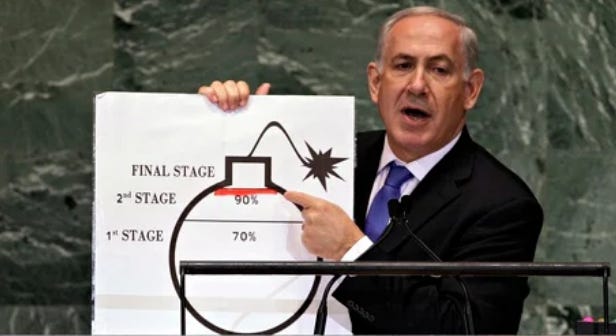
Benjamin ‘Bibi’ Netanyahu’s warnings of an “imminent” nuclear weapon in Iran go back 30 years
Bibi Netanyahu understood Joe Biden well enough to know he could not pressure him into joint military action against Iran, no matter the frequency or volume of his perpetual warnings of a nuclear-armed Iran. A seasoned foreign policy expert, President Biden read the intelligence daily. And he was no pushover—even when the Israeli Prime Minister spoke to the GOP-controlled Congress in an attempt to humiliate him into war with Iran. Even as Netanyahu sought his cooperation in a counterstrike against Iran for their drone and missile attack on Israel in April 2024—a response to an Israeli airstrike that killed an Iranian general. Biden was rightly concerned that an Israeli-U.S. military response could lead to a wider war bearing catastrophic consequences for the region and for Americans. Indeed.
Then came the return of Donald Trump. It cannot be forgotten that the suddenness of war on February 28 came after the president’s diplomatic emissaries—a real estate tycoon and his son-in-law—abruptly terminated discussions with Iran that would have given Trump more favorable uranium-enrichment terms than Barack Obama had achieved in the JCPOA. The current president demonstrated yet again not just his petulance and ignorance of modern Iran and its history, but his utter hostility to the attributes that guided U.S. policy with Iran in our best moments: Harry Truman’s restraint, Jimmy Carter’s commitment to democracy and human rights, Barack Obama’s patient diplomacy, Joe Biden’s prescient wisdom.
Why now, after a 75-year history steeped in hostility crowned by 40 days of hellacious bombing and genocidal threats of annihilation, would Iran ever trust the United States again?
Chris J. Magoc is Professor Emeritus of History from Mercyhurst University in Erie, Pennsylvania. His most recent book is A Progressive History of American Democracy Since 1945: American Dreams, Hard Realities (2022).
.
No posts
Comments
Nothing yet. Say the first thing.
Sign in to join the conversation.