
Ben Shapiro titled his August 11 essay “The Cardinal Sin That Shattered America’s Trust” and gave it the subtitle, “Data still doesn’t lie.” On that much we agree. Data do not lie. They can, however, be asked a narrow question and then conscripted into answering a much broader one. They can be averaged across people who are biologically unlike one another, stripped of inconvenient subgroup results, interpreted through a design changed after investigators have seen the findings, or cited as though a study of one product settled every question about an entire class of products. The data remain where they were. The overclaim belongs to the person speaking for them.
Shapiro’s overclaim could hardly have been more categorical: “There is no data, none, that links vaccines to autism.” He used that assertion to dismiss President Trump’s suggestion that reducing or spacing childhood vaccinations would reduce autism. Trump’s prediction was not established by the evidence Shapiro reviewed. If the president presented a schedule change as a demonstrated way to reduce autism, he ran ahead of the science. Shapiro then ran just as far in the opposite direction and called the distance certainty.
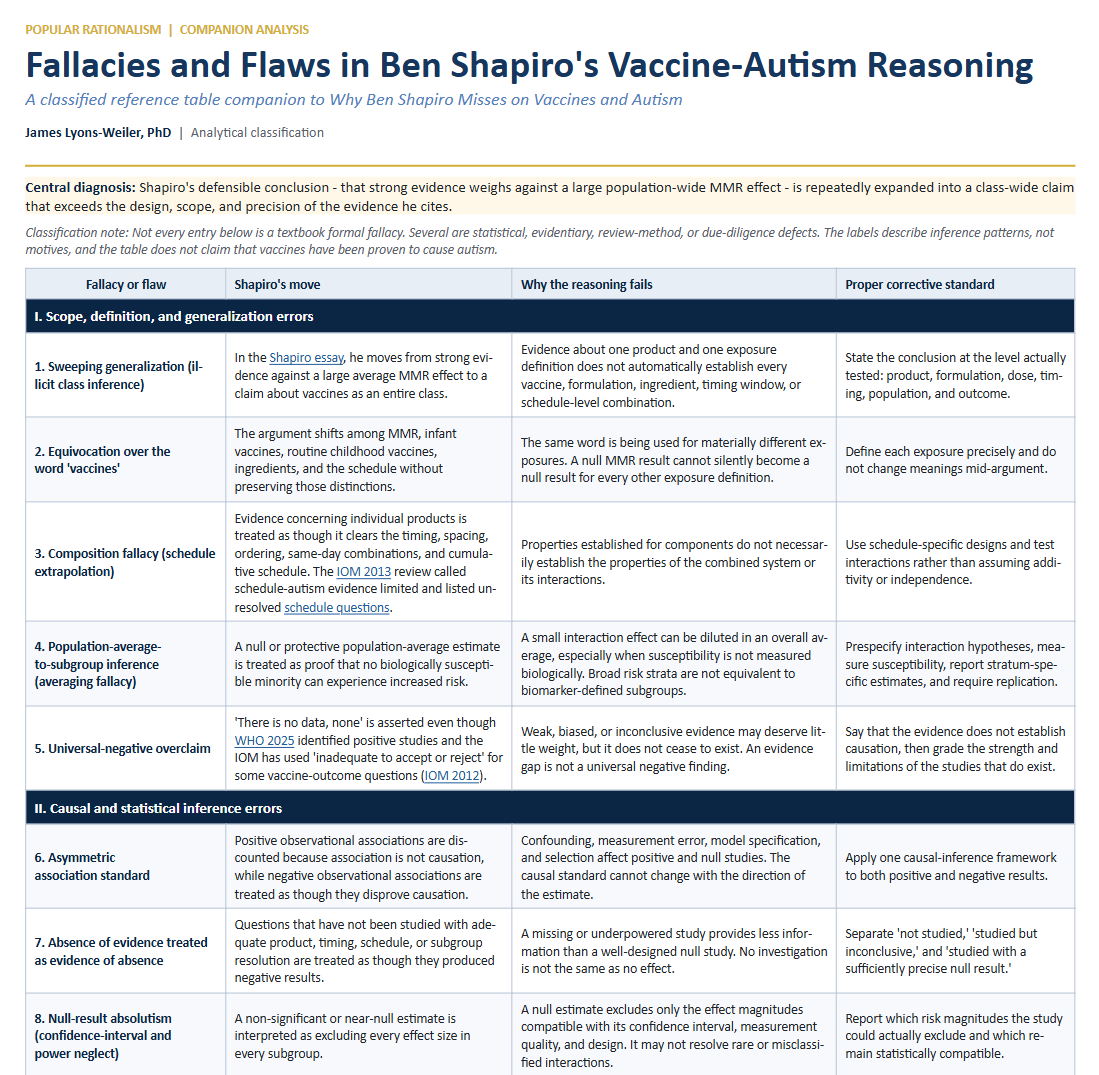
That is the problem with Shapiro’s handling of the evidence. He did not merely say that the strongest studies weigh against a large average association between MMR vaccination and autism. That would have been defensible. He said there were no data linking vaccines to autism, treated MMR as interchangeable with every vaccine and the entire schedule, substituted a prevalence-by-severity study that contained no vaccine-exposure variable, repeated the prosecution’s account of Andrew Wakefield without examining the defense, and ignored both the William Thompson record and the basic problem of susceptible subgroups. He then turned his own incomplete review into a lecture about scientific integrity.

No one has proposed that their child developed autism after eating cheese. But hundred and thousands and tens of thousands of parents have observed their child change their developmental trajectory after vaccination. So Ben’s correlations do to equal causation argument misses the initial source of the hypothesis: real-world, empirical observation. I dare Ben to spend two days with moms and hear their stories. I dare him to watch Vaxxed and Vaxxed II, and spend a third day explaining his understanding. Perhaps reading this article alone will help him recognize is logical shortcomings.
No serious person is claiming that the average vaccinated child develops autism. I am certainly not making that claim. Vaccines prevent infections, some of which can kill, disable, or injure developing brains. The existence of those benefits does not establish that every vaccine is incapable of contributing to neurodevelopmental injury in every child under every set of biological conditions. Population benefit, individual adverse events, and causal contribution to a heterogeneous diagnosis are separate questions.
Autism is not a single molecular disease with one cause. It is a diagnostic category containing different developmental histories, genetic liabilities, metabolic states, immune phenotypes, levels of function, comorbidities, and likely causal paths. This is not a “complexity” obfuscation point; I’ve spend years studying the literature and have the receipts on plausible mechanisms. The scientifically serious question is whether a particular exposure, formulation, ingredient, combination, or timing window can contribute to a particular autism phenotype in a biologically susceptible minority. Shapiro answered a different question: whether vaccination produces a large average increase in autism across broad populations. When studies did not find that large average increase, he treated the result as proof that no susceptible subgroup could exist.
That inference does not follow. If an exposure raises risk in a small group but has no effect in most people, the population average can dilute the signal. A very large sample helps with statistical power, but it does not repair exposure misclassification, poorly chosen time windows, outcome heterogeneity, post hoc subgroup decisions, or the failure to measure the biology that defines susceptibility. Family history is useful, but “has an older autistic sibling” is not a complete biological definition of mitochondrial impairment, impaired toxicant handling, ER-stress susceptibility, immune dysregulation, or any other proposed pathway.
This does not mean subgroup hypotheses are automatically true. It means they must be specified, tested, replicated, and subjected to interaction analysis. A subgroup claim invented after looking at the data deserves skepticism. A subgroup signal that survives a prespecified analysis deserves investigation. The cure for a difficult causal question is better design, not the declaration that heterogeneity has been averaged out of existence.
There is substantial evidence against a large population-level MMR effect, and a fair appraisal should say so plainly, but with strong caveats. The 2019 Danish cohort led by Anders Hviid followed 657,461 children and reported an adjusted hazard ratio of 0.93, with a 95 percent confidence interval of 0.85 to 1.02. The investigators also examined several broad risk strata and found no increased MMR-associated autism risk. The study strongly weighs against MMR as a major population-wide cause. It’s flawed in many ways (as I reported), but fine: It tests the wrong hypothesis.
A 2015 study of 95,727 children found no increased autism risk after MMR vaccination among children with or without an older sibling diagnosed with autism. A 2014 meta-analysis combining cohort and case-control evidence likewise found no association between vaccination and autism or autism spectrum disorder. In 2025, the World Health Organization’s vaccine-safety committee reviewed 31 primary studies published since 2010. Twenty, including the studies judged most methodologically rigorous, found no association; eleven reported possible associations, but WHO judged them to have serious methodological problems and a high risk of bias.
In 2012 IOM had looked at 22 and rejected 17 as flawed and reported that 4/5 they left in their consideration were underpowered. They accepted the negative result anyway. Similarly, WHO therefore was flawed in the reaffirmation of its conclusion that the evidence does not support a causal link.
Institute of Medicine’s 2012 report, Adverse Effects of Vaccines: Evidence and Causality, specifically Chapter 4, “Measles, Mumps, and Rubella Vaccine,” and Conclusion 4.8.
The report’s exact accounting is:
It reviewed 22 epidemiological studies concerning MMR and autism.
It excluded 12 because they used passive-surveillance data without an unvaccinated comparison group or ecological comparisons without individual-level data.
It excluded another 5 controlled studies for what it called “very serious methodological limitations.”
That left 5 publications contributing to the evidence.
One of those—Farrington et al. (2001)—was a reanalysis of the same 357-case population used by Taylor et al. (1999). Consequently, the IOM described its conclusion as resting on four independent studies/data sets.
It then concluded: “The evidence favors rejection of a causal relationship between MMR vaccine and autism.” Official IOM chapter
The 2012 IOM review located 22 MMR–autism epidemiological studies, excluded 17 from its evidentiary weighting, and based its high-confidence conclusion on five publications representing only four independent data sets—one population-scale cohort, one substantial case-control study, one much smaller study with serious limitations, and one 357-case data set reported twice.
Is this “strong evidence”?
These findings matter. While they make a large average causal effect of MMR implausible and sharply constrain any defensible hypothesis, detailed understanding of the studies show they could not have detected an association even it one was present. They also do not establish that every vaccine has been tested against autism, that the childhood schedule as a whole has been tested in every relevant way, that every timing question has been answered, or that every biologically defined subgroup has been examined with enough power and measurement accuracy to exclude a clinically meaningful risk.
The Institute of Medicine made these distinctions more carefully than Shapiro did. Its 2004 review concluded that the epidemiological evidence favored rejection of a causal relationship between MMR and autism. The same report explained why its framework had no category called “establishes no causal relationship”: proving universal absence is not equivalent to showing that the balance of evidence weighs against a proposed relationship. In 2012, when the Institute reviewed DTaP-containing vaccines and autism, it found that the epidemiological evidence was insufficient or absent and concluded that the evidence was inadequate to accept or reject causation. That is neither proof of harm nor proof of safety. It is an evidence gap.
I apologize for the repetition, but I think it’s important: Over that time period, they had to reject 17/22 studies, and lean heavily on negative results from underpowered (too small to detect) studies.
Ben: Is this strongest evidence?
The Institute’s 2013 review of the childhood schedule was equally explicit. It found that evidence concerning autism and the overall immunization schedule was limited in both quantity and quality. The report discussed questions involving timing, spacing, same-day combinations, ordering, interactions with health conditions, and cumulative measures of vaccine components. It also recommended research methods capable of examining potentially susceptible groups. If the whole question had already been answered, those recommendations would have been incoherent.
The final word from the IOM is that susceptible subgroups should be sought and studied. That has never happened.
The CDC’s current autism page now states that studies have not ruled out the possibility that infant vaccines contribute to autism and calls for study of mechanisms and potential causal links. That page has been politically contested, and an agency webpage is not scientific proof. It does, however, make Shapiro’s class-wide statement especially difficult to defend. Even the agency at the center of the dispute now distinguishes the evidence concerning MMR and thimerosal from the incompletely studied question of infant vaccines as a whole.
Shapiro’s reasoning depends on an asymmetry that appears constantly in vaccine-safety rhetoric. When a study reports a positive association, we are correctly reminded that association does not prove causation. Confounding, selection, measurement error, reverse causation, multiple testing, and chance can produce a signal. When a study reports no association, however, the same people often promote that result as proof that causation is impossible, especially when the studies are analyzed over and over to produce a null result. I am putting my reputation and neck on the line to say plainly: I believe Ben has been duped into citing fraudulent and mis-aimed science.
Even without analysis-to-result (which we know has been used over and over), let me explain how causal inference works. A positive association is evidence whose causal weight depends on design, timing, consistency, dose response, bias, biological coherence, and replication. A null association is evidence that the study did not detect an effect under its definitions, measurements, population, model, and statistical resolution. Strong, repeated null results can make a proposed effect increasingly unlikely, and the MMR literature has done exactly that, but only for a large average effect. Yet no observational study can convert “not detected here” into “cannot occur in any child or subgroup of susceptible children through any pathway.”
This matters because nearly all of the evidence Shapiro invokes is observational association research. Randomizing children to the full recommended schedule, an alternative schedule, or no vaccination for years of autism follow-up would create ethical and practical problems, and the Institute of Medicine advised against such a trial. Observational studies are therefore indispensable. Shapiro cannot dismiss positive observational findings because they are “only associations” while treating negative observational findings as causal absolution. The standard has to be the same in both directions.
Association does not test cauasility. Again, the wrong type of study.
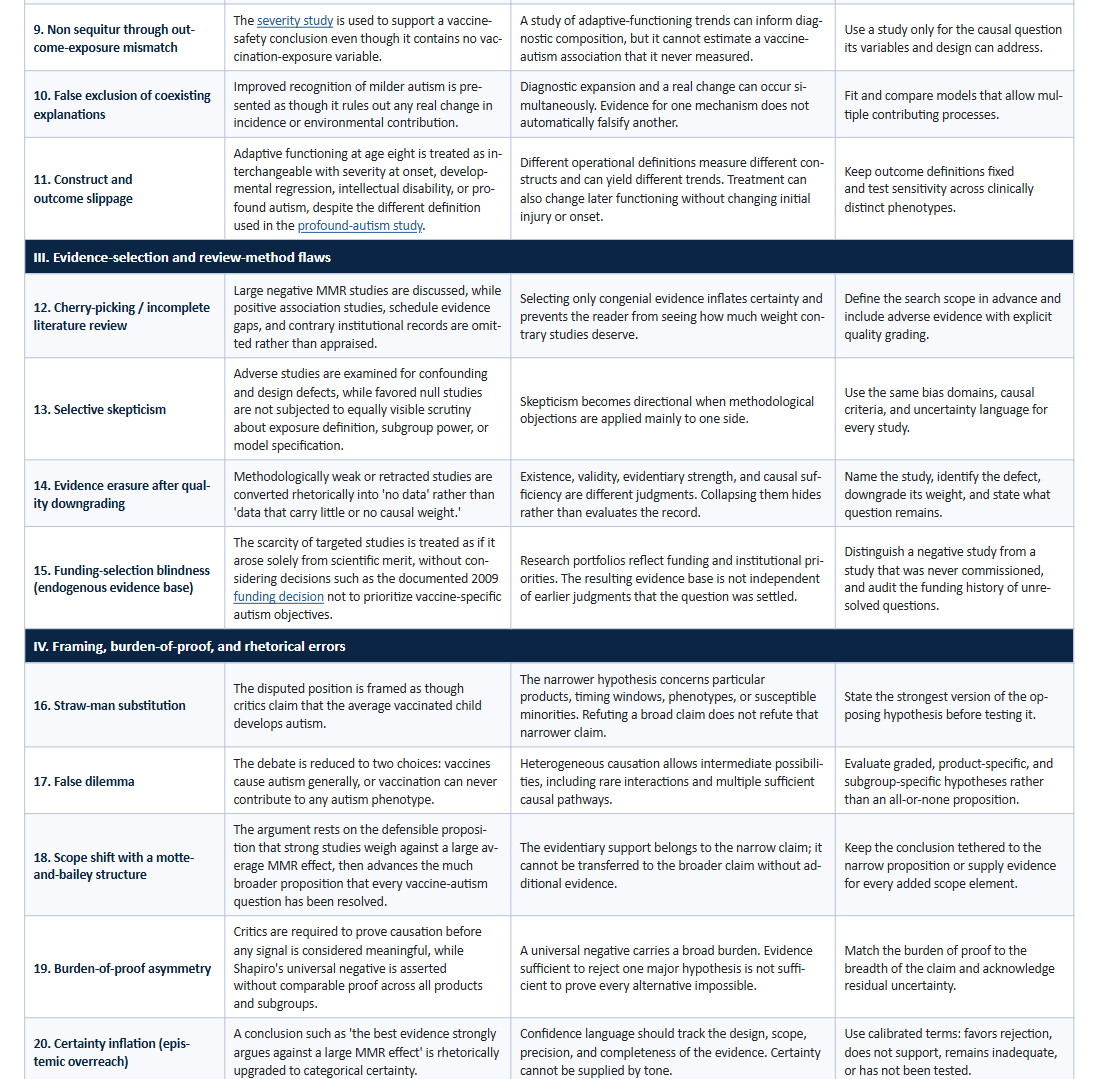
Shapiro tried to explain rising autism prevalence by pointing to a 2026 paper on adaptive functioning. The paper found that diagnosed autism with mild, borderline, or no significant adaptive challenges increased between 2000 and 2016, while the estimate for moderate-to-profound adaptive challenges declined slightly from 1.5 to 1.2 per 1,000 children. The authors wrote that the trend could reflect improved identification of milder autism and possibly greater access to therapies that improved functioning. Their paper is useful for understanding changes in the population being identified. It contains no analysis of vaccine exposure.
It therefore cannot carry the causal weight Shapiro placed on it. Diagnostic expansion and a real increase are not mutually exclusive. Changes in ascertainment can operate alongside changes in environmental risk. But were doctors in the 1950s, 1960s, 1970s, and 1980s so bad they could not see that a child could not speak at age 3, 4, 5, 6, 7, and 8? Pediatricians do not do diagnosis anyway: speech language pathologists do. Adaptive functioning can also improve with treatment, making severity at age eight an imperfect proxy for severity at onset or for the number of children who experienced developmental regression. A different CDC-network analysis, using a different definition of profound autism, estimated that profound-autism prevalence rose from 2.68 per 1,000 in 2000 to 4.59 per 1,000 in 2016. That does not automatically invalidate the adaptive-functioning study; it shows why definitions and denominators must be examined before a commentator turns one severity trend into a complete explanation of autism prevalence.
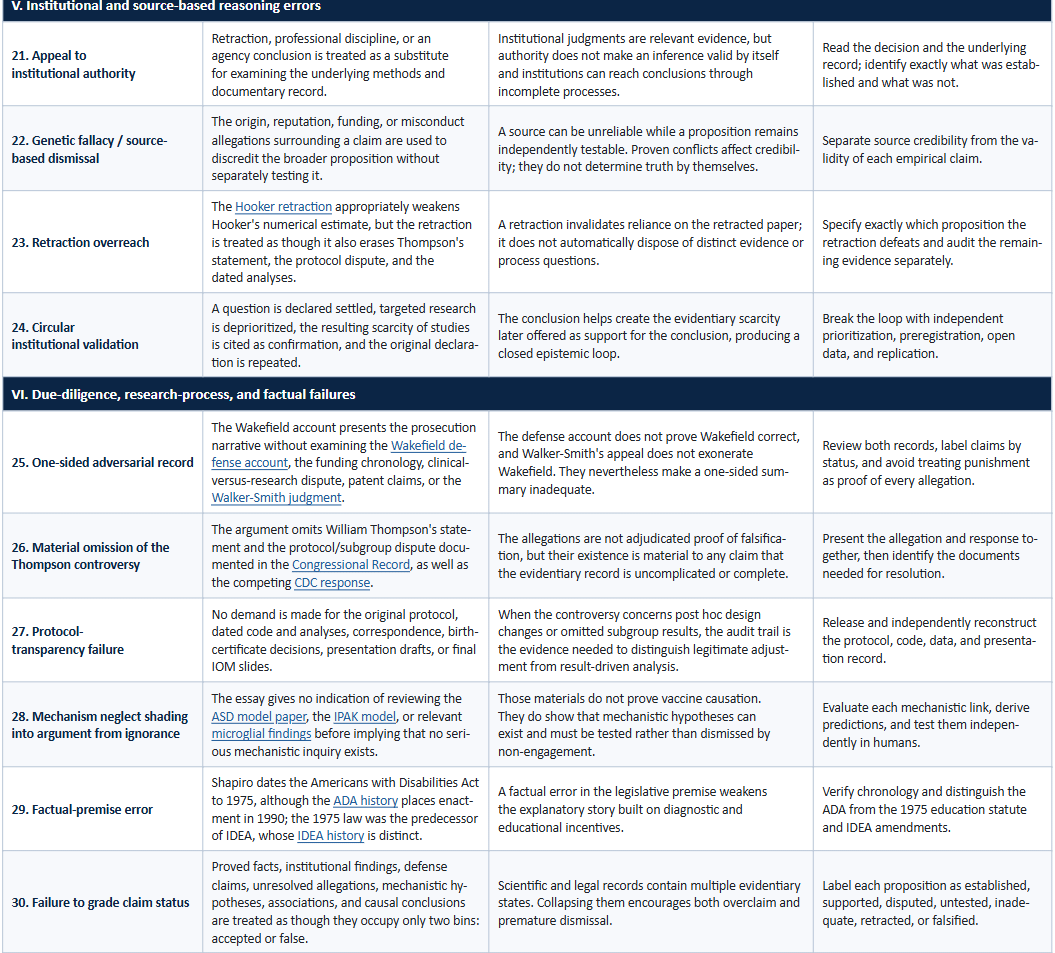
Shapiro compounded the problem with an avoidable factual error. He dated the Americans with Disabilities Act to 1975. The ADA was enacted in 1990. Congress passed the Education for All Handicapped Children Act in 1975; the law was renamed the Individuals with Disabilities Education Act in 1990, when autism and traumatic brain injury were added as disability categories. Unless he had an unstated reason for that reference, Shapiro may have blended those events together, but a thesis built around legislative incentives ought to get the legislation right if not.
Shapiro’s Wakefield account contains important truths. The 1998 Lancet report was a case series of twelve children. Parent-reported timing could generate a hypothesis but could not establish causation. The article itself did not prove an MMR-autism association, and it is true that The Lancet later retracted it. Large subsequent studies did not support a broad MMR-autism relationship. Anyone presenting the case series as decisive causal proof would be overstating it. My friend and colleague, Dr. Andrew Wakefield would agree.
Wakefield’s hypothesis was that something was going on with GI issues following MMR vaccine in children with autism. If Ben had read the study, he would have seen that the pilot study in fact, it never claimed, or even proposed that vaccines might be involved as a causal factor in autism.
Shapiro nevertheless repeated the institutional case as though no adversarial record existed. Before presenting Wakefield as the origin and embodiment of the entire question, he should have examined the chronology of the litigation funding, the dispute over whether the children’s procedures were clinical investigations or research, the referral histories, the patent claims, the General Medical Council record, and the defense offered by Wakefield and his supporters. Mary Holland’s account argues that the litigation grant concerned a later project, that the Lancet children were investigated for clinical reasons, that referrals did not occur as the prosecution alleged, and that the relevant patent was held by the hospital and concerned a therapeutic product rather than a competing preventive measles vaccine. Those are defense claims, not established facts, and they should be checked against the underlying documents. Due diligence means reading them before rejecting them.
Ben should know that it was clear at the time that the reason why Wakefield was Wakefield was the fear that parents might refuse vaccines for their child if it was acknowledged that vaccines might cause autism.
Is that reason? Logic? Does that lead to knowledge? Or does the denialist agenda lead to an autism epidemic, altering the lives of millions of children and their families?
The 2012 High Court judgment in the appeal of Wakefield’s coauthor John Walker-Smith makes the duty to pay attention to the reasoning used unavoidable. The court found that the General Medical Council panel’s conclusion rested on “inadequate and superficial reasoning” and, in a number of instances, wrong conclusions. It quashed both the finding of serious professional misconduct and the sanction of erasure. The judgment does not exonerate Wakefield, who did not pursue the same appeal, and it does not validate an MMR-autism hypothesis. It does establish that a material part of the disciplinary narrative failed under judicial scrutiny.
I am not asking Shapiro to believe Wakefield. I am asking him to do what he demands of journalists examining Anthony Fauci: read the adverse record, separate proved findings from accusations, and stop treating institutional punishment as a substitute for evaluating evidence.
Shapiro also ignored the most serious unresolved research-integrity controversy involving a CDC MMR study. William Thompson was a coauthor of the CDC’s 2004 Pediatrics paper on age at first MMR vaccination and autism. In a 2014 statement issued through counsel, Thompson said that the authors had “omitted statistically significant information,” that the omitted analysis suggested increased risk among African American males vaccinated before 36 months, and that he believed the final study protocol had not been followed. In the same statement, he said vaccines save lives, advised no parent to avoid vaccination, and judged vaccine benefits to outweigh the risks. His position was not the cartoon Shapiro’s narrative requires.
The Congressional Record contains a longer account attributed to Thompson. It says the team had finalized an analysis plan in advance, that a race effect appeared in the sample not restricted to children with Georgia birth certificates, that the authors decided not to report race effects, and that controversial findings were intentionally withheld. In recorded conversations with Brian Hooker, Thompson said he had run analyses for the group over several years and met with the coauthors weekly to discuss results. He described the restriction of the race analysis to the birth-certificate subgroup as the study’s biggest problem and said the team had deviated from what it had agreed to do. The transcript is publicly available.
CDC gave a substantive response. It said birth certificates supplied more reliable race information and covariates such as birth weight, maternal age, and education, which were unavailable for children without those certificates. CDC also argued that the association observed for vaccination between 24 and 36 months likely reflected immunization requirements for enrollment in preschool special-education programs. That response belongs in the record, just as Thompson’s objections do.
Hooker’s numerical reanalysis cannot settle the dispute. The journal retracted it after concerns about the statistical analysis, the validity of its conclusions, and undisclosed conflicts. That retraction weakens Hooker’s reported effect estimate and makes it unsuitable as proof of causation. It does not erase Thompson’s signed statement, the protocol question, or the existence of multiple dated analyses.
I have previously reported more detailed allegations: that Coleen Boyle directed changes to age-group definitions after the signal was known, that the valid-birth-certificate restriction removed many valid data points and reduced power, that the African American boys subgroup analysis was omitted by Frank DeStefano from his presentation to the Institute of Medicine, and that Thompson was placed on leave during the relevant period to prevent him from reporting the result after approaching then-CDC Director Judy Gerberding with the results. Those allegations have not been independently adjudicated in a process that released and tested the complete documentary record. But they come from Thompson himself. The answer is in the record straightforward: we have the original protocol, dated analysis files, code, correspondence, presentation drafts, final slides, and complete data and independent reconstruction corroborates. Shapiro did not examine the accusation, the defense, or the material needed to resolve it. He simply acted as if these events never happened.
Shapiro could have argued that studies reporting positive vaccine-autism associations are methodologically weak. Many are. A 2013 paper by Geier and colleagues reported an association between thimerosal-containing vaccine exposure and autism diagnoses, but its use of passive reporting and administrative data creates serious vulnerability to reporting bias, selection, and confounding. A 2014 study by Deisher and colleagues reported ecological correlations between autism-prevalence change points and vaccines manufactured with human fetal cell lines. Ecological timing cannot establish individual-level causation. Gallagher and Goodman reported higher odds of parent-reported autism among boys vaccinated against hepatitis B in the neonatal period, but that paper relied on a very small number of autism cases and was retracted in May 2026 after an independent statistical review identified major defects.
The proper conclusion is that these papers do not prove that vaccines cause autism. The improper conclusion is that they do not exist. WHO’s own 2025 review identified eleven studies reporting potential associations and then judged their evidentiary strength very low. That is an appraisal. “There is no data, none” is an erasure.
Weak positive studies can still perform a useful scientific function when they identify testable exposure windows, products, or subgroups for better research. Some will fail replication. Some signals will disappear when confounding is controlled. Others may survive. The point of science is to find out which is which. Declaring an empty record before reading the adverse evidence is not skepticism; it is message discipline.
Shapiro speaks as though the quantity of research reflects only the inherent merit of the question. Research agendas are also shaped by prior institutional judgments. In 2009, the Interagency Autism Coordinating Committee declined to approve two objectives that specifically called for additional vaccine research. The Autism Science Foundation celebrated the decision, while noting that vaccines could still be examined under broader environmental and susceptible-population initiatives. Its public explanation was candid: the committee believed vaccine research should no longer be called out because the question had already been resolved. The decision is part of the public record.
This creates a closed loop. Institutions declare the question settled, targeted funding contracts, the resulting scarcity of product-specific and subgroup-specific studies is then cited as evidence that no serious question remains, and commentators such as Shapiro announce that there are no data. A funding decision does not prove a suppressed causal relationship, but it can explain why the exact studies needed to test a narrowed hypothesis were never prioritized. Absence of funded investigation is not the same thing as a negative result.
Shapiro gives no indication that he searched for a serious mechanistic model. He could have found my 2016 book, The Environmental and Genetic Causes of Autism. He could have found my freely available 2018 review, “Autism Is an Acquired Cellular Detoxification Deficiency Syndrome with Heterogeneous Genetic Predisposition”, or the accompanying IPAK ASD causality model.
The model integrates heterogeneous genetic susceptibility with toxicant exposure, endoplasmic-reticulum stress, the unfolded-protein response, impaired mitochondrial function, disrupted cellular detoxification, cytokine signaling, neuroinflammation, chronic microglial activation (immunoneuroexcitotoxicity sensu Blaylock), and altered neuronal and glial survival leading to altered neurodevelopment. It proposes that different families can arrive at overlapping behavioral diagnoses through different combinations of susceptibility and exposure. It also generates testable predictions about developmental timing, gene-by-environment interaction, metabolic state, dose, recovery capacity, and biological markers.
The model is a hypothesis with many, many lines of corroborating evidence. It is not proof that any vaccine causes autism, and it should not be sold as such because science does not use the currency of proof. Its links must be tested in human studies with accurate exposure histories, relevant biomarkers, prespecified interaction terms, and independent replication. If we can prevent autism by finding who might be at highest risk due to vaccine effect, causality is moot.
Shapiro was entitled to challenge the model, identify an unsupported step, show that its predictions failed, or argue that another model better explains the observations. He did none of those things because he appears not to have read the paper, the model, or my book. He should call for the right studies, not rely on the absence of evidence.
The biological observations underlying this line of inquiry are not imaginary. Postmortem work has reported microglial activation and increased microglial density in autistic brain tissue. Other work found an active neuroinflammatory process involving microglia, astroglia, and cytokines, and PET imaging reported excessive microglial activation in multiple brain regions. These findings do not identify the initiating exposure. They do show that chronic neuroimmune activation is a legitimate part of autism biology and that mechanistic questions involving immune activation cannot be dismissed merely because an average epidemiological estimate is null.
A responsible review would say that large, well-designed studies strongly weigh against MMR as a major cause of autism across the general population. It would say that the evidence against a population-wide association is much stronger than the positive evidence offered by ecological studies, passive-reporting analyses, small cross-sectional studies, or retracted reanalyses. It would also say that not every vaccine and schedule-level hypothesis has been examined with equal quality, that some Institute of Medicine conclusions remain “inadequate to accept or reject,” that rare susceptible subgroups are difficult to define and study, and that the Thompson controversy warrants documentary resolution rather than ritual dismissal.
The next studies should be independent, preregistered, product-specific, and adequately powered for biologically defined interaction effects. They should use individual vaccination dates and formulations, co-administer vaccines and validated developmental phenotypes, clinically relevant exposure windows, sibling and within-family comparisons where appropriate, negative controls, active safety surveillance, and transparent code. Schedule research should examine cumulative and same-day exposure without pretending that antigen count is a complete proxy for every immunological or toxicological property. Any positive subgroup finding should be replicated before clinical claims are made. Any null finding should report confidence intervals capable of showing which risk magnitudes were actually excluded.
I would change my mind if repeated, independent studies used those methods and consistently excluded meaningful product-, timing-, and susceptibility-specific effects while the mechanistic predictions also failed. I would change my mind if, using family history, genetics, immune markers, and other lines of clinical and demographic evidence we failed to be able to prevent autism in the unvaccinated-at-risk compared to the vaccine-at-risk.
We need to move beyond association to prevention, and I invite skeptics and those interested to come to ipakedu.online where I will make my white paper, Beyond Association, available to members. That said, evidence favoring causation would require the opposite pattern: replicated associations in prespecified susceptible groups, temporality, dose or timing response, convergence across designs, and human mechanistic findings that connect exposure to the relevant developmental pathology. That is how a disputed hypothesis should be narrowed or rejected.
Shapiro offered none of this. He converted “the best evidence argues against a large average MMR effect” into “there is no data linking any vaccine to autism.” He converted a study of diagnostic severity into a vaccine-safety study without a vaccine variable. He repeated one side of the Wakefield case, ignored the Walker-Smith judgment, omitted William Thompson, overlooked positive studies instead of appraising their weaknesses, and never confronted the funding conditions that helped determine which questions were studied. He did not engage the mechanistic literature because he did not appear to know it existed.
The irony is hard to miss. Shapiro ended by blaming Anthony Fauci for destroying public faith in data. Yet Shapiro committed the same institutional offense in miniature: he began with the approved conclusion, selected the portion of the record that supported it, and treated confidence as a substitute for completeness. Data do not lie, but they do not answer questions they were never designed to test, and they cannot rescue a commentator who reads the verdict without reading the record.

Comments
Nothing yet. Say the first thing.
Sign in to join the conversation.