
Everywhere I turn, there’s a man with power abusing it. Both in the headlines and in history, the story of men with status using it to sexually abuse women is so trenchant that it’s becoming horrifyingly easy to tune it out. I look away from the dumpster fire of the world at the moment to reconsider some 1990s nostalgia from my youth, and there it is again: pure flaming garbage. I recount (very briefly) animator John Kricfalusi’s sexual abuse charges in this article, so if you’d like to skip it, I understand.
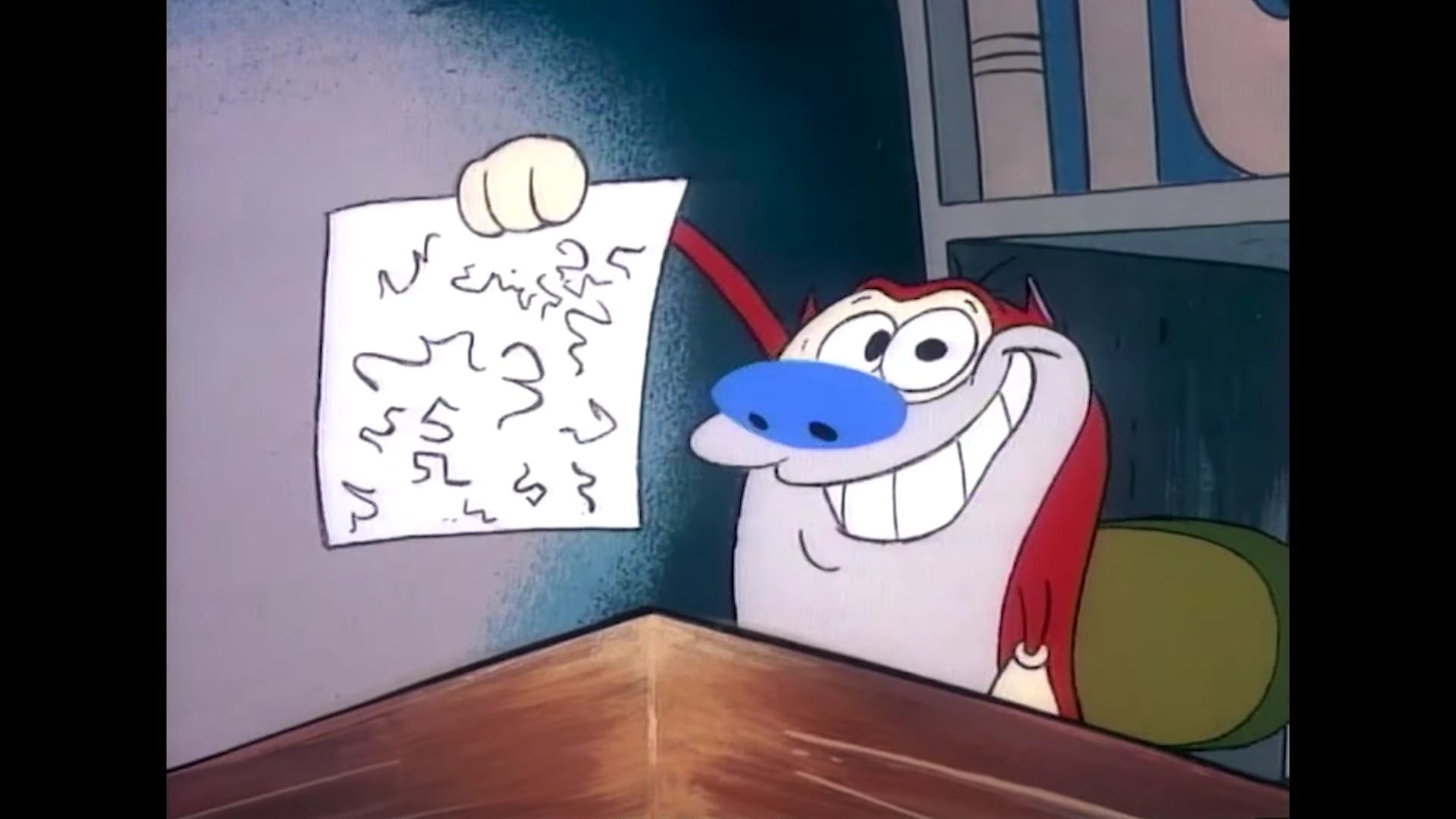
We were recently gifted with a Paramount+ subscription, which allowed me to rewatch episodes of one of the best and most bizarre cartoons of all time: Ren & Stimpy.
I started right at the beginning, just for fun. You may or may not remember (I certainly didn’t) that the pilot episode centers on a poem. Stimpy writes an ode to Gritty Kitty Kitty Litter in order to enter a contest to be on television. And he wins!
The whole thing is actually kind of funny and serves as a lukewarm commentary on the state of art. Stimpy wins a wholly unrealistic prize of $47 million and the chance to become a big-time celebrity on the strength of his mediocre poem. The joke, of course, is that poets make no money, and even the most famous among us are nowhere near celebrity status. Ha. Funny, right? RIGHT??
Here’s what Stimpy ends up writing, with some bad-faith assistance from Ren:
Text within this block will maintain its original spacing when published
Gritty Kitty ain’t so pretty,
but it’s really thick.
It fills my cat box oh so snug,
it always does the trick.
I like to rub it on my toe
and squish, and squish, and squish.
It ne’er offends my tender nose
like a smelly fish.
Its texture is a joy to me,
it’s just as smooth as silk.
It makes my little whiskers twitch—
it stays crunchy, even in milk.
I may not be the President, I may not be the Pope,
But as long as I have Gritty Kitty, I shall never mope!
The rhyme scheme is a little sus, but I’ll be damned… she’s a sonnet! A piece of shit sonnet.
Here are those ever-present stereotypes again:
Poetry has to rhyme
The rhyme is more important than the content
Using antiquated language makes you more poetic (“ne’er”)
The poem is a kind of closed system, allowing no other interpretations and nothing else inside. More accomplished odes are larger than the thing or idea that they’re praising, opening the door to meaning for those who don’t know or understand the object of the ode, feel differently, or have some other point of entry other than the thing being praised.
Stimpy’s ode to Gritty Kitty cat litter, by contrast, is only about Gritty Kitty Cat Litter. And that’s what capitalism does! A poem about a consumer product that is only about the product itself, as Stimpy’s is, is doomed to be worth only a chuckle and nothing more. For a poem to rise to the level of… poetry, you might say, it has to do more than laud the product or describe it.



Consider, for example, Matthew Olzmann’s “Mountain Dew Commercial Disguised as a Love Song.” The poem promises to be an ode or ad for Mountain Dew but is, of course, an ode to the speaker’s beloved. It’s astounding, a poem I never tire of, and that’s because it’s not really an ode to the thing it’s supposed to be an ode to. Even Keats’ “Ode to a Nightingale” isn’t really an ode to a bird: it’s an ode to immortality and imagination. Neruda’s “Ode to a Large Tuna in the Market”? Believe it or not: it’s about more than a shopping trip for fish.
But because this is a cartoon, Stimpy wins millions of dollars for his ode. If only.
My delight at rewatching the show as an adult has been tempered, however, with my (re)discovery of the Ren & Stimpy creator’s abusive past.
Series creator John Kricfalusi, who was fired from his own show after two seasons due to chronic failure to meet deadlines and the age-old “creative differences,” retreated from the animation world after his history of grooming teenage girls became public. Following the revelation that he had a 16-year-old girlfriend, Kricfalusi’s attorney responded by asking us all to feel very sorry for the poor guy:
The 1990s were a time of mental and emotional fragility for Mr. Kricfalusi, especially after losing Ren and Stimpy, his most prized creation. For a brief time, 25 years ago, he had a 16-year-old girlfriend. Over the years John struggled with what were eventually diagnosed mental illnesses in 2008. To that point, for nearly three decades he had relied primarily on alcohol to self-medicate. Since that time he has worked feverishly on his mental health issues, and has been successful in stabilizing his life over the last decade. This achievement has allowed John the opportunity to grow and mature in ways he’d never had a chance at before.
Ren & Stimpy, unfortunately, was not as compelling without Kricfalusi’s particular brand of weirdness, but it still ran for five seasons. The man himself retreated from the limelight but continued to work quietly, even creating artwork for Miley Cyrus on her Bangerz tour.
It’s a story as old as time: man achieves some sort of status and wealth and consequently uses it to exploit children. When this exploitation is discovered, cue the waterworks. Then the tale about the tarnished reputation standing alongside a career that still plods along. Louis C.K. comes to mind. So many, many other media men come to mind. So many men, in general.
I’d rather eat a mouthful of Gritty Kitty than listen to the non-apologies of famous men.
Write a poem that functions as an advertisement for a product that you despise. Rhyme or don’t, but ensure that the poem gives way to a kind of anger about something other than the product, in the end.
I’ve got some ideas about what that thing could be.
Comments
Nothing yet. Say the first thing.
Sign in to join the conversation.