
Poets on Film is a review series for biopics of poets. What can they teach us about poets, our ideas about who poets are, and ourselves? Read on to find out. Poets on Film is a semi-regular feature of PopPoetry, a poetry and pop culture Substack written by Caitlin Cowan. You can learn more about PopPoetry here. Check out the archive to see other TV shows, movies, and films whose intersections with poetry I’ve covered. If you like what you read and want it in your inbox, subscribe so you won’t miss a post!
Charles Bukowski is a divisive figure in the poetry world. I’ll just come right out and say it: That asshole you met in your college English survey who always made a big show of how worldly and “over it” he was while lowkey telegraphing his misogyny to every woman in the room? Bukowski is his favorite poet.
Some worship him, some roll their eyes. In this day and age, revering this guy’s work feels almost like a sin. And I expect that he would enjoy this facet of his legacy very much.
Bukowski was known for his hard drinking, his craggy face and demeanor, and the cigarette permanently dangling from his hand. He was an underground figure who worked a series of regular-guy jobs, including a long stint with the U. S. Postal Service. His early attempts at publication were slow-going, and he took a 10-year hiatus from poetry as a result, during which time he drank heavily and lived a peripatetic existence (great fodder for poems and novels, it turns out). But he just couldn’t quit writing, and when times were tough, as they often were, he turned to poetry again and again. The death of a longtime girlfriend ignited his real success as an author, and small literary magazines championed him in life and beyond his death, cementing his poetry of the fringe as real, bonafide literature. Bukowski made a career out of bringing outsider art inside.
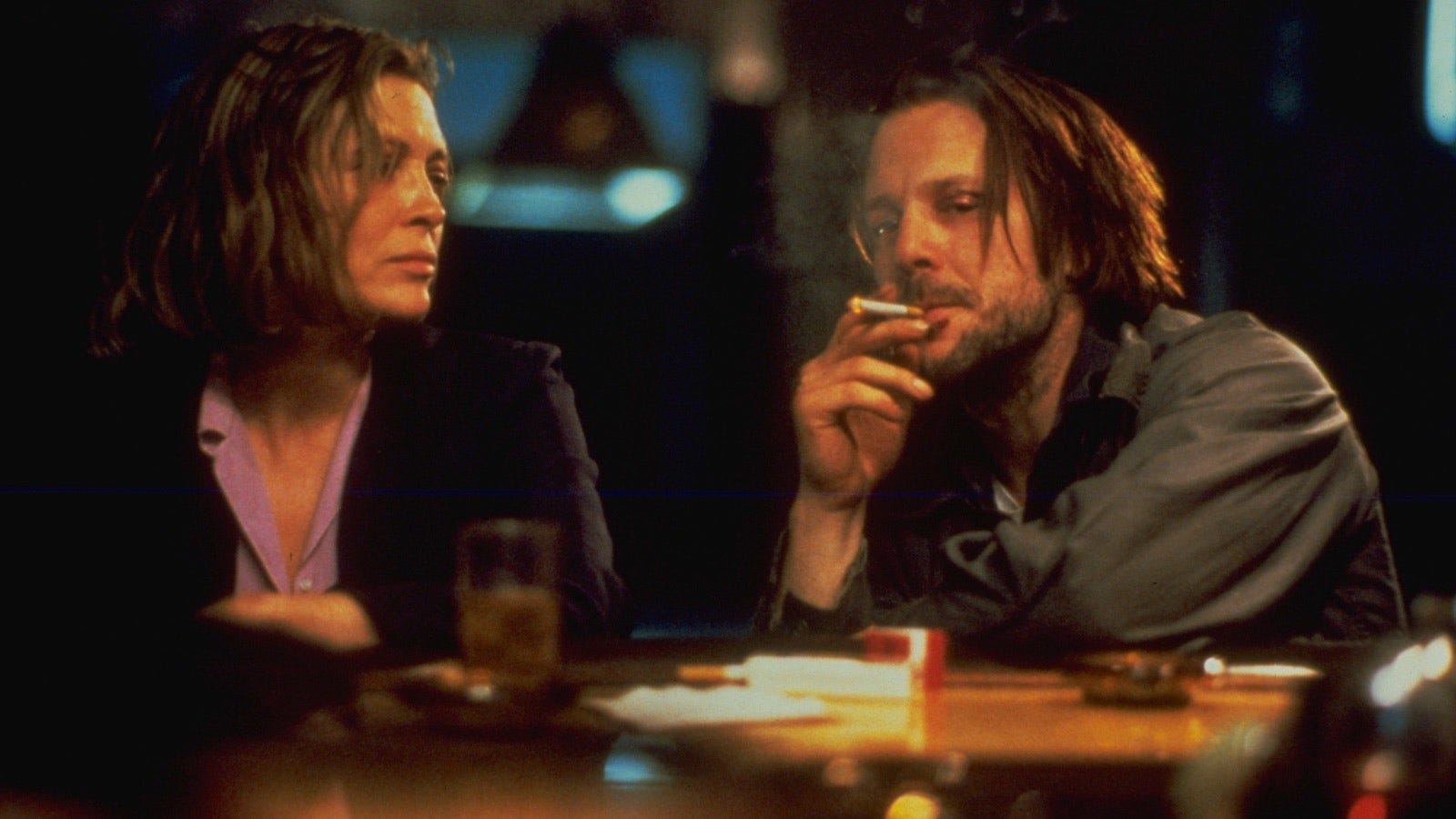
Barfly, a truly bizarre and often hilarious 1987 film centered on Bukowski’s alter ego, Henry Chinaski, borders on required viewing purely for its gritty masochism and exploration of the low life. But it’s not quite a biopic of a poet, strictly speaking, and it leans into a whole host of poet stereotypes that we may, or may not, have left behind.
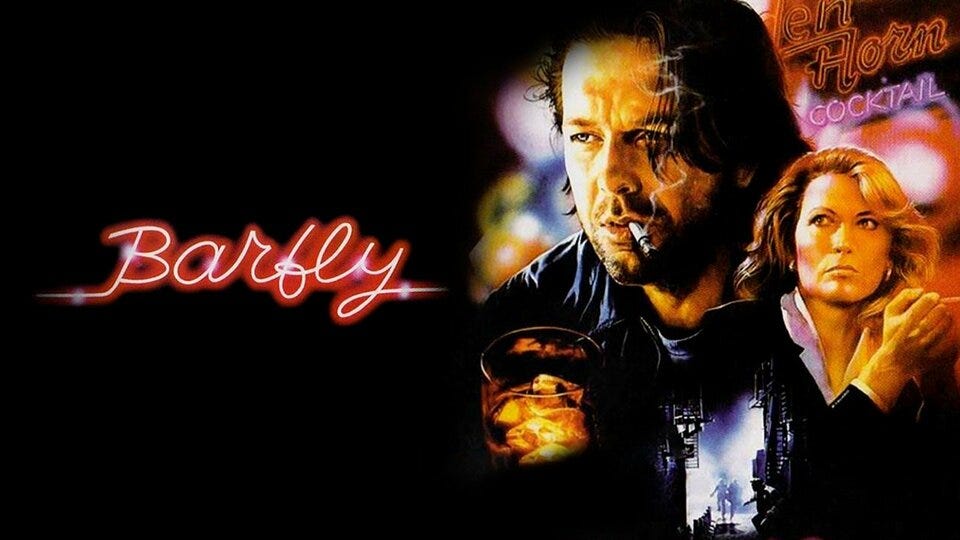
Henry, played memorably (if familiarly) by Mickey Rourke, is a bellicose, drunk writer who drifts from situation to situation trying to literally fight for dominance at his local watering hole and scratch up enough money to buy rounds for the house (and, of course, for himself). Faye Dunaway plays Wanda, what some might call a “kept woman” who latches on to Henry so the two can swirl down the drain in an alcoholic, codependent spiral. Henry gets a shot at publishing his poetry in the big leagues but ultimately turns it down because he doesn’t want to be caged by the trappings of the upper class.
This last part, where he rejects the “golden bars” offered by a beautiful literary agent who wants to sleep with him and give him lots of money, is your clue that this is a black comedy. But until this final act, it’s honestly a little hard to tell what the film wants to be. It’s dark and sad and kind of gross, and it’s not really very funny (except, I admit, for the scene in which Dunaway claims to be dying and the EMTs who attend her leave and just tell her she’s drunk and “fat,” and even that is kind of cringe-inducing).
Often called a “semi-autobiography,” Barfly and the associated Henry Chinaski properties blur the line between fact and fiction. Some outlets erroneously call Barfly an autobiography outright, but it’s more complex than that. Heinrich Karl Bukowski (1920–1994), born in the Weimar Republic, started going around as “Hank” as a bullied, acne-riddled schoolkid after being moved to California as a child. Heinrich Karl became Henry Charles, Henry became his alter ego, and Charles became his nom de plume.
Chinaski appears in five of Bukowski’s novels and is memorialized on screen in Barfly. But the alter ego and the man himself You might say that Chinaski is just Bukowski imagining himself in fictitious or lightly fictionalized situations, a creation in the zip code of autofiction but not exactly living next door.
After a while, Rourke’s line reads start to grate on you. He delivers every line with the same intonation and volume, both of which start high and then end low. I couldn’t quite put my finger on what it reminded me of, then my husband nailed it: Rourke’s Henry Chinaski sounds almost exactly like Snagglepuss.
Need a refresher?
Watch the video above, then watch Barfly and tell me Rourke isn’t (un?)consciously doing an impression of a cartoon puma who debuted on TV when the actor was 7 tender years old. The thing is, that’s kind of how Bukowski himself spoke. Consider, for example, this supercut of his interviews (hysterical, volume up):
However, Bukowski’s verbal tic has more to do with emphasis and volume, whereas Rourke also modulates the tone. Bukowski begins his utterances emphatically and loudly and finishes more softly and quietly. Rourke does the same, but also starts with a higher pitch, and the combination of the three is what puts one in mind of a certain rose-colored cat.
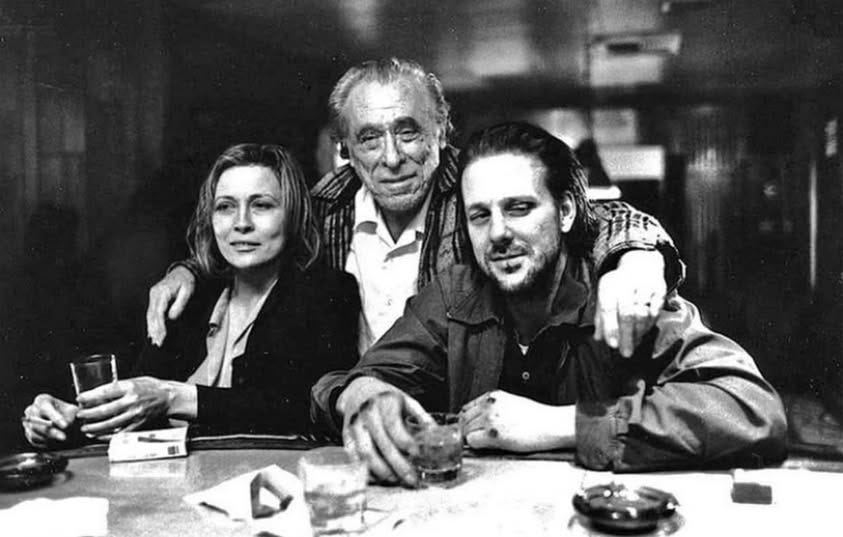
But all criticisms of the film have to go on hiatus so I can remind us all that Bukowski himself wrote the screenplay. And for a time, he even told media outlets that he enjoyed and thought highly of Rourke’s performance. Yikes!
There are certain broad-stroke similarities between Bukowski and the man who plays him, or plays a version of him, in Barfly. In his lifetime, the poet flip-flopped on his own views about the film, at first lauding and later deriding it and Rourke’s performance. Rourke ascended to the top of the Hollywood heap more than once, only to tumble down its facade in utter ignominy. In many of the clips above, Bukowski describes how much he dislikes people in general; Rourke famously thanked his dogs in an awards acceptance speech, noting that at times they were all he had. These two dudes deserve each other, truly. Total weirdsmobiles who apparently struggle to adapt and have deep misanthropic tendencies.
The result is a film that somehow competed for the Palme d’Or but seems utterly confused about what it is or should be. It feels like Rourke’s character is only a poet because Bukowski was a poet. If we didn’t get a few errant scenes of Rourke scribbling on some wrinkled sheets of paper to remind us, this guy could be anyone. The poetry, here, is ancillary to the lifestyle. And in some ways that’s how Bukowski’s poetry seems to me, as well.
For all my dissection of Rourke’s accent work in this film, I don’t want to kick a guy when he’s down, though: Rourke was recently evicted from his residence after falling behind on his rent to the tune of $60,000. He later turned down the proceeds raised on his behalf (more than $100,000) out of, I guess, pride. Woof.
He’s been famous for a long time, and has had a fascinating career. Darren Aronofsky crowned his career renaissance in 2008 when he cast him in The Wrestler, for which Rourke won a BAFTA and a Golden Globe. Today he’s 73 years old and reportedly studying Brazilian Jiu-Jitsu and posting his old mugshots on Instagram. He’s a maniac, and in some ways the only choice to play Bukowski on screen. I truly wish him the best.
Only a film whose screenplay was written by the guy it’s kind of sort of about could go the way Barfly does. Today, any biopic would critique Bukowski or any fictionalization of the writer himself. For all his cool underground grit, Bukowski was fond of reducing women to their parts. Take, for example, “a 340 dollar horse and a hundred dollar whore,” a poem that elapses primarily at a racetrack:
Text within this block will maintain its original spacing when published
...he won like he was mad as hell
and he wasn’t even tired,
and the biggest blonde of all
all ass and breast, hardly anything else
went to the payoff window with me.
that night I couldn’t destroy her
although the springs shot sparks
and they pounded on the walls.
later she sat there in her slip
drinking Old Grandad
and she said
what’s a guy like you doing
living in a dump like this?
and I said
I’m a poet
and she threw back her beautiful head and laughed.
you? you... a poet?
I guess you’re right, I said, I guess you’re right.
but still she looked good to me, she still looked good,
and all thanks to an ugly horse
who wrote this poem.
You can shout “a product of his time!” and you will be correct, but there’s something truly brazen about Bukowski’s most chauvinist and misogynist works.
But today, I don’t think we need more of this guy in the world. His poetry seems born out of his personal pain and doesn’t speak easily to anyone who isn’t as disaffected as he is. It’s well-crafted and often funny, but it feels like it takes something from you instead of giving you something.
Bukowski wasn’t just some drunk or some womanizer. All human beings are complex. He was tough as hell: his father beat him three times per week and he later said it helped him as a writer because he became accustomed to “undeserved pain.” Jesus!
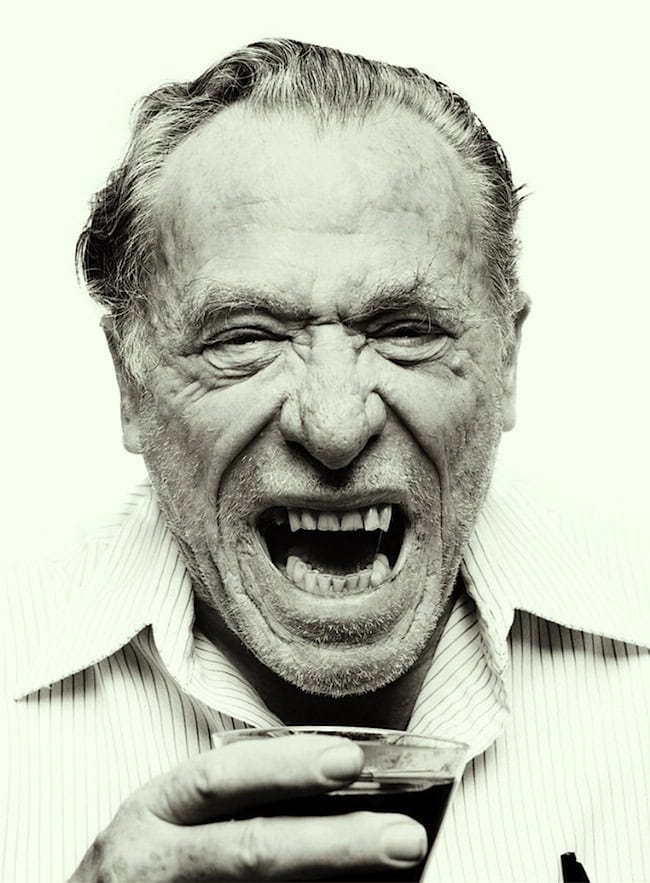
For such a rough-and-tumble figure, Bukowski has name recognition even among people who don’t read poetry. His reputation as a hard-living, hard-drinking outsider is a stereotype that he partly helped to create. Los Angeles dives wear the “Bukowski drank here” badge like a jewel.
In 1987, the stereotype of a poet as a drunk outsider was more accepted than it is today I think. Right?
I guess the message, for me, is not all poets. For a long time, I, too, thought that poets had to be intoxicated fringe-dwellers, and I was just a toddler when Barfly premiered. Am I sitting here sipping on an adult beverage as I write this? Indeed. But that has more to do with the fact that sometimes I get out of the house sans kids and hole up somewhere to write. My days of hard drinking in service of getting at the edge, the “truth” or whatever, are long over. The truth is everywhere, including in the suburbs on a Saturday morning Costco run. You young poets who are reading this: rest assured that you can be whoever you are and still write poetry.
Maybe the stereotype is dead and I just don’t know it yet. What do you think? Does the “poet” identity still come with alcoholic, low-life baggage? Let me know how you feel in the comments.
Cheer’s, y’all. Drink responsibly.
Comments
Nothing yet. Say the first thing.
Sign in to join the conversation.