
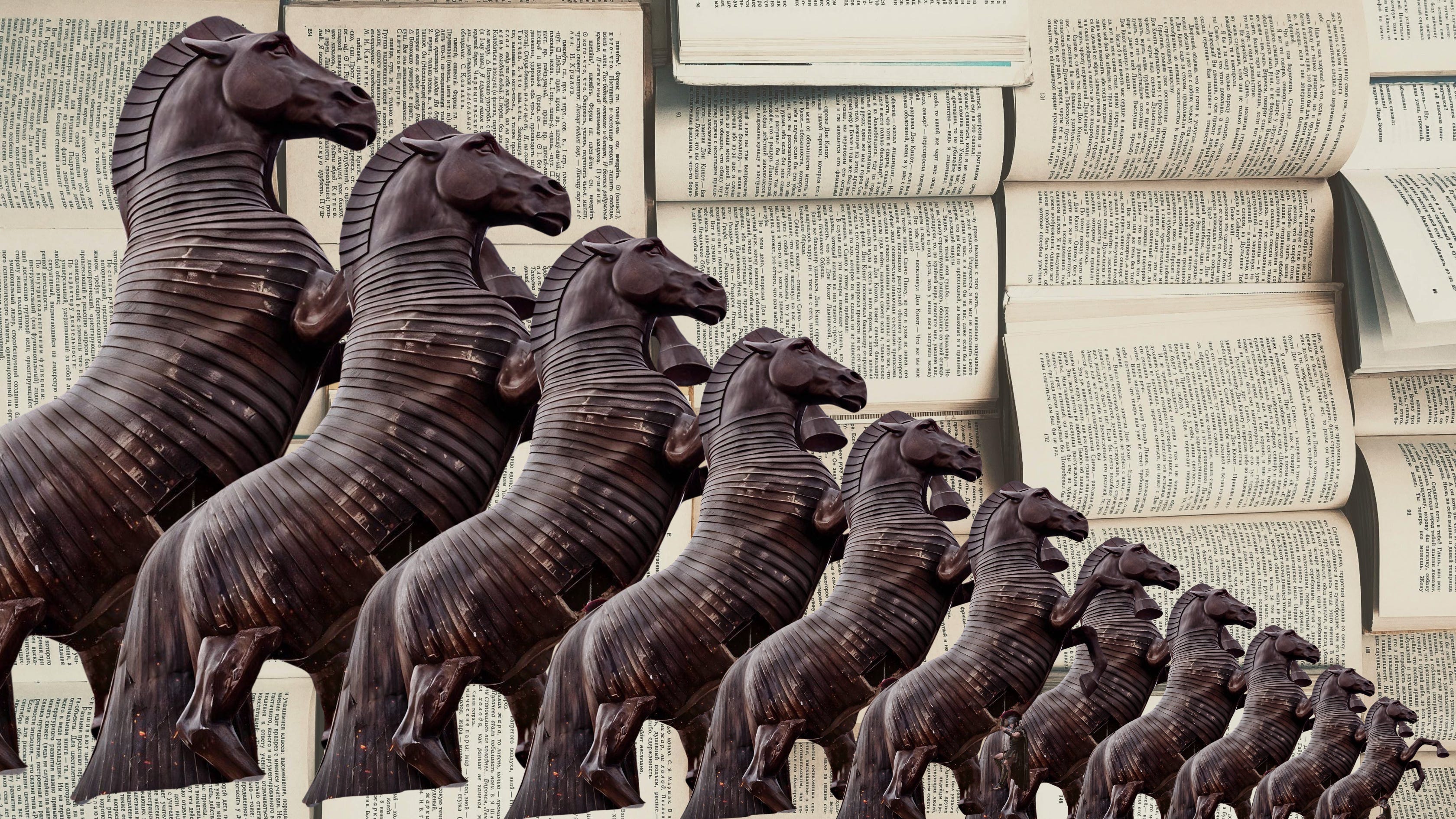
Here we are: the final installment of PopPoetry’s Epic Summer Odyssey. We looked back at silver screen adaptations of Homer’s famous poem all summer long in anticipation of Christopher Nolan’s latest film. Check out the archive of these posts here.
At long last, here’s the review: I loved it. But that’s conflicting for me.
Part of the reason it took me longer than expected to come back with this post is that I wanted to think hard about what it meant to me that I enjoyed the experience, even for all the film’s shortcomings. As it turns out, in that time there has been some discourse.
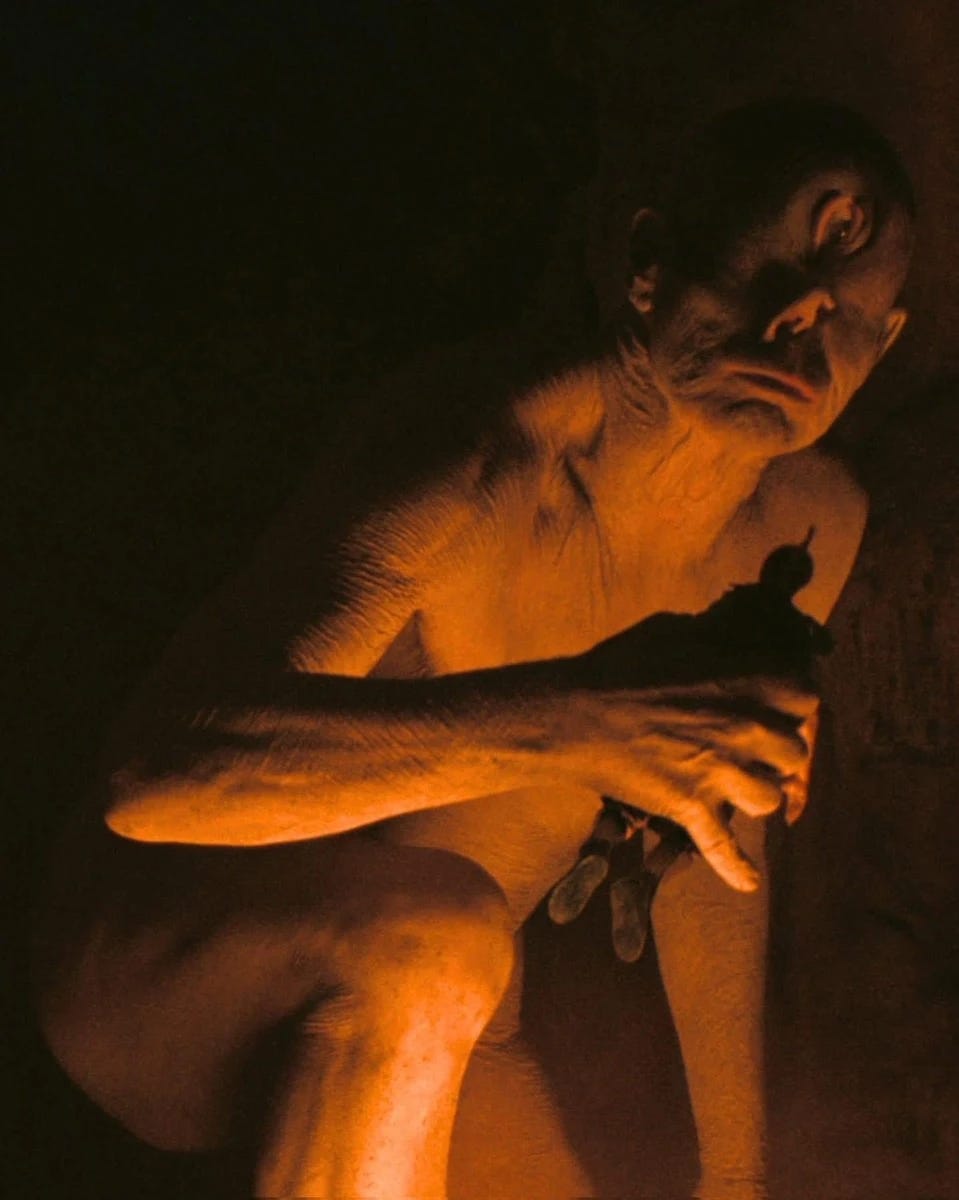
I have to say, I had the time of my life in the three hours I was under the spell of the film. It was exciting, thoughtfully shot, and by far the most complete and deep screen adaptation of The Odyssey. Matt Damon was damn good, John Leguizamo as the loyal and cunning swineherd Eumaeus was an unexpected delight, and Elliot Page shone bright as Sinon, particularly in the chilling and masterfully shot underworld scene.
Does it match the power and achievement of the poem? No, of course not. And nothing can.
The film has its problems and its own preoccupations. As much as it includes, it’s still an abridgment of a 12,000-line poem. Adaptations, like translations, have a certain sovereignty because they can’t (and indeed, shouldn’t) attempt to simply “be” the source material. We can judge them against their sources in some ways, but we must ultimately judge them on their own merits. Nolan has his own vision of Homer’s epic, for better or for worse, and his own vision, as it turns out, of poetry.
*Spoilers for the film ahead*
Nolan was obviously deeply influenced by Emily Wilson’s translation of the poem. Wilson focuses deeply on the extent to which The Odyssey is a story about guests and hosts, about the consequences of our treatment of strangers, and about the sanctity of entering someone’s home. What Nolan’s characters refer to as “Zeus’s Law” is an ancient Greek custom of hospitality called xenia.
Wilson explains its significance in the introduction to her translation:
Hospitality is important in all human cultures… What is distinctive about the customs surrounding hospitality in this culture is that elite men who have entered one another’s homes and have been entertained appropriately are understood to have created a bond of “guest-friendship” (xenia) between their households that will continue into future generations. Guest-friendship is different from philia, the friendship, affection, love, and loyalty that connects a person to his or her family members and neighborhood friends. It is created not by proximity and kinship, but by a set of behaviors that crate bonds between people who are geographically distant from each other… It is the means by which unrelated elite families can connect to one another as equals, without having to fight for dominance…When xenia is absent or is abused, violence follows.
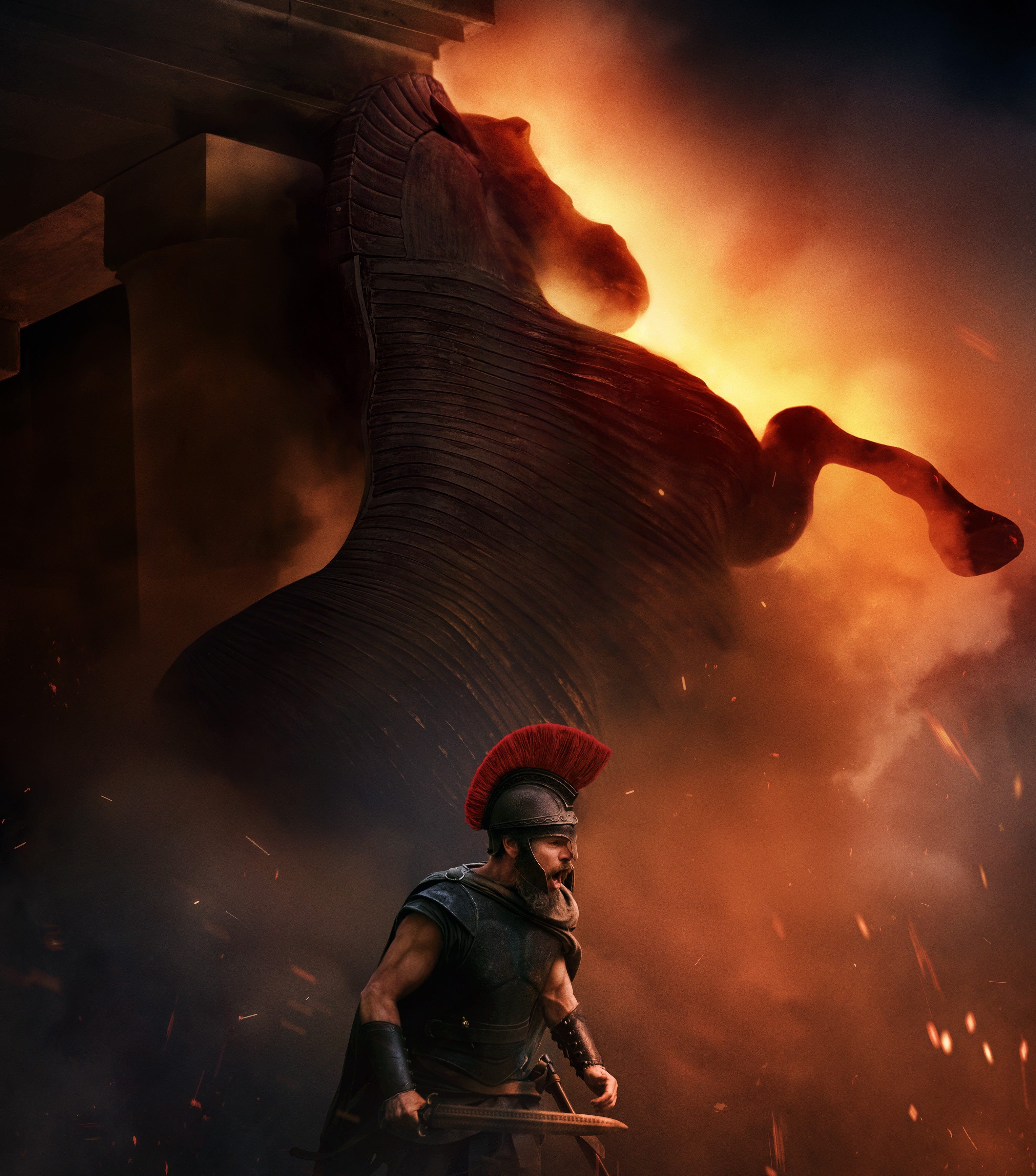
It’s obvious in this film that Nolan, to some extent, seemed to be living out some of his repressed desire to make Troy, which he was originally hired to direct. The war scenes are by turns tense and spectacular, and the ones that occur at the film’s end as Odysseus remembers once again what he and his men did at Troy are key to Nolan’s thesis: Odysseus’s Trojan Horse gambit, in which the Greeks offer a gift and enter a home under false pretenses in order to do harm, violated the sacred contract between guests and hosts and between human beings more generally, thus ushering in the fall of (Bronze Age) civilization.
Wilson herself just released her own review of the film in the London Review of Books, and to put it mildly, she wasn’t a fan. There is now a backlash to her review, accusing her of biting the hand that feeds her, among other perceived sins. The leader of the backlash pack is the somehow terminally online Joyce Carol Oates, which tracks.
But here’s the thing: even Wilson admits that The Odyssey is appealing to potential new audiences for poetry, Ancient Greek, and history. And whether you want it to or not, that matters. A lot.
In her words:
In what we are told is the streaming era, this epic is bringing audiences back to cinemas. In what we are told is a time of declining literacy and the ‘death of the humanities’, translations of The Odyssey, including mine, are flying off the shelves. Some of those who buy the book or show up in cinemas to watch Tom Holland may go on to study ancient Greek. Perhaps the film will persuade a few college administrators not to cut their literature, language and history departments. Nolan, who studied English at University College London – where students still study The Odyssey as a first year ‘foundational text’ – is doing his best to get the general public reading again, and I am grateful.
Wilson has sold more than a million copies of her translation this year. She owes some of these sales to Nolan, but that doesn’t mean she isn’t allowed to have a critical opinion of the film. More than one thing can be true. The movie can have its shortcomings and still be a vehicle for change and interest in Ancient Greek, Homer, and (gasp!) poetry.
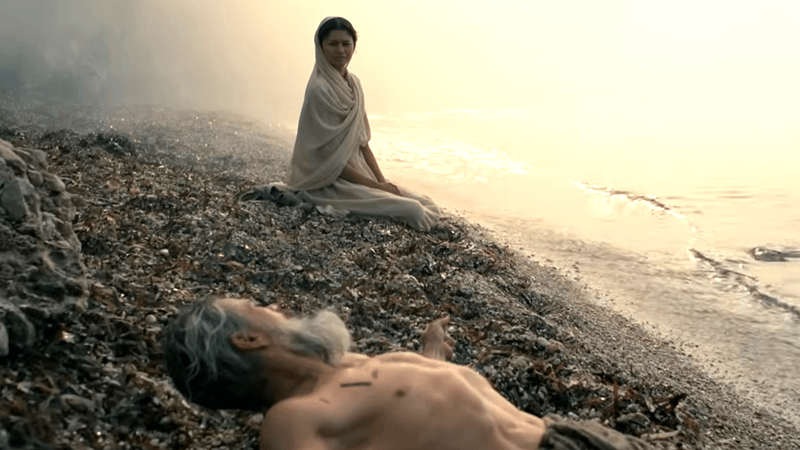
Among the chief complains of other negative reviews of the film is the absence or minimization of the gods who take up so much space in the original poem. This is a pretty fair assessment, but I can’t help but wonder if Nolan might have felt that cinema, which is glutted on superheros—the gods of our contemporary culture—could do without such figures for once. The film focuses squarely on the emotional turmoil of humans and other terrestrial beings: Odysseus, Penelope, Telemachus, Helen, Clytemnestra, the Greek and Trojan warriors and citizens, and even Argos the dog. And while it’s not loyal to the source material, this decision feels understandable, and the results are still moving.
Many have said that Nolan did Circe dirty in particular, but I loved Samantha Morton’s portrayal and the grotesquerie of the pig scenes. I think it’s about as much complexity as a contemporary audience can handle. We still love the trauma plot.
And as for trauma, Odysseus comes through in the end as a good guy who’s deeply remorseful, which doesn’t align with Homer’s tricksterish, morally ambiguous hero (though we do see Odysseus making some profoundly bad decisions in the film, such as zinging an ill-advised arrow into Polyphemus’s eye purely because he’s pissed).
Have we lost our stomach for anti-heros, unreliable narrators, and flawed figures? Possibly. And Nolan, a true movie theater-filmmaker, seems to know this. He knows that we come to the movie theater for spectacle and heroism and happy endings, so his film delivers all three. And this combination has helped the film gross nearly a billion (with a B!) dollars as of this writing. Click here to see the stats as they update.
Wilson is dead-on about the failure of the film to capture the poem’s complexities, but I’m afraid that ours is such a terribly illiterate age that it feels almost compulsory to laud the scope, ambition, and execution of Nolan’s own vision of the narrative.
Except for one hill I’m choosing to die on: the “poet” who opens the film.
Matt Damon’s “Ten years on this fucking beach!” took me OUT.
But first, the poetry, such as it is.
I could yap at you for hours about the overall level of language in the film. From the first few minutes, I knew I was going to be a little irritated throughout because Tom Holland’s Telemachus insisted on calling Odysseus “Dad” instead of “Father.” And Matt Damon’s “Ten years on this fucking beach!” took me OUT. I laughed audibly in the theater. No one else did (for some reason?) and I’m still puzzling out why. Are we used to the anachronistic turn? Do we not give a shit?
Wilson herself argues that highfalutin language isn’t exactly required to adapt and translate The Odyssey:
[Homer’s] language is not colloquial, and it avoids obscenity, but it is not bombastic or grandiloquent. The notion that Homeric epic must be rendered in grand, ornate, rhetorically elevated English has been with us since the time of Alexander Pope. It is past time, I believe, to reject this assumption… Impressive displays of rhetoric and linguistic force are a good way to seem important and invite a particular kind of admiration, but they tend to silence dissent and discourage deeper modes of engagement.
Wilson is right on, here, and by this measure, Nolan has partially succeeded: He doesn’t avoid obscenity, but he does strip away any vestige of pomposity in order to make the emotional stakes clear to a contemporary audience. Wilson, however, was still not a fan of the dialogue, which she said that she would have been “ashamed” to have written. Hoo boy! Tell us what you really think, Em.
Though the film’s dialogue is rather plain spoken, we do get some bargain-basement anaphora here and there. A Homeric epithet or two! So starved am I for an acknowledgement of the original’s music and linguistic richness that I nearly came out of my seat when Telemachus repeated that various characters had the “wise eyes” of Athena.
A poetic device… thank god! But the film still lacks any real sense that it’s based on a poem, as is the case with all the Odyssey adaptations I watched.
So we get a briefest glimpse of poetry. But what about the film’s poet?
I don’t want to do this, but I have to do this:
We have to talk about Travis Scott.
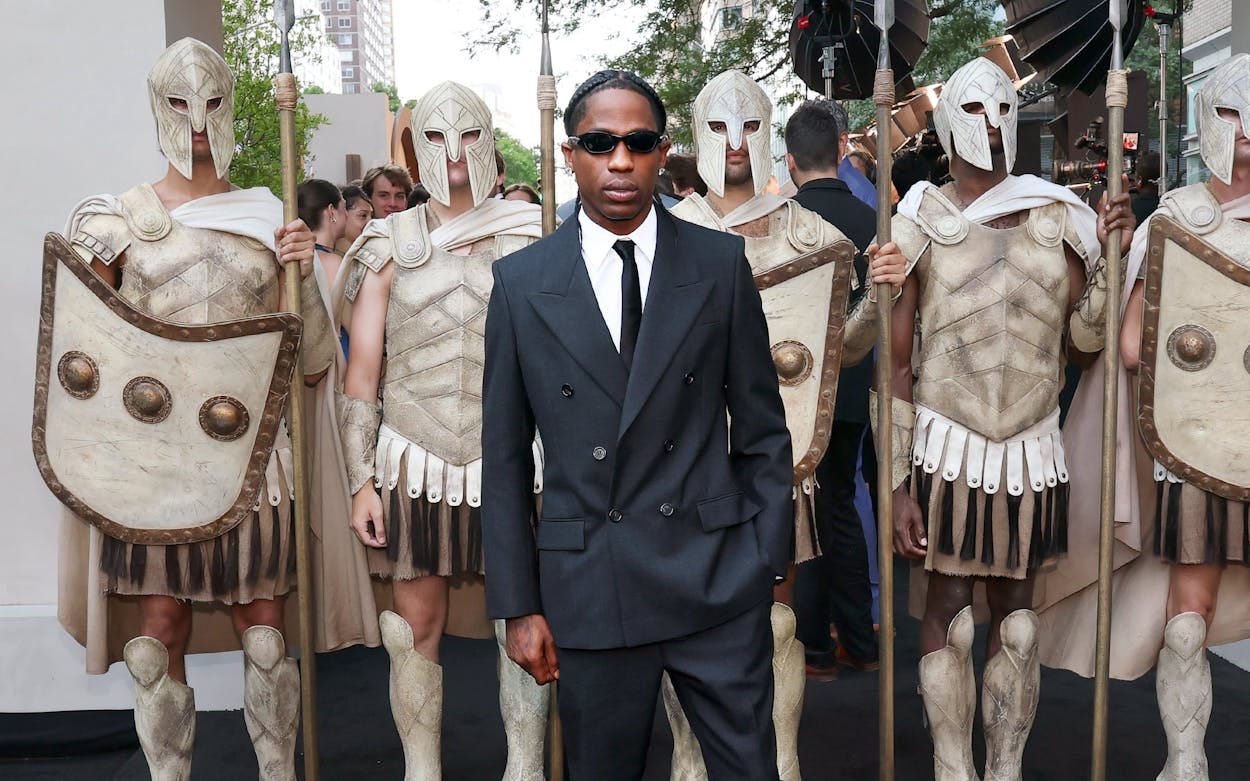
The first words of Nolan’s Odyssey are spoken by the rapper best known for hit songs like “Sicko Mode” and inexplicably having two kids with Kylie Jenner. In an interview with Rolling Stone, Nolan explained his rationale for Scott’s casting as Phemius, the poet who performs in Odysseus’ home:
“I cast him because I wanted to nod towards the idea that this story has been handed down as oral poetry, which is analogous to rap.”
I need a drink.
Nolan’s comments make poetry seem like an art form whose bones are frosted with dust. Thank God we have rap today, because the poetry of the bards is long dead. That’s the subtext.
Like, I’m not a square. It’s cool that Travis Scott played a bard in The Odyssey. Sure. And rap absolutely shares a lineage with oral poetry. But do you know what would have been really cool? Having a poet play the poet. Because poetry didn’t stop being written in Homer’s time, and poets are alive today. You can call them up on the phone and everything.
I’m just saying. I’M JUST SAYING! Don’t come for me on this one, but you know I’m at least a little bit right. And I understand the following:
Poets aren’t famous the way that rappers are and don’t have the kind of name recognition that would draw large general audiences to the film.
Poetry in general doesn’t occupy the same place in our culture as rap, or popular music in general.
I don’t want to be making this argument any more than you do, but it’s still true that once again, the highest echelons of pop culture and its fabricators have the opportunity—and even demonstrate the willingness!—to consider the work or role of contemporary poets and choose to do otherwise.
Nolan has worked with Scott as a musician on Tenet in the past, so this he didn’t even have to break a sweat making this choice. He just reached out to a guy he already knew. First thought. But if you’re going to choose a rapper to serve as the film’s poet figure, why this one in particular? Why not go with someone like Kendrick, whose lyrical depth won him a Pulitzer Prize for Music?
Instead, we get a guy whose legal and cultural history is troubling at best: Remember the Astroworld crowd crush, during which he continued to perform while fans screamed at him to stop and dead bodies of concertgoers as young as nine were being removed from the venue? Since then, he’s had multiple arrests for what I can only describe as flagrant asshole behavior—assaulting a security guard in Paris, punching a sound engineer who told him to turn the volume down at a show… the list goes on and stretches back more than a decade.
Nolan’s cast is pretty squeaky clean. Why do this? It’s a high-profile role for a rapper OR a poet, and you give it to a guy who assaulted the crew of a yacht because they told him he was too drunk to operate a jet ski?
Really?
It’s just a bad decision that has everything to do with Hollywood politics and maybe the fact that Nolan doesn’t know any other rappers. It’s a disappointment, even if the end credits song Scott is credited on does kind of slap (but that’s mostly due to James Blake’s haunting vocals!)
Leave your vote for a living poet of color who could have replaced Travis Scott. Who would you have applauded?
Perhaps if we lived in a different age, where public intellectuals were still household names, where most people still read for pleasure, and where the poetry shelf at Barnes & Noble wasn’t just Homer, Neruda, Kahlil Gibran, and 27 different Instagram poets, something amazing like the platforming of a living poet in a big budget film could happen.
But not in this world. Not in our time.
At the end of Nolan’s film, Odysseus says that the dawn will come, that even as literacy fades away and civilization crumbles, there will be a way to come back, and that way is paved with stories and storytellers. I have to admit: I teared up because I want that to be true. I’m a sap.
Poetry is alive in this age, and poets will be among those who bear the flame if and when things get worse for literacy and literature. I just wish that people like Nolan could see past the glitz of movies and rap and hip hop and the high-school-English-teacher-gambit of “Shakespeare was basically a rapper!” to see the work of the countless living poets as it appears in the world today. Rap might be poetry, but you know what’s also poetry?
Poetry.
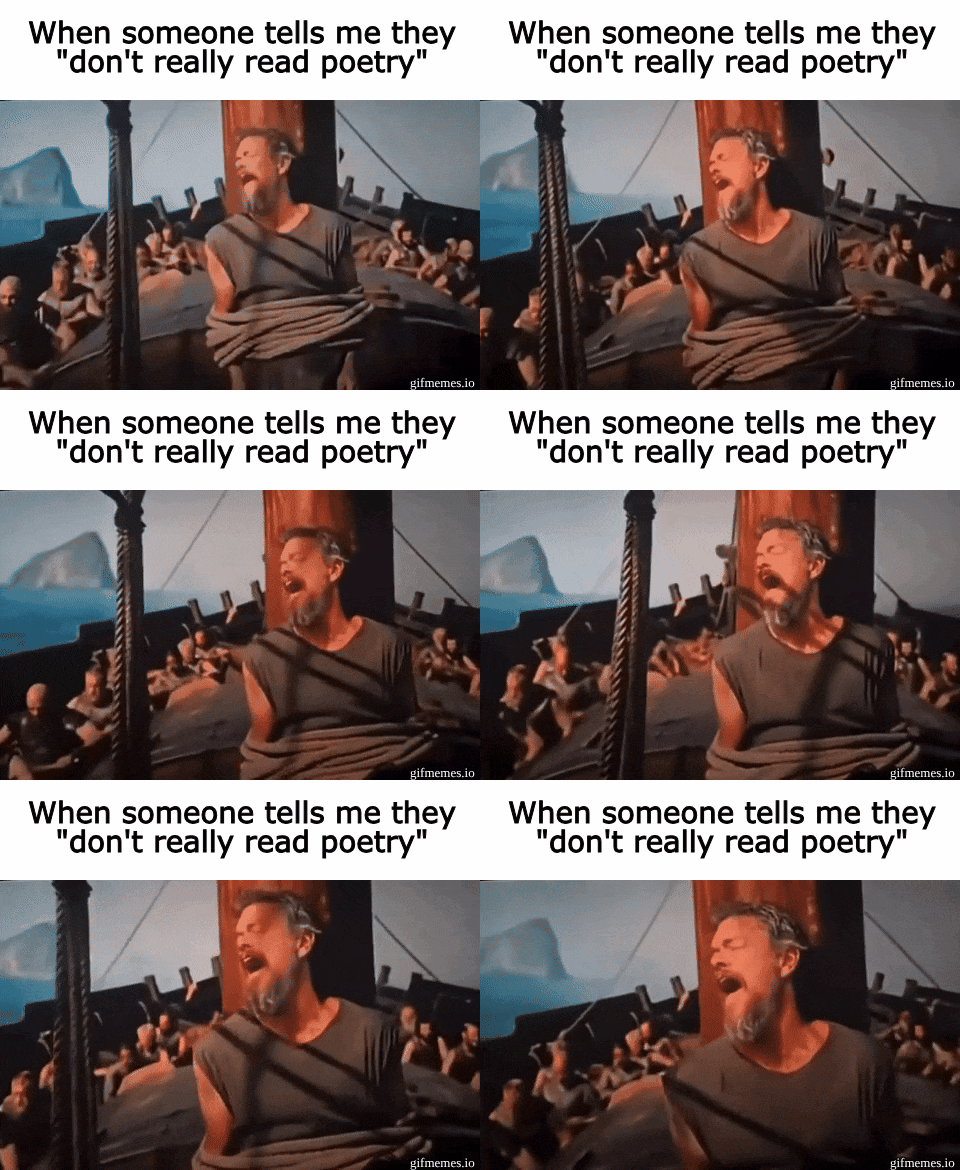
So what’s the final score, for those playing along at home? How does Nolan’s Odyssey stack up? Pretty damn well on the plot side, you have to admit.
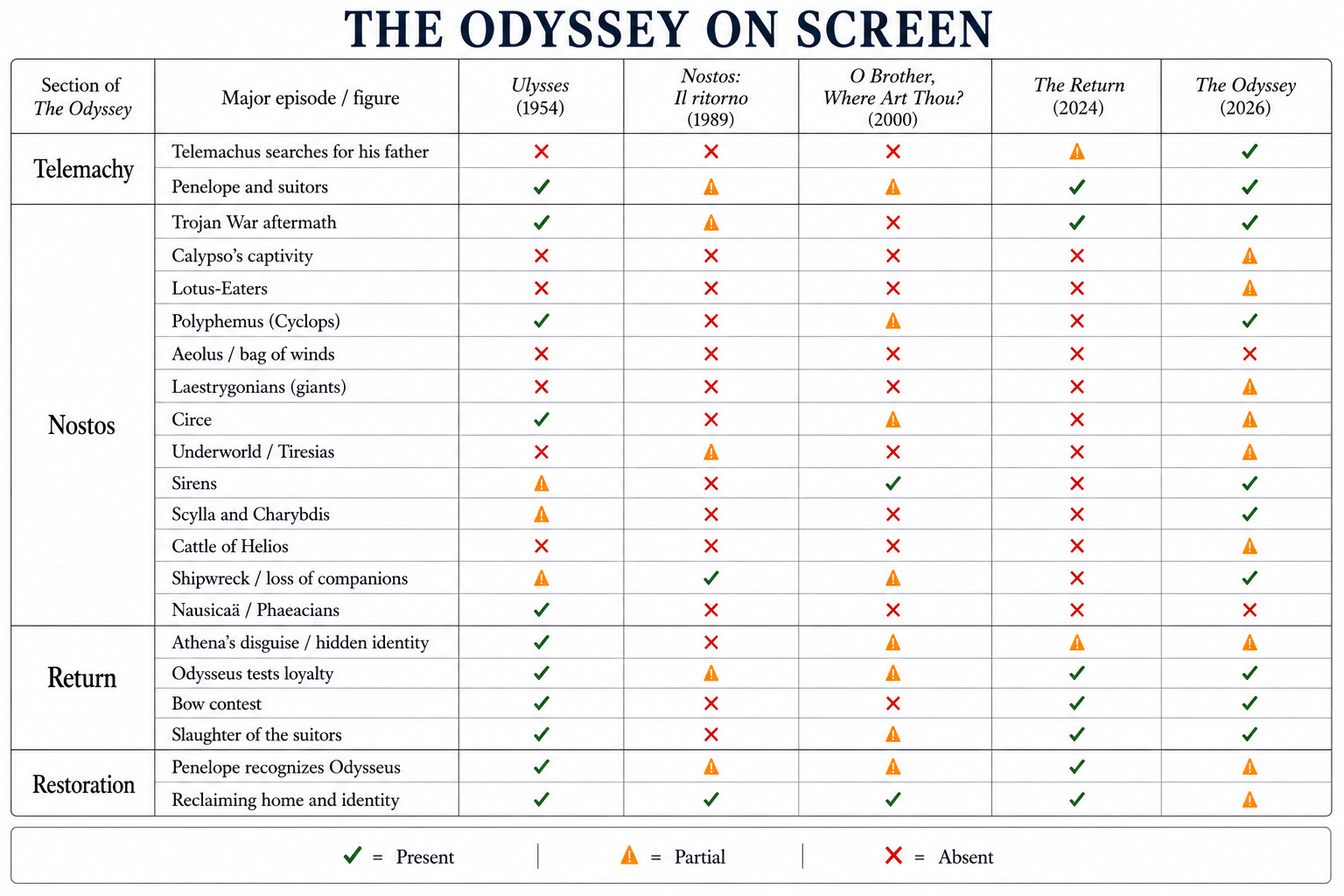
There is at least some attempt to render the vast majority of major plot points from the poem, here. It’s an impressive feat.
Have you watched as many of these adaptations as I have? Should I venture into the Armand Assante-led miniseries next summer? IMMEDIATELY? Have you seen the Nolan Odyssey? Does any of this resonate with you? Let me know below.
Comments
Nothing yet. Say the first thing.
Sign in to join the conversation.