
Those intrepid and curious souls interested in the work of Don Miguel Serrano tend to require a reading list, a structure in which to start their journey into his wonderfully weird oeuvre. Serrano’s simple prose is elegant and yet disorienting, as his approach to writing resembles the way nature composes a tempest. The mounting cascade of symbols and esoteric references that accompany his train of thought can be daunting and impenetrable to the neophyte, and so his genius is met with mockery in the minds of those not equipped to decipher the absolute lucidity and coherence of his project. Serrano completely exotericizes the esoteric, as he refuses to play the initiatory tricks of other authors, removing all veils from the content of his work. While other writers suggest, he proclaims. There are plenty of well-read right-wingers who mock Serrano while holding Ezra Pound in high esteem, completely ignorant of the fact that The Cantos posited a hierohistory no less audacious and grandiose than Don Miguel’s own counter-history.
Many open-minded and intelligent readers will begin his work and quizzically state, “I am not really sure how to read him.” As in, they are not sure what is allegorical and what is genuine, what is fact and what is fiction. They have no truth organ for penetrating the prose of the Magus of the South. Let me restate the aforementioned reader's query more bluntly, “Is Serrano just making things up?”
The answer is an emphatic “No.” He is not just “making things up.” Serrano’s knowledge is encyclopedic, and every seemingly absurd reference derives from a definite source. None of this is helped by Serrano’s refusal to hold a reader’s hand, his refusal to ease one in. Apologia is anathema to the Forbidden Man.
I have long contemplated something of a preamble, a minor initiation to prime the palate of those curious souls, so they may find the magus a little more digestible. All cards on the table: there is a reason I have finally decided to take on this task. A comrade of mine has been hard at work on an English translation of Don Miguel’s memoirs. I cannot say much at the moment, but the stars are alligning, and I feel it is my duty to partake in the constellation.
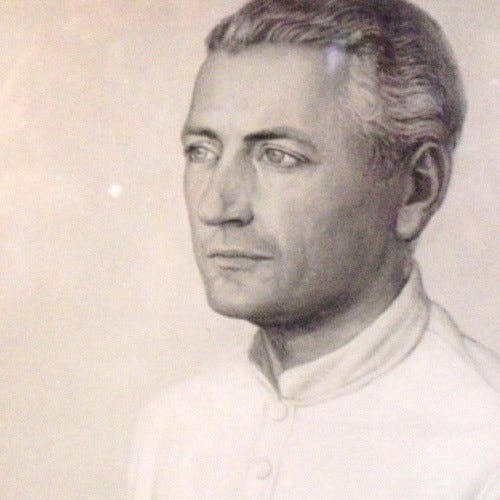
In this extended preamble, I plan on placing Don Miguel in conversation. To demonstrate the hidden sympathies between his lifeswork and the lifeswork of more digestible and academically licit thinkers. We will begin with Henry Corbin.
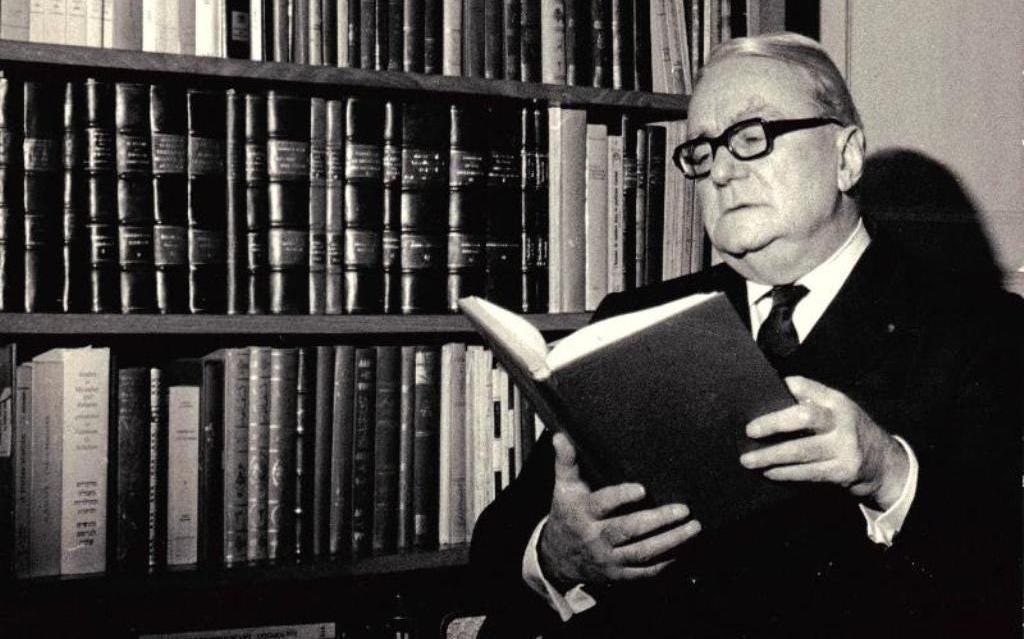
To the outside observer, no two individuals could be further removed than Serrano and Corbin. Serrano is a pariah, while Henry Corbin is one of the most celebrated French Orientalists and historians of religion of the 20th century. Corbin is widely regarded by Shiites as the first western academic to truly pierce the veil of that religion, to present the hidden essence of the Shiite tradition to the Occident. His legacy can hardly be captured in a few sentences, so I will leave biographical inquiries to the reader’s own research. However, suffice it to say, Corbin practically founded the field of Shia studies in the West, and his influence outside of academia is incalculable. Lacan, Foucault, Hillman, Scholem, Bloom— all credit Corbin as the prime influence upon their own respective understandings of Shia Islam and Gnosticism as a whole. Moreover, he is still widely read and widely loved in post-revolution Iran, with native Shiite scholars still translating and studying his work. Few academics of the 20th century were so universally loved and respected.
And so in terms of reception, no one could be further removed than Henry Corbin and the Forbidden Man.
A few years ago, I stumbled upon Henry Corbin’s book, The Man of Light in Iranian Sufism. Going into it, I knew nothing of Corbin and even less of “Iranian Sufism.” And yet, as I turned through the pages, I could not believe my eyes. It was as if I were reading a compilation of exquisite footnotes, an academic disambiguation of Miguel Serrano’s work. Many of the major themes of Serrano were there, but approached from the perspective of Iranian gnosis. I found this quite odd, as Serrano’s esoteric synthesis rarely ventured into Islamic waters, but the taste was unmistakable. Shortly after, I took a glance at Corbin’s biography and uncovered the first filament binding the two men’s lives. Corbin, like Don Miguel, had been a close confidant and collaborator of Carl Jung. And both men had the privilege of being told by Jung that they were among the only ones who ever truly understood him. I immediately began to scour Serrano’s works, trying to find any reference to Corbin, convinced they must have known each other and engaged in long conversations. But nothing. How could this be? In fact, there are no records of either figure ever encountering the other. Could there have been some truly hermetic sympathy between the two, an ethereal bond, a synchronicity that correlated their spirits in esoteric unity? It would be a few years later that I would receive confirmation via an intermediary from Serrano’s son, that too his knowledge, his father had never spoken to or spoken of Henry Corbin.
Corbin and Serrano were both staunch partisans of a distinct strain of “spiritual nationalism.” They were heralds of palingenesis, poets who hummed a martial tune. Don Miguel was explicit in defining his warrior ethos- “Our Weltanschauung is warlike. It is faced with a war, because at the beginning of Time someone declared war against the Immortals…” Both thinkers recognized the absolute occlusion of power, both in its current form as a system of sociocosmic oppression, and as the ultimate remedy for countering this veiled structure. But Corbin had long remained insulated from any suspicions of his inherent extremism, and even placing these two figures in harmonic dialogue would send shockwaves through religious studies departments the world over. The first scholar who seemed to intuit the truth behind this camouflage was Steven M Wasserstrom, and he sounded the alarm in his book “Religion After Religion: Gershom Scholem, Mircea Eliade, and Henry Corbin at Eranos.”
These militant interpretations of the function of “making culture”— and thus of the History of Religions—seem especially illuminated by a statement Eliade issued to emigre Romanians in 1950. “In this historical moment of ours, we, on this side of the Iron Curtain, can do one thing alone: culture. . . . I have said this many times, but it is good to repeat: in the religious war we are engaged in, the political struggle has moved to the spiritual realm.” The point at present, in short, is that the work of Corbin and Eliade is suffused with metaphorical violence in a way that Scholem’s manifestly is not. Eliade celebrated what I have elsewhere detailed as his “violent rebirth” model of sacrality. “Today we are beginning to realize that what is called ‘initiation’ coexists with the human condition, that every existence is made up of an unbroken series of ‘ordeals,’ ‘deaths,’ and ‘resurrections,’ whatever be the terms that modern language uses to express these originally religious experiences.” Corbin, for his part, grew increasingly explicit in the violence of his rhetoric as he aged. He convoked the final session that he led of his Universit´e Saint Jean de Jerusalem on a topic of his choosing, the “Combat for the Soul of the World.” In their public activities, their choices of topics, and their rhetorical stance, Scholem showed himself a peacable man, in opposition to his comparatively aggressive Eranos companions Corbin and Eliade.1
Wasserstrom was dismayed to discover in Henry Corbin and his Eranos comrades a cadre of “Historians” who had declared war upon history, academics united by a shared fixation upon esotericism and gnosis, who had the utmost contempt for modernity and the world of the moment. In Henry Corbin’s own words, “Counter-history is ultimately more true than history.”
Both Scholem and Corbin thus spoke of “historiosophy.” They also spoke of their own work in terms of a kind of “counter-history.”2
Corbin seemed, of the three, to have developed, on a philosophical basis, the foundations for a full-blown metahistory. “The epochs of the spiritual world are totally different from the epochs of the exterior world of geology or of sociopolitical history. The epochs of the spiritual world make up a history sui generis, which is in its very essence imaginal history.”3 Elsewhere Corbin spoke of “metahistory” and “hierohistory.” Metahistory, he asserted, “bestows meaning on history, because it makes it into a hierohistory. In the absence of metahistory—that is to say, in the absence of anteriority ‘in Heaven’—and in the absence of an eschatology, to speak of a ‘sense of history’ is absurd.”4 Corbin adopted the related conception of “historiosophy” from von Baader and Schelling. “By contrast, that which certain Western philosophers, like Baader, and Schelling, have called Historiosophy would not be able to do without a metaphysics, for if one ignores or excludes the hidden, esoteric sense of things, the living phenomena of this world are reduced to those of a cadaver.”5 Elsewhere he struck a Heideggerian note, invoking the notion of “being thrown into history,” in order to underscore his preference for Historiosophy:
“Take note! When a man lets himself be thrown into history he can go through all the philosophies of history he likes, he can legislate in the name of a historical causality which ignores all metaphysic, he can behave like a complete agnostic. This is no longer possible when history is interiorised, integrated into man’s consciousness. . . . Only that which theosophists like Franz von Baader or Schelling have so rightly named “historiosophy” can now be pursued.”3
Corbin’s radical anti-historicism was a product of the reading of his beloved Shia theosophers. For Corbin, events in heaven preceded and engendered all material phenomena, that true history, hierohistory, occurred upon the horizon of the soul.
In declaring, “The Intelligence is one with eternal Time,” Nasir-e Khos- raw is also slating the secret of the speculative Ismaili cosmology: the eternal birth of the pleroma from the Ibda (eternal Existentiation), formed of archangelical hypostases originating in the first among them. This world is not of an immutability and immobility presenting a simple contrast to the perishability of sensuous things; there are Events in Heaven, archetypal Events preceding the Creation of things, and these Events are the very genesis of being.4
The unsayable which the mystic seeks to say is a story that shatters what we call history and which we must indeed call metahistory, because it takes place at the origin of origins, anterior to all those events recorded—or recordable—in our chronicles. The mystic epic is that of the exile, who, having come into a strange world, is on the road of homecoming to his own country. What that epic seeks to tell is dreams of a prehistory, the prehistory of the soul, of its preexistence to this world, dreams which seem to us a forever forbidden frontier. That is why, in an epic like the Mathnawˆı we can scarcely speak of a succession of episodes, for all these are emblematic, symbolic. All dialectical discourse is precluded. The global consciousness of that past, and of the future to which it invites us beyond the limit of chronology, can only attain musically its absolute character5
If a certain science of our times views Nature [as a corpse], it may be said that it is this transgression which all esoterisms have subsequently tried to redeem, and that is their significance for a spiritual history invisible to historians of external events . . . no esoterism, until the coming of the Iman, can be anything more than a witness, recognized by a small number, ridiculed by all the others, and not progressing except in the night of symbols.6
Profane history sees mankind as mankind has created itself; History is the creation that man regards as his own, and of which he is the result. Sacred history or hierohistory reascends to events that are prior to the world, prior to the destruction of Temple, because it is by this Temple that I was created, and its Imago exists within me. This is the key to my hermeneutics, the sacred norm which determines the ascent from world to world.7
Ultimately, Corbin’s anti-historicism amounts to a violent polemic against popular understandings of time and causality. For Corbin, time is “discontinuous, qualitative, pure, psychic,” and modern man’s understanding of cause and effect is nothing but a lecherous groping of sand and mud, an effort to unite the discontinuous while ignoring higher principles.
The fundamental idea is this: visible, apparent, outward states, in short, phenomena, can never be the causes of other phenomena. The agent is the invisible, the immaterial. Compassion acts and determines, it causes things to be and to become like itself, because it is a spiritual state, and its mode of action has nothing to do with what we call physical causality; rather, as its very name indicates, its mode of action is sympatheia. 8
If the chronological succession does not suffice to give us knowledge of a causal historical filiation between these recurrences, at least we see arising between them the continuity of a “hierophanic time,” which corresponds not to the external history of the sects and schools connected with the Gnosis, but to the cyclical presence of their “archetype,” to their common participation in the same cosmic dramaturgy.9
For Corbin, the cosmos emanates cyclically, produced by an interplay of archetypes and symbols moved through sympatheia. Material events are engendered by their celestial antecedents, and history is willed. The logical conclusion, frequently hinted at by Corbin, is that popular history is itself a sludge of confusion and falsifications. It is the goal of the gnostic to replace this mundane history with a hierohistory or counterhistory.
And this “goal of the gnostic” is exactly what was undertaken by Miguel Serrano in his El Cordon Dorado trilogy. Serrano actualized these hierohistorical yearnings in a grand epic of cosmic revisionism, a recentering of world history in which myth penetrates the sap of the soul. He sings a song of hyperborean exile, a cosmic draumaturgy against the falsification of the demiurge. Serrano recognized this present earth as a palimpsest, a crude perversion, a painting painted over.
Why did it happen? Was it pure chance? Did someone cause it? Going out from Eternity, from Nothingness, to create this bad copy of something else, then invisible but immortal, beautiful, eternal. What is unmoving, on the other side, could not go out from itself or become imperfect and active without the act of Someone who was outside and then became. Without a point of fabricated assistance. A type of Robot, Cosmic Machine, a Golem that had lost control and tried to create on their own, in their own image and likeness. An event as if over a beautiful painting of Leonardo there were overlaid a monstrosity of Picasso. So that the existence of the entire mechanical Universe, visible matter, would be a poor copy made over a fine canvas original by a Satanic plagiarist. A palimpsest. And because of this within this Nature, in which we are now, we can sense the presence of another underground Universe that has been imprisoned and tortured. In her creatures, minerals, plants, in the mountains, rivers, seas and even the stars, in all of Nature there is a nostalgia of lost perfection, a Paradise that was and still remains beneath within her core.10
Nature, and the gods, are imprisoned by this demiurgic bondage. A corruption befalls the soul of the world, and this spirit has a concrete personification, not in an abstract sense, but a personification more real than the common sense perceptions of man. Serrano, like Corbin, despises allegory.
The ancients did well to represent the Gods in human form as an Archetype recurring in all the Universes. The same stars are a gigantic man, clothed in demiurgic matter, imprisoned in this Nature and repeating himself although decreasing in size. We do not see the inhabitants of those worlds because our eyes made only to perceive our terrestrial space and time do not catch their matter. The sky has the form of a man, said Swedenborg. Everything would be as in those Persian, Indian and Chinese miniatures where there are inside men and animals other even smaller beings and other animals. Such that we ourselves, within, or on the surface of a star, would be like cells of a giant’s body, an imprisoned God who can only free himself with our efforts and our victory over the Great Jailer. Victory that often inhibits that same God.
Because this entire Universe of visible material stars, fire, ice and combustion, is the land of the Demiurge, the prison in which the Gods are bound and enslaved. This aberrant similitude has been superimposed over the pre-existence of another Divine Nature and extends itself towards the worlds of the immortals, winning battle after battle until everything would be destroyed by its own mechanical action at the end of a Kalpa when its finite energy has been exhausted, having to recommence an identical history thanks to the eternity of an imprisoned God, Time-Kronos- Saturn. Thus the Gods themselves enable the survival of their executioner, giving over to him the energy that allows his Will to Power to reform and begin everything all over again in the Eternal Return of the Same. The Demiurge receives his ‘food’ that prolongs his Cosmic Vampire existence. He keeps the Gods imprisoned within the hypnotic cycle of his diabolical Will.11
The dramaturgy of the imprisoned time god and his combat with the assistance of his emanations, is in near perfect accord with Corbin’s own understanding of Ismaili gnosis. The only difference is a matter of definitions. Where Serrano says God or immortal, Corbin says Angel. For Serrano, the archetypes are gods; for Corbin, the archetypes are angels. This may at first read as a monstrous oversimplification. But bear with me, and let us tease out the nectar of both systems.
The first key to unlocking the fundamental homology between the polytheism of Serrano and the angelology of Corbin lies in their shared “exemplification.”
Corbin:
The special and characteristic nature of the situation is shown in this process of exemplification, which constitutes the individual person and raises him to the dimension of an archetypal Person. Essentially, the perception of all reality becomes the perception, or visualization, of a concrete person. This situation creates the schema of a fundamental angelology, which is essentially the mode of self-understanding of an existence which undergoes what we may now call an angelomorphosis—that is to say, the passage from “angelicity in potentia” to “angelicity in actu,” which is the positive culmination of the Ismaili anthropology. On the other hand, this exemplification which personifies all reality in a concrete person presupposes both coincidence and distance, identity and difference, and for this reason the totality must also be present in the “every instance.” This recurrence is the foundation of the homology between the total cycle of the aeon and the cycle of resurrections which in the life of the adept constitutes his ascension from one esoteric degree to another. In the Ismaili theosophy the idea of an exemplification of archetypal persons and the idea of a homology between the cycles define the religion of Resurrection (da’wat-e qiyamat) as an angelomorphosis.12
“The sky has the form of a man.” It is no coincidence that Serrano singled out a Swedenborg quote to illuminate this point, as Corbin shared this fascination for the Buddha of the North. In Corbin’s reading of the Ismailis, each person, thing, thought, and moment has a concrete personification as an angel, and therefore a theophany.
i. Archetypal Persons. How is exemplification possible? It is to Nasiraddin Tusi that we owe the elements of a brief and profound analysis. It seems to postulate that the aspect of action which we state in the infinitive, or the aspect of the event which we denote by an abstract noun, are by no means the true aspect of their reality, and that in the last analysis they refer back to the person of the agent who enacts the action or the event as the true reality of both. For all mental or ideal reality, every concept (ma’na) in the world of the universal has its counterpart in the world of the individual: a concrete person (shakhs-e ‘ayni) outside of which this ideal or mental reality remains virtuality and pure abstraction. Everything takes place as though the question “Who is it?” were substituted for the question “What is it?”— as though to name the person were to define its essence; and it is to this person and not to the abstract, universal concept that the ta’wil or internal exegesis leads back. We gain this impression by juxtaposing propositions such as these: “Paradise is a person (or a human being).” “Every thought, every word, every action is a person.” And finally: “Every true thought, every true word, every good action has an Angel.”13
Both Corbin and Serrano are accomplishing the same transmutation of the Jungian archetype. The archetype is a concrete essence, an angel or a god.
Serrano:
Each star of the firmament is a God divided by the demiurgic explosion and imprisoned. Now serving as slaves of the Demiurge, awaiting the ultimate day of Ragnarök when the Great Fenrir Wolf will devour them. But beneath each star, in the untouched center, there is a God in pain awaiting his resurrection, his transfiguration, as in each rock, each plant, each animal.14
Serrano was quite adamant that he was not endorsing a form of gnosticism. He described his theocosmology as “Tantrism, Wotanism and an ever-particularizing pluralistic paganism.” This ever-particularizing pluralistic paganism is functionally identical to Corbin’s own exemplification. And it is here we begin to pierce the mysteries of what Corbin described as the “Paradox of Monotheism.”
I will leave you with one more quote from Corbin, which will both emphasize the mystery of this paradox and introduce the subject of the next article.
“I believe that this imaginal world is the locus of the rebirth of the Gods, those of Greek theogony, as well as of Celtic theogony, which with those of the Greeks and the Iranians, are the closest to our consciousness.”

Steven M. Wasserstrom, Religion after Religion: Gershom Scholem, Mircea Eliade, and Henry Corbin at Eranos (Princeton, NJ: Princeton University Press, 1999) Page 18
Steven M. Wasserstrom, Religion after Religion: Gershom Scholem, Mircea Eliade, and Henry Corbin at Eranos (Princeton, NJ: Princeton University Press, 1999) Page 159
Steven M. Wasserstrom, Religion after Religion: Gershom Scholem, Mircea Eliade, and Henry Corbin at Eranos (Princeton, NJ: Princeton University Press, 1999) Page 159
Henry Corbin, Cyclical Time and Ismaili Gnosis, Islamic Texts and Contexts (London: Kegan Paul International in association with Islamic Publications, 1983), Page 34
Corbin, Henry. “On the Meaning of Music in Persian Mysticism.” Translated by Kathleen Raine. Temenos 13 (1992): 107–18.
Corbin, Henry. “Swedenborg and Esoteric Islam.” Translated by Leonard Fox. West Chester, Pa.: Swedenborg Foundation, 1995. Page 110
Corbin, Henry. “Temple and Contemplation.” Translated by Philip Sherrard with the assistance of Liadain Sherrard. London: KPI in association with Islamic Publications, 1986. Page 280
Corbin, Henry. “Creative Imagination in the Sufism of Ibn Arabi.” Translated by Ralph Manheim. 1969. Page 119
Corbin, Henry. “Avicenna and the Visionary Recital.” Translated by Willard R. Trask. Irving, Tex.: Spring Publications, 1980. Page 17
Serrano, Miguel. Manu: “For the Man to Come.” Translated by Franz Berg. 2nd ed. Cape Schanck, Victoria: Hermitage Helm Corpus, 2016. Page 36
Serrano, Miguel. Manu: “For the Man to Come.” Translated by Franz Berg. 2nd ed. Cape Schanck, Victoria: Hermitage Helm Corpus, 2016. Page 43
Henry Corbin, Cyclical Time and Ismaili Gnosis, Islamic Texts and Contexts (London: Kegan Paul International in association with Islamic Publications, 1983), Page 50
Henry Corbin, Cyclical Time and Ismaili Gnosis, Islamic Texts and Contexts (London: Kegan Paul International in association with Islamic Publications, 1983), Page 50
Serrano, Miguel. Manu: “For the Man to Come.” Translated by Franz Berg. 2nd ed. Cape Schanck, Victoria: Hermitage Helm Corpus, 2016. Page 50
Comments
Nothing yet. Say the first thing.
Sign in to join the conversation.