
This article is part of my series on alliances.
Anders Fogh Rasmussen, former Prime Minster of Denmark (2001-09) and General Secretary of NATO (2009-14), has proposed an alliance of democracies, to combat threats from aggressors such as the USA, China and Russia.
(The article links to a full report with all the details).
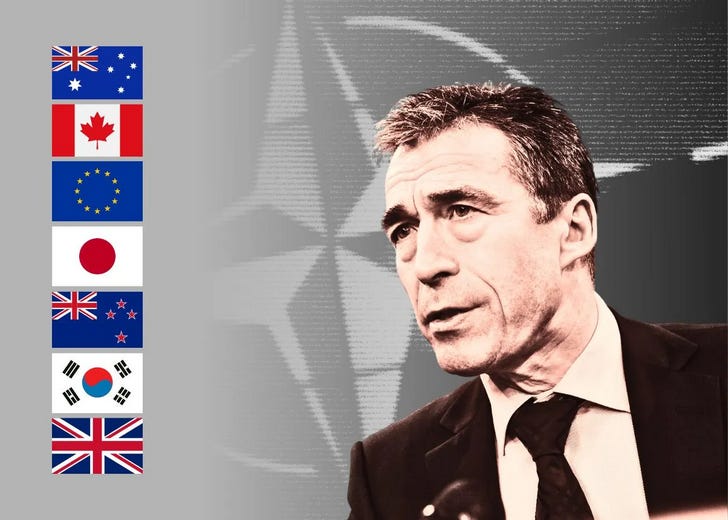
Rasmussen starts off by explaining the need for such an alliance:
The post–World War II order has ruptured.
An Axis of Autocracies is consolidating, visible on the Ukrainian battlefield through North Korean soldiers and Iranian drones. United States foreign policy has turned erratic, with tariffs at levels not seen since the 1930s. China weaponizes economic dependence to extract political compliance from democracies one at a time, from Australia to Lithuania, South Korea to Canada. Democratic middle powers now face coercion, protectionism and multilateral institutions that can no longer protect them.
Middle powers may appear to face a binary choice: pursue unattainable self-sufficiency or accept a performative sovereignty as satellites of a great power.
This article sets out a third path.
I agree here. This was my reasoning behind calling for a European Military Alliance back in 2024. While Trump wasn’t president at the time I said that:
Donald Trump, or someone like him, might become US president, and stop protecting Europe from Russia.
Rasmussen calls his alliance the Democracies-7 or D7:
At its center is a Democracies-7 -- a D7 -- consisting of Australia, Canada, the European Union, Japan, New Zealand, South Korea and the United Kingdom as founding members. Together they represent roughly $36 trillion USD in combined GDP, around 30% of the global total.
The EU members might want individual representation rather than being represented solely through the EU. I would add to these countries: Iceland, Norway, North Macedonia, Albania, and Turkey, all of which are in NATO but not the EU. Taiwan is also an important omission. Rasmussen is also open to more members, as he adds:
The D7 would act as a vanguard, not a boundary, with concentric tiers of Associates and Partners engaging on specific initiatives creating variable geometries.
It makes a lot of sense for there to be different tiers of membership; the alternative of one-size-fits-all would in practise mean one size fits no-one. Rasmussen suggests some countries that might be interested in joining:
This is not a closed club. It is a centre of gravity around which democratic initiatives can converge. India, Indonesia, Brazil, South Africa, Ghana, Norway and many others could strengthen, and benefit from, aligning with D7 initiatives on a case-by-case basis.
Rasmussen suggests 3 tiers:
The D7 could build three tiers to structure engagement:
(1) Core (D7). Seven members providing economic weight and political direction.
(2) Associates. Democracies aligned on specific initiatives, e.g. India on critical minerals and space; Brazil on raw materials; Indonesia and South Africa on supply-chain resilience; Norway on Arctic and energy security.
(3) Partners. Non-democratic states that wish to cooperate on issues of mutual interest without political alignment.
Rasmussen describes the alliance’s remit:
We identify six areas of potential focus:
A plurilateral trade alliance to keep rules-based open trade alive as WTO reform stalls.
An Economic Article 5 to create a collective front of defence against coercion.
A Democratic Technology Initiative to shape standards, align export controls and invest jointly in AI, quantum and space.
A critical raw materials strategy to break China’s grip on rare earth processing.
A defense pillar, taking inspiration from Ukraine and the Coalition of the Willing.
Coordinated global investment as a credible alternative to China’s Belt and Road.
I would add that the defence pillar needs to have a strong guarantee that an attack against one is an attack against all, stronger than NATO’s article 5 which merely says that each ally shall take “such action as it deems necessary, including the use of armed force”.
How will the alliance make decisions? Rasmussen says:
The D7 should be understood as a cooperation format in the mould of the G7, with high-level political engagement, not built around a heavy bureaucracy.
Annual leaders’ summit. Provides strategic direction and political visibility. Given his leadership on the topic, Prime Minister Mark Carney of Canada could serve as the inaugural chair, with the chairmanship rotating annually thereafter.
Quarterly Steering Council. Senior trade and economic officials from each member serving as the principal coordination body.
Super-majority decision-making. Four of seven votes to invoke collective action such as Economic Article 5, preventing any single member from wielding a veto.
Lean secretariat. Ministerial and Sherpa-level working groups on each priority area to maintain continuity between summit
I don’t think this is good enough. There are three main threats members of the alliance face:
economic coercion
low level violent acts such as sabotage and assassination
a full scale military attack/invasion
China and the USA frequently use economic coercion, and Russia frequently uses low level violence. If the alliance wants to effectively counter these, it needs to be able to make decisions fast. An annual summit won’t cut it, nor will meetings every three months. There needs to be a permanently staffed command center, with a secretary-general of the alliance and ambassadors from every member country. Brussels would be a good location for this as it is also the headquarters of NATO and the the EU.
Rasmussen correctly identified vetoes as a serious weakness:
Super-majority decision-making. Four of seven votes to invoke collective action such as Economic Article 5, preventing any single member from wielding a veto.
Note that the entire EU gets the same one vote as tiny New Zealand which I don’t regard as a particularly workable voting system.
But then weakens this by saying members don’t have to go along with decisions:
Action within the D7 should not be obligatory on every issue. A coalition of four, five or six members acting in concert still represents formidable economic weight.
Rasmussen envisages situations where only some of the D7 will act to counter a threat:
On China, D7 members have very different economic exposures and political appetites. South Korea and Japan are deeply integrated into Chinese supply chains. The EU is China’s largest trading partner. Australia has experienced the sharpest deterioration in relations. These differences are real, but they are precisely what variable geometry is designed to accommodate. A coalition of five acting together is still more powerful than any member acting alone.
The premise is simple: those willing to act should be empowered while maintaining interoperability within a broader alliance
If any alliance member can at any time opt out of actions agreed by a supermajority of the alliance, then it’s a very weak alliance that does not promise strong pushback against an aggressor.
An alliance must be strong and united, so would-be aggressors realise that aggression (either economic or military) simply isn’t worth it.
It may be that the alliance will start off as weakly coordinated and get more united over time. If so then I would accept it being weakly coordinated at the start.
The full document goes into more detail on membership:
Core membership should not be permanent. It should be structured around renewable two-year terms, with members reviewed against democratic commitment and will to act.
This gives members an inducement not to chicken out of collective decisions, as if they do they might be kicked out of the alliance. That’s a step in the right direction.
On the whole this is a good effort. It’s very welcome that statesmen such as Anders Fogh Rasmussen and Mark Carney are thinking along similar lines.
The thing to do now is to implement it!
Comments
Nothing yet. Say the first thing.
Sign in to join the conversation.