
Pollutical takes a lot of time and energy because I’m determined to make it reliable, well documented, and useful, which means lots of research. I’m not just giving you my opinion.
If you’re in a position to do so, please help keep Pollutical going!
DonorBox lets you customize your support to match your resources. Set an amount you can afford. It can be recurring or one-time. Or, of course, subscribe. Whatever works for you—every contribution makes a huge difference.
Thank you very much!
None of the main players have taken the Covid message to heart, to judge by their reaction to the H5N1 bird flu that's rapidly spreading through North America—a flu with the potential to cause a human-to-human human pandemic .
In the previous Pollutical article (Covid: A Dry Run For Environmental Breakdown) I looked at Covid-19 as a dry run for environmental collapse.
At its height, the pandemic stress-tested many of the systems that are important in dealing with widespread ecological disaster in domains like:
individual human rationality;
crowd psychology and rational behavior;
the necessity for corporate leaders to understand that a genuine solution would have to involve prioritizing people over profits;
the necessity for incumbent parties to understand that lives would have to be prioritized over electoral considerations (including the continuing flow of corporate donations);
and so on. The results are critical to understanding how well or how badly we’re likely to respond to the environmental polycrisis—the cluster of interacting crises represented by our having violated 7 of the 9 planetary boundaries (for scale, climate change is only one of those nine).
1. “Covid: A Dry Run For Environmental Breakdown,” Cai Stark. Pollutical, June 4, 2025.
So how did we do? On just about every conceivable front the result was a deadly failure.
And since then? Well, none of the main players have taken the Covid message to heart, to judge by their reaction to the H5N1 bird flu that's rapidly spreading through North America—a flu with the potential to cause a human-to-human pandemic that has required mass slaughter of poultry, including more than 58 million birds culled or confirmed infected in the US and more than 7 million in Canada. And plenty of mammals are now being infected: cows, cats, ferrets. We recently learned that one strain of H5N1 that’s infectious in humans can be communicated between mammals by airborne transmission. That particular strain H5N1 wasn’t fatal to the ferrets that were used as an animal model, but there are strains that can be fatal in humans, so it remains an important proof of concept. So far we haven’t seen airborne transmission combined with human fatality, but given the safeguards we’re not getting, that may just be a matter of time.
2. “How the U.S. Lost Control of Bird Flu, Setting the Stage for Another Pandemic,” Amy Maxmen. Scientific American, December 19, 2024.
3. “What Does First U.S Bird Flu Death Tell Experts about Disease Severity?,” Tanya Lewis. Scientific American, January 7, 2025.
4. “The U.S. Is Not Ready for Bird Flu in Humans,’ Megha Satyanarayana. Scientific American, February 7, 2025.
5. “Avian influenza A(H5N1) isolated from dairy farm worker, Michigan,” Brock N et al. Emerging Infectious Diseases. (2025) DOI: 10.3201/eid3106.250386.
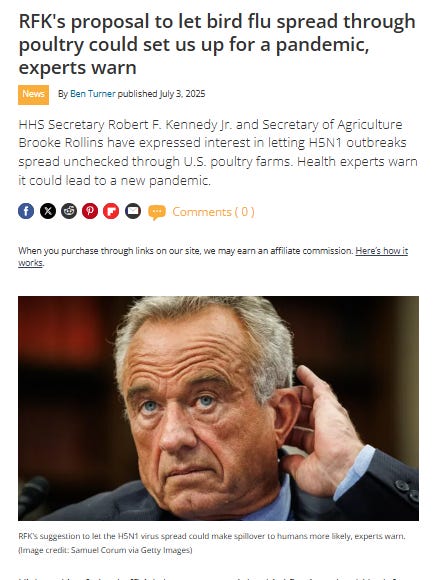
And the lethality of H5N1 is mind-boggling. It’s referred to here as the “case fatality” rate, or CF.
Accurate estimation of the case-fatality (CF) rate, or the proportion of cases that die, is central to pandemic planning. While estimates of CF rates for past influenza pandemics have ranged from about 0.1% (1957 and 1968 pandemics) to 2.5% (1918 pandemic), the official World Health Organization estimate for the current outbreak of H5N1 avian influenza to date is around 60%… Clearly, if such a CF rate were to be sustained in a pandemic, H5N1 would present a truly dreadful scenario. A concerted and dedicated effort by the international community to avert a pandemic through combating avian influenza in animals and humans in affected countries needs to be a global priority.
So the 1918 flu, the “deadliest recorded in history, was documented at around 2.5%, resulting in an estimated 50 million deaths worldwide,” but H5N1 has a CF of about 60%. And even after the experience of Covid-19, our various institutions have already made a mess of controlling it.
6. “Finding the real case-fatality rate of H5N1 avian influenza,” Li, et al. Journal of Epidemiology & Community Health 62:555-559 (2008). [Non-paywalled link via Sci-Hub, use at your own discretion: https://sci-hub.ru/10.1136/jech.2007.064030]


He confirmed the connection between the polycrisis and covid, but he took that connection out of the sphere of the vague, woowoo mysticism of “nature’s revenge” and put the emphasis on the actual nuts-and-bolts mechanisms.
This time I'm not dealing in metaphors. A second way that environmental issues are related to outbreaks like Covid-19 is that the polycrisis can take an infectious disease that's normally found only among other animals and cause an outbreak in humans.
This is why, in response to people who said vaguely that Covid-19 was “nature's revenge” on human beings, Thomas Lovejoy (who until his recent death was a university professor in the Environmental Science and Policy department at George Mason University and, among other things, the World Bank's chief biodiversity advisor) said, of the pandemic:
…this is not nature’s revenge, we did it to ourselves.”
In other words, he confirmed a causal relationship between polycrisis and zoonotic diseases like Covid-19, but took that connection out of the sphere of the vague, anthropomorphic, woo-woo mysticism of “nature’s revenge” and put the emphasis on the actual nuts-and-bolts mechanisms.
Unfortunately, like so many people—and oil companies, and right wing think tanks—he failed to make a distinction between the governments and corporations who have wielded most of the power in degrading the world and the rest of “ourselves.” In fact, many of us have been fighting against the course that’s brought us to this point for a long, long time.
Apart from that, though, he’s right. Whether or not Covid-19 itself arose from our abusive interaction with the rest of nature, the fact is that in multiple ways we’ve laid the foundation for a host of such spreading infections, possibly including further pandemics.
7. “'We did it to ourselves': scientist says intrusion into nature led to pandemic,” Phoebe Weston. The Guardian, April 25, 2020.


…the more we penetrate into previously unexplored areas, disturbing or destroying habitats, the more we encounter animal species we’ve never met before and it’s one more chance to meet a new disease as well, carried by these animals.
Just as human land use can result in habitat destruction, which can contribute to species extinction and the potential for food web collapse, that land use is also a major factor in encouraging diseases found in other animals to migrate to humans. Diseases that make that jump are described as zoonotic. Covid-19 is zoonotic, as are many of the most dangerous new diseases of the past few decades, like HIV-AIDS, ebola, SARS 1, and MERS.
How does our land use encourage zoonotic disease?
Because the more we penetrate into previously unexplored areas, disturbing or destroying habitats, the more we encounter species we’ve never met before (or infected populations we’ve never encountered before of species we already know). Every time that happens it’s one more chance to meet a new disease as well, carried by these animals. To add insult to injury, urbanization is driving a preference amongst mosquitoes for human blood over that of other animals.
8. “Climate and Urbanization Drive Mosquito Preference for Humans,” Rose et al. Current Biology 30, 3570–3579, September 21, 2020. DOI: 10.1016/j.cub.2020.06.092
9. “Human animal contact, land use change and zoonotic disease risk: a protocol for systematic review,” Ahmed et al. Systematic Reviews 14:65 (2025). DOI: 10.1186/s13643-025-02805-3
10. “Zoonotic host diversity increases in human-dominated ecosystems,” Gibb et al. Nature 584, 398–402 (2020). DOI: 10.1038/s41586-020-2562-8 [Non-paywalled link via Sci-Hub, use at your own discretion: https://sci-hub.ru/10.1038/s41586-020-2562-8]
11. “Land-use change and the livestock revolution increase the risk of zoonotic coronavirus transmission from rhinolophid bats,” Rulli et al. Nature Food 2, 409–416 (2021). DOI: 10.1038/s43016-021-00285-x [Non-paywalled link via Sci-Hub, use at your own discretion: https://sci-hub.ru/10.1038/s43016-021-00285-x]
12. “Land use-induced spillover: a call to action to safeguard environmental, animal, and human health,” Plowright et al. Lancet Planet Health 5: e237–45 (2021). DOI: 10.1016/ S2542-5196(21)00031-0
Ahmed et al summarize the overall problem in “Human animal contact, land use change and zoonotic disease risk: a protocol for systematic review”:
Human animal contact (HAC) is particularly important… where it serves as the pivotal interaction for pathogen spillover to occur from an animal reservoir to a human. In the context of disease emergence linked to land-use change, increased HAC as a result of land changes (e.g., deforestation, agricultural expansion, habitat degradation) is frequently cited as a key mechanism.
Gibb et al confirm the effect and identify the types of animals most involved, those being rodents, bats, and passerine birds (birds adapted for perching, including all songbirds):
The magnitude of this effect varies taxonomically and is strongest for rodent, bat and passerine bird zoonotic host species, which may be one factor that underpins the global importance of these taxa as zoonotic reservoirs… Our results suggest that global changes in the mode and the intensity of land use are creating expanding hazardous interfaces between people, livestock and wildlife reservoirs of zoonotic disease.
13. “Human animal contact, land use change and zoonotic disease risk: a protocol for systematic review,” Ahmed et al. Systematic Reviews 14:65 (2025). DOI: 10.1186/s13643-025-02805-3
14. “Zoonotic host diversity increases in human-dominated ecosystems,” Gibb et al. Nature 584, 398–402 (2020). DOI: 10.1038/s41586-020-2562-8 [Non-paywalled link via Sci-Hub, use at your own discretion: https://sci-hub.ru/10.1038/s41586-020-2562-8]

During the early part of the 21st century, an unprecedented change in the status of vector-borne disease in Europe has occurred. Invasive mosquitoes have become widely established across Europe, with subsequent transmission and outbreaks of dengue and chikungunya virus. Malaria has re-emerged in Greece, and West Nile virus has emerged throughout parts of eastern Europe. Tick-borne diseases, such as Lyme disease, continue to increase…
Changes in land use and other forms of habitat destruction are not the only man-made elements of the polycrisis that encourage new exposure to dangerous diseases.
Climate change extends or shifts the habitats of many animals as temperatures in temperate areas warm. Some of these animals, like mosquitoes and ticks are vectors for disease, meaning that they can transmit the microbe that causes the infection, like a virus or bacterium. And since mosquitoes bite humans, they can transmit it to us.
In The Lancet, Medlock and Leach paint a gloomy overall picture for Europe:
During the early part of the 21st century, an unprecedented change in the status of vector-borne disease in Europe has occurred. Invasive mosquitoes have become widely established across Europe, with subsequent transmission and outbreaks of dengue and chikungunya virus. Malaria has re-emerged in Greece, and West Nile virus has emerged throughout parts of eastern Europe. Tick-borne diseases, such as Lyme disease, continue to increase, or, in the case of tick-borne encephalitis and Crimean-Congo haemorrhagic fever viruses, have changed their geographical distribution.
Colón-González et al emphasized the connection to greenhouse gas emissions in “Projecting the risk of mosquito-borne diseases in a warmer and more populated world: a multi-model, multi-scenario intercomparison modelling study”:
The predicted increases in climatic suitability and population at risk of malaria and dengue highlight the importance of emission reductions to limit climate change and increased surveillance in potential hotspot areas to monitor disease occurrence and plan adaptation interventions in a warmer and more urbanised world. These actions are particularly important in transmission fringes, where public health systems might be unprepared to control and prevent these diseases.
Ticks transmitting Lyme disease have already moved north into Canada and further into Russia, a change that has been specifically correlated with temperature change, and even under optimistic warming projections are expected to push further in that direction:
The first infected ticks were found on the Ontario shore of Lake Erie in the early 1990s. Ixodes ticks have since spread farther north into Ontario, parts of Quebec, Manitoba, New Brunswick, and Nova Scotia. The incidence of Lyme disease has increased from 0.4 to 2.7 per 100,000 population from 2009 to 2016 in Canada; 88% of cases were reported in the provinces of Quebec, Ontario, and Nova Scotia. Even under an optimistic climate change scenario, for which the global warming increase is limited to 1.5 °C, consistent with the Paris agreement target, Lyme disease was found in simulations to spread farther north in Canada in the future. Northern Russia has also experienced an increase in the Ixodes tick population and in TBE [tick-borne encephalitis] cases over the past decades. In particular, a 50-fold rise in TBE incidence was reported for the far northern province of Arkhangelsk Oblast during the 2000s compared with the 1980s. There was also a distinct correlation between TBE incidence and increases in mean annual air temperatures from 1990 to 2009.
15. “Projecting the risk of mosquito-borne diseases in a warmer and more populated world: a multi-model, multi-scenario intercomparison modelling study,” Colón-González et al. Lancet Planet Health 5: e404–14 (2021).
16. “Future scenarios of risk of Vibrio infections in a warming planet: a global mapping study,” Joaquin Trinanes, Jaime Martinez-Urtaza. Lancet Planet Health (2021) 5: e426–35
17. “Impact of recent and future climate change on vector-borne diseases,” Caminade et al. Ann. N.Y. Acad. Sci. ISSN 0077-8923 (2018). DOI: 10.1111/nyas.13950
18. “Effect of climate change on vector-borne disease risk in the UK,” Jolyon M Medlock and Steve A Leach. The Lancet Infectious Diseases, Volume 15, Issue 6, 721-730 (2015). [Non-paywalled link via Sci-Hub, use at your own discretion: https://sci-hub.ru/https://www.thelancet.com/journals/laninf/article/PIIS1473-3099(15)70091-5/abstract]
19. “Environmental drivers, climate change and emergent diseases transmitted by mosquitoes and their vectors in southern Europe: A systematic review,” Brugueras et al. Environmental Research, Volume 191, December 2020, 110038. DOI: 10.1016/j.envres.2020.110038
20. “Climate and Urbanization Drive Mosquito Preference for Humans,” Rose et al. Current Biology 30, 3570–3579, September 21, 2020. DOI: 10.1016/j.cub.2020.06.092

So, we’re in for trouble.
We already have the multiple man-made causes of the polycrisis to deal with (trying to stop the burning of fossil fuels, the unnecessary use of fresh water, excessive fertilizer use, and so on), as well as fixing or coping with the effects they have (drought, floods, failed crops, heat waves, a critical shortage of fresh water, and more), and we have to do all that while wading around in a swamp of new diseases, plus ones that used to stay within a smaller, better defined geographical range, but now don't, like H5N1, with its case fatality rate of 60%.
Interesting times.
Comments
Nothing yet. Say the first thing.
Sign in to join the conversation.