
Note: Emphasis (bold + italics) within quoted passages is added unless otherwise specified.
It’s not just bunker-building billionaires who expect to see the environmental situation deteriorate, possibly until civilization collapses. Banks and other financial institutions are now actively preparing to maintain profits in a 3° world.
The big banks' acknowledgment that the world is likely to fail at preventing warming of more than 2 degrees Celsius above preindustrial levels is spelled out in obscure reports for clients, investors and trade association members. Most were published after the reelection of President Donald Trump, who is seeking to repeal federal policies that support clean energy while turbocharging the production of oil, gas and coal — the main sources of global warming.
The recent reports — from Morgan Stanley, JPMorgan Chase and the Institute of International Finance — show that Wall Street has determined the temperature goal is effectively dead and describe how top financial institutions plan to continue operating profitably as temperatures and damages soar.
"We now expect a 3°C world," Morgan Stanley analysts wrote earlier this month, citing "recent setbacks to global decarbonization efforts."
The stunning conclusion indicates that the bank believes the planet is hurtling toward a future in which severe droughts and harvest failures become widespread, sea-level rise is measured in feet rather than inches and tropical regions experience episodes of extreme heat and humidity for weeks at a time that would bring deadly risks to people who work outdoors.
1. “Big Banks Quietly Prepare for Catastrophic Warming,” Corbin Hiar & E&E News. Scientific American, March 31, 2025.

They don’t say this kind of thing in their feel-good ads for individual consumers who are looking for a home mortgage in, say, coastal Florida, but they’re pretty clear and direct about it with investors and other institutions.
Morgan Stanley’s climate forecast was tucked into a mundane research report on the future of air conditioning stocks, which it provided to clients on March 17. A 3 degree warming scenario, the analysts determined, could more than double the growth rate of the $235 billion cooling market every year, from 3 percent to 7 percent until 2030.
2. “Big Banks Quietly Prepare for Catastrophic Warming,” Corbin Hiar & E&E News. Scientific American, March 31, 2025.
The reason for this sobering outlook?
Well, decarbonization efforts are falling behind what’s needed to meet the Paris goals and stave off disaster. Never mind that financial institutions and their corporate clients—many of whom never took their sustainability commitments seriously (like formulating an actual plan to achieve them), and an increasing number of whom have been backing away from or dropping them over the last two years or so—deserve a large share of the blame for that failure. As the Harvard Business Review reported in August 2024:
In the past 18 months, many companies have initiated a sobering retreat from their prior commitments to sustainability, related to both the environment and people. In June 2024, for example, Tractor Supply Co., a $14 billion agriculture, livestock, and pet care retailer, announced that it was… withdrawing its carbon-emissions goals. The company previously had targeted achieving net zero emissions in operations by 2040… In the same week, Canada’s six largest oilsands companies wiped their websites clean of their decarbonization goals. The month before, as part of a company-wide expense reduction, Nike laid off dozens of sustainability managers.
These changes coincide with corporate backsliding on an array of sustainability targets. For example, in light of increasing oil prices both bp and Shell cut their commitments to lower carbon emissions; footwear maker Crocs reset its target for net zero carbon emissions back by a decade from 2030 to 2040; and Microsoft missed their carbon-reduction goals due to the growth of AI... and, according to the WSJ, companies including Coca Cola and Nestle “kicked the plastic can down the road (again)” after missing virgin plastic–reduction goals.
This lapse in commitment to sustainability is shortsighted and ill advised.
3. “Companies Are Scaling Back Sustainability Pledges. Here’s What They Should Do Instead,” Kenneth P. Pcuker. Harvard Business Review, August 20, 2024.
4. “Why Big Corporations Are Quietly Abandoning Their Climate Commitments?,” Jemma Green. Forbes, August 29, 2024.
5. . “The planet is warming at a record pace. So why are many companies retreating from their climate targets?,” Andre Mayer. CBC News, October 2, 2024.
6. “Companies made big climate pledges. Now they are balking on delivering,” Evan Halper. The Washington Post, December 3, 2023.
7. “Why SBTi [The Science Based Targets initiative] Has Delisted More Than 200 High Profile Companies,” James Darley. Sustainability, January 17, 2025.
8. “Canada’s biggest companies have climate targets but haven’t shown how they will meet them,” Arthur Zhang. 440 Megatonnes Project, January 30, 2025

So what’s the solution when profit-oriented companies (and their friends in government, who often come from corporate boards and/or become board members once out of office) pretend they’re becoming environmentally friendly but then don’t? When they contribute so substantially to the sabotage of environmental plans such that meeting the Paris Agreement targets becomes near impossible?
Corporate climate pledges surged recently, with over 500 companies globally committing to net-zero emissions by 2040. This momentum continued between June 2022 and October 2023, with a 40% increase in new net-zero targets. Yet, as the AI revolution gains traction, cracks in these promises are beginning to show. Recent analysis reveals that only 4% of these companies are on track to meet their goals, highlighting a disconnect between corporate rhetoric and reality.
9. “Why Big Corporations Are Quietly Abandoning Their Climate Commitments?,” Jemma Green. Forbes, August 29, 2024.
Why aren’t companies living up to their promises? There are several reasons, all of which come down to prioritizing profits.
There’s been a large jump in energy use by some companies, like Google and Microsoft, due to the power demands of increasing AI use, making carbon-reducing policies impossible to fulfil.
In other industries, abandoning such policies has more to do with the ineffectiveness of the mechanisms they chose to help them enact the policies in the first place.
Companies heavily favored carbon offsets as the solution of choice. For one thing, they’re voluntary, unlike the dreaded prospect of government regulation. Compliance with environmental regulations by private companies is notoriously low.
Serious noncompliance with environmental rules is common. It is common across all programs and industry types. Significant violations occur at 25 percent or more of facilities in nearly all programs for which there is compliance data. For many programs with the biggest impact on health, serious noncompliance is much worse than that. Significant violation rates of 50–70 percent are not unusual. These widespread violations have a direct effect on people’s health.
10. Next Generation Compliance, Environmental Regulation for the Modern Era, Cynthia Giles. New York: Oxford University Press (2022), p45.
Plus, purchasing offsets placated environmental demands from consumers but didn’t require them to alter their operations in any way—they just bought offsets to (theoretically) counterbalance their emissions.
In the absence of adequate regulation limiting climate-warming emissions in affluent countries, personalized offsets of this nature have become big business. They form what is known as the voluntary carbon market (VCM): a decentralized space where people and businesses can choose to buy credits to offset their emissions. The market for these offsets, which is largely unregulated, could hit $50 billion as soon as 2030 and grow 100-fold by 2050, according to McKinsey.
11. “Are carbon offsets all they’re cracked up to be? We tracked one from Kenya to England to find out,” Angus Chapman and Desné Masie. Vox, August 3, 2023.

But many environmentalists called out carbon offsets as a fraud from the outset, and now that message is taking hold.
The forest carbon offsets approved by the world’s leading certifier and used by Disney, Shell, Gucci and other big corporations are largely worthless and could make global heating worse, according to a new investigation.
The research into Verra, the world’s leading carbon standard for the rapidly growing $2bn (£1.6bn) voluntary offsets market, has found that, based on analysis of a significant percentage of the projects, more than 90% of their rainforest offset credits – among the most commonly used by companies – are likely to be “phantom credits” and do not represent genuine carbon reductions.
12. “Revealed: more than 90% of rainforest carbon offsets by biggest certifier are worthless, analysis shows,” Patrick Greenfield. The Guardian, January 18, 2023.
13. “Carbon offsets are a scam,” Chris Greenberg. Greenpeace, November 10, 2021.
As the doubtful nature of the claims made for offsets becomes more widely known, companies no longer want to be associated with offset schemes and simply abandon their policies. In all likelihood they were never living up to their policies via offsets in the first place—it’s just that now they admit it.
This challenge is not unique to the tech giants. Other major corporations are also reevaluating their sustainability strategies, particularly around the use of carbon offsets. The growing concerns around the effectiveness of carbon offsets and the risk of reputational damage if commitments are not met have prompted several companies to shift focus.
Shell, for instance, has abandoned its 2035 target of a 45% reduction in net carbon intensity, citing “uncertainty in the pace of change in the energy transition.” This target was a key milestone towards Shell’s broader goal of net-zero emissions by 2050.
The same goes for luxury fashion house Gucci, which once committed to carbon neutrality through verified carbon offsets and in May 2023, quietly removed its claim of being “entirely carbon neutral” from its website. Nestlé has also shifted its focus, moving away from reliance on carbon offsets and instead prioritising the reduction of actual emissions within its operations and supply chain.
14. “Why Big Corporations Are Quietly Abandoning Their Climate Commitments?,” Jemma Green. Forbes, August 29, 2024.
The reason some banks are expecting a 3° world, I suspect, is that they looked over this landscape of fakery followed by the open abandonment of any serious environmental commitment, and took note of the continuing rise of global greenhouse gas emissions, and began planning for a world of incessant disaster—but with profits, because that’s what matters.
Business continuity in the teeth of an apocalypse, right to the bitter end.
It’s worth asking, though: What will the business environment be like in a 3° world?
In a previous post (Kick Out The Jams), I referred to the latest report from the Institute and Faculty of Actuaries at the University of Exeter, Planetary solvency—finding our balance with nature, in which actuaries, who are experts in evaluating risk for insurance companies and pension funds, applied standard actuarial techniques to calculating the risks involved in the environmental polycrisis.
15. Planetary solvency—finding our balance with nature, S. Trust, et al, Institute and Faculty of Actuaries, University of Exeter, Jsnuary 2025.
What do they say a 3° world would look like?
More than 4 billion deaths (about half of all human beings)
Multiple climate tipping points triggered, creating a tipping point cascade.
Breakdown of several critical ecosystem services and Earth systems. High level of extinction of higher order life on Earth.
Significant socio-political fragmentation worldwide and/or state failure with rapid, enduring, and significant loss of capital and systems identity. Frequent large scale mortality events.

So about half of all people will die—presumably mostly in the global south if current temperature extremes are any indication. That’ll cut into your market a little.
Still, I guess the authors of the Morgan Stanley report on the future of air conditioning stocks figure that you can sell a lot of air conditioners to those who cling to life and still have electricity.
That’s assuming that you (and they) aren’t in one of the countries to experience “state failure,” because you can’t have a currency in which to buy, sell, and make a profit without a state to issue it. Of course, small, regional DIY currencies may arise in certain areas to facilitate local trade, but that’s really not what air conditioner companies want to be paid in. And in a true failed state—let’s say it’s South Africa, just to pick at random—getting your hands on funds in a reliable currency like, say, the Chinese yuan in place of your now-useless rand is going to take a lot of doing.
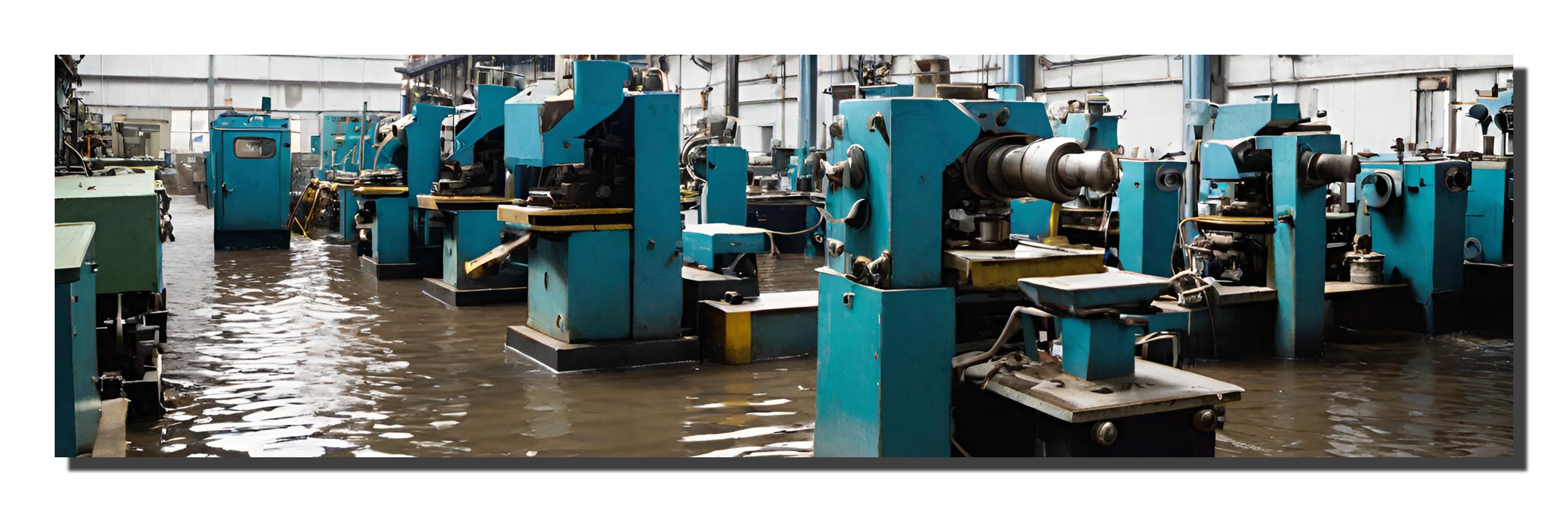
And air conditioner manufacturing would have to be drastically altered. Right now profits are maximized by using international supply chains to get the cheapest materials and labor, but in a world of failed states and “significant socio-political fragmentation,” that’s unlikely to work. Inputs of all kinds might have to be locally sourced, and goods domestically manufactured, to a degree that companies aren’t used to—with who knows what results. What will inputs cost? What prices will this weird, new market bear?
And what happens to businesses and their profits when the average global temperature increase doesn’t stop at 3°? Because it won't. The cascading tipping points that the actuaries are projecting aren’t going to be climate-neutral. A 3° rise will trigger them, and then they’re likely to kick it even higher.
The actuaries aren’t the only ones with doubts about business at 3°.
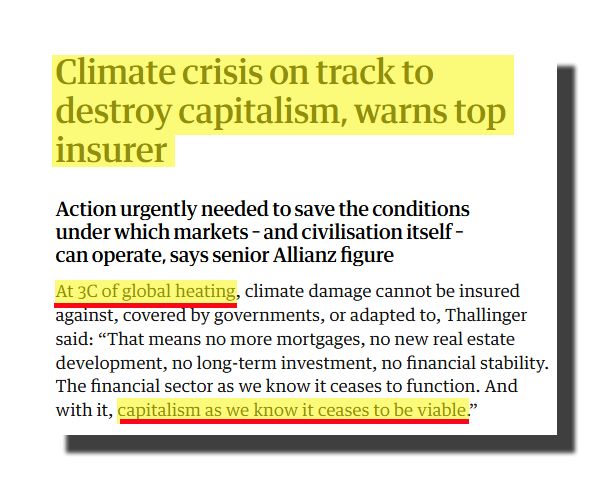
Günther Thallinger is on the board at the German company Allianz SE, one of the world’s largest insurers, and he’s a past CEO. Famously, Allianz was unfazed even when the Nazis came to power—they did good business insuring the concentration camps—but climate change has really shaken them up. Thallinger recently posted on LinkedIn that once we hit 3°, capitalism can’t function anymore. It’s worth quoting virtually his whole article (omitting citations), which is admirable for its bluntness:
CO₂ emissions directly increase the amount of energy trapped in the Earth’s atmosphere. This is not a vague or future issue—it is physical reality. The more emissions, the more energy retained. The more energy, the more extremely the atmosphere behaves. Storms intensify. Heatwaves last longer. Rain falls harder. Droughts cut deeper. This is the first principle.
These extreme weather phenomena drive direct physical risks to all categories of human-owned assets—land, houses, roads, power lines, railways, ports, and factories. Heat and water destroy capital. Flooded homes lose value. Overheated cities become uninhabitable. Entire asset classes are degrading in real time, which translates to loss of value, business interruption, and market devaluation on a systemic level.
The insurance industry has historically managed these risks. But we are fast approaching temperature levels—1.5°C, 2°C, 3°C—where insurers will no longer be able to offer coverage for many of these risks. The math breaks down: the premiums required exceed what people or companies can pay. This is already happening. Entire regions are becoming uninsurable.
This is not a one-off market adjustment. This is a systemic risk that threatens the very foundation of the financial sector. If insurance is no longer available, other financial services become unavailable too. A house that cannot be insured cannot be mortgaged. No bank will issue loans for uninsurable property. Credit markets freeze. This is a climate-induced credit crunch.
This applies not only to housing, but to infrastructure, transportation, agriculture, and industry. The economic value of entire regions—coastal, arid, wildfire-prone—will begin to vanish from financial ledgers. Markets will reprice, rapidly and brutally. This is what a climate-driven market failure looks like.
Some argue that the state will step in where insurers withdraw. But this assumes the state—i.e., the taxpayer—can afford to do so. That assumption is already breaking. Covering the cost of three or four major wildfires or floods in a single year strains public budgets to the limit. If multiple high-cost events happen within short time spans—as climate projections expect—then no government can realistically cover the damages without either austerity or collapse.
There is also the false comfort of “adaptation,” as many risks do not lend themselves to meaningful adaptation. There is no way to “adapt” to temperatures beyond human tolerance. There is limited adaptation to megafires, other than not building near forests. Whole cities built on flood plains cannot simply pick up and move uphill. And as temperatures continue to rise, adaptation itself becomes economically unviable.
Once we reach 3°C of warming, the situation locks in. Atmospheric energy at this level will persist for 100+ years due to carbon cycle inertia and the absence of scalable industrial carbon removal technologies. There is no known pathway to return to pre-2°C conditions.
At that point, risk cannot be transferred (no insurance), risk cannot be absorbed (no public capacity), and risk cannot be adapted to (physical limits exceeded). That means no more mortgages, no new real estate development, no long-term investment, no financial stability. The financial sector as we know it ceases to function. And with it, capitalism as we know it ceases to be viable.
Capitalism must now solve this existential threat. The idea that market economies can continue to function without insurance, finance, and asset protection is a fantasy. There is no capitalism without functioning financial services. And there are no financial services without the ability to price and manage climate risk.
There is only one path forward: prevent any further increase in atmospheric energy levels. That means keeping emissions out of the atmosphere. That means burning less carbon or capturing it at the point of combustion. These are the only two levers. Everything else is delay or distraction.
The good news: we already have the technologies to switch from fossil combustion to zero-emission energy. Solar, wind, battery storage, green hydrogen, electrification, grid modernization, demand-side efficiency—these are mature and scalable solutions.
The only thing missing is speed and scale. And the understanding that this is not about saving the planet. This is about saving the conditions under which markets, finance, and civilization itself can continue to operate.
16. “Climate, Risk, Insurance: The Future of Capitalism,” Günther Thallinger. LinkedIn, March 25, 2025.
17. “Climate crisis on track to destroy capitalism, warns top insurer,” Damian Carrington. The Guardian, April 3, 2025.
18. “Naming Rights and Historical Wrongs,” Richard Sandomir. New York Times, Sept. 9, 2008.
Well, apart from his overweening concern for markets rather than the planet, that was a bracing, clear, well supported counter-argument to Morgan Stanley and its air conditioner sales at 3°C.
Still, both points of view are worth looking at, though for different reasons.
Morgan Stanley, an absolute giant in financial services, which is paid unthinkable sums to manage its clients’ wealth and invest on their behalf, and which generally makes sure it's well informed on an issue before giving advice, believe that a 3°C world is coming, period, and is presumably devoting significant resources to planning around that fact, still hoping to make money in that new world.
Another absolute giant, Allianz, agrees that 3°C is coming unless we drastically change course—or at least Thallinger does—but says that capitalism will collapse and civilization will fall if it gets here.
Personally, I'd love to see more of the world move beyond the shoddy, dangerous, soul-destroying relic that is capitalism, but collapsing civilization in a mass orgy of death and suffering isn't a sane way to get there, so I'm taking Morgan Stanley seriously, as we all should, but hoping Allianz is right and we still have a chance.
And the first step in my prescription for survival is pretty much the same as Thallinger’s: By whatever means necessary, just stop oil.
Comments
Nothing yet. Say the first thing.
Sign in to join the conversation.