
Here’s something worth sitting with: men operate on a 24-hour hormonal cycle. It resets every single day — like clockwork. Society, workplaces, medical research, even the way we structure productivity — almost all of it was built around that rhythm.
But you? You run on a 28-day cycle. Your hormones don’t reset at midnight. They move through four distinct phases across an entire month — each one shifting your energy, your mood, your focus, your body, and your needs in ways that are completely natural, completely predictable, and almost entirely unexplained to most women.
You were never moody. You were never inconsistent. You were simply running a different operating system — in a world that only ever documented one.
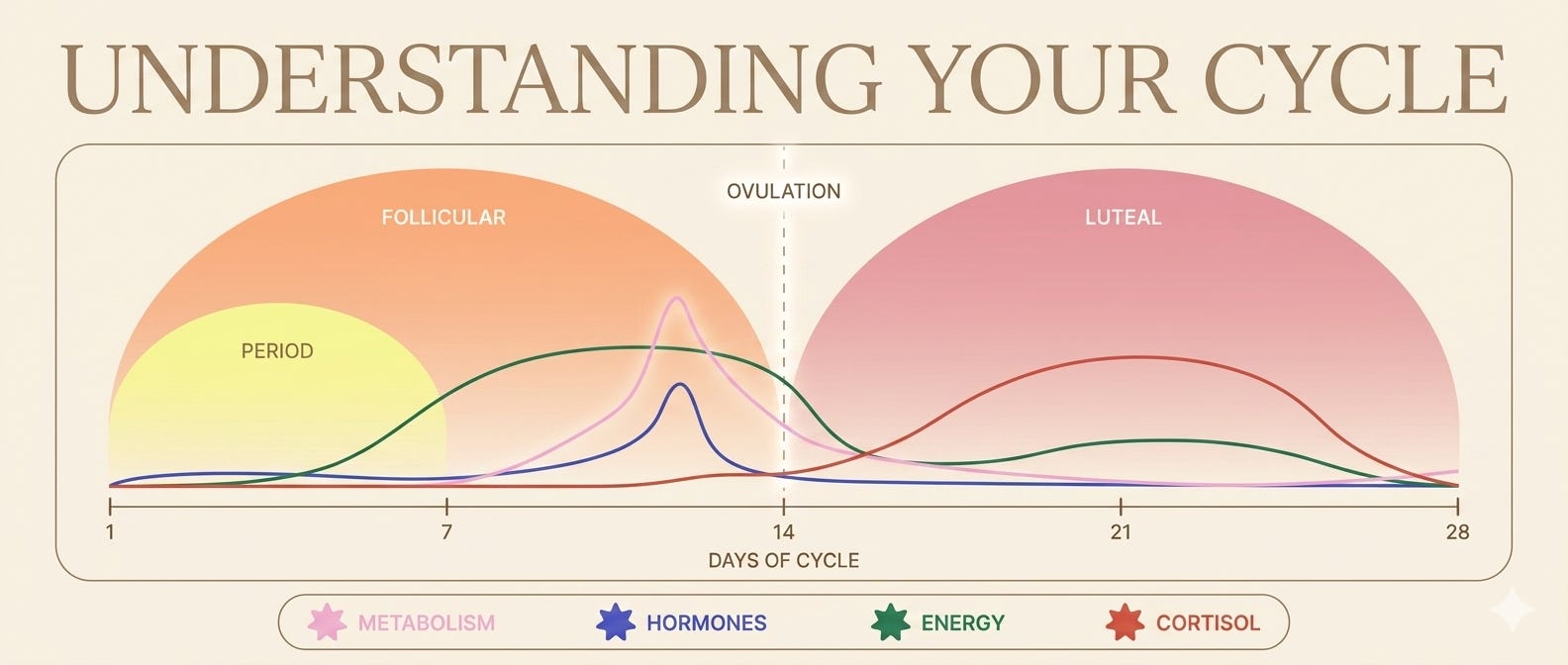
A healthy cycle can range from 21 to 35 days. The phases below are a template — a starting point, not a rule. What matters isn’t whether your cycle matches the textbook. What matters is whether it’s consistent, manageable, and not quietly trying to tell you something.
Days 1–5
Rest isn’t laziness. It’s biology asking for something specific.
Estrogen and progesterone are at their lowest. Your body is doing significant physical work, and it knows it. Energy dips, you turn inward, and emotionally you may feel more tender and quiet.
Digestive changes — cramps, bloating, loose stools — are common and hormonal. The goal isn’t to push through. It’s to minimise.
Hydrate actively — ORS, lemonade, herbal teas, fresh juices
Dark chocolate or cocoa powder for iron and magnesium (and the cravings)
Peppermint tea to ease bloating, nausea, and pain
Gentle movement only — stretching, yoga, light walking
Days 6–13
Brain fog lifts. The ideas start coming. Write them down.
As your period ends, estrogen begins to rise steadily. Energy returns, optimism colours your thinking, and there’s a quiet social openness that feels effortless. This is your most creative, focused window of the month. The hard conversations, the big pitches, the ambitious plans — this is where they belong.
Appetite may not increase much, and that’s completely normal. If you ate lightly during your period, ease back in gently — your digestive system will thank you.
Light, nutrient-dense meals — raw salads, seasonal fruit, a handful of seeds
Gentle fasting works well here if that’s part of your routine
Start building — strength training, cardio, moderate to high intensity
Days 14–16
Your peak window — physically, mentally, and socially.
Estrogen peaks. Testosterone briefly surges. For a short two-to-three day window, you are firing on all cylinders. Confidence is higher, communication flows more easily, and you’re naturally drawn toward people and connection. Schedule the important things here.
Energy and appetite both rise to match the demand. Feed it well.
More complex carbohydrates to meet the energy demand
Protein-rich foods, healthy fats, plenty of fibre
High intensity workouts — this is your peak performance window
Days 17–28
The world feels heavier. There’s a biological reason — and it has two chapters.
Early luteal (Days 17–22) — Progesterone rises after ovulation. You feel a quiet, nesting kind of calm — more inward, detail-oriented, reflective. Some women do their best deep work in this window, away from the noise.
Late luteal (Days 23–28) — As the days pass, both estrogen and progesterone begin to fall. That drop is where things get complicated. Sleep becomes lighter, hunger increases, and the emotional volume turns up. This isn’t you being difficult. This is your body responding to a hormonal shift with physiological precision.
This is also when conditions like PCOS, endometriosis, and PMDD tend to be loudest. More on that in coming editions.
Whole grains (wheat, oats, rice) plus plant protein at every major meal
Fibre-rich foods to support digestion
Tryptophan-rich foods — demand for this amino acid spikes in the late luteal phase
Maintain consistency, moderate intensity — prioritise hydration and pacing
So what do you actually do with all of this?
Start paying attention. Track your cycle — not just the dates, but how you feel in each phase. Your energy, your sleep, your mood, your appetite, your pain levels. Over a few months, a pattern will emerge. And that pattern is one of the most useful things you can bring to your gynaecologist.
You were never the problem. You were just never given the manual. Consider this the beginning of one.
Thanks for reading Pollen by Mayflower! If you liked what you read and would like to read more of it, please subscribe and receive regular updates from Mayflower.
And if you think a friend would love to read this, feel free to share it with them too. We’d appreciate it :)
No posts
Comments
Nothing yet. Say the first thing.
Sign in to join the conversation.