
“Ma’am... I think I’m bleeding.”
It was just another Tuesday afternoon. The mathematics teacher was explaining fractions while twelve-year-old Amaya sat unusually still. Something didn’t feel right. She shifted in her chair, uncomfortable and confused. Finally, she raised her hand.
“Ma’am... may I go to the washroom?” A few minutes later, she looked down—and froze. There was blood. Her heart raced. “Did I hurt myself?” “Am I sick?” “Am I dying?” She quickly folded tissue paper, hoping no one would notice, and asked the counsellor to call her mother.
When her mother arrived, she hugged her gently.
”Congratulations, sweetheart... you’ve got your first period.”
Congratulations? Amaya was confused. Her mind filled with questions.
“Why is this happening?”
“Will this happen every now and then ?”
“Can I still play?”
“Will everyone know?”
No one had prepared her. And that’s the story of countless young girls.
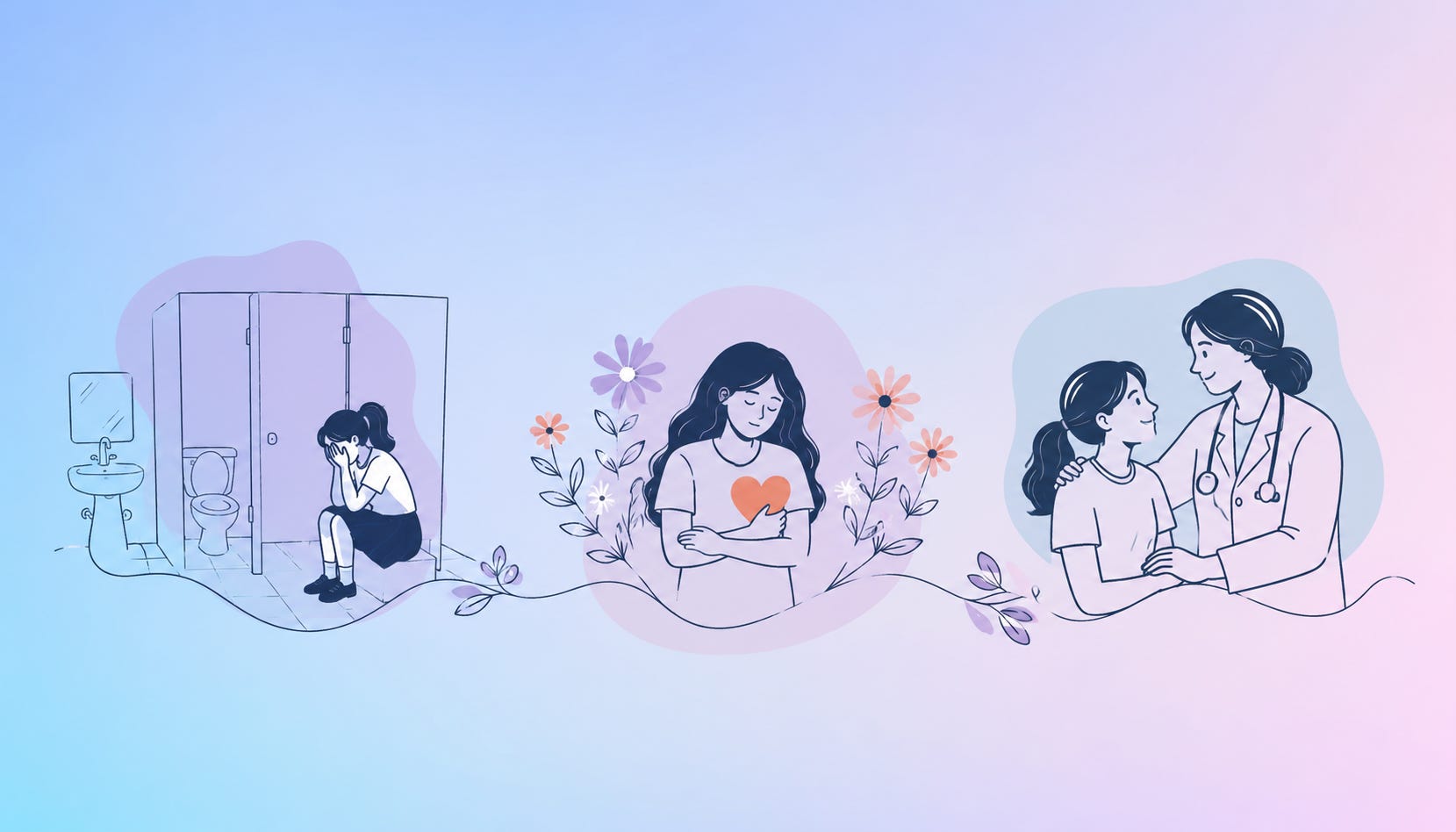
The first period is just one part of puberty.
During this phase, a girl may notice:
Rapid growth in height
Body shape changes
Breast development
Hair growth in new areas
Oily skin and acne
Irregular periods initially
Behind all this, something is changing in her body. The hormones are creating a new rhythm in her body.
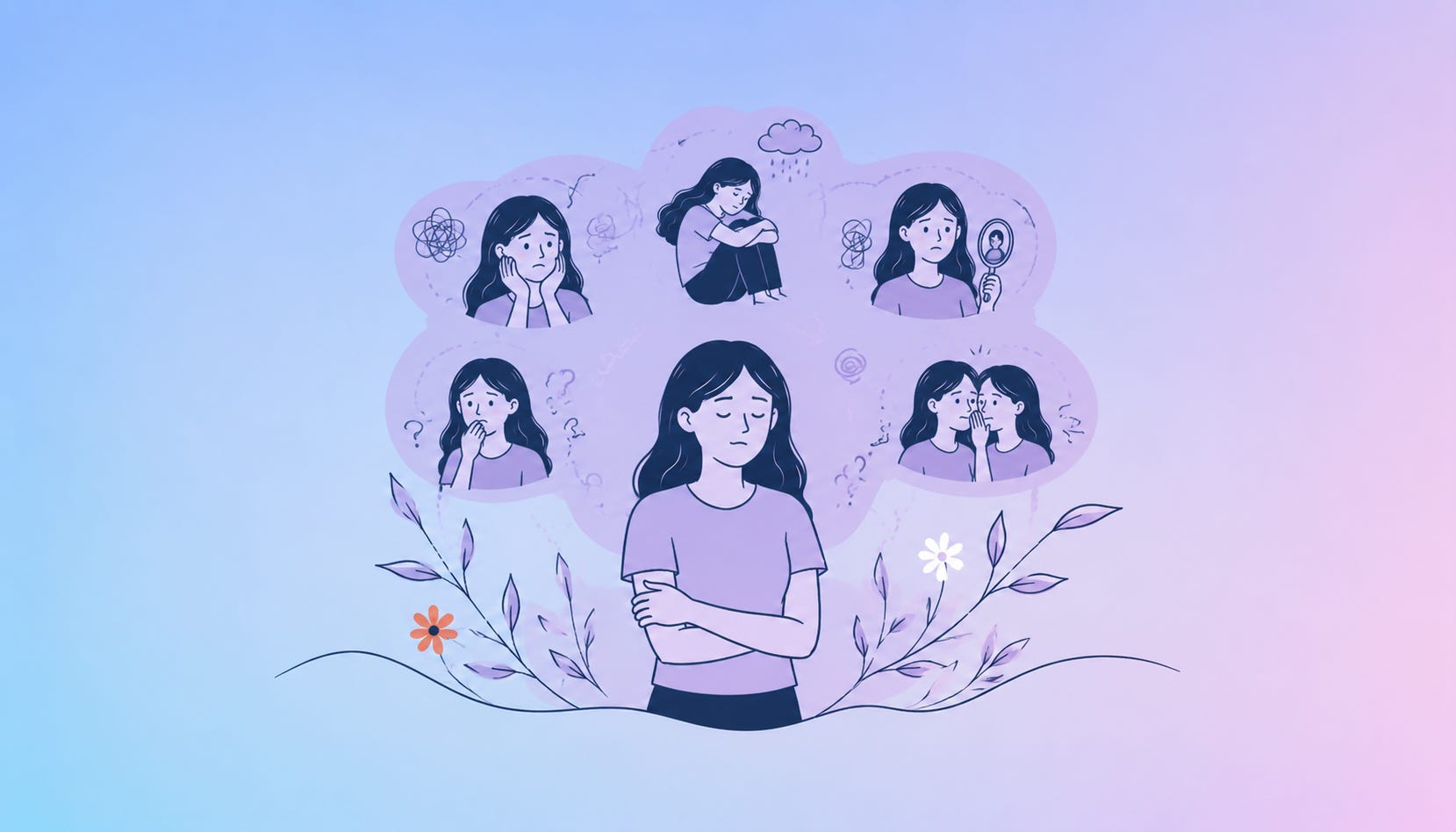
Puberty doesn’t only transform a girl’s body. It transforms her emotions too.
She may suddenly become:
more sensitive than usual.
emotional without knowing why.
worried about her appearance.
embarrassed by body changes.
confused about friendships.
anxious about fitting in.
curious about growing up but afraid to ask questions.
Mood swings become common. Confidence may fluctuate. Sometimes she laughs. Sometimes she cries. Sometimes she doesn’t understand herself. And that’s completely normal. This is precisely why puberty isn’t something a girl should navigate alone.
One of the biggest myths is that a girl should see a gynaecologist only after marriage or when she’s pregnant. Nothing could be further from the truth.
The first visit to a gynaecologist is not because something is wrong. It’s because knowledge is one of the greatest gifts we can give a growing girl. Think of it as a “Welcome to Womanhood” visit.
Most first consultations don’t involve any examination at all. Instead, they are conversations.
Comfortable, Respectful, Judgement-free. Exactly as they should be.
A girl’s first visit is an opportunity to understand her own body before myths and misinformation take over.
She can learn about:
What is a normal menstrual cycle?
Why are periods irregular in the first few years?
How much pain is considered normal?
When should heavy bleeding be investigated?
How can period cramps be managed? Which sanitary product suits her lifestyle—pads, tampons or menstrual cups?
How often should sanitary products be changed?
What is good intimate hygiene?
Can she play sports, dance, swim or travel during periods?
Why is nutrition so important during adolescence?
How do hormones affect mood, sleep and emotions?
When should acne, excessive hair growth or irregular periods be evaluated?
Instead of fear... she leaves with confidence. Instead of myths, she leaves with facts.
The Human Papillomavirus (HPV) vaccine is one of the most effective ways to protect against cervical cancer and several other HPV-related diseases. It works best when given before exposure to the virus, which is why it is recommended between 9 and 14 years of age.
Vaccination during these early years helps the body build strong, long-lasting protection—long before the risk of infection begins.
A simple decision today can significantly reduce the risk of a serious disease in the future. Prevention truly starts early.
Perhaps the most important thing isn’t when she meets her gynaecologist—it’s who she meets.
A good adolescent gynaecologist doesn’t begin with examinations. She begins with listening. She understands that behind every question is curiosity, confusion, and often a little fear.
When a girl asks, “Doctor… is this normal?” she’s often asking, “Am I okay? Can I trust you?”
The answer should always be: “Yes.”
No embarrassment. No judgment. No awkwardness.
Just kindness, science, and support—because feeling safe enough to ask questions is where good healthcare begins.
The first visit to a gynaecologist shouldn’t happen only when something is wrong. It should happen because something wonderful is happening.
Your daughter is growing up. She is entering a phase filled with physical changes, emotional growth, new questions and lifelong habits.
A trusted gynaecologist can become an educator, a guide and a reassuring presence through every stage of that journey.
If you’ve had your first period—welcome. Your body isn’t becoming strange. It’s becoming stronger.
You don’t need all the answers today.
Just remember:
Ask questions
Seek the right guidance
Trust your body
Because every confident woman once stood exactly where you are—confused, unsure, and curious. With the right support, she found clarity. And so will you.
There doesn’t have to be a problem to schedule her first visit. Think of it as a milestone—just like her first dental check-up or eye examination.
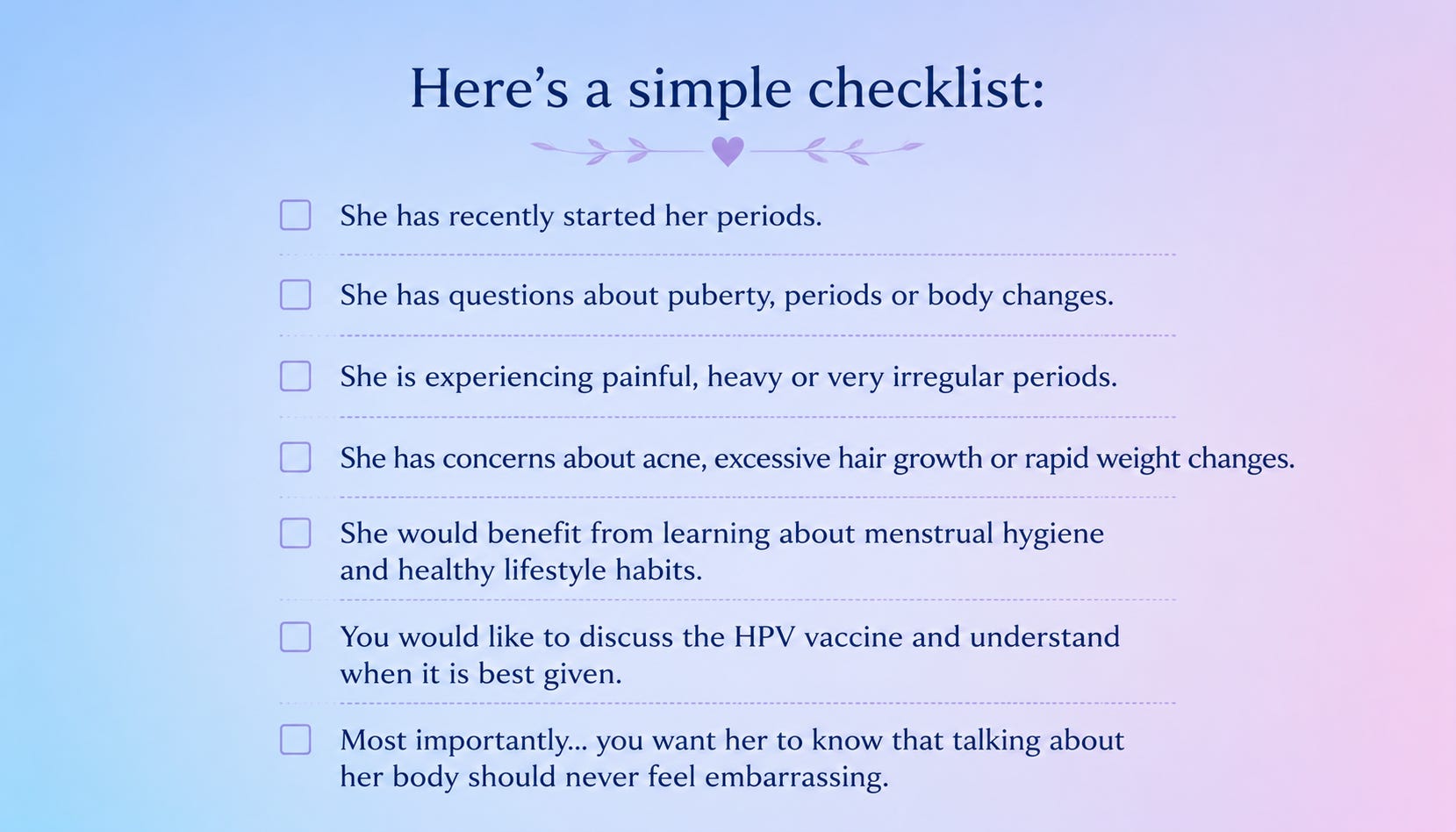
If you tick even one of these boxes, it may be the perfect time for her first visit. Remember, the goal isn’t to find a problem. The goal is to help her grow into a confident, informed and healthy young woman.
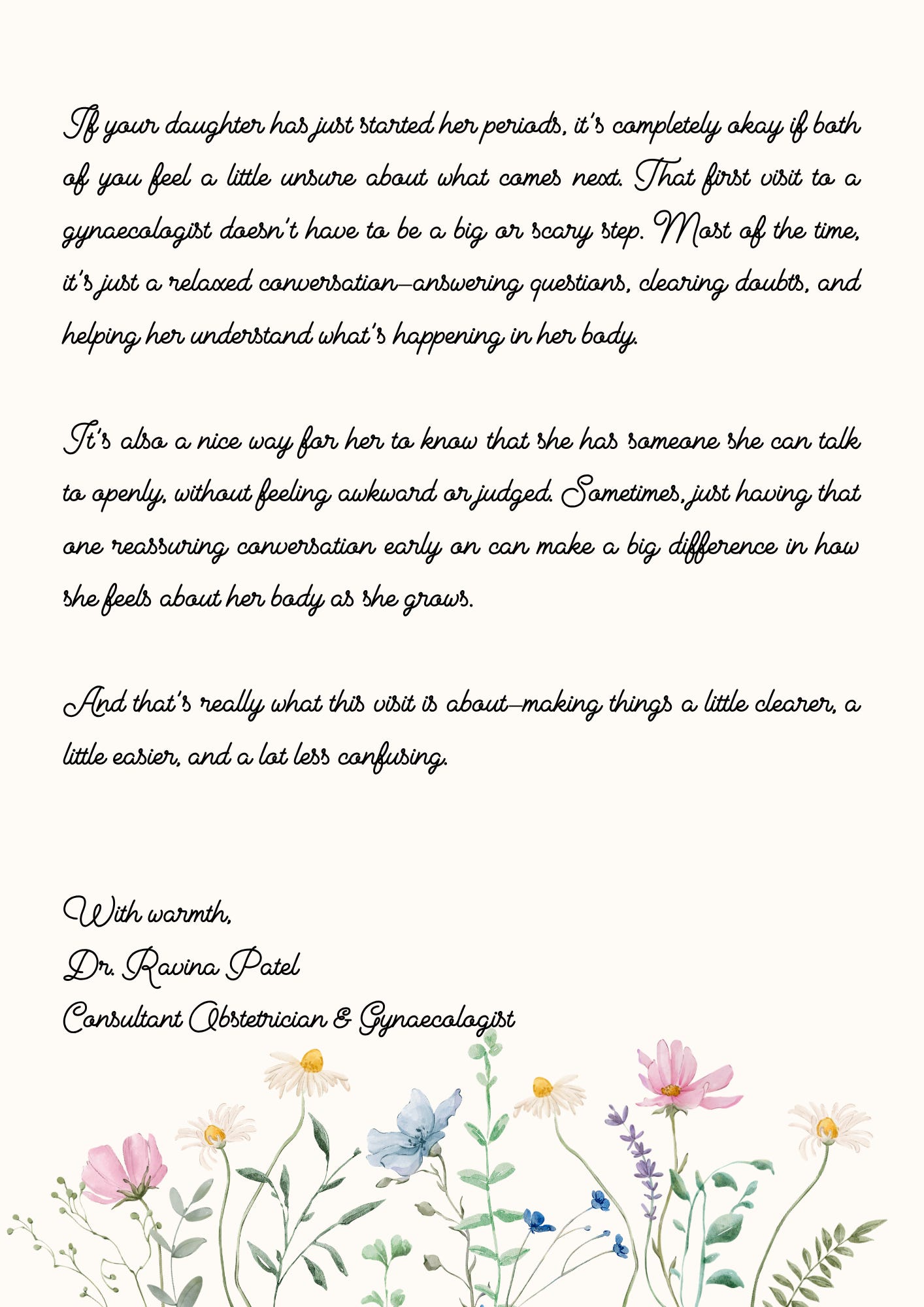
“Every girl’s first visit should begin with a conversation, not a concern.”
No posts
Comments
Nothing yet. Say the first thing.
Sign in to join the conversation.