
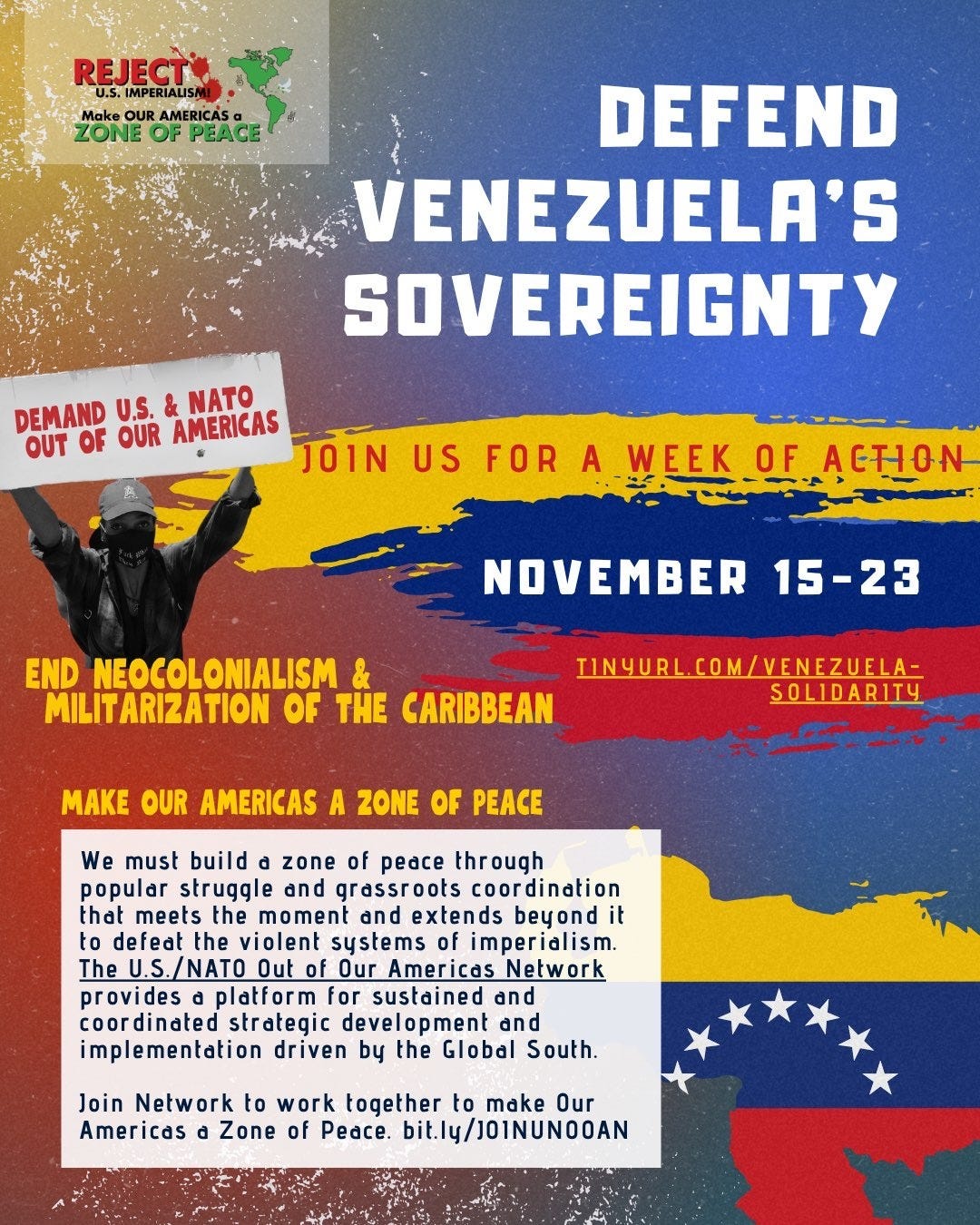
We are in the middle of an international Week of Action against U.S. War on the Caribbean and Venezuela, and today (Nov 19, 2025) specifically the U.S./NATO Out of Our Americas Network and the Black Alliance for Peace have called on people around the Americas to mobilize in order to Defend Venezuela’s Sovereignty and oppose the murderous U.S. actions over the last two months. This week of action is important and so is generally opposing the accelerating militarism and violence of the U.S. foreign policy apparatus and Trump in particular. However, for planners, organizers, activists, and anyone who cares about justice and democracy, defending Venezuelan sovereignty should not only be focus on opposing U.S. imperialism, but also protecting the transformative model of popular, comprehensive democracy that the Bolivarian Revolution and Venezuela’s communal movement represent.
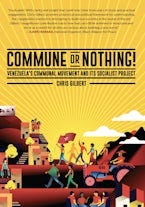
Venezuelan professor and comunera Cira Pascual Marquina recently described1 Venezuela’s communes as “the territorial spaces for the reorganization of society in economical and in political terms. They are basically the road map for building socialism in Venezuela.” For planners, Venezuela’s communal movement provides an example, and in some cases a template, for how we can undertake comprehensive planning and organizing processes that are serious about eliminating the root causes of oppression and suffering in our places and societies. This is only possible if the solutions we provide attack the core contradictions that cause this suffering and injustice in the first place, those of imperialism, capitalism, patriarchy, militarism, environmental degradation, and others. In his book Commune or Nothing, Chris Gilbert lays out how Venezuela’s communal movement has been developed through the wider process of the Bolivarian Revolution at a national level, but is built on the foundations of centuries of social and economic organizing among Indigenous peoples, African communities, and the working classes. Gilbert and Pascual Marquina, who are frequent collaborators, have written extensively about the communal movement and specific communes in far more depth and nuance that I can do here (in English, I recommend checking out their writing in Venezuela Analysis, starting with this recent series “A Story of Resistance and Renewal: The Palmarito Afro-Descendant Commune”).
It is hard to talk about Venezuela’s communal movement without going into all of the details, but for the sake of brevity, I’ll outline a few key concepts that are key:
Human emancipation and planetary survival: As Gilbert describes2, the power of communal form is that it “embrace the totality of social existence and proposes to (re)integrate productive and reproductive activities into a democratically organized whole, has the potential to transform the full range of social relations that exist in our society and thus eradicate the entire constellation of oppressions.” Unlike capitalist models, this mode of organizing production (and eventually society) takes as its goal the liberation of humans collectively and individually, the (re)establishment of ecological balance, and the institution of models that value the dignity of life and community. It is not a return to primitive communalism, but a qualitative step forward beyond the failures and harms of the status quo, towards a true and complete emancipation.
Directly social, non-alienated labor: Instead of organizing production around value realized by profits, communes in Venezuela focus on promoting mutual benefit through collective and cooperative labor. The forms that the various communal entities take are decided upon by the communes and wider communities themselves, but can include workers cooperatives that are producing goods, social cooperatives that manage human services, collective agricultural projects, community governance models, communal banking institutions and more. These forms allow for labor that is not coercive and does not produce devastating social and ecological “externalities. It is instead labor that directly addresses the social needs of communes and Venezuelan society, while also not isolating workers from the inputs, processes, and fruits of that labor. It also recognizes reproductive labor and care work as valuable and necessary, instead of regulating those to informality. What this enables are forms of communal production that can be both planned in advance and responsive to changing conditions, in a manner that puts human needs at the forefront, not profits.
Social protagonism and collective self-management: A core way that the communes and the broader movement sustain themselves is through the emphasis on changing relationships away from domination through exploitation, and toward mutual benefit through collective self-actualization. This is what has been referred to as the concept of social protagonism, or everyday people and communities taking control of their own destinies. The Venezuelan communes and communal movement build from an understanding of social protagonism at the individual, community, and institutional level to construct collective self-determination through participation, productive activity, and mutual relationship. This happens at the level of the individual enterprise/project, within the commune and local communal councils, between communes at a regional and national level, and with other movements and institutions at an international level.
National coordination for autonomous power and grassroots planning: The Unión Comunera builds a national, federated, autonomous base of power for the communes and their members, and helps to organize economic and logistical connections as well. Outside of this formal structure, many of the communes engage in regular communal exchange at all scales, which has been particularly important in breaking down urban-rural divides that are so politically and culturally tenuous in the modern world. This importantly fosters a change in relationship from competition to cooperation.
These are just a few of the key aspects that make individual communes and the communal movement as a whole such a critical inspiration and learning opportunity for us who live, work, and organize under the daily pressures of an unrepentant capitalist imperialist society.
Venezuela’s communes have developed and are now beginning to flourish because of the Bolivarian Revolution and the broader project of building Venezuelan national sovereignty. In a more recent piece for Monthly Review3, Gilbert discusses the importance of connecting communes and anti-imperialism, diving deep into how communes must refuse isolation, but instead must be engaged in broader national and international processes that oppose capitalist imperialism systematically. Core to this anti-imperialist politics, Gilbert notes, is not writing off the need to use state power to intervene against imperialism, and the possibilities of communal movements to transform state power from the grassroots upward.
In fact, state power has been crucial in guaranteeing the expansion and interconnection of the communal movement. This is why in Hugo Chavez’s famed ‘Strike at the Helm!’ speech, he emphasized the need to build out a vision for communal socialism within the Bolivarian Revolution. Venezuela now has a Ministry of Communes, Social Movements, and Urban Agriculture, whose head is Angel Prado, one of the key leaders of the communal movement in the last decade and founder of El Maizal Commune. On November 23rd, Venezuela will also complete its fourth National Popular Consultation, where citizens utilized processes of direct democracy to vote on social projects that will be implemented throughout the country. This consultative process relies on the foundations of 5,336 communal circuits and 3,652 communes to bring truly grassroots direct democracy to a national scale and coordination.
All of this has been possible because of the grassroots power and material impact of the communes with respect to the lives of everyday Venezuelans, as well as the national articulations of this movement, most prominently the Unión Comunera. This model of real popular power, human dignity and protagonism is what propels the communes to be the strongest source of militia volunteers to defend their homeland from U.S. aggression. If there is one lesson here for those of us outside of Venezuela it is that we must engage in processes of real, revolutionary organization geared toward changing social relations and our everyday material realities, understanding the role and interests of various existing institutions of power.
For all of us who see collective self-determination, human dignity, ecological balance, and popular democracy as objectives, the progressive developments in Venezuela over the last 25+ years should inspire us. And we cannot fall victim to the counter-revolutionary tactic of claiming that these developments have happened despite the Bolivarian Revolution — the two are intertwined. Venezuela’s popular and national sovereignty is a crucial prerequisite to the continuing expansion of popular sovereignty and democracy in Venezuela, socially, economically, and politically. As Minister of Communes Angel Prado stated clearly in a recent interview: “Venezuela is committed to transforming the state, building a new society, constructing rue democracy, and preserving national independence. We are also committed to building socialism…and the people are driving this forward.”
Knowing this, we must join the peoples and nations of Our Americas in educating, agitating, mobilizing, and organizing to defend Venzuela’s Sovereignty, and construct a Zone of Peace in Our Americas. ¡Comuna o Nada!
Upstream Podcast, “Venezuela Pt. 3: Sanctions as Economic Warfare w/ Cira Pascual Marquina”
Chris Gilbert, Commune or Nothing. Monthly Review Press, New York: 2023.
I am planning to do a more full review of this issue of Monthly Review: “Communes in Socialist Construction”, but in the meantime I highly recommend that folks in interested in the subject read it front to back.
No posts
Comments
Nothing yet. Say the first thing.
Sign in to join the conversation.