
I have been in Government and seen the submissions and options paper for social care reform. I have been in meetings with number 10 and the Treasury trying to find common ground, without success.
So with those scars I set out to write a piece on Burnham’s social care reform plan. This started out as a piece to answer a simple question ‘is a cross party consensus on social care possible?’
My hypothesis was no; but in building the piece I landed on something interesting, both on how to make social care reform more sticky and what Burnham might actually be up to. Do grab a hot or cold drink as this is a slightly long one!
A short voice note is here to summarise the thrust of the piece
0:00
-8:43
Every serious attempt to reform social care in England over recent decades has ended the same way: in defeat. Political parties have seen greater opportunity in attacking reforms rather than delivering them. Ed Davey counts 22 failed attempts since 1997, while the King’s Fund reports at least 20 significant reviews and reform efforts since 1948.
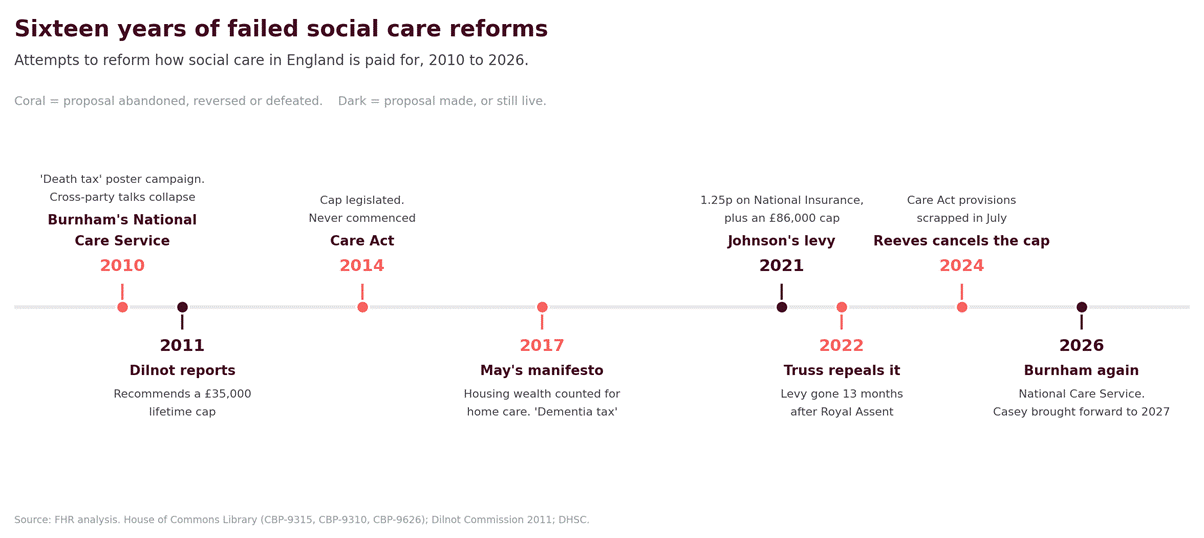
Attempts to reform how social care in England is paid for, 2010 to 2026.
This is one of the reasons why social care reform comes with well heard siren-calls for a ‘cross-party consensus’.
On the surface the logic feels sound. Reform costs money up front and delivers over decades. No government will spend that political capital if the next one can simply reverse it.
However the reality of delivering a cross-party consensus on this issue should not be under-estimated. Indeed many such as Isabel Hardman in this piece think it impossible.
So is it?
Let’s start with the announcement. Burnham announced three things this week.
A National Care Service “fully integrated” into the NHS, asking the ministerial group led by Yvette Cooper, Angela Rayner and John Healey to build outwards from the fair pay agreement already legislated for 2028-29. The framing was workforce: lifting social care “closer to NHS standards”, progression routes from care into NHS roles, “one workforce”. He paid tribute to former Prime Minister Sir Keir Starmer for the fair pay agreement, calling it a “massive building block”
He brought Baroness Casey’s Commission forward by a year, to 2027 (as I speculated on the Prevention is the New Cure podcast in early June), and tasked her explicitly with funding options
And separately, he tried to convene cross-party talks. Kemi Badenoch did not attend, sending shadow health secretary Stuart Andrew instead, having written ahead to challenge Burnham to rule out tax rises or increased borrowing. A Conservative source called the short-notice invitation “almost like it’s only being done for show”. Ed Davey joined by video link. Reform UK and the Greens were not invited at all, and Nigel Farage called it the “uniparty in action”. Zack Polanski was more measured, saying he would like to be included but that “the point is not politicians’ personal egos”
Burnham’s own pitch was the strongest part of the day. He called it a “major dereliction of public duty” that Parliament has not faced up to the issue, said “social care in England is as unfair as American healthcare”, and told the room: “You’ve probably got a feeling of déjà vu. Don’t have that. This time we’re going to do it.”
Burnham’s social care reform pitch comes against a backdrop where voters are largely unaware of how the system is funded.
Approximately 33% of people in England believe social care is free at the point of need and 31% believe the NHS provides most of it, and neither figure has shifted since 2022.
Adult social care in England is means-tested. The upper capital limit is £23,250: above it you pay for everything. The lower limit is £14,250: below it your capital is disregarded and you contribute from income. As Tax Policy Associates notes, 2026-27 is the sixteenth consecutive year they have been frozen; uprated with prices the upper threshold would be worth roughly £36,400.
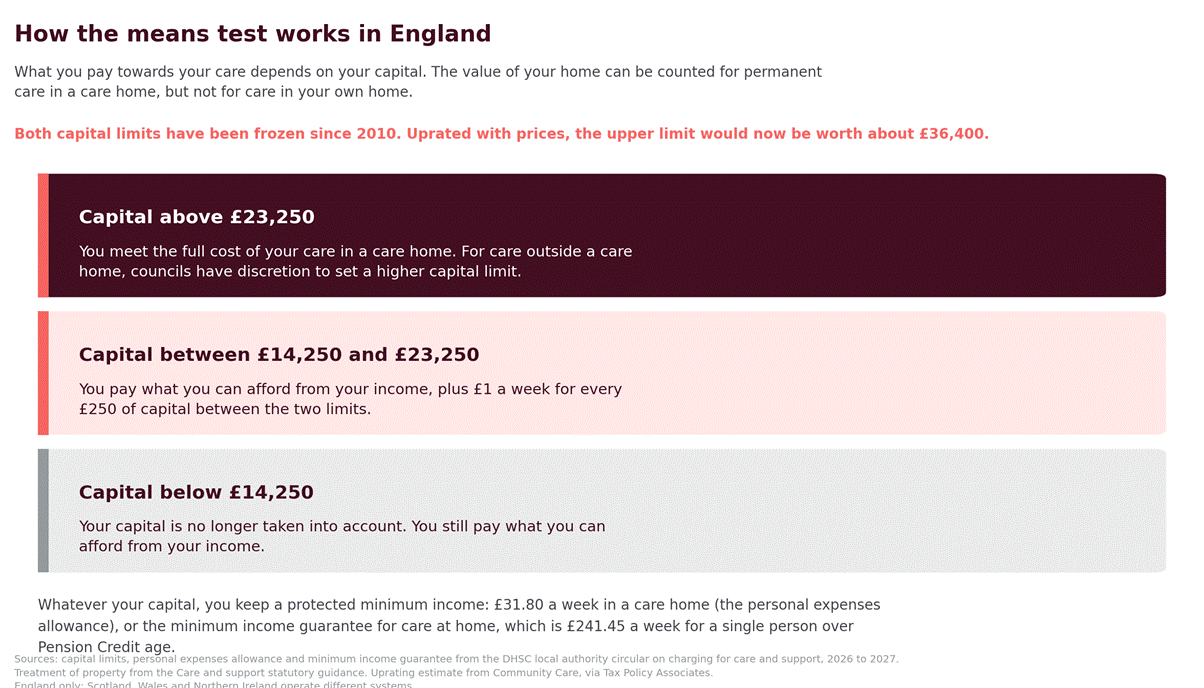
The means test in England, 2026-27. Both capital limits have been frozen since 2010.
Self-funders subsidise the state: the Competition and Markets Authority found self-funders typically pay around 40% more than councils for identical care. Roughly half of residents in care homes for older people fund themselves. And access has not kept pace with the ageing population: 890,000 people received publicly funded long-term care in 2024/25, of whom 576,000 were over 65. That is the highest number since comparable records began in 2015/16. But measured against the population it is a fall, not a rise: 6% of people aged 65 and over were receiving publicly funded long-term care in 2015/16, against 5.2% in 2024/25.
Current spending is roughly £28.7bn in 2024/25, and the Health Foundation estimates an extra £9.4bn will be needed by 2034/35 simply to keep pace with demography.
The Health Foundation published estimates of high-level reform costings on 24 July.
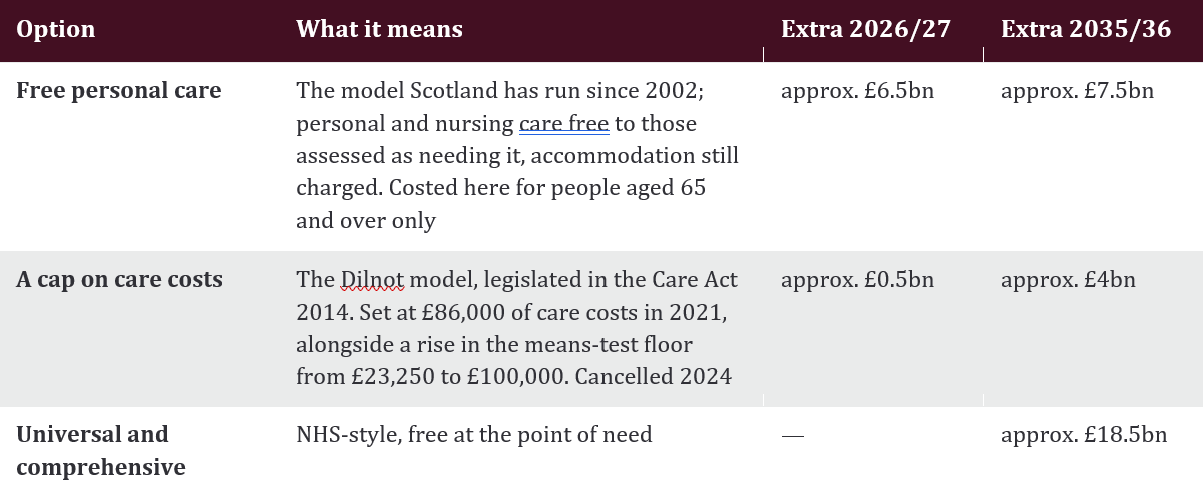
Health Foundation estimates, 2026/27 prices. The comprehensive figure excludes suppressed demand from people currently going without.
Other options include Re:State’s Beyond Caring proposal – to which Burnham himself contributed – that splits working-age and later-life care entirely, with mandatory contributions of around 1.8% of income from age 34 into a managed Later Life Care Fund, and a protected asset floor of £75,000.
Burnham has said he wants social care to work on NHS principles. If that means fully free at the point of need this is a significant spending commitment (particularly when weighed up against defence spending and other pressures). Though for now he has ruled out additional taxes to pay for such a move.
I spoke to LBC about how unpalatable these options really are and you can listen to the exchange below:
0:00
-4:15
Knowledge of how the system works may be relatively low but there is a surprising degree of alignment between supporters of different political parties on the importance of the service, their satisfaction (or lack of) with it and the changes they feel it needs.
On importance, Ipsos’s 2024 general election campaign tracker asked voters in late June 2024 which issues would be very important in deciding their vote. Healthcare and the NHS came first, on 65%. Care for older and disabled people made the top ten, with 37% of Labour voters naming it as a top issue compared with the Liberal Democrats 34% and Conservatives 33%. The King’s Fund puts the figure across all voters at 31%. Unprompted however, social care ranked only 20th in Ipsos’s October 2025 issues index, with just two respondents out of 1,002 naming it the most important issue facing the country.
On satisfaction, the 2024 British Social Attitudes survey found satisfaction at 13% and dissatisfaction at 53%, the worst since the series began in 2005, with no significant differences between Labour, Conservative, Liberal Democrat and Reform supporters, and none by age or sex.
On who should pay, Health Foundation and Ipsos polling from May 2025 found a clear majority for a universal element, with those who can afford it contributing on top:
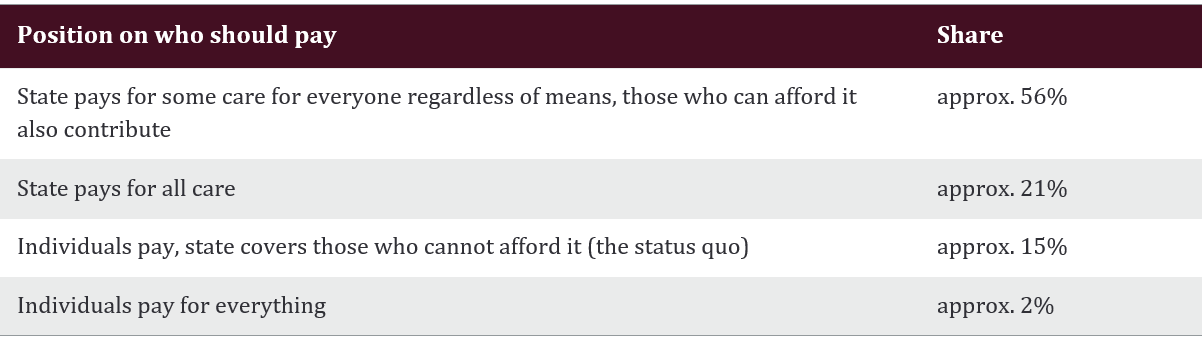
The Health Foundation found that Green (30%) and Reform UK (28%) voters were more likely than average to want the state to pay for everything, and that there were “few other notable differences between different population groups.”
The electorate is not split by party on the offer. Indeed if anyone is an outlier it is Reform UK, whose voters are the most collectivist of any group bar the Greens (which is more expected).
So if voters across parties want broadly the same thing, why has a cross-party approach to reform never worked?
Let’s start by looking at where the parties are on social care reform today.
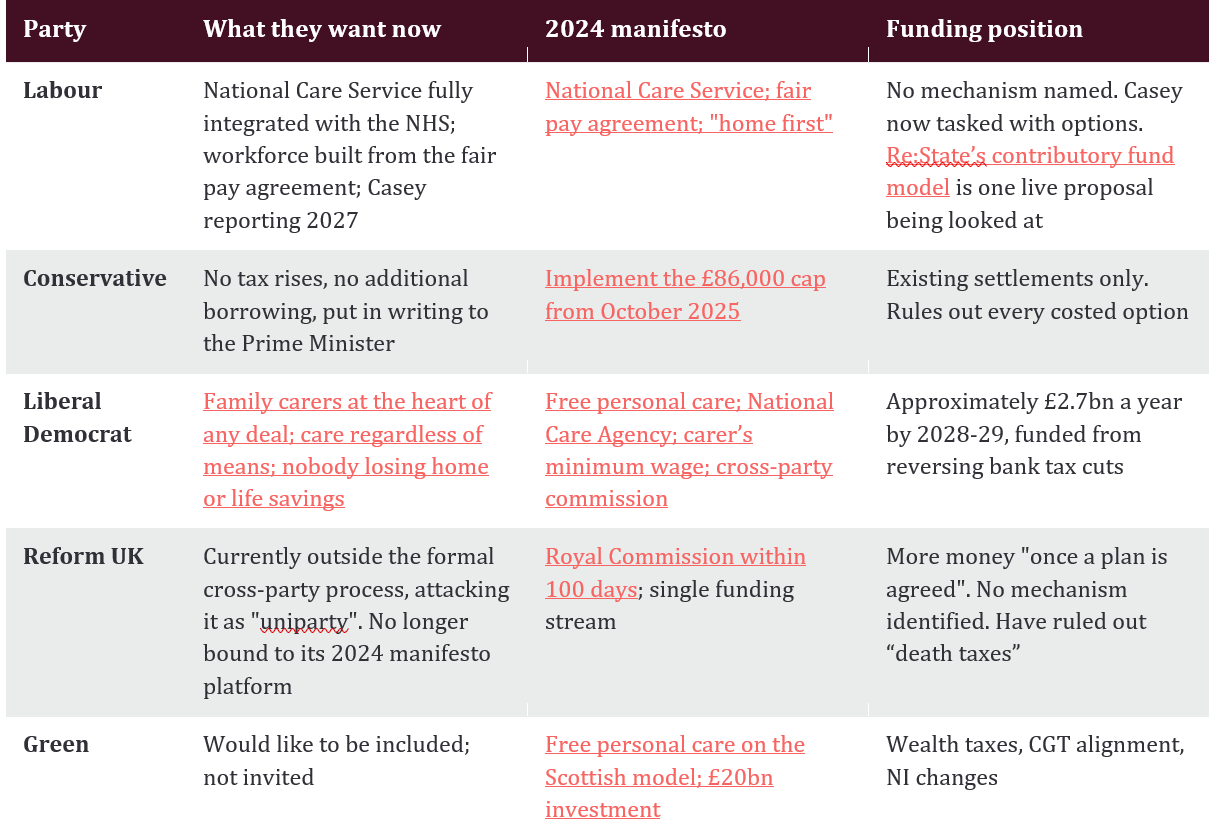
Looking at the grid, three of the five parties went into 2024 asking for a commission or cross-party process rather than a policy: the 2024 consensus therefore was more about how to decide the reform plan, not what to do. However both the Lib Dems and the Greens called for the introduction of free personal care, linked to bank and wealth taxes. Reform UK has seemingly travelled furthest from its own manifesto, denouncing a commission it once demanded (though in fairness they have not been invited into the talks yet).
The different party policy positions are heavily driven by fears of how to incorporate housing wealth and associated ‘accommodation costs’ into the care equation.
The evidence that this is a universal rather than partisan taboo is strong.
Just Group’s Care Report 2025, the thirteenth edition of the longest-running survey of public attitudes to care in England and Northern Ireland, put a series of funding models to over-45s. A safety net came close to consensus: 68% agreed the state should pay when someone cannot pay for themselves, against 7% who disagreed. Full state funding for everyone was supported, though divided across the sample, 42% for and 26% against.
Asked whether the state should pay once a person has contributed up to a set limit, for example £86,000, 52% of over-45s agreed and just 14% disagreed. This is the care cost cap.
The Conservative position here is perhaps most instructive. Following the pandemic in 2021, and its devastating impact on social care, the Johnson government faced the same arithmetic every government faces: reform needs money. It chose to raise that money by taxing working-age earnings through the Health and Social Care Levy, a 1.25 point rise in National Insurance, rather than by touching assets. The £86,000 cap it introduced alongside, and the rise in the means-test floor from £23,250 to £100,000 that went with it, were explicitly designed to protect estates. A Conservative government with an eighty-seat majority declined to use housing wealth as a funding source. Then Liz Truss repealed the levy months later.
So the modern Conservative Party has demonstrated both that it will not fund social care from housing wealth, and that it cannot sustain funding it from tax either.
The red lines in Badenoch’s letter are therefore not only positioning and posturing they are based on the substance of the party’s actual position.
In some ways then a care cap looks like a potential landing zone for consensus. It commands cross-cutting public support when described. It is already on the statute book. The Conservatives legislated it and the Liberal Democrats have supported it.
However it is not going to be Labour policy. Rachel Reeves cancelled the funding of the cap in July 2024 – with the County Councils Network costing the reforms at around £30bn over a decade.
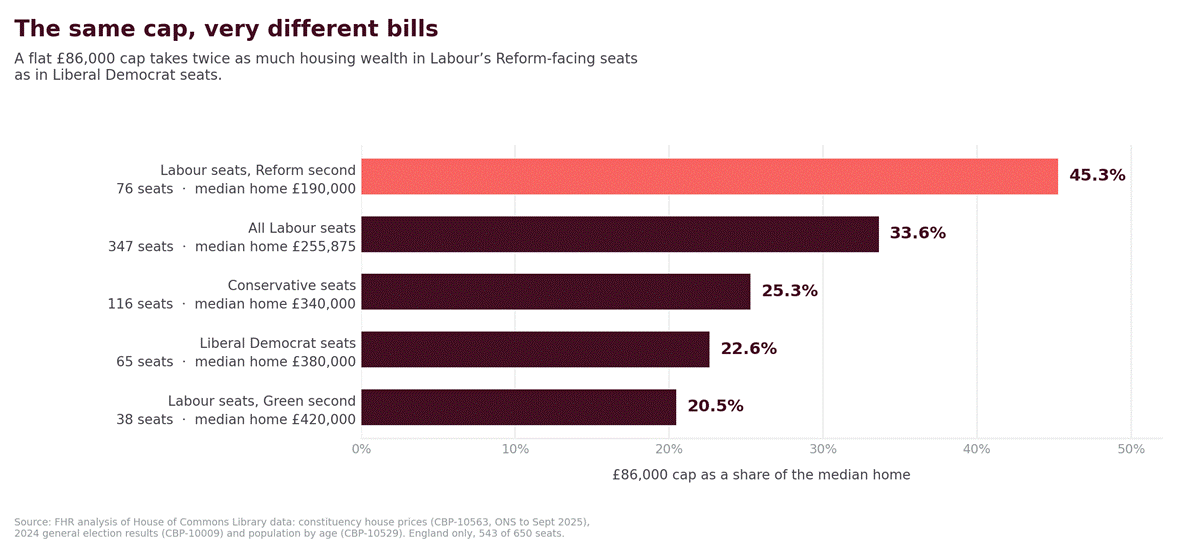
But the cap model generally does not work for Labour. An £86,000 cap is a fixed cash sum applied to a variable: the value of a home.
To look at the politics of this I merged three House of Commons Library datasets on 2024 boundaries: constituency house prices (ONS data to September 2025), the 2024 election results, and population by age. House price data covers England and Wales, but social care is devolved and a Care Act cap would apply in England only, so this runs on the 543 English seats.
The result is stark.
FHR analysis of House of Commons Library data.
In the 76 English Labour seats where Reform came second in 2024, the cap consumes 45.3% of the median home. In Liberal Democrat seats it consumes only 22.6%.
Liberal Democrat seats are the wealthiest in the country – With a median house price of £380,000, higher than Conservative seats and almost 50% above the Labour median. Not one of the 65 Lib Dem seats in England sits among the 100 least expensive constituencies; 31% sit among the 100 most expensive. Exactly two Conservative seats out of 116 are in the hundred least expensive.
And the seats with the highest share of older people are the seats where the cap provides greatest protection – Of the 100 constituencies with the highest share of residents aged 65 and over, 47 are Conservative and 22 Liberal Democrat against 26 Labour. Conservative seats are the oldest in the country (median 23.3% over 65) with the Lib Dems close behind (21.7%), against 17.3% for Labour.
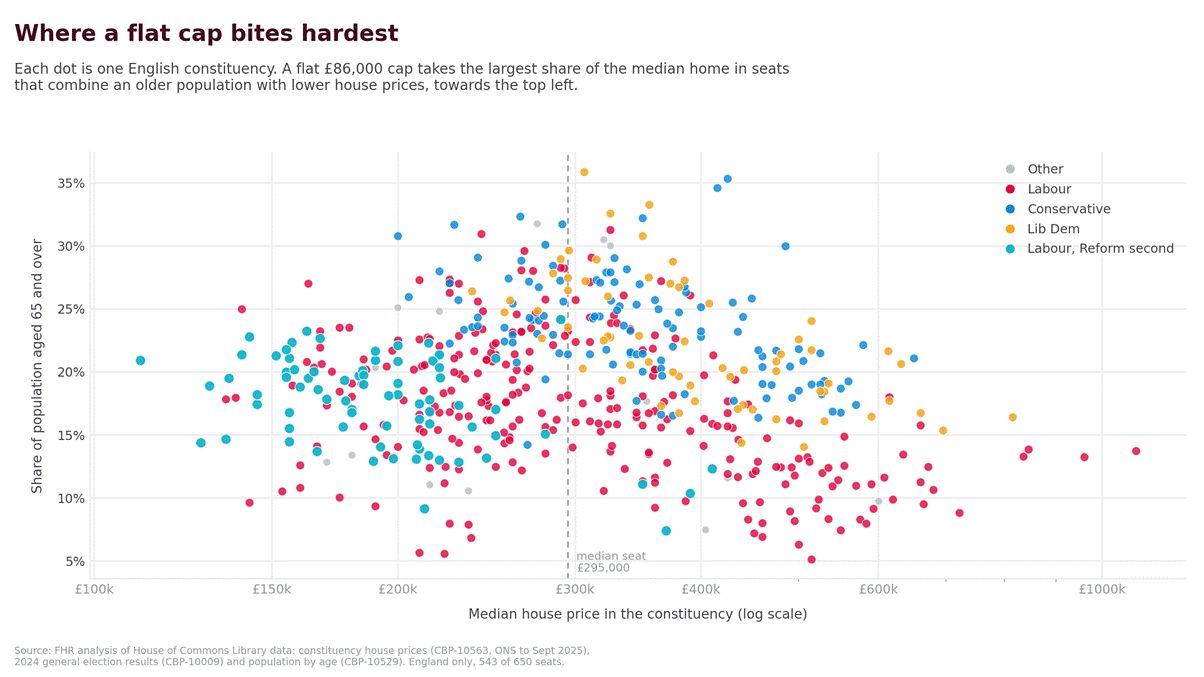
Each dot is one English constituency. FHR analysis of House of Commons Library data.
Those on the left of the chart above are constituencies with lower median house prices. Those seats are overwhelmingly Labour, and disproportionately the ones where Reform UK is breathing down Labour’s neck (the turquoise dots). A cap in these seats will have far less impact than in those seats on the right of the graph.
Interestingly a cap would seriously split the Labour Party, between the more affluent Southern seats (bottom right) and the less affluent Northern seats (middle left).
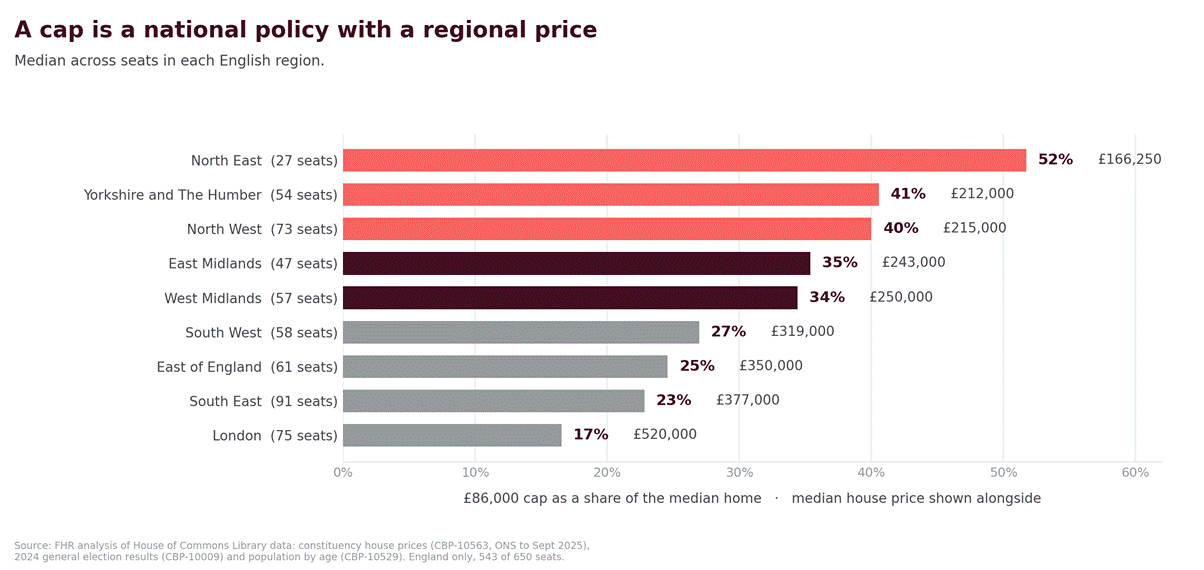
Looking at the pattern regionally confirms this.
FHR analysis of House of Commons Library data.
In the North East the cap takes 52% of the median home. In London, 17%. This is not a new observation, but it now has current numbers behind it: Department of Health modelling reported in September 2021 suggested people in the South East would be better off on average than those in the North East. Dilnot himself warned of a north-south axis, singling out areas with lower house prices such as Hull as likely to be hit hardest.
There is of a course a counter measure here aiming to mitigate these impacts. The means-test floor. The 2021 package raised the means-test floor, from £23,250 to £100,000. The floor works in the opposite direction to the cap. A £100,000 floor protects 53% of the median home in Labour’s Reform-facing seats against 26% in Liberal Democrat seats. Where the cap is regressive across the country, the floor is progressive.
And it does real work at the bottom of the market. In 64 English seats the median home is worth less than £186,000, which is the point at which the floor starts to bite before the cap does and total exposure falls below £86,000. Sixty-two of those 64 seats are Labour-held, and 36 of them are seats where Reform came second at the last election. Raise the floor and the worst case across seats in England falls from 77% of the median home to 46%, and the gap between the North East and London narrows from 35 points to 23.
But narrowing is not a closing and as a man who has heavily burnished his northern roots and who faces a challenge from Reform UK in the region, Prime Minister Andy Burnham is not going to introduce a cap on care costs against this backdrop. Indeed whilst not completely ruling it out, he argued against the regional unfairness of the cap in 2014.
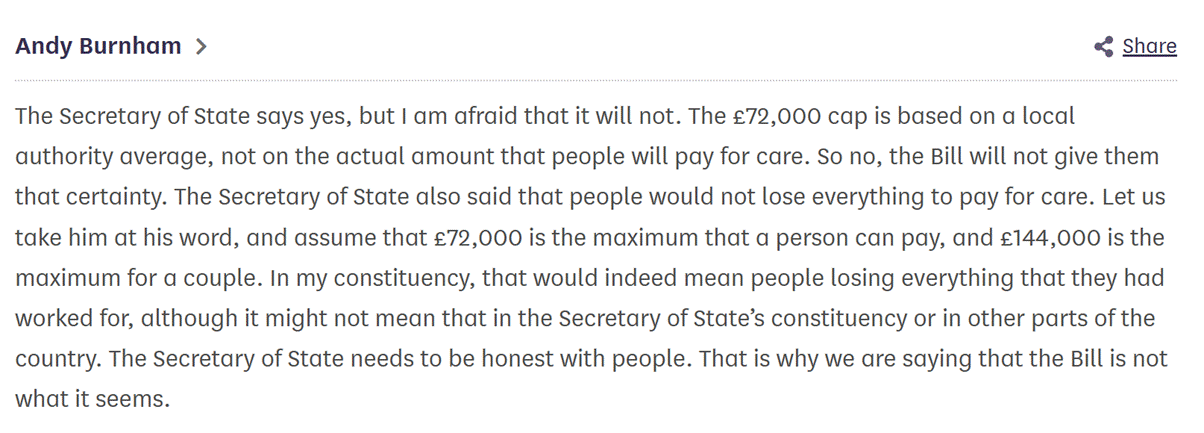
The cap is also the clearest evidence that legislation alone does not create durability in this space. Recommended by Dilnot in 2011. Legislated in the Care Act 2014. Scheduled for 2016, deferred. Revived in 2021. Postponed to 2025. Cancelled in 2024. It sat on the statute book under six Prime Ministers and was never taken forward.
Burnham’s approach to tackling this durability element is potentially more interesting and is structural than legislative, namely: integrating care into the NHS deeply enough that pulling it out again would be very difficult for future administrations to do.
This is a long-held position, not a new one. Burnham has long championed the role of local government in health. During discussions on the Dilnot cap in 2014 he argued against the false economy of cutting local government budgets to cut the NHS.
In 2013 he used a King’s Fund speech to call for full integration into a single health and care service, and then commissioned Sir John Oldham’s Independent Commission on Whole Person Care to work out how. Its 2014 report, One Person One Team One System, became the architecture of Labour’s January 2015 ten-year plan for health and care: health and wellbeing boards as a single commissioner, a single pooled health and care budget, and “year of care” budgets covering both a person’s health and their social care needs. The “one workforce” language from his reform speech this week is that argument a decade on.
It also has recent cross-party pedigree, which is what makes it plausible as a potential anchor. Sajid Javid and Michael Gove’s 2022 integration white paper committed to pooled budgets becoming routine “wherever possible” and eventually covering much of the funding for health and social care at place level. Merged budgets are one of very few social care ideas a Conservative Health and Social Care Secretary has advocated for in the past five years.
So the idea for Burnham would be to use Casey (who herself talked about the injustice of cancer versus dementia care on her media round and through her Commission) to advocate for a shared health and care system with joint budgets. Fusing social care to the NHS and pooling the budgets would be far harder for other parties to subsequently unwind – doing so would become disruptive, costly and lead to some fiendish edge cases emerging.
It would be a National Healthcare Service (or National Health and Care Service as Casey herself said on Radio 4…)
There are of course HUGE questions about how this would work in practice, how money would be divided up and what the NHS would have to do (i.e de-prioritise) to absorb it and how social care would avoid becoming a junior partner in it; but it may be the way to actually make the reforms durable.
On the traditional policy options for social care reform a Labour-Conservative agreement is a non-starter: every costed option needs money, and the Conservative precondition excludes new funding from increased spending or tax. Reform has said it will oppose any similar Government moves on tax in this space.
That leaves a narrower and more progressive arrangement: Labour with the Liberal Democrats, and possibly the Greens.
The case for it – Labour and the Lib Dems barely compete electorally. Of 65 Lib Dem seats in England, the Conservatives were second in 63 and Labour in only two. Labour and the Lib Dems together held 483 seats after July 2024, 487 with the Greens, a majority large enough to legislate and to bind a successor. The Lib Dems have demanded cross-party talks for years and cannot easily walk away from talks they have asked for. Two of their three tests, carers at the centre and care regardless of means, sit comfortably inside Labour’s policy space. The third however does not. “Nobody losing their home or life savings” is an asset-protection guarantee, and on the geography set out above an asset guarantee is worth most in the seats the Lib Dems already hold and least in the seats Labour has to defend. That is the test that will have to give. The Greens’ 2024 offer of free personal care on the Scottish model, by contrast, is close to the Lib Dem position on substance and could be made to work for Labour too.
There is also something in Burnham’s own method here and a desire to do politics differently that is worth exploring briefly. Nine years running a combined authority as mayor of Greater Manchester depends on continual negotiation with councils, not all of them Labour, and Burnham has described his approach as putting place first rather than party first. He co-chaired the board of NHS Greater Manchester’s Integrated Care Partnership, building on the health devolution deal struck in 2015. Cross-party working is something Burnham has actually practised and wants to do more of.
The case against it - There are three main problems with a progressive alliance approach as set out here.
It is not a national consensus – It excludes the party that has led national polling for most of the past eighteen months, and Farage has already characterised it as an establishment stitch-up. That characterisation would not be entirely unfair
It does not solve the durability problem it exists to solve – The point of consensus is that a settlement survives a change of government. A settlement agreed by the centre-left and rejected by the right survives only as long as the centre-left governs (this opens up a whole range of questions about proportional representation and electoral reform that I won’t go into here!)
The distributional data cuts against it – The thing the Lib Dems most want, protection of the family home, is worth most in the seats they already hold and least in the seats Labour must defend against Reform. Labour’s Green-facing seats have a median home of £420,000 and have a similar profile to Lib Dem seats; its Reform-facing seats sit at a median home value of £190,000. Labour holds 93 of the 100 least expensive constituencies in England, and 52 of the 100 most expensive. There is no single Labour interest here to represent which makes alignment a challenge
But that alignment challenge is an argument against the cap/floor, not against the alliance being able to come to an agreement.
And free personal care might be a landing zone.
It is allocated on need rather than assets, so it is worth as much in Burnley, Easington and Middlesbrough as in Esher or Cheltenham, and it does not ask a Red Wall homeowner to underwrite the protection of a Surrey estate.
It is also the one costed option all three potential partners have already argued for: the Liberal Democrats and the Greens in their 2024 manifestos, and Burnham himself has hinted at it. It is not cheap, at approximately £6.5bn in 2026/27 rising to approximately £7.5bn by 2035/36 on the Health Foundation’s numbers, and those figures cover people aged 65 and over only. Scotland extended free personal care to working-age adults in 2019, and doing the same here would cost more again. But it is the option where the politics might work best for these parties.
A traditional model of cross-party consensus, the kind that puts the main opposition, the Conservatives and/or the poll leaders – Reform UK inside the tent, is unlikely. Every costed option needs money. The Conservative precondition excludes money, and Reform UK has ruled out further tax rises.
A progressive arrangement has some potential.
It is not impossible to pull off, but it will require compromise from everyone in the room, and Davey has already conceded the point, calling his first conversation with Burnham constructive and adding that everyone will have to accept things they might not like.
For the Liberal Democrats the compromise is giving up the flat cap and the asset guarantee that sits behind it. For Labour the compromise is to raise funding for social care at the expense of other policy areas - and potentially slow down on aspects of core NHS business to do so. For the Greens the policy is already what they asked for in 2024. Their compromise is over how it gets paid for, since aspects of their plans: the wealth taxes, capital gains alignment and National Insurance changes in their manifesto won’t all get past the Treasury.
The landing zone then for a cross-party consensus, if there is one, is free personal care rather than a cap/floor.
And to make it stick (with the Conservatives and Reform UK on the outside), the approach might be to fuse it to the NHS and finally walk the walk on joint budgets.
Indeed that is perhaps the most interesting part of the announcement this week.
Legislation did not protect the Dilnot cap: it was put onto the statute book across multiple Prime Ministers and was never implemented. A more embedded structural lock might have more success. A service where the money, the workforce and the accountability are genuinely shared is one a future government would have to proactively dismantle rather than simply decline to commence.
So a National Health AND Care Service then? After writing this I don’t think it’s impossible.
No posts
Comments
Nothing yet. Say the first thing.
Sign in to join the conversation.