
Last Thursday the Defence Secretary resigned. John Healey told the Prime Minister he could not accept a Defence Investment Plan that, on its own numbers, reaches just 2.68% of GDP by 2030 – when he, and the Prime Minister’s own assessment of the threat from Russia, judge 3% to be the minimum needed.
What does that have to do with the NHS?
In April I wrote here that the conditions which sustained rising health spending for thirty-five years – a falling defence budget, a growing economy and a willing taxpayer – had quietly expired. Now a senior minister has walked over precisely this collision.
Reach back further than I did then and the inversion is stark. In 1955–56 the UK spent around 7.6% of GDP on defence and under 3% on health. Today those figures have not just crossed but inverted.
For most of that period the trade was fairly painless, but that has now ended. The recent top-ups to defence came from raiding the aid budget – and that is all but gone too. The Strategic Defence Review set out a genuinely more dangerous world: Russia, the High North, the Strait of Hormuz. NATO’s allies have signed up to head towards 5% of GDP on defence and security by 2035. For the first time in a generation, defence needs some proper investment and with economic growth low, that investment needs to come from somewhere. Welfare and public services are obvious candidates given the size of the budgets – indeed a Treasury source argued that what Healey was asking for was ‘cuts to schools and hospitals.’
There is something of a historical symmetry here. In 1951 it was the architect of the NHS, Nye Bevan, who resigned when rearmament squeezed the health service. In 2026 it is the Defence Secretary who resigns as health and welfare squeeze defence.
A conference in a bubble
The row about the Defence Investment Plan was the backdrop to this year’s NHS ConfedExpo conference.
I thoroughly enjoyed the conference. The level of innovation on display was exciting, seeing old colleagues was heart-warming, meeting new contacts genuinely stimulating, and I did two podcasts on prevention and the politics of health.
But the national conversation and dynamics at the conference felt a bit rudderless. And the conference was a bit of a shelter from the storm outside (and I’m not referring to either the anti-Palantir protestors or the Manchester weather on day 2).
The Department has, in effect, a caretaker at its head. James Murray picked up the brief when Wes Streeting resigned in May, and holds it as the Starmer administration staggers towards its end (this brings back memories of Theresa May’s Government in 2019).
Murray’s speech gave some insight into how he wants to go about his task (well covered here by Siva at the King’s Fund). Though the optics of appearing at the end of the conference – when many had already left – to try and land a message of accelerated reform felt awkward and frankly a little unrealistic.
An interim Secretary of State would not necessarily be an issue if the wider system was more stable, but the problem right now is the level of flux at all levels.
Streeting’s own reforms set a path for concentrating significant power amongst Ministers with NHS England folded into the DHSC. Jim Mackey has always been clear that he is in post on a time limited basis. There is even speculation that his NHS England CEO role could be scrapped and folded into the responsibilities of the Permanent Secretary at the DHSC (see Nick Timmins for an analysis of why this is not a good idea). Integrated Care Boards are still going through significant redundancies and restructures.
Just at the moment Ministers want to take more control over the system there is once again wider political dysfunction and turmoil.
The opportunity
But within this messy change process now underway, there is an opportunity. An opportunity to move forward differently.
Because the most impressive thing at ConfedExpo was the local systems and leaders quietly getting on with change – building new partnerships, redesigning pathways, reaching patients differently – frequently in spite of the national noise rather than because of it.
For years the national health-policy prospectus has run the same way. To deliver improvements in health and the health service we need to: improve the nation’s health, fund a clear health service plan, shift care towards prevention, digital and more community care, invest in the workforce, stop raiding capital, reform social care. It is broadly where Darzi landed, and it is not the wrong package on paper.
But the woes of the Defence Investment Plan and the wicked and contested trade-offs it involves show that this package of health policy measures is simply not possible right now (and indeed might never be).
That opens up a genuine question for what national policymakers should do next.
To address this, we need to ask a more fundamental question about what our national health policy is for and how it should work.
Too often there is an instinctive belief that national policy in health – aligned to the equity based ethos of the NHS – is itself a good thing and a force that must be brought to bear on an issue.
There are some terrific examples in health where this has been the case – tobacco control, reductions in teenage pregnancy, progress on HIV and Hep C – are just some that quickly come to mind.
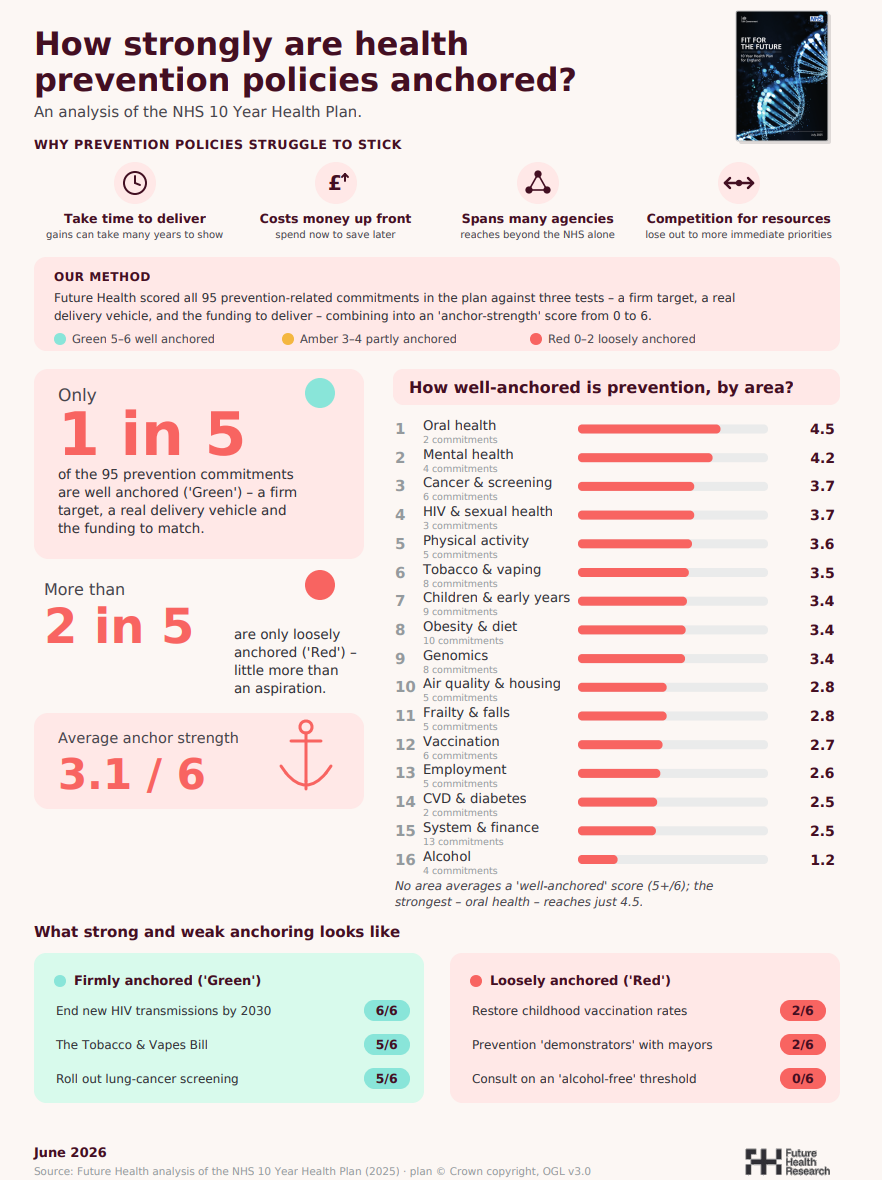
But in reality successful national health policy only succeeds when you are clear on the goal, delivery vehicle and resources for execution.
When these ‘anchors’ are not in place – national policy is narrative, initiative, confusion inducing and damagingly cluttering (see the recent Future Health Research analysis on prevention policies in the Ten Year Health Plan).
And while looking historically at what has worked before is important, we also need to ask how we adapt the policy development process to where we are today. We have lots of new powerful tools at our disposal to build models, deploy solutions, assess evidence, analyse approaches and make change much more quickly. If we are for example to develop Modern Service Frameworks for particular major conditions, why are they taking months/years?
Murray was right to talk about the need for a change of gear in the pace of frontline reform even if he is unlikely to be the person to deliver it. The world is speeding up, it is more dangerous, the public are frustrated with public services and resource is finite.
Whoever is Health and Social Care Secretary in the second half of this year should heed his words. But they should also start by asking some searching questions about the policy process they are in charge of and how it can be improved – it can and it should be.
No posts
Comments
Nothing yet. Say the first thing.
Sign in to join the conversation.