
This is the first piece in a new short series that I am exploring on dentistry – do get in touch with thoughts, inquiries, any expressions of research interest I’d love to hear from you. It also includes reference to a new suite of policy tools I’m building over at Future Health tracking and analysing the Government’s health reforms. More on those to come…
Labour came to power promising to rebuild the NHS. Nearly two years in, voters aren’t feeling it. Waiting lists have fallen modestly. A&E access has barely improved and concerns about accessing General Practice remain high. The political narrative — inherited mess, long-term fix, complex system, some green shoots — is not landing.
The Secretary of State’s recent Times opinion piece was something of a greatest hits (so far) but in a fragmented and noisy environment is struggling to cut through. Health as an issue is falling not rising in salience.
And cut through is important here.
Labour needs the NHS to not only work better come 2029 but (critically) it also needs the public to feel that it is working better AND to give it credit for doing so.
The danger for the Government is even if it can (and it is still debatable if it will) deliver a noticeable uptick in performance, that it does not translate politically in the way it needs to.
Falls of thousands in the elective list or upticks in percentages of GP satisfaction here and there are unlikely to provide the boost the Government needs. Indeed polling from last year showed that even though the waiting list was falling, the public did not believe it was. Trust in Government to deliver anything frankly is low.
So here is a proposition. Why not pick a tangible battle you can actually win — and win it visibly, in communities that matter?
On that basis, there is a case for a significant push on improving access to NHS dentistry.
The reasons for this are four fold.
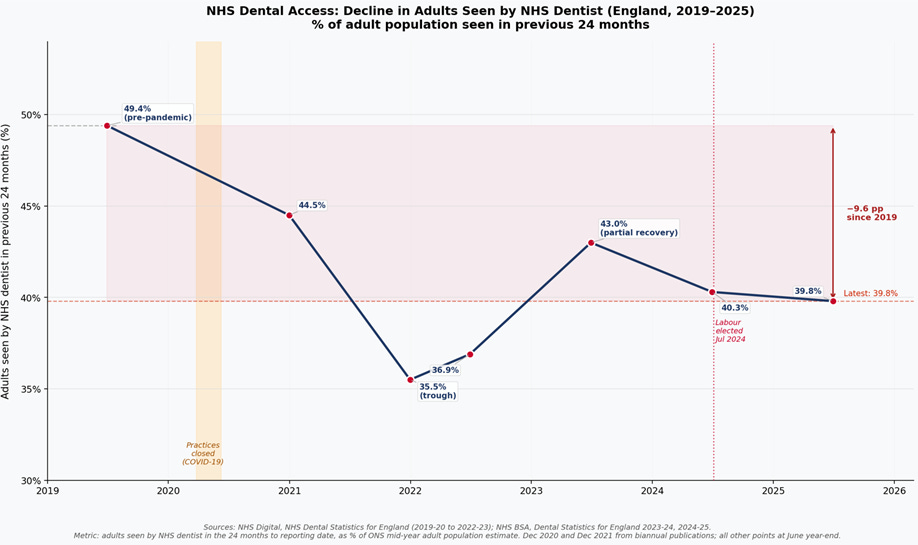
First there is a clear problem. Only 40% of adults have seen an NHS dentist in the last two years. This has fallen from approximately half before the pandemic (see graphic below). 13 million people cannot see an NHS dentist, over half of dentists in England have reduced their NHS workload since the pandemic and hundreds fewer NHS dentists are providing NHS care. Nearly 50,000 children are going to hospital to have their teeth removed
How access to NHS dentistry has fallen post Covid
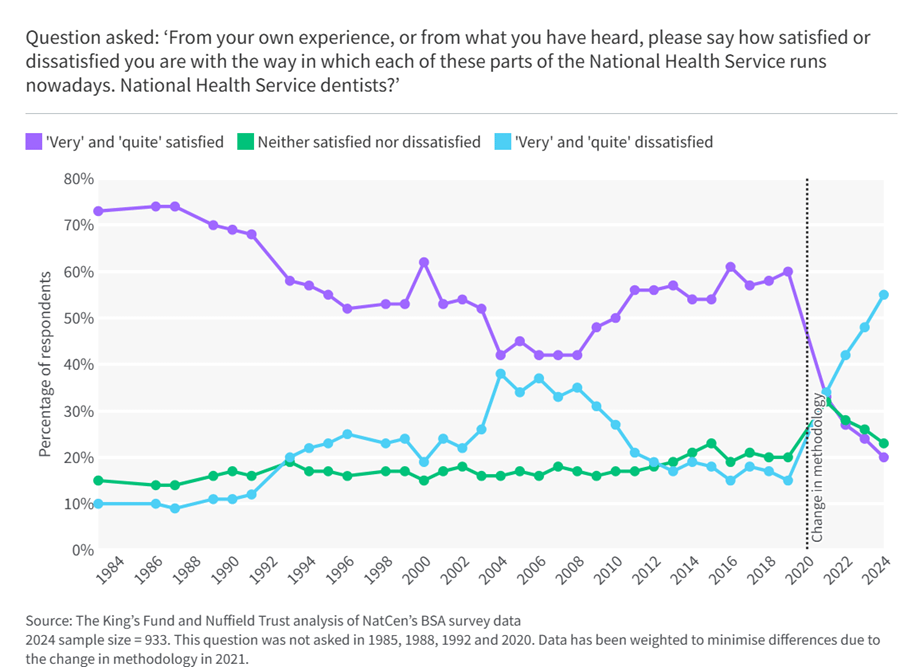
Second this is a political issue. Public satisfaction with NHS dentistry has fallen from 60% to 20% since Covid – this is the highest level of recorded dissatisfaction in the BSA survey’s history.
How satisfaction with NHS dentistry has fallen
Last year MPs from across Labour’s new intake lined up in a Commons chamber debate to describe the problem of access in their own seats. An Early Day Motion following a PAC report on the failings of the system attracted 41 signatures and MP inboxes are full of stories of patients unable to access care. A petition backed by the BDA, the Women’s Institute and the Daily Mirror has gathered over 260,000 signatures.
And new analysis for this Substack shows how politically difficult access to NHS dentistry is on the ground for Labour. The below graph shows seats in Future Health’s dental tracker tool (which is under development). The ‘red zone’ is where access to an NHS dentist is poor and the incumbent MP has a relatively small majority. It includes a number of seats in the South West and urban centres such as Peterborough, Swindon and Portsmouth.
The ‘red zone’ - where poor NHS dentistry access meets small majorities
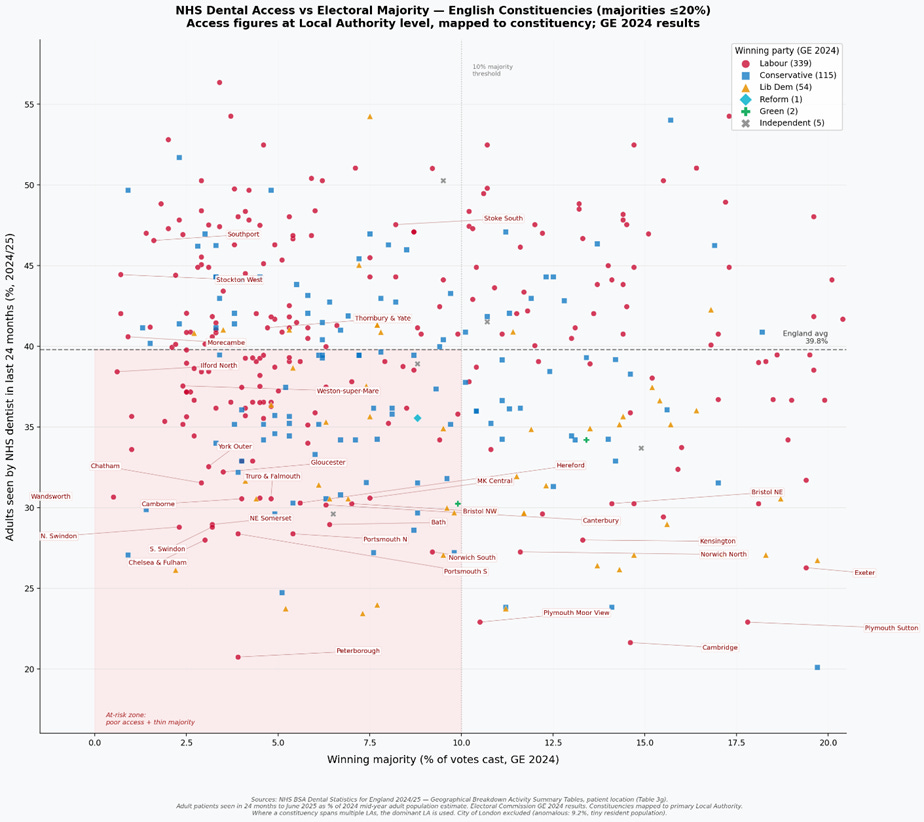
In total 75 Labour held seats are in the ‘red zone’ where the switch of a few thousand votes could spell the end of a Labour MP in Parliament. To put this in context Labour’s current majority is 158 (working majority 167). If these seats were to flip it would nearly wipe this out.
Third, whilst the Government has tried some policy reforms – and there has been an uptick in NHS appointments – these are widely seen to be inadequate to the scale of the challenge. The current contract from 2006, based on Units of Dental Activity is widely seen to be defective. It is underfunded – practices lose £42 on a set of NHS dentures – and fails to incentivise prevention – criticisms that have been made since the Steele review way back in 2009. Government action to fix the system has included plans to deliver 700,000 additional urgent dental appointments from April 2025; a much welcomed supervised toothbrushing scheme for three- to five-year-olds; a requirement for newly qualified dentists to spend at least three years in the NHS and a package of contract reforms due from April 2026.
The profession’s verdict though has been pretty damning. The BDA’s Shiv Pabary called the December 2025 contract changes “the biggest tweaks this failed contract has seen in its history.” Chair of the Health and Social Care Select Committee Layla Moran MP concluded that the situation had “not improved and actually appears to have worsened” since the committee investigated in 2023.
Fourth fixing the issue is not impossible. NHS spending on dentistry is only 1.5% of the overall NHS budget and has fallen 22% in real terms since 2010/11. The BDA has estimated between £300-£450 million of private work is being used to keep NHS dentistry afloat and that £1.5 billion would help restore access for patients to dentistry on the NHS. Wes Streeting has described the BDA’s figures and challenge as ‘not unfair.’ £1.5 billion equates to less than 1% of the NHS’s annual budget.
Now money is clearly very tight and there are significant and obvious pressures on the public purse, but politics is about choices and trade-offs. If the full £1.5 billion is beyond reach then could the Government not come up with a figure of say half that to uplift dental tariffs, make NHS work more viable for practices and increase access to at least pre-pandemic levels by 2028/9? Could it target this at particularly under-served communities, aligned to shifts in the Ten Year Health Plan and just so happen to land it in politically important geographic areas?
Both the symbolism and action would be powerful and show that the Government has – in a particular area of public importance – turned the NHS around. We all know that the Government wants to show the elective waiting list graph falling under Labour (vs the Tories) as its main health message in 2029. Showing a rise in NHS dentistry access might a far more cost effective deliverable.
The Blair Government provides an interesting lesson here. In his 1999 conference speech the Prime Minister announced that everyone would have easier access to an NHS dentist within two years. However the pledge struggled to be delivered and Blair was regularly challenged on it throughout his term of office. In 2007 he admitted defeat. Despite all the progress made on the NHS during Blair’s term, dentistry became something of a stick to beat the Government with, undermining its health successes.
The Treasury of course is the main block to progress (and has a long and chequered history on its attitude to publicly funded dentistry right back to the early days of the NHS); but the sums in the scheme of things are not vast and there is political upside to be had. Might number 10 see an opportunity here? There are backbenchers after all who need good news and who need to be kept onside….
PS Interestingly the argument I am making aligns me with Nye Bevan himself (!) – read the background to his resignation over dental and spectacle charges in the early 1950s here: https://www.nationalarchives.gov.uk/education/resources/fifties-britain/aneurin-bevan-resigns/
No posts
Comments
Nothing yet. Say the first thing.
Sign in to join the conversation.