
Somewhere between “mindfulness” apps & herbal bollocks pills, there’s a far cheaper, clinically tested painkiller available to every adult with a mouth and able to give voice, or fast fingers and the ability to make the sign for it: the word “fuck”.
Yet swearing still gets treated as a sign of low IQ, bad upbringing & moral decay, rather than what it actually is: a social tool, a neurological hack, & a contact sport the British have been quietly world-class at for centuries.
I was taught by some of the best, I’ve read and enjoyed being on the end of some of the best, watched earth ending carnage unleashed.
All before the Internet, was a thing.
No one swears like a Brit, no one swears like a Brit that served in the forces.
Stripes nor stars or bars, can elevate that to to levels that come from the lower ranks and those from the streets where working class is still a tier or three from where you grew up or were born and raised.
The battle is won when you can kill a mind with a word, the war is over when you can fire a volley of words that make a grown man flinch when a flinch is the difference between life and death.
I assure you as eggs is eggs, some of the most blood curling combinations of swear words that have ever been uttered, were done as a room was stormed, a trench was over run, or a tank was charged at against all odds.
It is a dark art, because it is a science.
There is power in words.
Suffering is the cost to enter the ultimate ranks.
Pain is the currency.
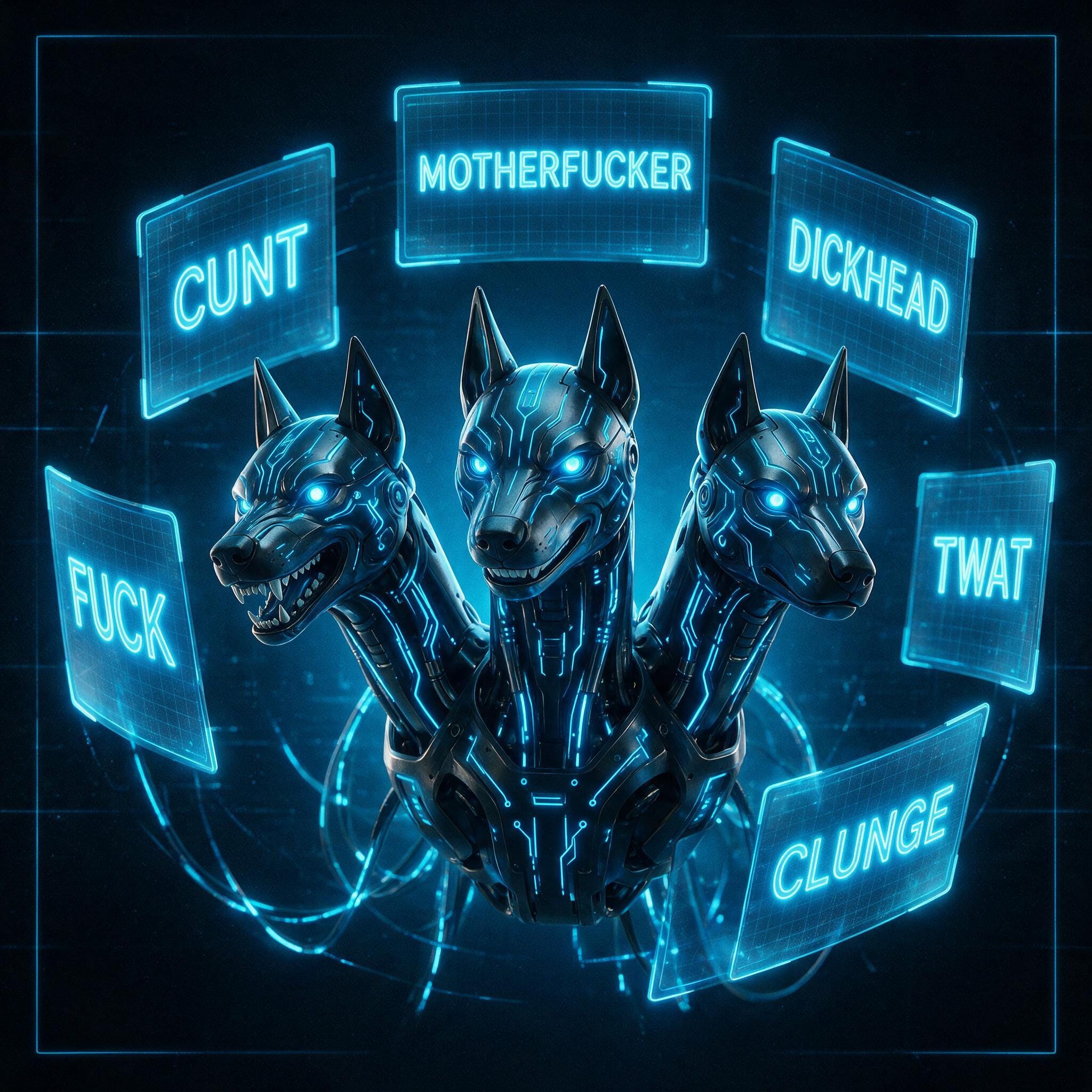
F*ck, C*nt or Cl*nge?
There is more actual science behind saying “fuck” than there is behind most wellness nonsense flogged online, yet swearing still gets treated like the linguistic equivalent of turning up to a funeral in a leopard-print thong.
That is daft.
The thong is a bad idea also, just saying.
Unless you turn up wearing at least rollerblades and flashing neon red deeley boppers, have some respect…
>..>
<..<
Swearing is not just verbal litter.
It has history, structure, social purpose, class baggage, political utility, measurable neurological effects, & a frankly glorious ability to terrify the sort of people who think “robust language” is how one describes a minister calling somebody a useless twat on a hot mic.
So this is the proper version.
No etiquette-column pearl clutching.
No fake acronym myths.
No lazy guff about low IQ.
Just some of the history, the science, the politics, & the fine British art of knowing when a plain old insult will do, & when the occasion truly demands a hand-tooled, artisanal motherfucker.
Shackles of long held and taboo yokes such as religion, have become a self perpetuating panopticon.
When people talk about swearing now, they usually mean sex words, body words, or the sort of insult that can get you barred from Christmas dinner. But the oldest English taboo language was not really about anatomy at all.
It was about blasphemy.
In medieval Europe, the gravest verbal offence was not saying something rude about somebody’s bits. It was using God’s name improperly, or swearing by divine things in a casual, profane way. That is why the word “swear” has always had this double life. It means to make a solemn oath, but it also means to come out with language that would make a bishop spill his soup.
Which led, naturally, to some truly inventive filth. Medieval expletives were often built around the body of Christ. Not in a reverent way. In a “By God’s bones” sort of way. Theologically speaking, they were doing body horror with liturgical branding.
This is the first big lesson of swearing history. What a culture treats as unsayable depends on what it treats as sacred. Once upon a time that was God. Later it became sex, bodily functions, & the general British obsession with pretending nobody has genitals until required for succession planning.
By the Renaissance, the linguistic panic had shifted from heaven to the human body. Sex, shit, anatomy, blood, stink, all the things polite society cannot stop thinking about while claiming to be above them, took over as the main engines of taboo.
That shift matters, because it shows swearing is not fixed. It migrates. A word is not born obscene in some eternal moral category. Society makes it obscene. One century prints it in a medical text.
Another century treats it like radioactive waste.
That is why the history of swearing is also the history of class performance. Once words get coded as vulgar, the respectable classes start finding ways to avoid them in public while continuing to think them, understand them, & often enjoy them in private.
Repression did not kill swearing.
It just forced it to get clever.
And this, for Britain especially, was catastrophic in the funniest possible way.
Because once you tell British people they cannot say something directly, they do not become cleaner.
They become sarcastic. 😏
One of the stupidest claims ever made about swearing is that people do it because they do not know enough better words.
That argument should have been buried centuries ago under a large stone marked “William Shakespeare, exhibit A”.
Shakespeare’s insults were not evidence of lexical poverty. They were evidence of lexical sadism. He did not need to rely on a blunt modern “fuck off” when he could build you a bespoke verbal coffin out of imagery, rhythm, contempt, & just enough poetic flair to make the murder sing.
This is the real tradition of creative swearing. It is not the opposite of eloquence. It is eloquence with a knife in its sock.
That matters for a modern piece because it gives the lie to every dreary scold who treats profanity as proof of some mental deficiency. English’s greatest show-off spent a great deal of time inventing glorious ways to call people useless, diseased, malformed, ridiculous, morally suspect, or all four before lunch.
In other words, creative swearing is not what happens when language fails.
It is what happens when language decides to stop being polite.
Then, as ever, came the middle classes.
The Victorian talent for making ordinary life sound like a criminal conspiracy transformed taboo language again. Direct anatomical terms became unspeakable in respectable company. Euphemism bloomed. Double entendre flourished. People started behaving as though saying a thing aloud was morally worse than doing it behind a curtain.
This is how you end up with absurdities like coy substitutes for ordinary body parts & clothing, or the general belief that if one can wrap filth in enough lace, it somehow stops being filth.
Of course it did not. It just became funnier.
The British genius for euphemism comes partly from this period. It is the age that taught the country to nod gravely while saying something so obviously dirty that everyone in the room understands it, nobody admits it, & one old colonel nearly dies trying not to laugh.
Victorian prudery did not clean up language. It pushed obscenity into metaphor, innuendo, tone, timing, & implication.
Which, again, is excellent news for anybody writing satire.
Once the modern world properly arrived, swearing changed again.
Factories, militaries, trench warfare, machinery, mass politics, mass frustration, bureaucracy, command structures, class resentment, all of it fed the next era of profanity. Swearing became more modular, more direct, more adaptable, more aggressive, & more useful as a tool of solidarity among people doing dirty, dangerous, or exhausting work.
This is where English really leans into compound obscenity. Not just isolated rude words, but engineered constructions. Verbal munitions. Language that sounds as though it was assembled in a workshop from spare parts & rage.
That is how you get things like “motherfucker” and “clusterfuck”. Not delicate terms, not subtle terms, but extremely efficient ones. Each does a great deal of work very quickly.
Military contexts matter here. So do industrial ones. Under pressure, people do not merely swear more. They swear more inventively. Stress forces compression. You need words that can convey pain, contempt, absurdity, hierarchy, disbelief, camaraderie, & the suspicion that your superior officer is an absolute bellend, all before the next thing catches fire.
This is why swearing is not just about offence. In the right context, it is social glue. It signals trust, informality, shared suffering, & the permission to stop pretending.
Or, more simply, it is how people talk when something real is happening.
If the piece is going to do this properly, the main offenders need their own case files.
Still the reigning heavyweight.
The earliest clear English evidence lands in the late 15th century, already meaning sexual intercourse. Its deeper roots appear Germanic, tied to a family of words involving striking, thrusting, moving back & forth, or copulating. Which is not romantic, but it is efficient.
The fake acronym stories, “For Unlawful Carnal Knowledge”, “Fornication Under Consent of the King”, all that pub-lore rubbish, are nonsense. They survive because people enjoy tidy fake explanations more than messy real history.
What matters is not just the origin, but the versatility. “Fuck” is a noun, verb, adjective, adverb, interjection, intensifier, dismissal, expression of pain, delight, outrage, admiration, disbelief, exhaustion, & resignation. It is essentially a linguistic multitool with anger settings.
It also has rhythm. That matters more than many people realise. A good swear survives because it hits the ear as well as the nerve.
Older than most people think, & historically more literal than the modern panic around it suggests.
Middle English forms appear early, & medieval London really did have a Gropecunt Lane, because our ancestors, for all their theological anxieties, occasionally named streets with the subtlety of drunk navvies.
The deeper root is disputed. Germanic links are strong, links to Latin have been argued, other theories wander off in more speculative directions. So this one needs care. Say what is well supported, & flag the rest.
What is beyond dispute is the social journey. A once more straightforward anatomical term became one of the most taboo words in modern English, especially in American usage, while remaining more flexible, though still potent, in Britain, Ireland & Australia.
That difference alone is worth a comic aside. In some countries it detonates a room. In others it just means the bloke in the Audi has parked like one.
Later, louder, American, & built for maximum taboo yield.
The point is not literal meaning. The point is escalation. Take the already powerful “fucker”, then attach the most culturally radioactive family relation available. It is insult design by overkill.
By the late 19th century it is documented in American legal records. Later it moves through blues, jazz, stand-up, street language, film, & eventually everywhere else.
It works because it is obscene, but also because it is theatrical. Nobody tosses off “motherfucker” accidentally. It arrives with intent.
Less mysterious, more workmanlike.
It does exactly what it says on the tin. English takes “dick” as slang for penis, then converts it into a personality diagnosis. The target is not just a penis. He is the head of one, or perhaps has allowed one to take over central command.
That is the beauty of the insult. It is almost bureaucratically literal.
Another anatomical term that drifted into general insult use, particularly in British English.
Its etymology is murkier than people often pretend, so it is worth treating carefully. But its modern function is clear enough. “Twat” sits in that very British zone between genuinely insulting & almost affectionate, depending entirely on tone, setting, & whether somebody has just reversed into your wheelie bin.
Modern, British, grubby, & less historically documented than the older artillery.
That is part of the point. Swearing does not stop evolving because dictionaries have finished pretending to catch up. Slang keeps breeding. Television, playgrounds, barracks, pubs, message boards, all of them continue manufacturing new vulgarity out of boredom, lust, cruelty, & comic instinct.
Language is a filthy little factory. 😈
Now for the bit that upsets the etiquette brigade.
Swearing is not merely cultural. It is physiological.
Researchers using cold-water pain tests found that people repeating a swear word could typically tolerate pain longer than people repeating a neutral word. They also rated the pain as less intense. Other work found increases in pain tolerance of roughly a third under swearing conditions.
That is not a placebo-level pub anecdote. It is an experimentally observed hypoalgesic effect.
Put plainly, swearing can work as a mild, immediate, self-administered pain management tool.
No app subscription required.
The leading explanation is that swearing activates older emotional systems in the brain, including regions involved in threat response. Heart rate rises. Fight-or-flight kicks in. Adrenaline does its thing. Pain gets blunted because the body interprets the moment as urgent.
Which makes evolutionary sense. If you have just smashed your hand, now is not the ideal time for your nervous system to hold a seminar. It needs to get you through the next few seconds.
So yes, when you bark “fuck” after injury, you may genuinely be helping yourself cope.
Science has, at last, vindicated every mechanic, squaddie, chef, builder, nurse, parent, & poor bastard who ever stood on a plug.
Heavy habitual swearing appears to blunt the pain-relief effect.
That is the annoying part.
If every minor irritation gets the full verbal broadside, the emotional charge of the word may drop, & with it the body’s physiological response. In simple terms, if everything is “fucking this” and “fucking that”, then when you really need the emergency swear, your nervous system may just fold its arms & say, yes yes, very dramatic, carry on.
So there is a genuine tactical lesson here. Swear creatively all you like, but keep some powder dry.
The best swear words are like good whisky or artillery support.
They lose something if used on cereal choices.
At this point, some of you may have clicked what this article is about, and actually about, creative swearing, has purpose and reason. Generation or creation is not always for shock and awe sensation, it can also be about channelling pain management, or feeling out or seeding new channalable analgesic mantra ululations.
Or, it is just bloody funny when dropped as entertainment and signature delivery.
Dark arts are sometimes just dark arts...
Sometimes "fuck" just is not good enough.
A piece of LEGO barefoot at 3am when busting for the loo? Childbirth for over 6 hours with no gas and air, and that curry you had just before being admitted is going to be evil coming out and you know it?
Stubbed a toe, so you know. 😉
Quick as a flash, ‘fanny or gash’, ‘cunt or bastard’, ‘fuck this’, ‘fuck that’, or ‘you fucking twat’?
Try fiddlesticks or fluffy bunnies though?
What about that?
One of the lovelier details in the research is that invented pseudo-swears do not seem to work like the real thing.
Researchers tested made-up words designed to sound swear-y, such as “twizpipe” and “fouch”. People found them amusing. They produced some emotional response. But they did not deliver the same pain-tolerance benefit as established taboo words.
Which makes perfect sense once you think about it.
Swearing does not work because of the noise alone. It works because the word is socially loaded. It carries years, decades, centuries of taboo charge. Your body is reacting not just to a sound, but to a whole cultural battery pack attached to that sound.
This is also why people can tell the difference between a naturally filthy speaker & somebody trying on profanity like rented leather trousers.
One has voltage. The other has a costume.
Now for one of the most persistent bits of snobbery around this whole subject.
The idea that people swear because they lack vocabulary sounds clever until you look at the evidence, whereupon it falls over.
Studies comparing taboo-word fluency with general verbal fluency found that people who were good at generating swear words were also often better on broader vocabulary measures. Researchers explicitly argued that a large taboo lexicon is better understood as evidence of healthy verbal ability than as a sign of lexical poverty.
Other work found no meaningful statistical link between swearing & intelligence in either direction.
So the stereotype is basically social judgement dressed up as cognitive science.
People hear swearing & make class-based assumptions. They infer lack of control, lack of education, lack of intellect, even when the actual data does not support any of it.
Which is unsurprising. A great deal of what passes for language etiquette is just status anxiety in a cardigan.
The better argument is this. Swearing badly can make you sound dim. Swearing well can make you sound precise, funny, forceful, vivid, human, or all of the above. As with any tool, misuse proves nothing except misuse.
Swearing does social work.
Research on workplaces found that, in the right setting, swearing can function as a marker of trust, solidarity, stress relief, informality, & shared identity. People often use it more around colleagues they feel comfortable with than around outsiders.
This is obvious to anybody who has ever worked in a kitchen, depot, workshop, newsroom, military unit, building site, or public office where the official tone is professional but the unofficial tone is one HR complaint away from medieval.
Swearing can be aggressive, yes. It can also be affiliative. It can say, you are one of us, we can drop the mask, this situation is absurd, & I trust you enough to talk like a real person.
That is why attempts to strip all profanity from public language often feel false. They do not just remove offence. They remove texture, urgency, intimacy, & a lot of truth.
Sometimes “this is a challenging situation” is not neutral. It is a lie in a tie.
Sometimes the correct phrase is “this is a complete shitshow”.
And everybody knows it.
In America, George Carlin turned a list of dirty words into broadcast law history. His “Seven Words You Can Never Say on Television” became legendary not just because it was funny, but because it dragged the state into the ridiculous business of deciding which mouth-noises were acceptable on air.
That led to arrests, complaints, Federal Communications Commission action, & eventually a US Supreme Court ruling in FCC v Pacifica Foundation in 1978, which effectively affirmed that indecent language on broadcast media could be restricted.
The legal legacy outlasted the routine.
Which is generally what happens when the authorities take a joke too seriously.
Britain’s version is less theatrical, but no less absurd. Ofcom does not give you a neat immutable blacklist. It gives you context, likely offence, audience expectation, watershed timing, & the sort of judgement calls that create a thousand producer panic attacks.
So the culture adapts. Broadcasters bleep. Presenters quote somebody else’s swearing for public-interest reasons. Politicians say the rude bit when they think the microphone is off.
Everyone plays this ongoing national game of obscene hide & seek.
It is not a system designed to eliminate swearing.
It is a system designed to make it more entertaining.
Politics is full of people who want the emotional force of swearing without the reputational cost of being caught doing it.
This never works for long.
Hot-mic incidents have become their own subgenre. Gordon Brown’s “bigoted woman” moment is still the gold standard of campaign self-harm. Gillian Keegan’s complaint that nobody recognised she had done a “fucking good job” while others had “sat on their arse” managed to sound both furious & accidentally honest. Heather Wheeler’s muttered “oh fucking hell” during a Commons session was politely translated by Hansard into “an interruption”, which is one of the funniest euphemisms ever committed to the parliamentary record.
That is the beauty of political swearing. It punctures the performance. Suddenly the machine slips, & out comes the real register. Not the briefing note. Not the sanitised line. The actual human reaction, usually involving incompetence, frustration, contempt, or all three.
In July 2026, during campaigning in Clacton, a driver shouted “wanker” at Farage, then immediately crashed into the vehicle in front after running a red light. Farage posted the clip himself & called it “instant karma”.
You could not script a neater little morality play if you tried. A pastel prancing pustulent panhandling populist demagogue gets heckled, the heckler momentarily loses concentration, Farage harvests the footage for content, & the internet gets another tiny chapter in the long British novel titled ‘Everybody Is Embarrassing’.
The insult itself matters too. “Wanker” is not just generic abuse. It is deeply British. Petty, specific, dismissive, unserious in tone but sharp in intent. You do not call somebody a wanker because you fear them.
You call them a wanker because you think they are ridiculous.
For a man like Farage, that probably lands harder than something more apocalyptic.
Working class jab aimed hard into the open yellow-toothed grin of the faux working man’s club of the 70’s, wishing for his Bernard Manning like banter and fag soaked racism and zenophobia on someone else’s bar tab.
A true double edged moment, instantly political and social, weapon and shield.
For satire, it made Grade A thunder ammo, and was deployed as such by some brilliant wit and writers, and artists, using it both sides of the political wings or cross faction.
Meme’worthy and made so instantly, pop culture in action.
Creative swearing is not verbal vandalism carried out by the dim.
It is a historical record of what societies fear, worship, repress, & pretend not to notice. It is a pressure valve. It is pain management. It is class theatre. It is social glue. It is censorship’s favourite recurring nightmare. It is the difference between a lifeless sentence & one that actually admits what the room feels like.
And, crucially, it is funny.
Not because the words are magical by themselves. A dull person can make even “motherfucker” sound tired. But because good swearing reveals energy, instinct, timing, character, rhythm, context, & the exact temperature of a moment.
A really well-placed swear does what good satire does. It punctures pretence.
Which is probably why the powerful hate it.
Swearing makes hierarchy wobble. It drags the high down into the language of the body, pain, sex, muck, rage, & everyday life. It reminds everyone that beneath the robes, titles, lecterns, codes, & briefings, we are still just animals with nerves, fluids, egos, & a limited tolerance for bullshit.
That is not a degradation of language.
That is language doing its bloody job.
You can see what this thing is turning into. If you want it to keep going after Farage, Reform, GBNews & the rest with receipts, some of you are going to have to sling it meat. Everyone else can keep watching it hunt from a safe distance.
~ 400 Articles free in my vault if you want to sample my work & decide after. 😉
I go much Further & Deeper, in the rest of the article… (usually…)
You are currently about 50% through this article.
Paid Subscribers get access first - [Depending on the article size/content]
Timed or Fully Paywalled content may apply - Free trial offer if you’re tempted. 😎
Support keeps the articles flowing & for when Westminster or GBNews gets litigious. 😏
If it went Viral, made you think or laugh, liked or shared?- Support the Writer with a Coffee?
Comments
Nothing yet. Say the first thing.
Sign in to join the conversation.