
This piece is drawn from a recent conversation on PODS by PEI, a policy discussion series hosted by Policy Entrepreneurs Inc.
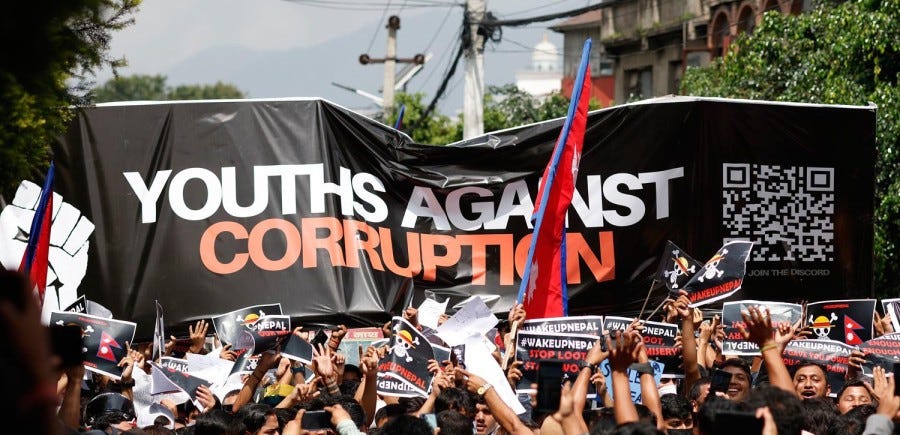
The September 2025 protests were more than a "flash movement"—they were a catalyst for a new kind of civic engagement. In our latest podcast, PEI researchers Khushi Hang and Anusha Khanal share initial findings from their project, A Political Economy of Nepal’s Youth Mobilization. They explore how "Gen Z" evolved from a social trend into a formidable political force and the future of the activists who remain outside the formal electoral arena.
1. People showed up for their own reasons — and that was the point
The conspiracy reading of September 8th goes: there was a hand behind it, young people were mobilized for someone else’s ends, the leaderlessness was theater. But what makes that feel beside the point is something simpler — people didn’t need a central figure to mobilize. The umbrella terms of the movement — good governance, anti-corruption, nepotism — weren’t a precise program. They were a gathering point wide enough that many people could find themselves under them, each arriving with their own experience of what those words actually meant.
2. The movement was rhizomatic — and the internet was its soil
September 8th spread without a center: through TikTok trends, Instagram reposts via VPN, and a general ambient charge in Nepal’s digital environment. The #nepobaby trend was one of the sparks — significant because of the connection it made visible in real time between the aspirational lifestyles people saw online and the structural conditions of corruption that made those lives inaccessible to most. It felt political before the protest even had a name.
3. “Gen Z” shifted from a social label to a political one — almost overnight
Before September 8th, Gen Z was a generational category largely absent from Nepali political discourse. After September 9th — when young people found themselves in conversation with the interim government — it became a political one, with capital, stakes, and an agenda that needed definition. The problem is that a category born from age rather than ideology carries inherent ambiguity. Gen Z was a social cohort that found itself holding a political mandate it hadn’t formally claimed, which invited competing and conflicting interpretations of what it stood for.
4. After the movement: ownership without structure
In the weeks after September 8th, the language of the movement was claimed by people well beyond its original base — older politicians, civil society figures, establishment actors who had never been near the streets. The term Gen Z expanded, became porous, and was partially absorbed into the political mainstream it had disrupted. This is the core tension of leaderless movements: they are powerful in a moment, harder to co-opt and harder to suppress. But they are also harder to translate into sustained political change once the energy begins to settle.
5. Not everyone went into politics — and that matters!
When the dust settled, some of those who had been most visible in the movement found their way toward electoral politics. But many did not. And the question of what happens to that second group — the researchers, the activists, the organizers who chose to stay outside formal political structures — is one of the more consequential open questions in Nepal’s civic landscape right now.
The PxP conversation goes much deeper — the “rhizomatic” nature of youth clusters, the shift from digital trends to political mandates, the challenges of horizontal organizing, and how this new civil society is holding the state accountable beyond the ballot box.
Watch the entire conversation on YouTube.
Comments
Nothing yet. Say the first thing.
Sign in to join the conversation.