
You spent the money on that “safer” gel kit. You switched brands. You did the research. You bought the one with the long list of things they don’t put in it.
And you’re still reacting.
Here’s what no one is telling you — and it’s just one thing I wish someone had told me before I ended up in the hospital.
Let’s start with some numbers, because this isn’t just a feeling.
Researchers at Weill Cornell Medicine analyzed TikTok’s #gelallergy hashtag and found over 100 million views and nearly 100 reported cases of allergic contact dermatitis tied to at-home gel nail kits — leading them to describe it as a potential epidemic of acrylate sensitization. Sage Journals
A potential epidemic. That’s a medical journal using that word.
And where did a huge chunk of it come from? A survey of nail allergy support group members found that 78% of respondents had used home gel kits, with roughly half starting for the first time during the COVID-19 pandemic — and 68% of those home users learned about the kits through social media. Dermatology Advisor
Social media sold us the kits. Social media is now full of the reactions.
The brands knew this market was exploding. They watched the pandemic push millions of people toward at-home gel kits with zero training and zero real safety guidance. And when word got out about the effects?
They invented a new marketing term.
Imagine you have a severe peanut allergy. And a brand comes to you and says:
“Great news. Our peanut butter doesn’t contain the allergy-causing peanuts you’re reacting to. We use peanut-derived ingredients instead. It’s safer now.”
You’d laugh them out of the room.
But that is exactly what “HEMA-free” is doing to you.
HEMA (2-hydroxyethyl methacrylate) is one acrylate. ONE. Acrylates are now the most common nail cosmetic allergens Jaad, and there is an entire family of them; methacrylates, cyanoacrylates, isobornyl acrylate — all capable of triggering the same immune response in someone who is already sensitized.
Here’s the part that makes me genuinely angry: in a review of at-home nail products, over 40% did not include ingredients on the retailer website at all. Jaad
They’re not listing what’s in the bottle. But they’re very happy to tell you what isn’t.
And if you actually understand acrylate allergy — which I had to learn the hard way — you know that removing HEMA and replacing it with a different acrylate monomer is not a solution. It is a rebrand.
The “HEMA-free” era didn’t come out of nowhere.
The nail and beauty industry has been running this exact playbook for years — they just keep changing the villain.
First it was formaldehyde. So brands started shouting “3-free” from the rooftops. Formaldehyde, toluene, DBP — gone. Crisis solved. Buy the polish.
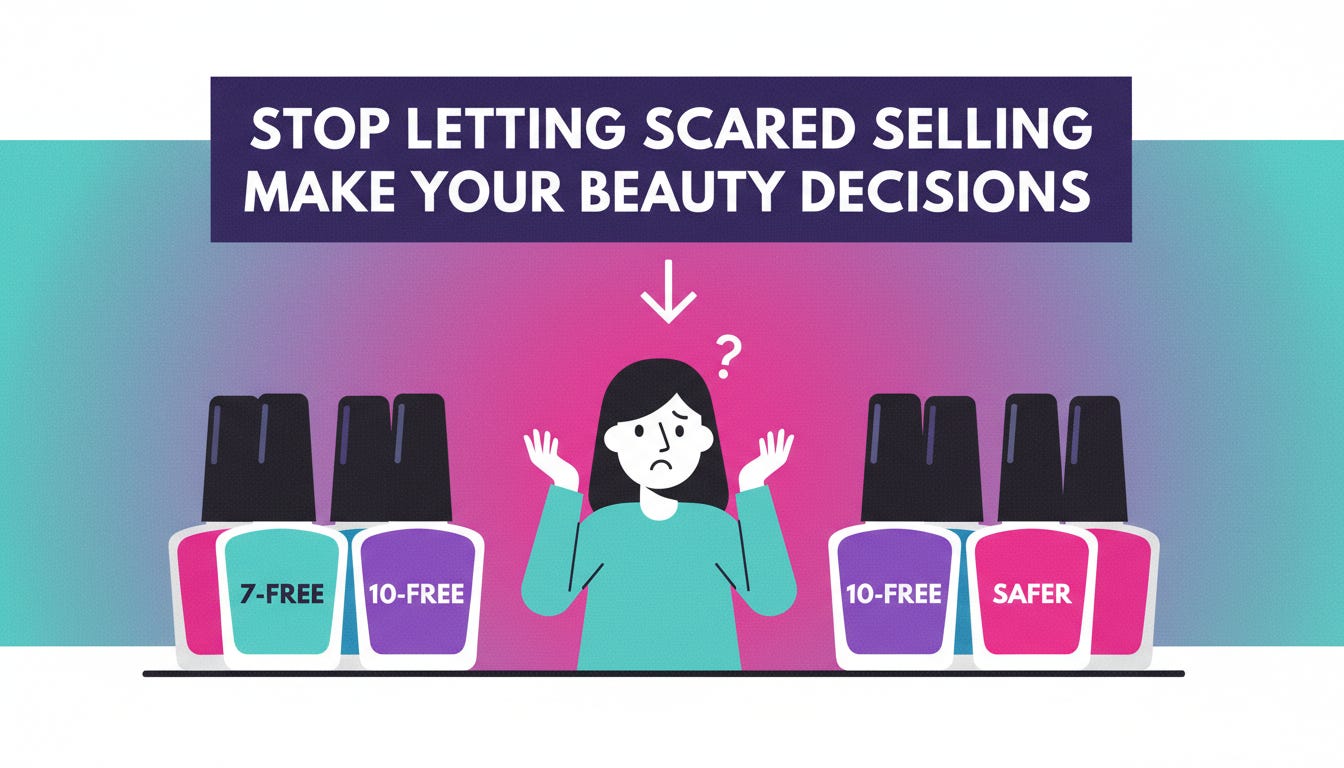
Then the list got longer. 5-free. 7-free. 10-free. At some point, brands started competing over who could remove the most things from their formula, and consumers started believing that a longer “free from” list meant a safer product.
Here’s the part they’re counting on you not knowing: there is zero regulation around “free from” claims. A brand can slap “10-free” on a bottle and list ingredients that were never used in nail polish to begin with. They didn’t remove them. They were never there. It’s the equivalent of a water bottle bragging that it’s gluten-free.
The ingredients most commonly showing up on these lists — camphor, xylene, ethyl tosylamide — were already being phased out or were never standard across the industry. Brands get credit for removing something they weren’t really using in the first place, and you walk away feeling like you made a safer choice.
Hypoallergenic is a marketing word. It is completely unregulated in the beauty industry. It means “less likely to cause an allergy in the general population.” It says nothing — nothing — about someone who already has the allergy.
I had spent hundreds, probably more, on products sold directly to my desperation. Each one promised it was different. Each one still had acrylates in it, just wearing a different name. I didn’t know enough to ask the right questions, and the brands didn’t know enough about these types of allergies and how to manage them for their consumer. They certainly were not going to turn down a sale.
The turning point wasn’t finding the “right” product. It was when I stopped looking for one.
I was exhausted. I was sick. I had been to urgent care far too many times, and then eventually I ended up in the hospital. They told me my career was over and my nail days were done.
That rage turned into research. And the research led me to one conclusion:
No brand has your health as their primary interest. They have their margin.
Once I genuinely understood my own allergy — what I was reacting to, why, and how my body processed these chemicals — everything changed. I could read a label and know if a product was right for me. I stopped being a target and started being a decision maker.
Here’s something that might surprise you: I can actually use some gel products now. My allergy doesn’t make every single one off limits.
I choose not to. Not because I’m scared. Because I’m informed. I know exactly what’s in them, what my body does with those ingredients, and what I’d be trading. That’s a choice I get to make from a place of confidence — not desperation.
That’s what real healing looks like. Not finding the magic product that finally works. Walking away from the cycle entirely and building something that actually belongs to you.
Your routine gets to look different than mine. Your allergy is your own. Your body is your own. But the framework — the education, the mindset, the ability to tune out the noise and advocate for yourself — that part I can absolutely show you.
Reading all of this, you might be wondering if I’m doing the exact same thing — just scaring you in a different direction. Are brands out to get you? Is everything a lie?
No. Genuinely, no.
There are incredible products out there made by brands that deserve your loyalty and your money. This was never about burning the whole industry down.
But I Imagine a world where a nail polish is simply... a really good nail polish. It stays on for two weeks. The color is stunning. It covers in two coats. etc..
The more informed we are as consumers, the harder it becomes to sell us fear. And if enough of us start asking better questions and spending our money differently — maybe we actually change how this industry talks to us.
Ready to become truly informed, help yourself and your clients, and finally have the long strong beautiful nails you thought you'd lost forever? Subscribe today and join hundreds of people who ready to commit to a beauty routine that actually works for them.
No posts
Comments
Nothing yet. Say the first thing.
Sign in to join the conversation.