
1976 was a big year. And that makes 2026 a big year for 50th anniversaries: the Concorde jet, the Cray supercomputer, “All the President’s Men,” “Taxi Driver,” and, of course, Apple Computer.
For me, last week was the 50th anniversary of another important event: my national spelling-bee fail.
As a kid, I was—I’ll admit it—an annoying bookworm. I never went anywhere without a book, devouring a couple of them every week. My mother used to bust me for reading under the covers with a flashlight, well after bedtime.
No surprise, then, that by middle school, I’d become a great speller. After so much time looking at printed words, I somehow absorbed them.
In 1975, in seventh grade at Woodbury Junior High School (Shaker Heights, Ohio), I won the spelling bee in my classroom. I advanced to the school-wide competition, and won that.
The next stop was Ohio’s state spelling bee, held in a theater in downtown Cleveland. An announcer read ten words; we 13- and 14-year-olds wrote them on paper. After each set of words, we’d swap papers with fellow spellers for grading as the announcer revealed the correct spellings. If you got a word wrong, you were out.
In the final round, only three of us were left. One kid missed chautauqua (an outdoor educational and cultural assembly). One missed suborn (to persuade someone to break the law).
But I got them all. I was the Ohio spelling champion.
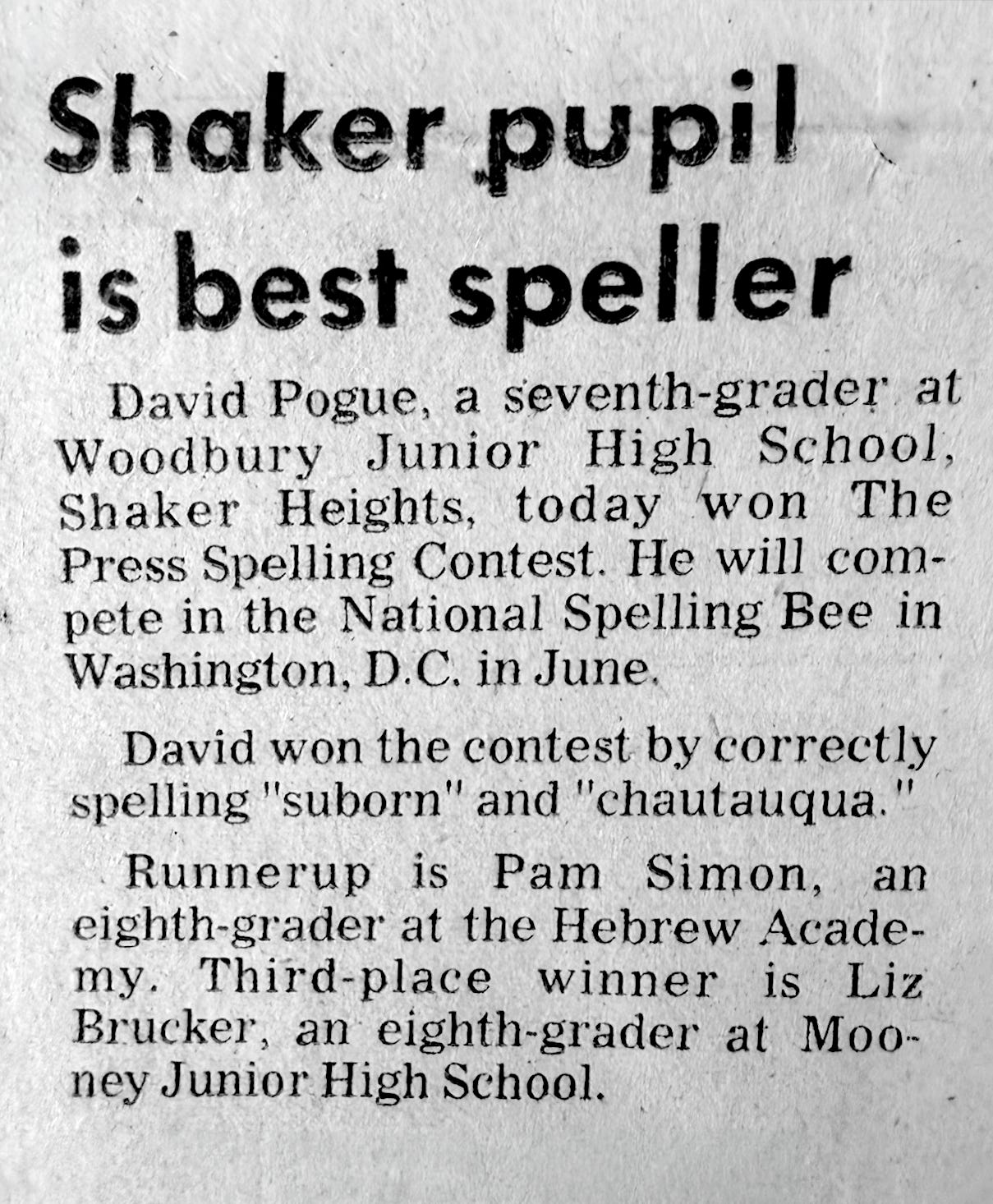
This was a huge deal in my family. To say that my parents were intensely achievement-oriented is the understatement of the half-century. In my entire K-12 educational career, I missed getting straight A’s only once, when I got a B+ in A.P. Chemistry. My parents were upset. My dad sat me down for a stern speech about doing better.
So yeah. When I won the Ohio bee, my stock went way up.
But now I had a bigger challenge: the 1976 National Spelling Bee in Washington, D.C. Winning the national competition was probably the biggest academic achievement a 13-year-old could attain. My mom wanted to make damn sure I didn’t blow my chance.
For the next six months, every meal of every day became a practice spelling bee. Mom held the dictionary in her lap and called out words for me to spell.
The Cleveland Press, the now-defunct newspaper, sponsored our trip to D.C. Mom and I checked into the Mayflower Hotel along with 86 other kids and their own chaperones. It was the largest roster of competitors in the Bee’s history.
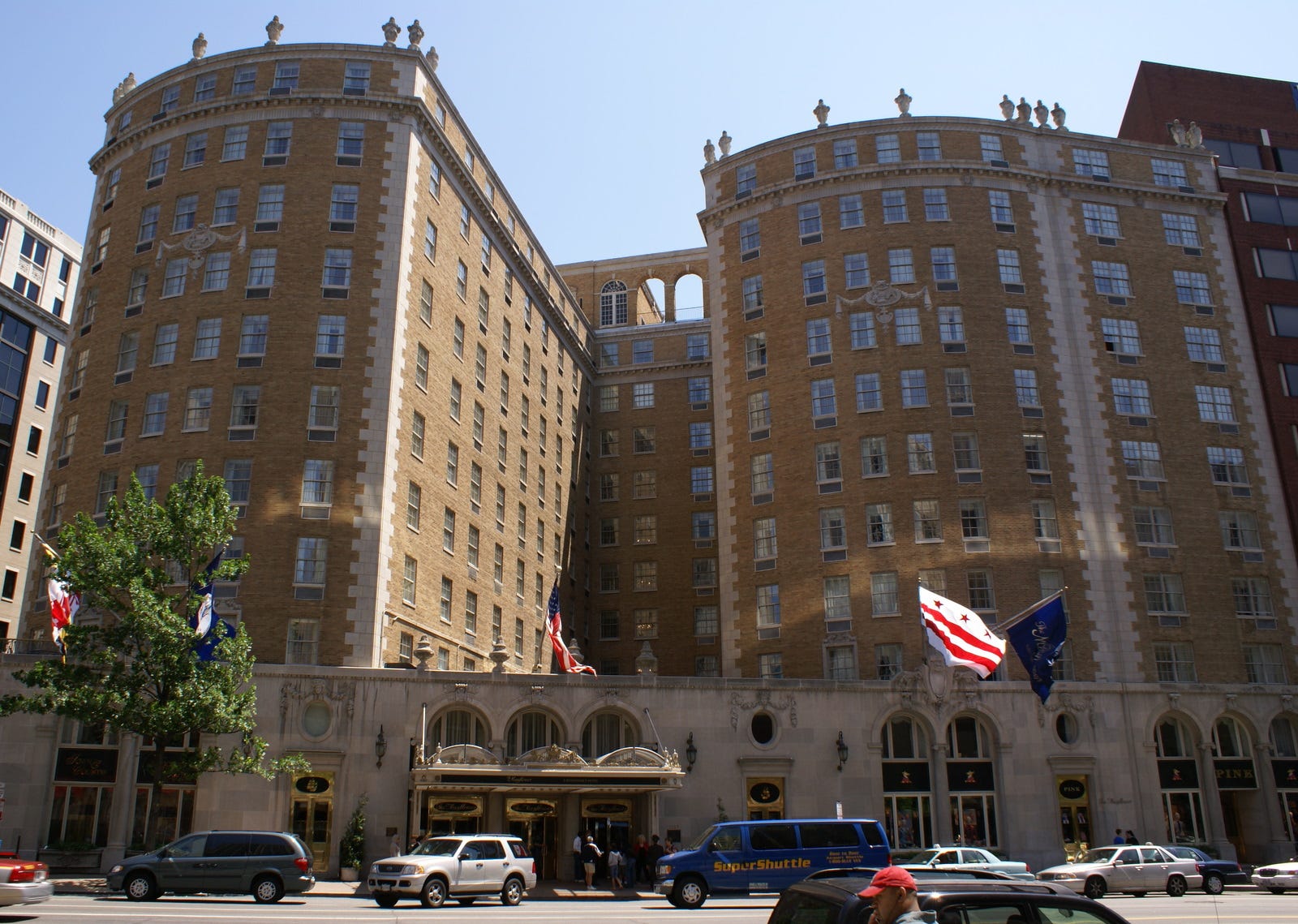
Some of the kids ran noisily around the ornate lobby; some stood shyly by their moms or dads. Many had never been out of their home states before.
The Scripps-Howard newspaper chain produced the event, and they made it unforgettable. Charter buses took us to the White House, where we got a tour. We even got to shake hands with President Ford.
There was a fancy dinner in the Mayflower ballroom. By nighttime, we were tearing up and down the hotel hallways, making friends and giggling, leaving our parents in the dust. I hung out with a couple of kids on my floor: Tim Kneale from Syracuse, and Donna Perry from Richmond, Virginia. They didn’t seem like competitors; we all felt like we had won a lottery together.
The spelling bee began the next morning, June 9. A stage in the ballroom was set up with risers for our chairs. We each wore a cardboard sign bearing our number and home city. I was number 14, meaning that I’d be the 14th speller at the microphone.
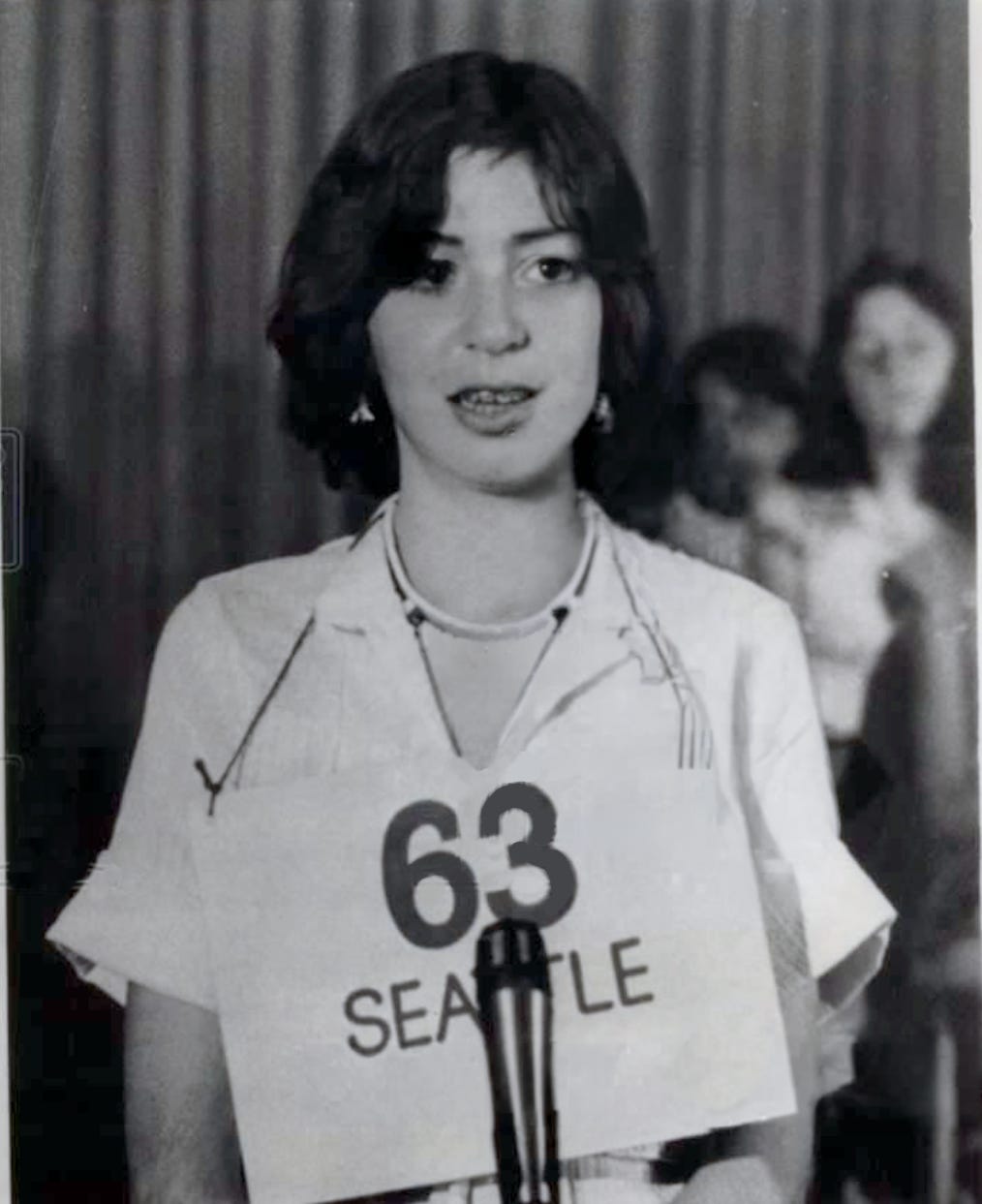
Despite all the spelling practice, I felt unprepared in some ways. The experienced kids, for example, wore sunglasses, so they wouldn’t be distracted by the blazing TV lights.
More critically, I had never before experienced an oral spelling bee.
All of my bees so far had been written, so you could review each word before turning it in. But in an oral contest, once a letter comes out of your mouth, you’re committed. In the National Spelling Bee, you can’t go “Oops!—I meant…”
The competition started out easy. The first 13 kids rattled off their words and then returned to their seats.
Then it was my turn.
I approached center stage and stood before the thick bundle of microphones in the bright lights. The TV cameras turned to face me. Back at Woodbury Junior High, I knew that the other kids were watching live in their classrooms. And if that weren’t enough stress, the audience included Vice President Nelson Rockefeller—and my mother.
The pressure was intense; if I’d had an Apple Watch, notifications about my heart rate would have buzzed the thing right off my wrist.
The pronouncer spoke my word, defined it, and offered a sample sentence.
“The word is denominator. The bottom number in a fraction; the total number of equal parts into which a whole is divided. ‘In the fraction three-quarters, four is the denominator.’ Denominator.”
I was thrilled. Denominator? Seriously? That’s all you got?!
The gods had smiled. A fifth-grader could do this one!
The only possible tricky part was the O-R at the end. I knew why they’d picked this word: They wanted to see if I was going to spell it “denominater.” Well, I wasn’t going to fall for it.
For months, I’d rehearsed a routine: take a deep breath, see the word in your head, mouth the letters before you speak them. But with this baby word, I didn’t even bother. I just went for it.
“D-E-M-O-N-I-N-A-T-O-R.”
I got the O-R, suckers!
But the judge did not say, “Correct.”
Instead, there was some hushed discussion at the judges’ desk. In fact, for the first time in the bee, they had to play back the audio recording to hear exactly what I’d said.
And there it was. In my haste, I’d mixed up the first N and M. I’d spelled demoninator, which is not a word at all.
The judges tapped a front-desk hotel bell. Ding! That’s how you knew you’d been eliminated.
I was not just out; I was the first one out.
I left the ballroom dazed, bewildered, and falling to pieces. Mom hustled out to find me. She held me as I cried. She didn’t voice a syllable of her disappointment, but she didn’t have to. Her face said it all.
By the end of Day One, 60 spellers were out; only 27 remained. By the end of the second day, we had a winner. Incredibly, it was Tim Kneale, my new buddy from the Mayflower hallways. After correctly spelling fatigue, conceit, opalescent, carafe, egalitarian, supernumerary, persiflage, literati, aphotic, bellipotent, physiolatry, demulcent, hagiology, and sauerbraten, he won on narcolepsy, a disorder that causes overwhelming daytime sleepiness.
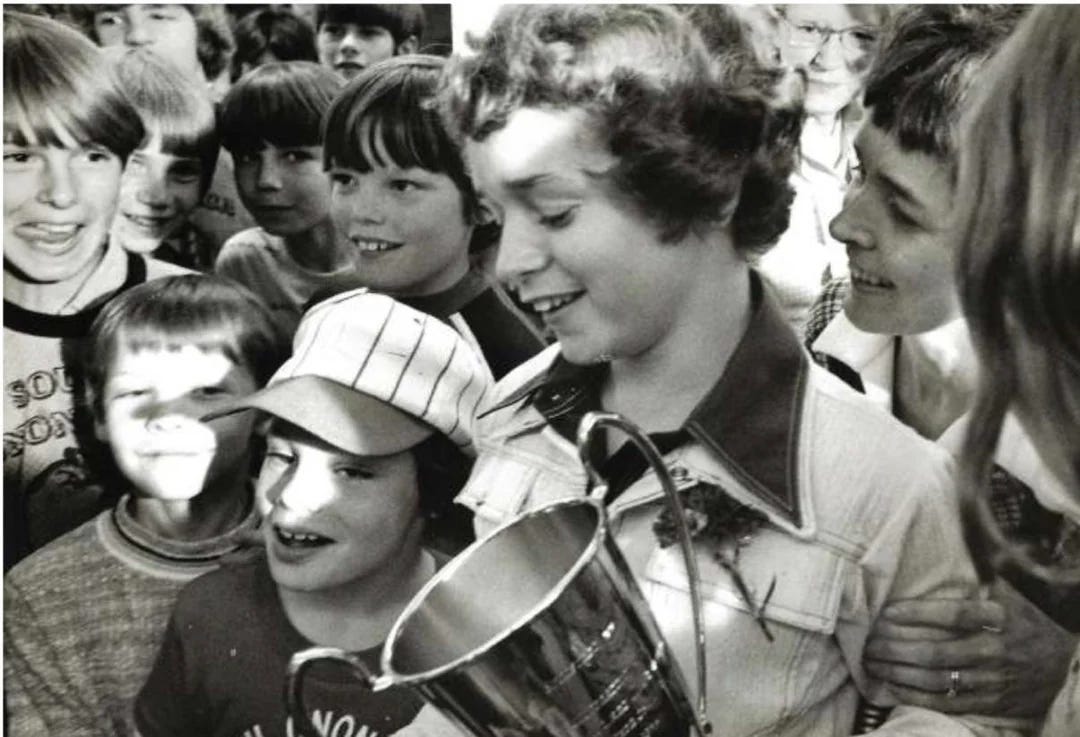
Tim won $1,000 and a week in the national spotlight. Years later, he went to MIT, majored in chemical engineering, and became the president of a plastics company.
Donna from Virginia became my pen pal for a year or so, and then we lost touch.
I returned home, devastated. All that work, all those meals, all those dictionary pages—blown in two seconds of nerves and haste. Dammit, dammit, dammit!
At my mom’s suggestion, I wrote a letter of apology—actually, a poem of apology—to the Cleveland Press. They published it.
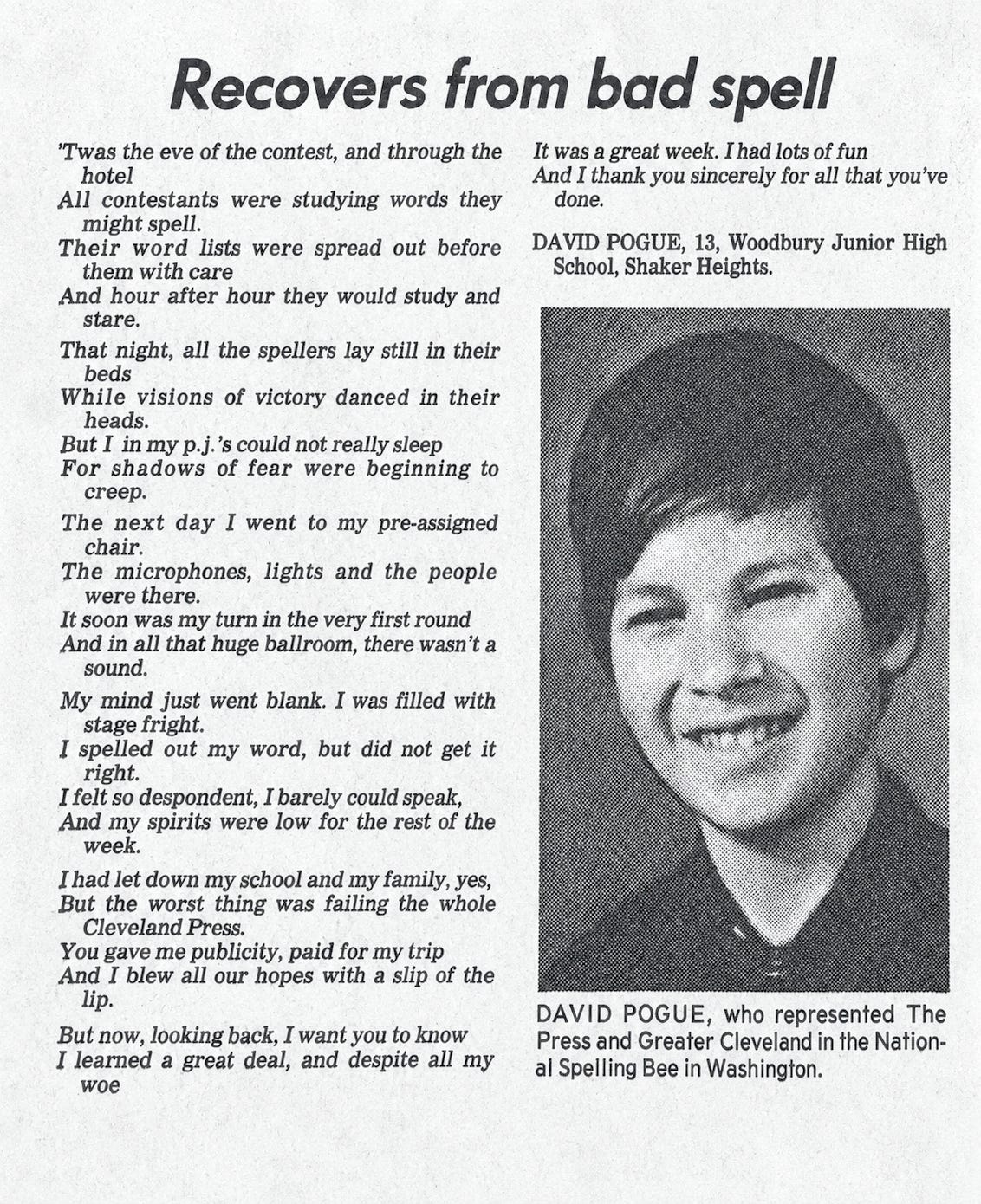
The most effective dose of forgiveness came in the form a letter from my grandfather, Jack Raney. We called him Poppa.
“Dave, you have so many blessings,” he wrote. “You’re a smart, funny, talented, good-looking kid. I think the good Lord just gave you a slip of the lip to prevent you from getting a big head. You’ll do wonderful things in this life.”
The modern Scripps National Spelling Bee is a different beast. ESPN broadcasts the Bee with celebrity hosts. The words are much harder, drawn from much more obscure lists. The prize is now $52,500 (plus a trip and other goodies). There’s now a vocabulary round—no more memorizing words without knowing what they mean—and a tie-breaking system. And for the last 20 years or so, the winners (almost always of Indian or Pakistani descent, for various cultural reasons) are kids who train for the Bee with the dedication of Olympic athletes.
I sometimes play it out in my head: What if I’d taken that deep breath? How many more rounds would I have lasted? Could I have spelled aphotic, demulcent, and sauerbraten? Would my life be any different if I’d lasted 10 rounds, or 20, or won the whole thing?
Clearly, the answer is no. At 13, the spelling bee was the biggest thing that had ever happened to me. At 13, failing so publicly felt like the end of the world.
But as life got bigger, the catastrophe grew smaller. And on its 50th anniversary, I try to see it for what it was: a slip of the lip, but a prelude to a life of wonderful things.
Comments
Nothing yet. Say the first thing.
Sign in to join the conversation.