
All this month, in honor of America’s 250th, I’ll be writing about: freedom!
Freedom, liberty, independence, autonomy, self-determination; individuality, selfhood, rights: these are words, and ideas, embedded and enshrined in America’s self-conception, but what do they mean?
Today, I wanted to share a special bonus post. This one is close to my heart, as it’s a direct invitation to teachers, educators, and anyone invested in how we talk about our shared history and civic future. How do you explore these ideas meaningfully with students? How can you bring the struggle for American independence into dialogue with our questions of today?
The poet Phillis Wheatley, an enslaved Black teenager who became a transatlantic celebrity in the 1770s, used her poetry to advance her ideas of freedom, as well as to point out the tensions between the different ideas of freedom being propounded in her day.
At an extremely young age, the self-taught Wheatley made herself an expert (an influencer, we’d say today!): Wheatley leveraged intellectual command of the Greek and Hebrew classics; firm grasp of 18th-century European geopolitics; and association with prominent abolitionists, artists and others of her day to make a difference in her world.
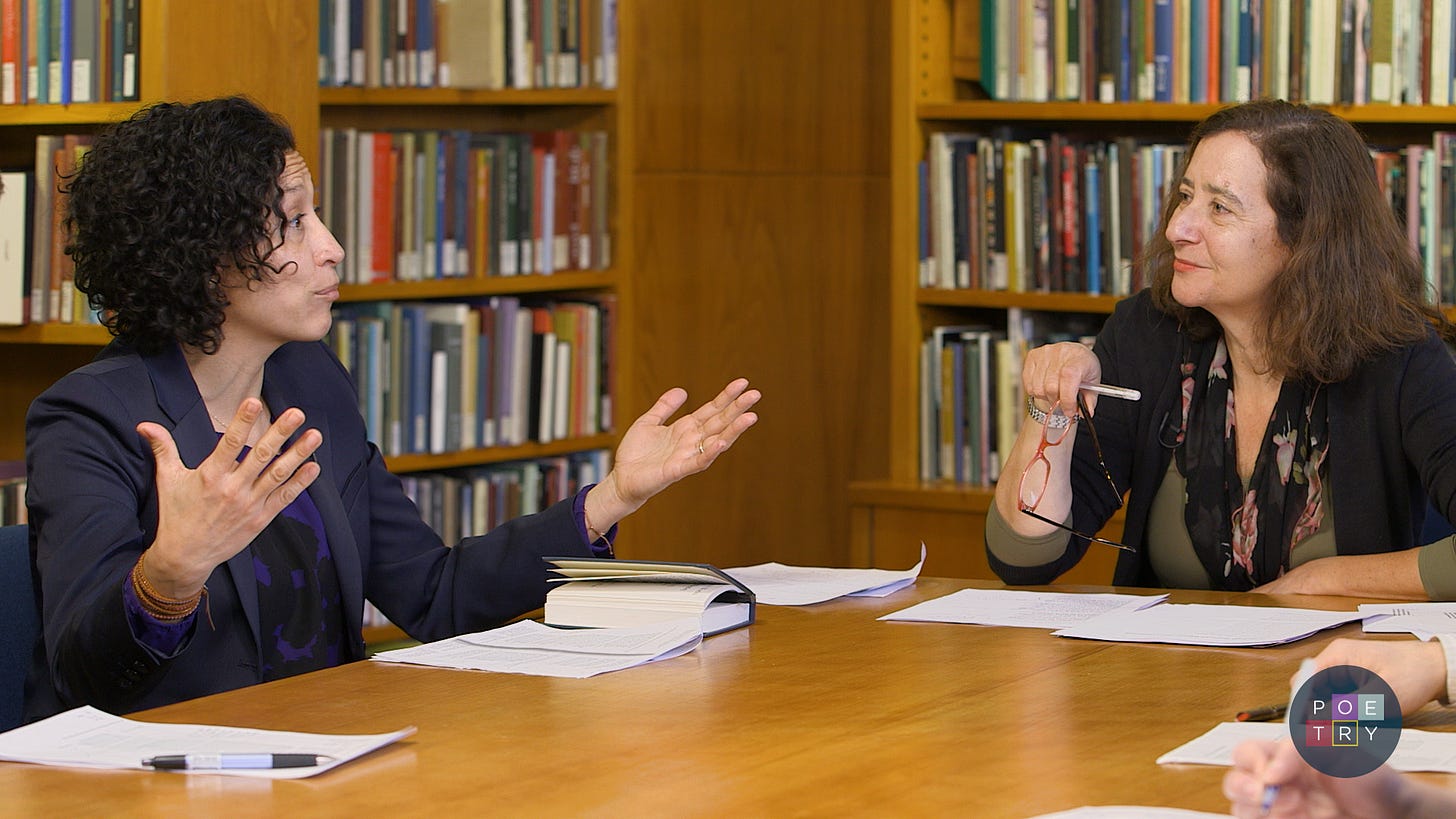
This fall, try using Wheatley’s work, and materials created for Poetry in America’s “Wheatley Week” from our course Poetry in America: From the Mayflower Through Emerson in your classroom. Though thousands of educators have used these materials before, this is the first time we are sharing them with the broad public.
View selections from our “Wheatley Week” here.
We are sharing:
“To The University”: Poetry in America Season 4, Episode 1 | Our full television episode (ca. 24 minutes) on Wheatley’s poem “To the University of Cambridge” to Harvard students and her poem to George Washington. This episode features guest interpreters Amanda Gorman, Henry Louis Gates, Jr., Glenda Carpio, and Clint Smith, and is suitable for students in grades 6–12.
3 shorter videos that dive into some of Wheatley’s best-known works, including “On Being Brought from Africa to America,” “On the Death of the Rev. Mr. George Whitefield,” and “To the Right Honourable William, Earl of Dartmouth.”
PDFs of several Wheatley poems.
Prompts for annotation and discussion.
In addition, I’m sharing below some questions that can spark more wide-ranging conversations about civic values and the words we use to articulate those values. I hope you’ll reflect on them, and use them—whether in your classroom, around your dinner table, or with your book group.
What is freedom, and how does the idea—and ideal—of freedom become part of a civilization’s values? Is freedom a political value? A spiritual value? A liberal value? Is it geographically determined? Is it guaranteed in “heaven,” protected by Divine will or by universal values? Or is it context-dependent, constructed epoch by epoch, subject to power’s definitions?
What safeguards does a society build to protect the individual’s freedom, and what are the agreed-upon limits on the individual’s freedom? What acts by government are understood to impinge on, and which to protect, individual freedom?
Must all members of a society enjoy the same freedoms, or is membership in a society—citizenship—a basket of freedoms contingent on conditions of origin or identity, of economic capacity, or of loyalty to region, faith, or creed?
How is freedom the same as, or different from, liberty, license, autonomy, or self-determination? And what new questions arise when freedom becomes an adjective—free access, free speech, free world, free market, but also scot-free, freeloader, free-for-all?
What role does the idea of freedom—the word “freedom”—play in an imperfect society governed by imperfect humans? Can freedom as an idea survive all the hopes and fears we project upon it, and can it continue to inspire our progress if we can all find some (if not the same) meaning in it?
250 years after the Declaration of Independence, these questions of freedom are hardly settled, but one place their sprawling complexities find expression is in the American poetic tradition. I look forward to exploring them with you this summer.

No posts
Comments
Nothing yet. Say the first thing.
Sign in to join the conversation.