
Today we’re pleased to share “Skyscraper,” the fourth episode in Poetry in America’s American History Collection. So far we’ve journeyed from Revolutionary War Boston to 1850s New York City to Civil War Washington. “Skyscraper” immerses viewers in early twentieth century Chicago, the city that was a great laboratory for urban innovation. Filmed on location in downtown Chicago and in the studio of the great American architect Frank Gehry (who just passed away in December), the episode explores poet Carl Sandburg’s ambivalent depiction of that great symbol of the modern city: the skyscraper.
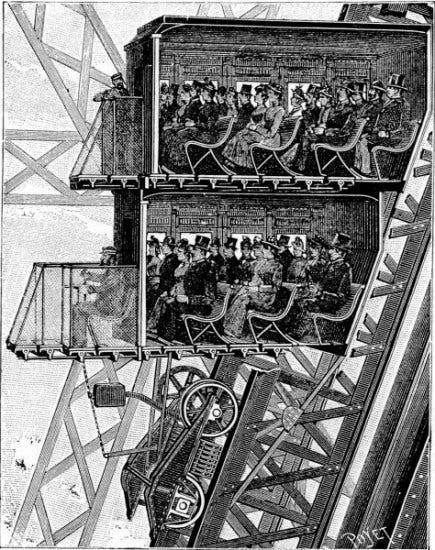
For there to be skyscrapers, first there had to be elevators, an invention that is unsung in the annals of poetry.
Imagine the disappointment that inventor Elisha Otis must have felt in 1861 as he lay on his deathbed, struck down with diphtheria at age 49, having seen his marvelous new invention come so close to popular adoption—and then: not.
Otis had wowed crowds of New Yorkers at the Crystal Palace Exhibition of 1854 (attended by over one million people, including a then-unknown citizen named Walt Whitman) in a performance he co-created with circus impresario P. T. Barnum.
Barnum had been hired to pump up interest in the exhibition when entrance fees were lagging, and Otis’s act proved enormously popular. Standing on an open elevator-car platform hoisted several stories above the ground, the car loaded with barrels and boxes to increase its weight, Otis would signal to his assistant who, after a dramatic pause, would cut the suspension cable with a large knife.
Otis then stood unperturbed and triumphant as the heavily loaded car scarcely dropped at all, stopped by his clever brake.
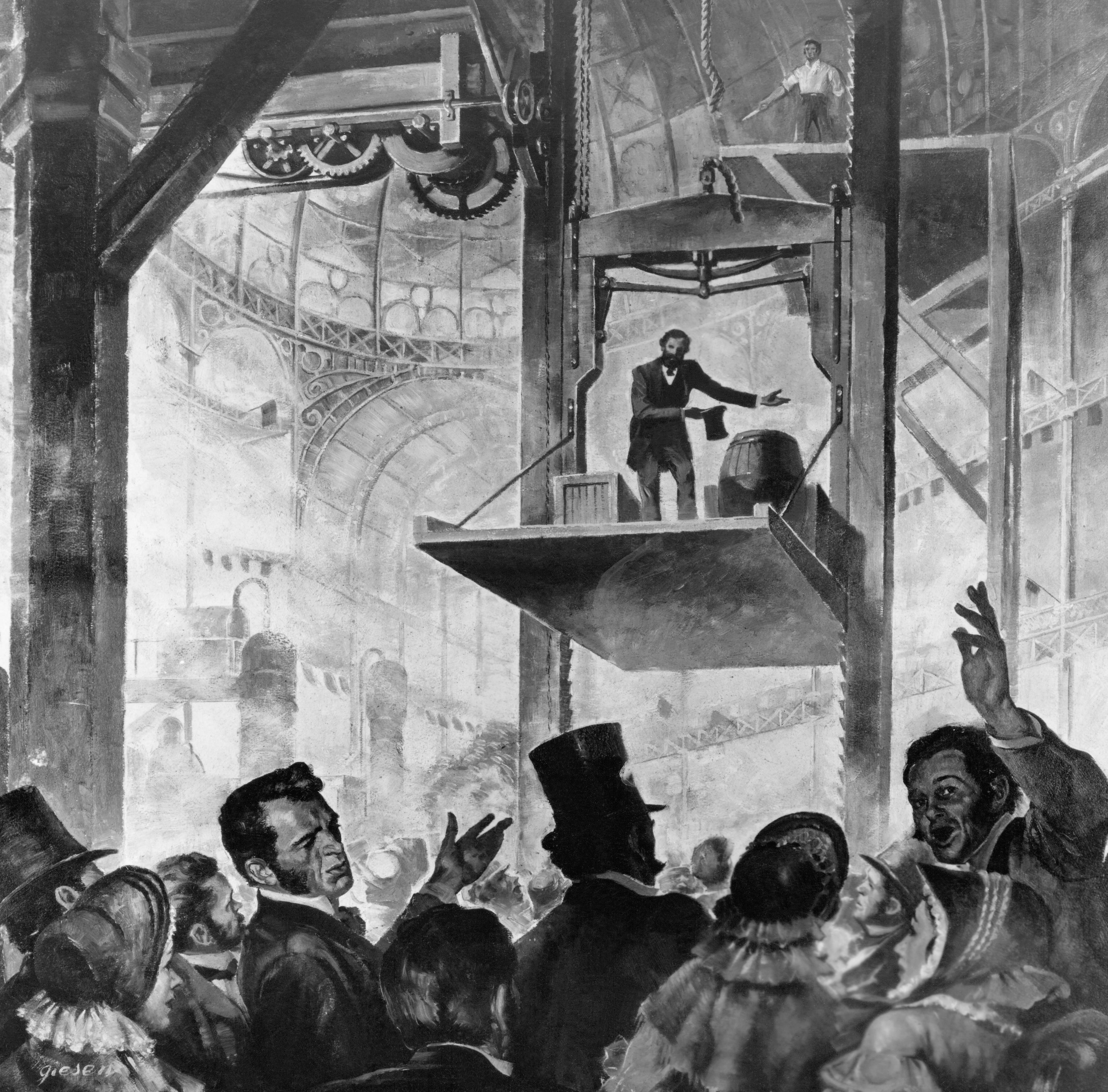
Along with the miraculous steel that replaced both wood (wood was vulnerable to fire, as blazes in nearly every nineteenth century American city proved) and brick (brick was impervious to fire, but too heavy for structures above three or four stories), it was Otis’s invention that eventually led to the vertical lives we live today. Because of steel construction, buildings are taller, but because of elevators, we live in the heights.
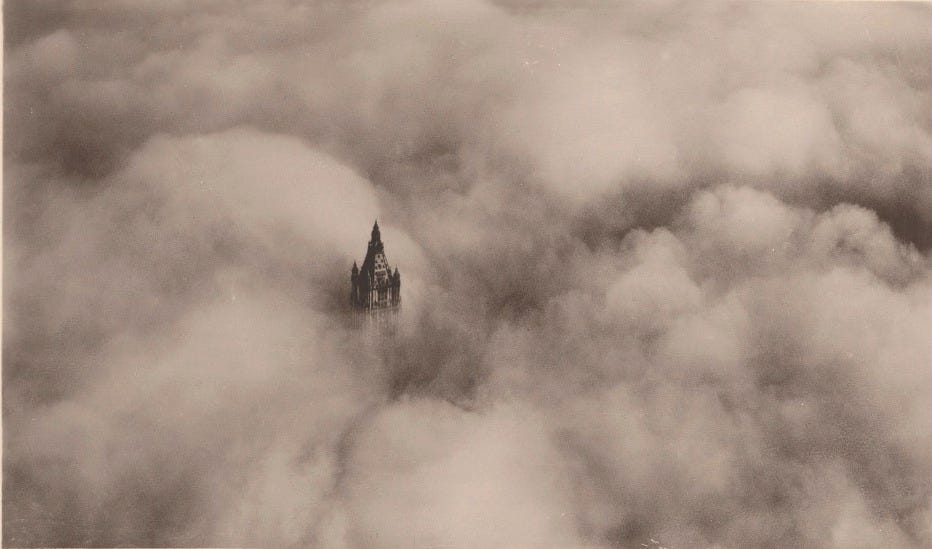
Even if you spend most of your time in the country or a small town, you likely use an elevator to ascend to your ophthalmologist’s fifth-floor office, to get to the 14th-floor conference room to give your PowerPoint presentation or sign your mortgage documents, or to join your daughter and her intended for a festive meal at the revolving restaurant on the hotel’s 25th floor. We generally take all but the most spectacular views for granted, despite the fact that throughout human history, up until the 1880s, no ordinary citizen ever viewed the world from a sufficient height that vehicles below could seem like bright little toys. Who had ever glimpsed actual clouds drift by at eye level from their desk on the 80th floor?
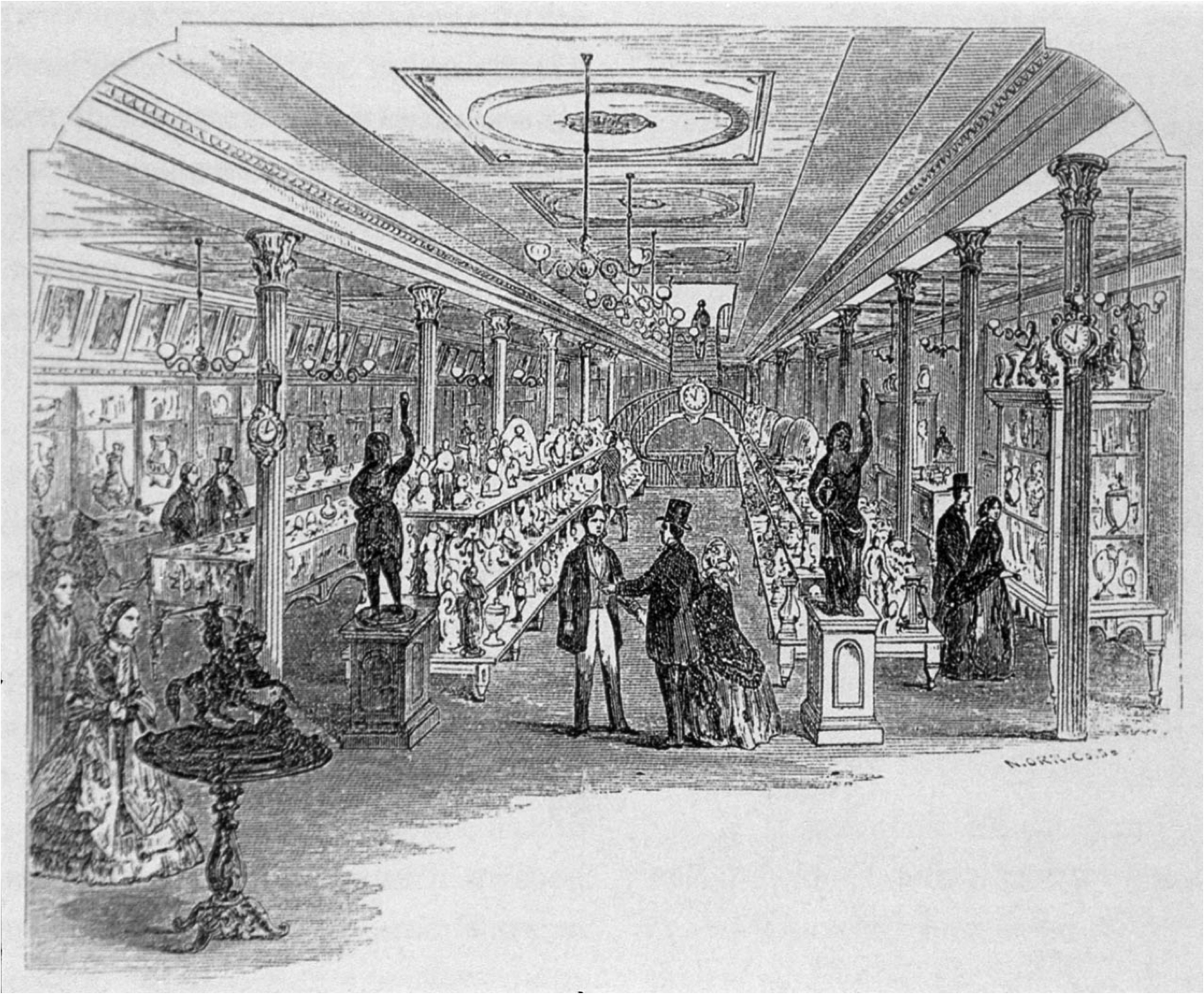
How thrilling it must have seemed for Otis when it all started in 1857, when his elevator was installed in one of New York’s most elegant new department stores, in the five-story Haughwout Building where fashionable New Yorkers shopped for their china and crystal, purchased wedding gifts, and picked up the paperweights and knickknacks they’d then bestow on hostesses in Saratoga and Newport.
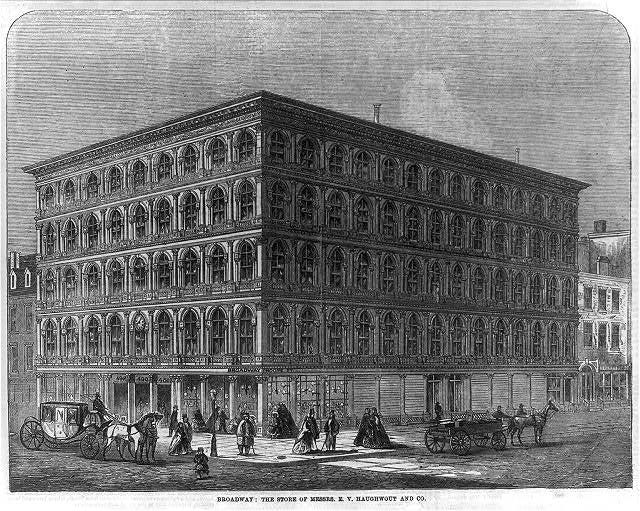
The elevator was installed as a marketing gimmick, its main purpose to entice shoppers to the upper floors. This was quite a challenge, given the mid-Victorian dress of the typical female customers, including cage crinoline and hoop skirts fabricated with yards of velvets, wools and heavy silks, all weighing some 10 to 15 pounds. In the elevator, this encumbered shopper could ascend a full 79 feet above the sidewalk at an astounding 40-feet-per-minute! (elevators today often rise 200-500 feet-per-minute), delivering her to chandeliers on three, or even higher, to the custom workrooms on floors four and five, where craftspeople labored away, painting and gilding custom sets of monogrammed china.
Haughwout’s, forgotten today, was the high-end emporium from which First Lady Mary Todd Lincoln ordered her controversial nearly-700-piece set of White House china (one of the biggest-ticket items in her equally controversial spending spree—the dinner service alone was 190 pieces).
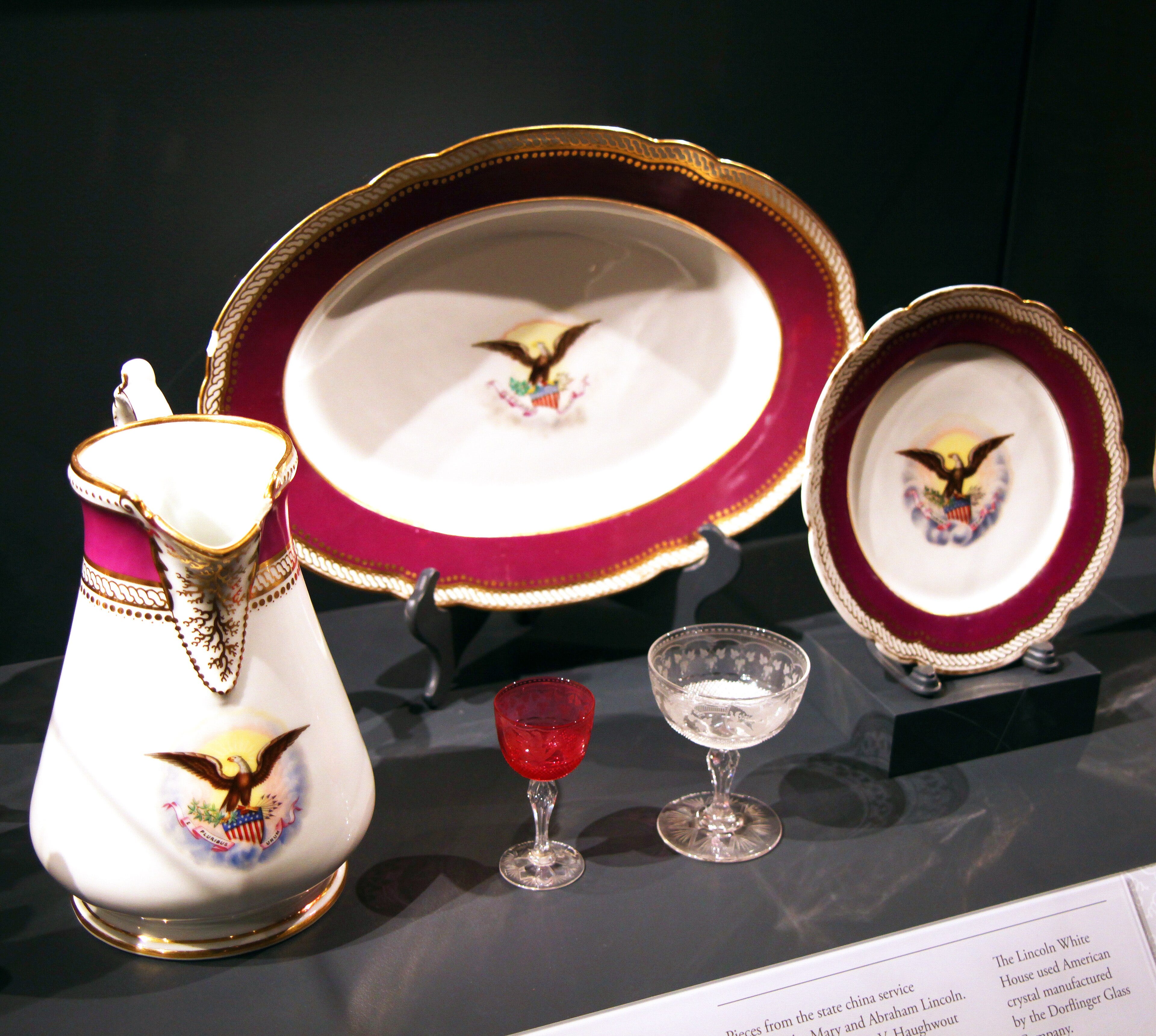
Mrs. Lincoln made 11 separate train trips to New York to place her orders, enraging Washington’s commercial community, Congress, and her husband, too. Accounts of her shopping spree leave out, however, that when the First Lady went to check on the progress of the White House soup tureens and pickle dishes in 1861, she would have taken the stairs, hoop skirts and all, arriving breathless at the fifth floor.
Because elevator service at Haughwout’s was discontinued in 1860.
Despite public fascination with Otis’s dramatic demonstrations, customers at Haughwout’s remained wary of this newfangled machine, worried it might drop them down through the crystal chandeliers on three and straight into the crowded display cases in the first-floor showroom.
(I myself might have worried more about getting shot upward on a column of steam through the showroom and chandeliers into the workrooms on five, like Roald Dahl’s Charlie and his great glass elevator. The first elevators were steam-powered, and given the great frequency of boiler accidents in the 1850s, I can just see pieces of me raining out over Broome Street in today’s SoHo.)
Though Otis did not live to see his invention’s future, his sons took over the business just as the Civil War was starting. Government contracts flowed their way, giving them the scope and capital to refine and build upon their father’s technology, and paving the way for peacetime applications.
Apparently, once you begin solving such problems as hoisting tons of heavy artillery onto steamboats, or moving tons of grain up the new (taller and taller) grain elevators, and once you’ve mastered the new hydraulics (that would eventually win the Otises their contract to install elevators in the Eiffel Tower), it becomes easier to believe you can get ladies (now in bustles rather than steel hoop skirts) up to the fifth floor to peek at the progress of their china. By the early 1870s, the new five-story Lord & Taylor in New York City had installed passenger elevators in its store.
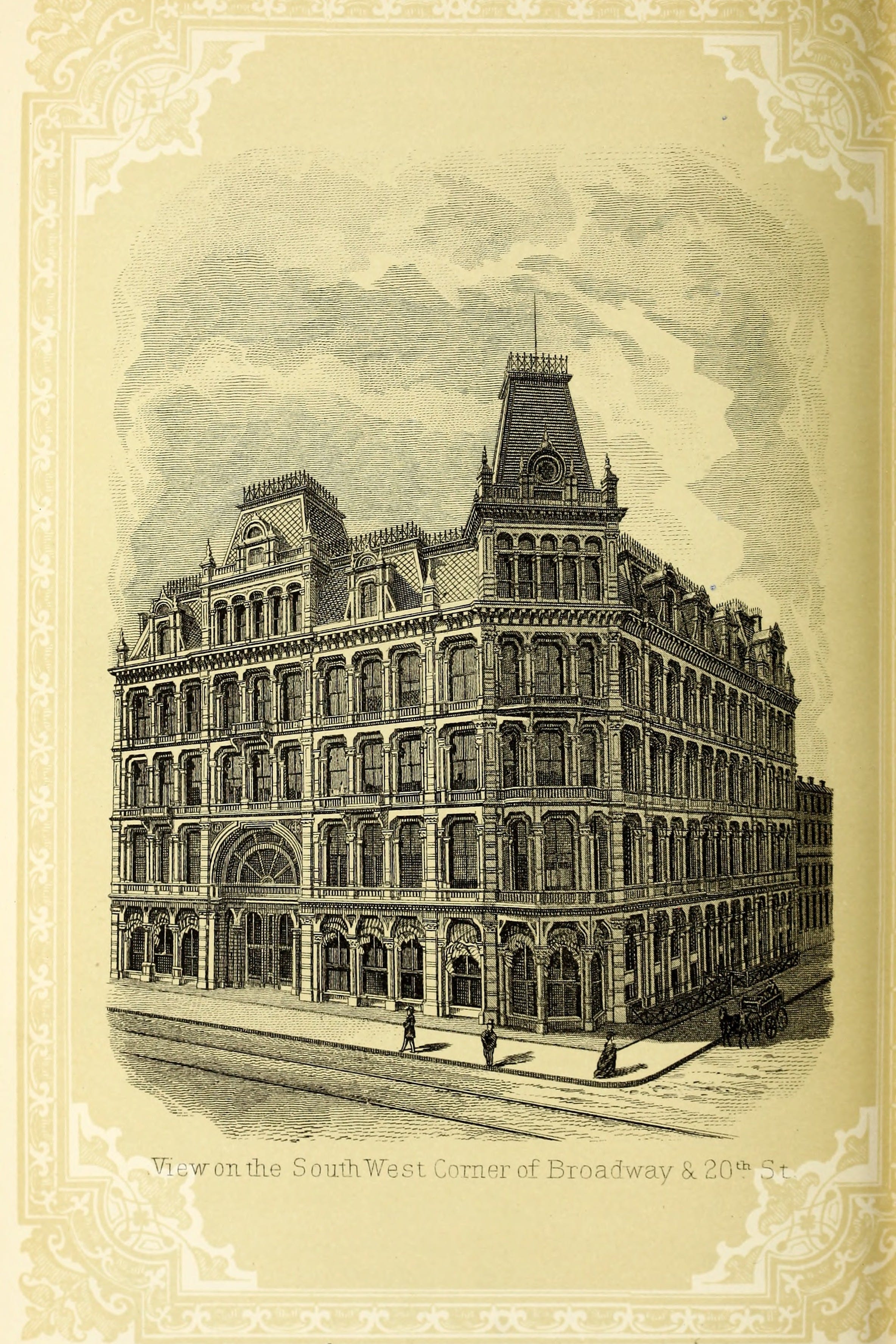
Would you call a five-story building—even one with an elevator—a skyscraper?
You wouldn’t, and New Yorkers didn’t.
Though a leader in so many things, and the very place where you might have expected skyscrapers of 10, 12, or even 15 stories to start popping up in the 1880s, New York actually ceded that distinction to Chicago, after the Great Fire wiped out much of that city in 1871.
Not to worry, though: New York caught up, and then some. You can watch Tony Malkin, President and CEO of Empire State Realty Trust, discussing the poetry, and the building of, the Empire State Building—from the Empire State Building’s Observation Deck—in this short video:
At the time of the Empire State Building’s completion, 64 Otis elevators were installed. Since a recent modernization project, the building now has 73 Otis elevators and 8 Otis Escalators, which carry over four million visitors a year, including drawing tourists and movie fans (King Kong, An Affair to Remember, Love Affair, Sleepless in Seattle, Superman II, Elf) from all over the world to ride to the top to gaze out at Manhattan, and where on a clear day, you can see all the way to Delaware.
Back to Chicago: the Great Fire of 1871 leveled more than 17,000 structures in a matter of days, destroying nearly all of Chicago’s nineteenth century downtown. The Chicago Fire enabled, and necessitated, a large-scale rethinking of the American city—not to mention a new role, and a new set of opportunities, for an American profession just coming into its own: architecture.
This was where Frank Gehry got interested, and also where, as you can see for yourself in my interview with him below, he also got a little bit…annoyed—both at Sandburg and at me.
Gehry was adamant that far too much of Sandburg’s focus—and mine too, in my conversation with him—was on the nuts and bolts, the engineering. In rereading the lines below from Sandburg’s “Skyscraper,” I do get why Gehry thought Sandburg overdid it on the building’s innards:
Text within this block will maintain its original spacing when published
          Elevators slide on their cables and tubes catch letters and parcels and iron pipes
                  carry gas and water in and sewage out.
          Wires climb with secrets, carry light and carry words, and tell terrors and profits
                  and loves—curses of men grappling plans of business and questions of
                  women in plots of love.
          Hour by hour the caissons reach down to the rock of the earth and hold the
                  building to a turning planet.
          Hour by hour the girders play as ribs and reach out and hold together the stone
                  walls and floors.
          Hour by hour the hand of the mason and the stuff of the mortar clinch the pieces
                  and parts to the shape an architect voted.
Of course, for Sandburg in the first decades of the twentieth century, as for most Americans, indoor plumbing was hardly to be taken for granted—and indoor plumbing at altitude must have seemed a marvel.
But did you have to put the elevator right next to the sewage pipes, Carl? I get the wires and caissons gripping the earth, but something about that sewage really does strengthen Gehry’s case for the relative banality of engineering versus, say, architectural inspiration. Gehry recognizes that Sandburg was an ardent socialist, who honors the nobility of the workers who worked on the building, and then those working in the building, imputing to them most of the building’s “soul.” It’s when the poet lets the pipes, wires, mortar, caissons eclipse the genius of the architect, who merely “votes” the shape of the building, that Gehry takes umbrage.
Votes?
“Votes” is not the right verb to connect Gehry and architectural shape.
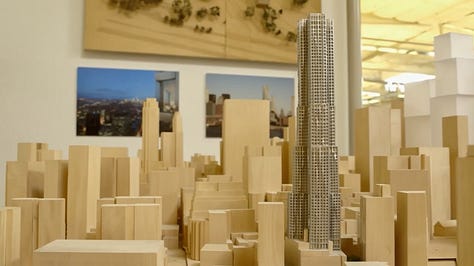
On the day Gehry and I met for our interview, and before the cameras began rolling, I toured his studio, stopping to admire the many models—beautiful in themselves—of Gehry’s startlingly original designs.
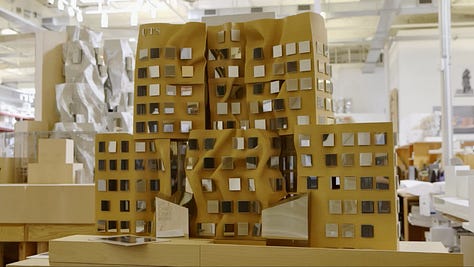
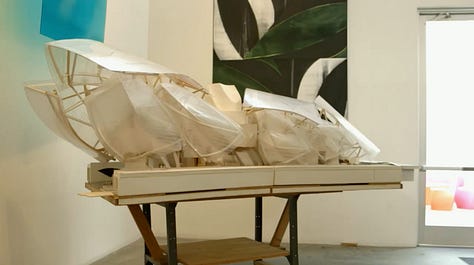
As a young child growing up in Canada, Gehry’s imagination had been fired by the shape of the live carp—the fish—his mother bought each Thursday and kept in the bathtub. By Friday morning the fish would have lost its head and become, by Shabbos eve, gefilte fish. As a young child, Gehry made a weekly study of this muscular, dynamic shape, which would later become a governing motif in his art.

Gehry loved to talk about buildings as sculpture and he did so for me that day in his studio, twisting the arms of a sweatshirt around its torso and bidding me admire the emergence—voilà!—of a new shape, no longer mere cotton and thread, but an idea in form realizing itself.
I’d seen this once before. Previously, when Gehry and I met for the first time to discuss plans for our interview, he’d astonished me by grabbing a large drawing pad, and placing it across our knees. On the pad he rapidly sketched the Parthenon, describing—as he had to many others—architecture’s emotional and expressive origins.
It was doubtless relevant to Gehry’s irritation at Sandburg that day we filmed in his Los Angeles studio. He had just completed one of his own most celebrated skyscrapers: 8 Spruce. At 76 stories high, it is no longer the tallest residential tower in the world, but it still has claims to abundant soul: a suave, silver curvilinear column that houses a public K-8 school, a residents’ library, medical facilities, multiple restaurants, a pool and 899 apartments—all serviced by 15 soulful elevators.
Going up?

No posts
Comments
Nothing yet. Say the first thing.
Sign in to join the conversation.