
The long, straight lines of medieval rig and furrow rake down the vermillion slope on the LiDAR, as straight and tight as if the teeth of a giant comb had been drawn down the hill, pushing the soil into vivid, even rows. A grey slash of a modern path cuts across them, disappearing vaguely to the north. The rig lines fade and the red-orange slope bleeds into pearlescent citron, like gasoline in a puddle, while the bent circle of the maybe-Iron Age earthwork wedged against them holds all the colours of the laser-drawn landscape within itself: high lavender-grey, deep borage-blue. More faded rigs scratch the inside of the earthwork, line the apple orchard to the north, strike imperceptibly through the play area and the defunct minigolf course to the south.
I am looking at the old arable land corrugated secretly under new-old trees, next to the modern rectangles of allotments. This is busy Queens Park in the southside of Glasgow and suddenly it is also a hill fissured with the rigs held in common by the folk in the village of Langside. The field boundaries then are still field boundaries now, marked – the most recent archaeological survey says – by ancient hawthorn. In his 1976 book Scottish Country Life, historian Alexander Fenton describes the surviving rig and furrow around abandoned settlements as “the time-softened skeleton of the medieval landscape”, and this is what I am astonished to see here on the National Library of Scotland maps website. The long, straight bones of pre-modern lowland farming, so crisp I can hardly believe the undulations on the LiDAR are not so distinct in person, rolling under the roots of many trees.
Rig and furrow was a system of agriculture built to fit the scale of the human body. A single-sided plough was pulled by livestock, pushing the soil up to the right to form one side of the ridge, then turned around at the headland to finish the other side. In Scotland’s wet climate, hills were favoured so the furrows could carry surface water away from the delicate roots of oats, barley, and sometimes wheat. Though animals were used for the ploughing, it was human hands that scattered the seed and cut the grain; Fenton describes how the width of the rigs “was adapted to suit the needs of sowing grain by hand, and to shearing it with hook or sickles.” This scale of hand-tools was, for him, “as important as the drainage function”, and he frequently describes the infield system of the rigs and Highland “lazy bed” cultivation as being closer to horticulture in its intensity of production and its proximity to the body.
So much about this way of growing feels familiar to smaller-scale regenerative and syntropic agricultural techniques used today: the soil was not tilled, but built; the birds ate lots of the seed sown but it was theirs to eat; the weeds were not weeds, but useful plants that kept the ground “warm”. In the archaeological survey of Queens Park from 1994, the author records that the rigs near the earthwork are 3 metres wide, and in my mind’s eye, I can see how each side of the ridge would have been planted upward with just more than a metre’s length of grain. I know in my own body the feeling of that length: the absolute limit for how deep a garden bed should extend before it’s too far to weed. I am moved to think of the depth of care required in a system that is essentially at a garden-like scale. The rigs are so long and straight that my 21st century brain can hardly believe they were not meant for machines, but my arms know the muscular reach of sowing, plucking, and cutting. I am mesmerised by how it is both easy to imagine the physicality of this system and how frighteningly far away it is from the systems we live in now. In this moment, looking at a map of my local park drawn by aerial lasers, my proximity to the rigs is both immediate and remote, touchable and unimaginable.
:
In the garden in February, I stand over the crown of rhubarb and make note of each muddy pink nubbin rising from the slippery brown of last years’ leaves. I listen carefully for the feelings in my body, expecting the drag of indifference, the remote blurring of apathy. But no: here is ready excitement. I test the feeling against the velvety spears of comfrey and the vivid shoots of garlic. Again and again, there is only relief and recognition.
The disconnect of depression was so abrupt. It was still so hot and there were still so many tomatoes in the brand new greenhouse, but I did not care to eat them or the basil, or to pull the slugs from the lettuce, or to stake the sunflowers against the wind. I sat in the garden and liked being there, but felt no urge to tend. A woman I so admired had died suddenly and unfairly. Families in Palestine and the Congo were being killed every day suddenly and unfairly. People in my homeland were dragged from their cars and houses by unmarked government abductors and caged in concentration camps suddenly and unfairly. The tomatoes rotted and I left them. The cosmos fell on top of the kales and I did not move them. Guilt ate away at the necrotic flesh of my depression but there was no impulse to act, even as I found that I was angry. I was furious. I screamed into the desk fan and sat for hours, seething and powerless.
It was only when the ground was cold and the nightshades in the greenhouse were mouldy and limp that I cared to probe at the spent desolation. Like the husk of collapsed fruit, I saw the shape of years trying to close the distance between my body and things we eat. How the anxiety about pesticides and industrial agriculture were chased so quickly by the experience of empty grocery shelves during sudden global crises. How the knowledge of someone else’s body very close to the chemical and physical violence in making these canned tomatoes makes the experience of the sauce deeply fraught. I saw the nervousness of trying to make a garden next to the neighbour who sprays the dandelions and the foreboding of watching bats try to feed in the daytime, of bumblebees motoring frantically on Christmas Eve. I saw how earnestly I believed that self-sufficiency is not the point, even as I answered every new geopolitical disaster with the panicky effort to grow something else just in case, to make a small garden resilient against every possible worst case scenario. A miniature Eden that could bring the whole world back to life if it needed to. I saw the disappointment in my own body as chronic migraines and autistic burnout kept me from sowing seeds on time, or making space for the garlic before they decayed in their net bags. How I did not connect my little garden with others in the ways I wanted to, because I was tired and overwhelmed and sometimes very shy. I saw how, somewhere between July and September, I simply let the tide of everything else pull me away from the garden so I merely floated above it, an observer tethered very loosely by remembered love, and how that felt both better and worse because I knew. I knew the distance, in all this processed food I relied on, between the wealthy and the workers, the buyers and the makers, between my body and the land, and I felt such guilt for no longer trying to bridge that distance with the garlic and the salad in my own garden.
:
Before the agricultural Improvements movement in the 17th century, land in Scottish lowland farming communities was occupied in runrig: “that is to say, the ridges and patches of land occupied by different tenants and even by different proprietors lay intermingled with each other, and in some areas were re-allocated at regular intervals.” Fenton Such intermingling was designed to equitably distribute varying qualities of land amongst tenants, so that no one tenant was favoured, on fields that were held in common. Together, the community decided what would be grown, when it would be ploughed and sowed, and when the grain would be harvested. Parcels of countryside might have been “owned” by the lords who swore fealty to monarchs, but the ground itself was accessible and cared for by all the people who worked it.
Unlike England, field systems in Scotland had no fallow period every third year. Lowland farmers broke their arable land into three types, divided by their proximity to the home: closest was the kailyard, that plot of land immediately around the house where vegetables like cabbage, kale, turnips, and aromatic herbs were grown; furthest was the outfield, which was land used for grazing, or for harvesting turf that was used for manuring, thatching rooves, making dykes, and forming walls of buildings; and in the middle was the infield, which was diligently fertilised with manure from byres and middens, ploughed into rigs, and, as Fenton says, “cultivated almost like a garden, which goes on producing year after year without being rested.”
He has said something like this so many times now that I wonder, at what point does a field become a garden? Or is it the other way around? In a system built to fit no technology larger than the human body, is it even useful to distinguish between the agriculture of the field and the horticulture of the domestic kailyard if they look and feel the same? If they both need the attention of the body, of many bodies all working together?
I think about the rigs and medieval landworkers’ proximity to earth, weather, animals, and each other as I clean the greenhouse of last year’s grim remains. This July will mark four years since we moved from our tenement flat and its parking-space-sized garden to this beautiful house with its front and back plots, and I wonder if my summer abandonment of the garden was triggered somehow by an unrecognised feeling of isolation. I didn’t think I would miss how public my tenement front garden was. It brought so many new friends, but it also brought hours of anxiety in negotiating unpredictable interactions with passers-by just to do some light weeding. But maybe, despite the autistic discomfort of it all, that exposure grounded me in place in a way that the privacy of this space hasn’t invited? I chew on this as I wipe the glass of mould and pollen. In between panels, I scroll through too many ads and suggested posts on Instagram and feel such a pang of missing the Instagram of 2020, when a small community of decolonial-minded gardeners found each other there; first in response to global white supremacist violence and its history in the horticultural world, and then in cheerful support of our individual gardens that, despite their geographical distance from one another, formed a kind of psychological commons. I knew my tiny garden then both in the digital context of many other gardens and their radical, outspoken growers, and in the physical context of neighbouring small-space growers doing beautiful work in cramped city conditions. My proximity to resilient hopefulness felt so much closer, as if just a little more time and good will could pull the strings of our worlds together to make one beautiful, garden-scale landscape.
Now, most front gardens in my new neighbourhood are paved or gravelled. Most of my friends and I are only on Instagram as resentful viewers and intermittent sharers, weary with the enshittification of a once-usable and beloved platform. My garden, wedged between sterile neighbouring yards and out of touch with the remembered gardens of others, feels mournfully disconnected from that wider, vital network of fruiting bodies. Part of me is surprised I didn’t see this isolation coming. After a whole winter spent musing on the loss of infield, outfield, and kailyard, surely I know where the garden and I sit in that order of events: the garden-scale runrig system of feudal Scotland was abolished by the post-Reformation landlords who – in the name of agricultural Improvements – broke up and violently enclosed the collective areas of the commons, destroyed the rigs to make flatter fields conducive to experimental mechanized machinery, and cleared the community of rural fermtouns to found single-family farms supported by itinerant labourers. With time, the cottars who worked on these farms and who were allotted a little land of their own had that taken away too by the rapid industrialisation that made their jobs irrelevant, and the families who ran the farms lost them after generations because the government subsidies ran out and the produce from half a world away was cheaper than what they could sell theirs for. Proximity between growers and eaters grew distant and opaque, hiding all kinds of violence. The idea of the garden as a place of real and valuable subsistence – or even as a scale for measuring one’s proximity to land and neighbour – was forgotten in the capitalist perversion of it as a hyper-individualist luxury space.
I know that this is where I am now: in the time of violent fragmentation. I know that it’s not my fault but it’s also not unstoppable. If we are to endure, the garden and I must grow differently this year.
:
Behind my closed eyes, the long, straight lines of medieval rig and furrow rake down the muddy green slope in front of me. It’s Imbolc, and I have climbed the hill past the allotments to see the rigs. I told myself, as I huffed up the incline, that if they weren’t apparent to the naked eye it was enough just knowing they were here. But as I emerge from the trees, I can see clearly the alternating depths of green. They make an obvious undulation underfoot, a regular up-and-down that makes me laugh to myself as I bob over them.
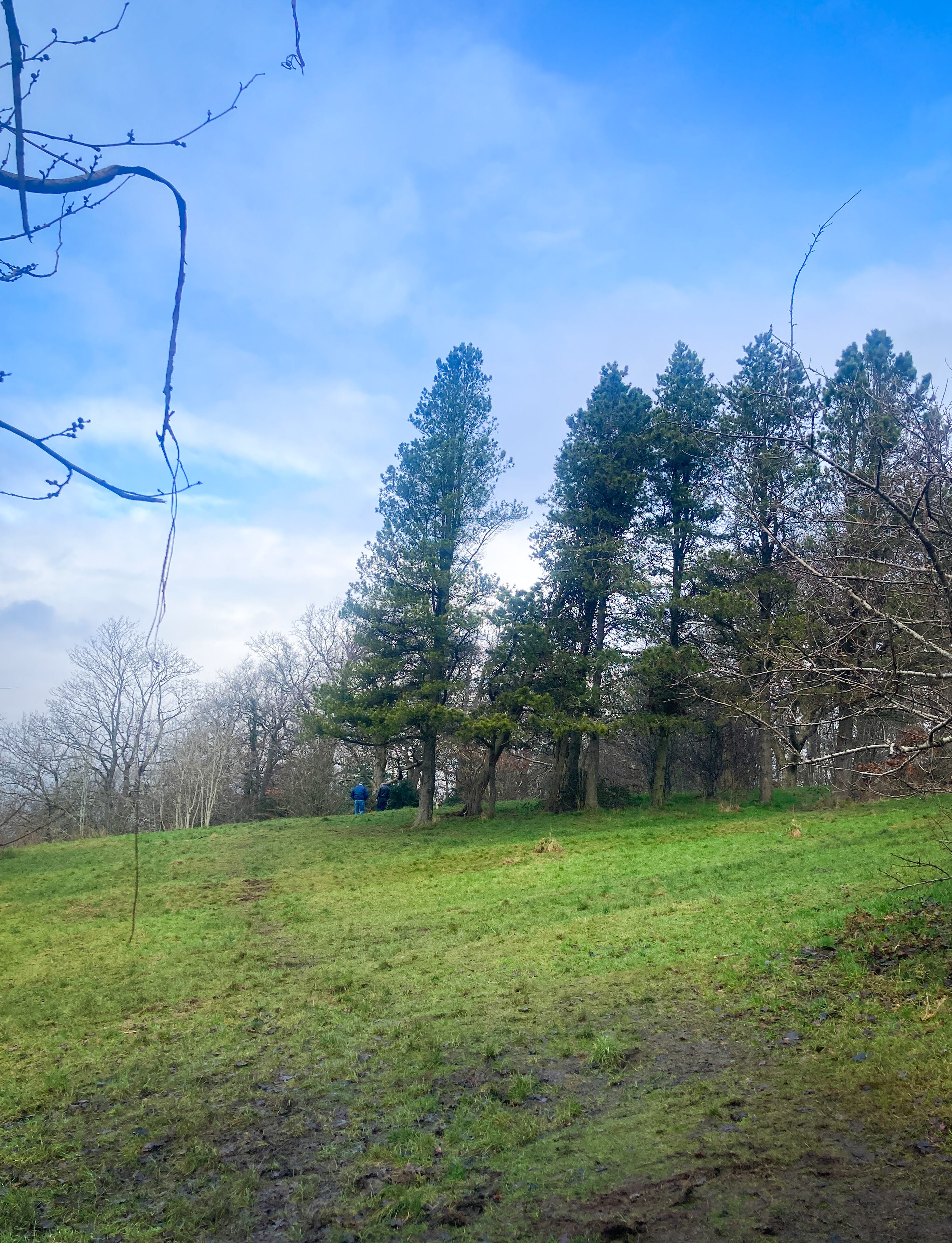
After I let a couple and their elderly Jack Russell terrier pass, I am alone in the field. Being alone makes it easier to imagine away the new-old woodland, build the ridges back up in my mind, feel the directness of the path I have just walked from the heart of the village behind me. Modern-day boundaries that I’ve always had trouble disregarding now disintegrate readily; thresholds of wrought-iron dissolve to consolidate village with field, field with hill. Every intimate detail I’ve gathered about this this landscape over the last seven years blooms into a ghostly projection of the world as it was before the Enclosures, before the Improvements. It’s been centuries but the rigs are still here; not a disarticulated artefact cast out of time, but a physical monument of collective care left by the medieval working class.
When I open my eyes, it’s the spring solstice. I am in my own garden, palm full of kale seed collected one hot spring from plants in my tiny tenement plot. I mean for some to grow again in this garden, next to the rhubarb I once got for free from the allotment next to the rigs, but the rest are destined to leave: to push the garden out into the gardens of others, and bring the gardens of others ever closer.
For more writing on political histories of growing, eating, and caretaking, do let me recommend some recent favourites:
And finally, a classically impassioned rant by the dearly departed Sara Venn, whose kindness and fierceness I miss every day. Her son Noah continues her legacy through The Sara Venn Project, which grows food solely for food banks in Bristol. You can donate to support the garden here.
No posts
Comments
Nothing yet. Say the first thing.
Sign in to join the conversation.