
It’s been a WHILE.
My apologies.
Sometimes writing a newsletter is easy. Stories pop up everywhere. When you’re walking, you’re mid-conversation, in the gym, doing the washing up.
And sometimes it’s hard. Your brain forgets how to grab on to the little sparks that trigger the words.
I’ve had a couple of months like that. Everything has just felt too big. Too cumbersome to manage. Too complex to write about.
During this time, I’ve even lost touch with sport.
I know. Shocking.
I haven’t been watching it much. What had excited before, has bored me. In the scheme of everything else happening in the world, sport shrank back to a small corner.
Sports that were important had become too hard to negotiate because I saw too many problems. I saw the big picture: the way in which they reinforced some of the worst gender beliefs, biases and behaviours, particularly in this country.
Someone, when they found out I wrote about sport, asked me if I was watching the Winter Olympics.
Not really, I said.
Then last week I watched the figure skating. I don’t care about skating. I don’t care about the Winter Olympics. The night before I’d watched some of the aerial skiing with Dash and the most excited I became was when there was a big stack. Sorry skiers.
So the figure skating came on and in that moment I couldn’t imagine a sport that spoke less to me.
But then three Japanese women performed their routines.
Mone Chiba, Ami Nakai and the veteran Kaori Sakamoto got out on the ice and the precision and speed in their movements caught me.
Chiba, 20 years old at her first Olympics. Nakai, 17 year old high schooler and the potential heir to the throne of Sakamoto who had said she would bow out after this, her third games, at the age of 25.
Then Amber Glenn from the USA. She missed a turn in one of her elements in the short program.
The Australian commentator quietly explained what had happened.
“She’s so familiar, this commentator”, said Liz
I realised she was right. Surely, she doesn’t do any other sports, but why do I know her voice? She lulls you into a trance as she gently explains what is happening.
“Triple flip. Double toe. Lutz. Edge”.
She creates drama without bombast. I think her name is Belinda.
Glenn was in tears as she sat waiting for her score, that small mistake potentially bringing down years of work.
Then, of course, there was Alysa Liu. Striped hair, frenulum piercing she did herself, first Olympics at 16, retired at 17, on her comeback.
Liu retired because she no longer received joy from the sport. If you read her story you wonder if there was ever joy, before she managed to find it herself.
After the short program, Nakai was in first, Sakamoto second and Liu third. Monie was fourth while Glenn had paid for that small miss, as she sat in 13th place.
The free skate portion of the competition saw Liu step on the gas and score enough to overtake those above her, securing gold. Sakamoto stayed in second while Nakai got bronze and Chiba fourth. Glenn absolutely smashed her second routine, clawing her way back to fifth.
It was a lot.
I don’t care about the winter Olympics, but I care about stories. I had forgotten that this is the reason I love sport.
The figure skating was technical, physically demanding and required years of work, from childhood. What I saw in those few hours that I watched this sport, was joy. I saw connection between athletes from different teams, from different countries. People of my vintage probably associate figure skating with the Tonya Harding / Nancy Kerrigan melodrama, which does it a disservice of immense proportions. Watching Liu skate to Donna Summer’s Macarthur Park is a long way from that.
“That’s what I’m fucking TALKING ABOUT” she said to the camera as she left the ice after a performance that would render her highest score ever.
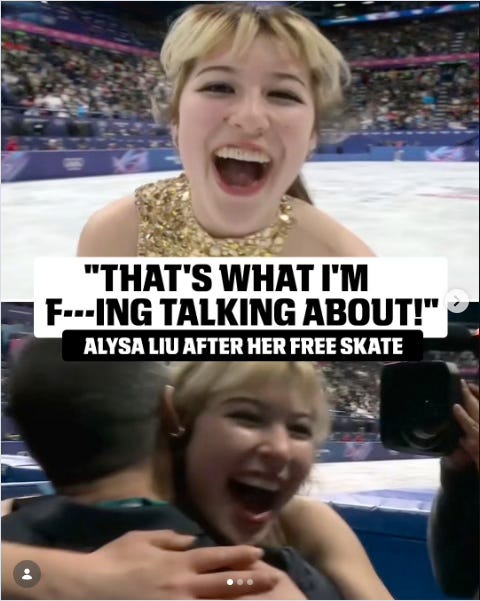
Then came everything else.
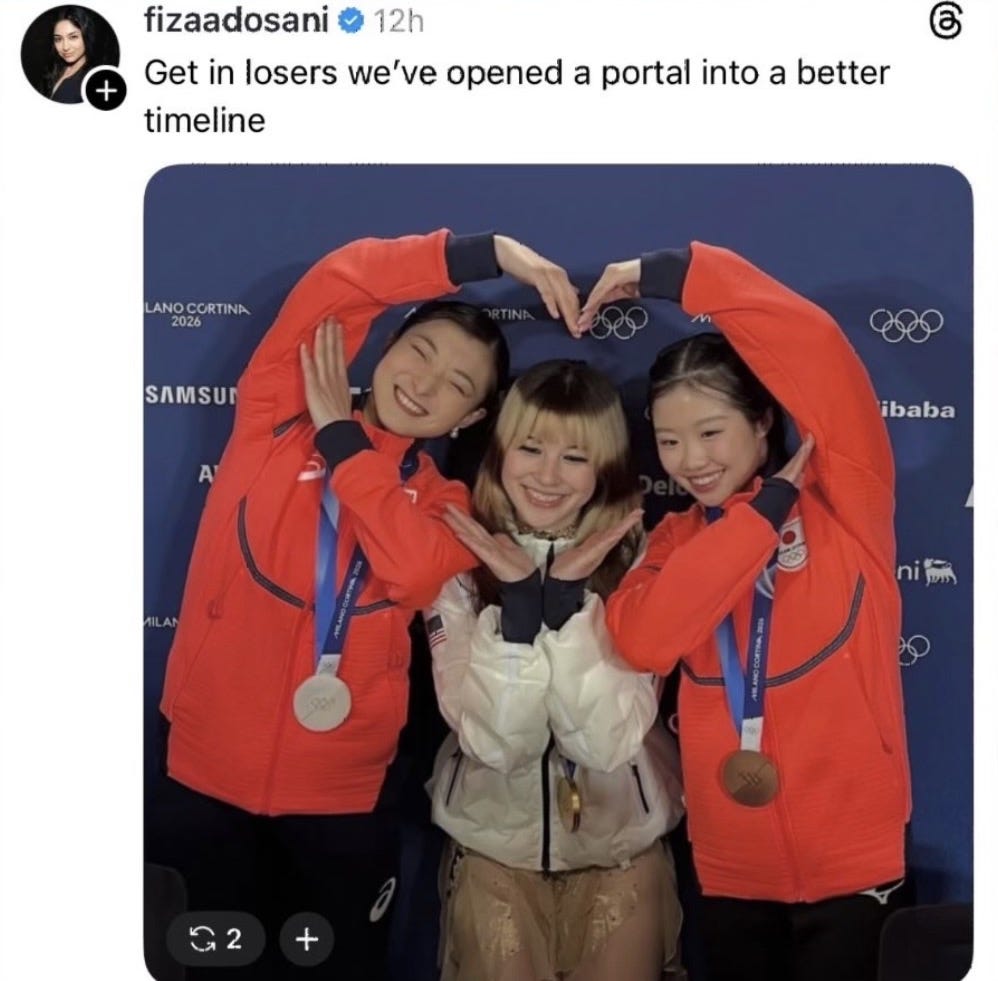
Liu congratulating a bawling Nakai, overwhelmed when she won bronze.
The leap on the podium.
The joy shared between the three medallists, even though Sakamoto was devastated at having not won gold. As she sat crying after her routine, Amber Glenn stood between her and the media, telling them to back off and leave her be.
Then, of course, my algorithms filled up with women’s ice skating, and I went down a rabbit hole.
Turns out I was not the only one.
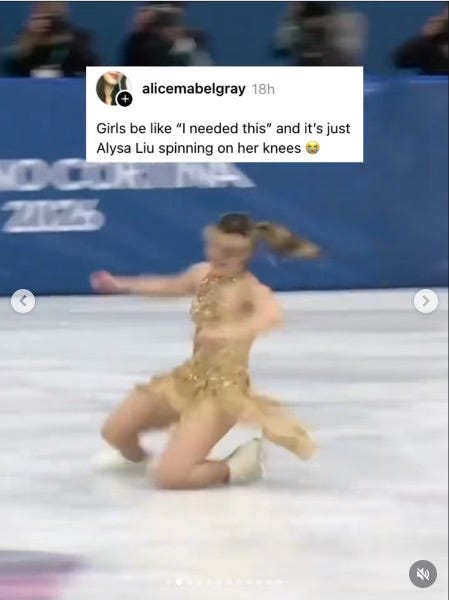
Glenn has previously come out as bisexual. After her glitch, she openly talked about having her period and performing in front of the world at the same time.
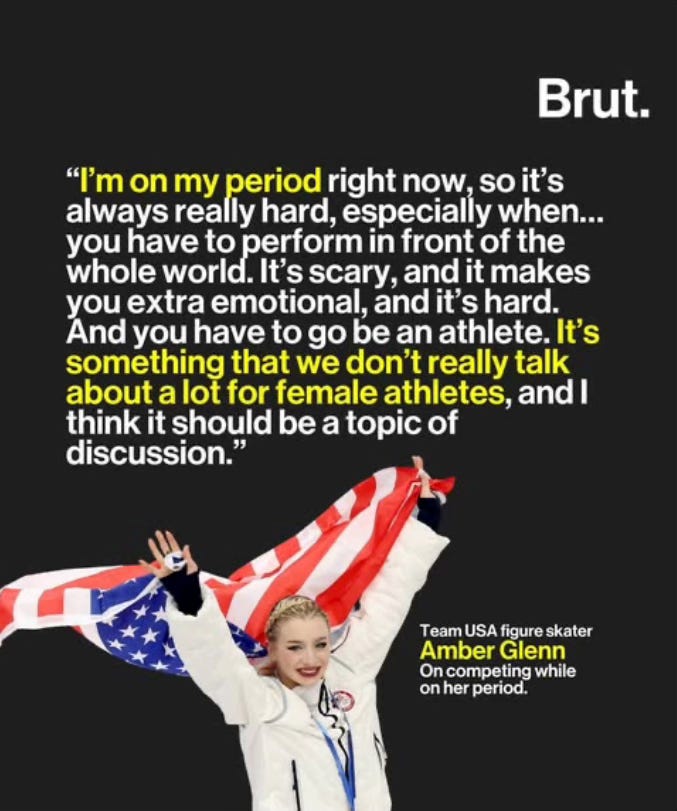
Liu talked about ‘connection’ and what she wanted from her skating and her life: to connect with people.
Women loved them. Others called them ‘woke’. I didn’t care. That figure skating competition was exactly what I needed. It reminded me why sport still fascinates and feeds me. It’s human.
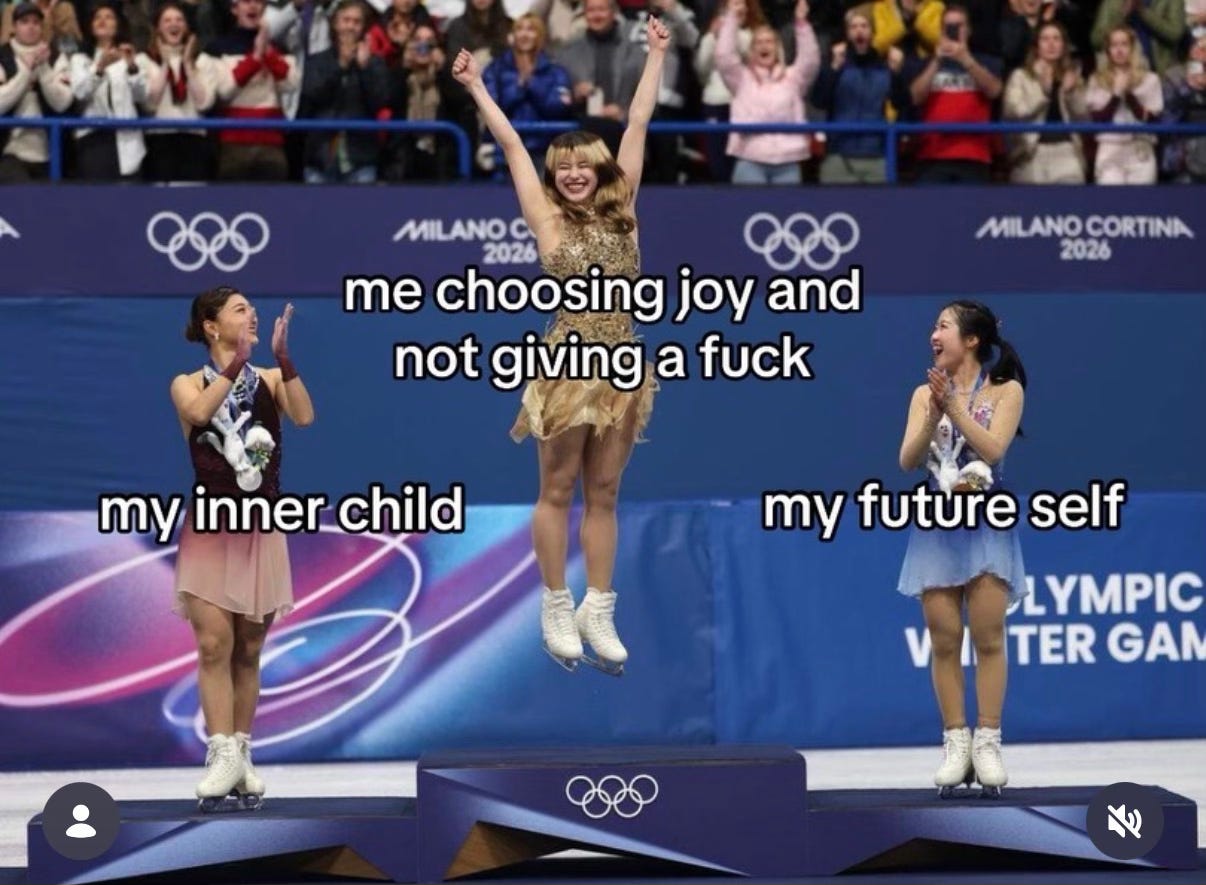
It also reminded me why I’ve always thought women’s sport is not just about the game. It can show us a different way to do things; a different way to approach our relationships and what we want from the world. At its best it demonstrates that competition can also be about joy and connection, rather than spite and pain, even at the elite level. It offers us a different way to think about other stuff, like, dare I say it, politics.
So when the USA men’s ice hockey team celebrate with the FBI Director (WTF) and laugh when the President treats the gold medal-winning USA women’s team as a burden and a joke, I am yet again reminded that despite the glitter and vibes of the women’s figure skating, there is still so much work to do.
<Rolls up sleeves and takes out pen>.
Buckle up.
Thank you, as always, for reading.
Georg x
I write this stuff because I have to, it’s a compulsion. However, if you like it and you want to show your appreciation, I admit that I get pretty chuffed when someone ‘buys me a coffee’ (makes a small, one-off contribution).
Comments
Nothing yet. Say the first thing.
Sign in to join the conversation.