
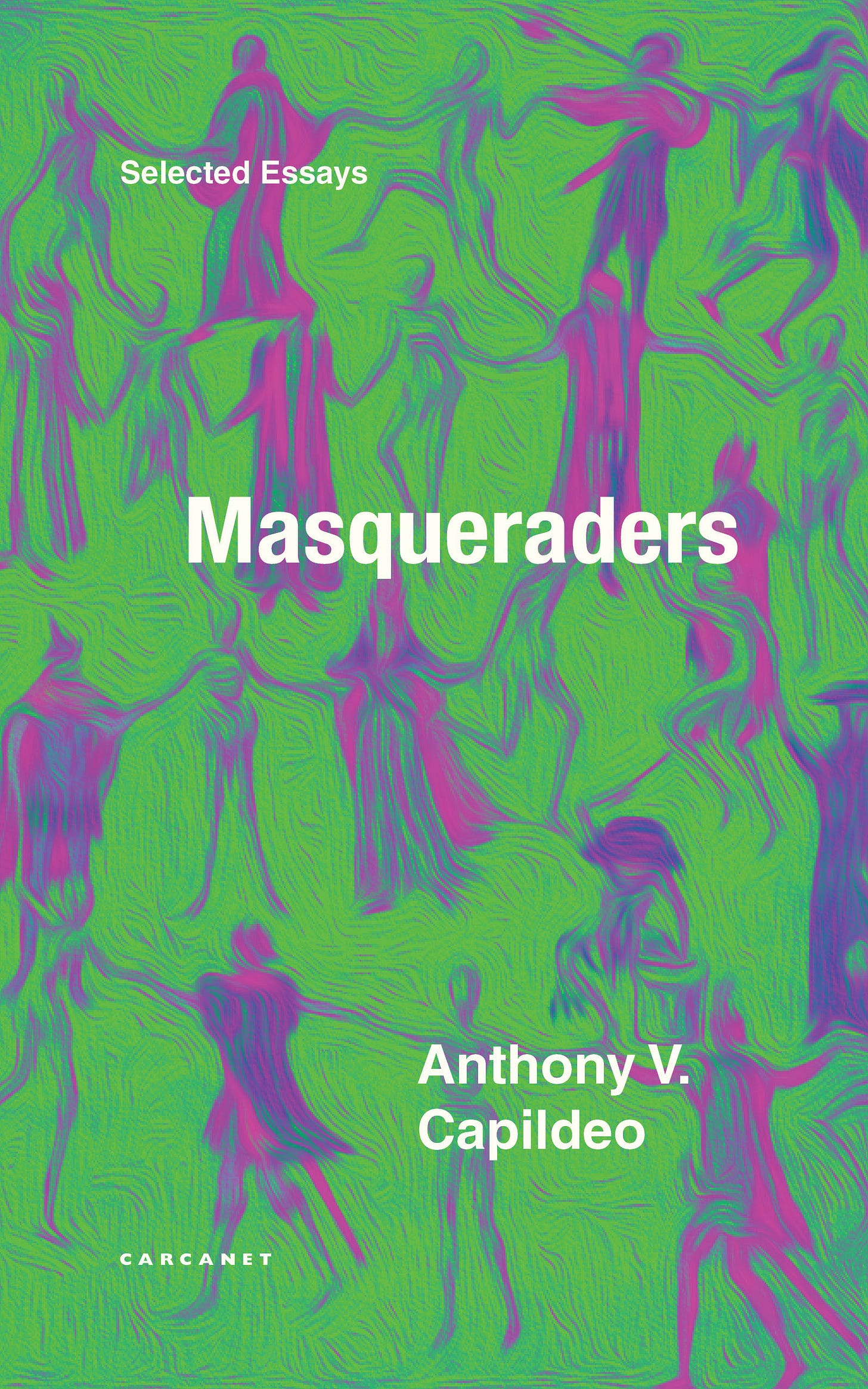
Anthony V. Capildeo’s latest collection, Masqueraders is being published this month. Use the code JULYBOOKS15 at our website checkout for 15% off.
Until the end of the week, we are also offering 25% off Capildeo’s previous titles. Use code AVCBOOKS here.
Listen! Something marvellous happened in the middle of the night when noisy folk had shut up and gone to bed. The Old English poet in The Dream of the Rood has to tell you about it. Fabulous and gleaming, then smeared with blood and sweat, the Cross on which Christ was crucified is appearing to him, one way then another, steadily but in flashes. It continues to stand steadfast, continues alternately to shine with glory or drip with gore, while telling the poet how it grew up: its innocent tree-childhood, one among many in the wood; being singled out, cut down, and carried away by the men who turned it into an instrument of torture; being put in the position of killing the young hero stretched on it dreadfully, desirously embracing him though it killed. The flashes troubled me. They reminded me of what my father suffered: obsessive images of harm occurring to his family, images of himself doing that harm. In my late teens, at university, I found ways to write about the poem that left out affect. But things on pages continued to move.
Before you enter the deep bath, roofed with a canopy of stars, you have begun to feel a change. Bodies in motion and leaping flame are reflected in polished metal, showing or casting shadows on the glitter moss of mosaic. They seem to metamorphose. Creature, you feel part of creation as process. So, at least, my friend Mike – theologian, classicist, puppeteer and trained clown – explained to me how Christian baptism in the ancient world perhaps partook of a sensibility not alien to earlier men afraid of being turned into deer, women desperate to become trees, and in-between genders blowing like windflowers. Dying to the old life and entering the new was a break, but not a discontinuity. I think this is what Mike said. The immersion in movement, openness to being moved, troubled me.
Mike and I are working with a dancer. The dancer creates a score in two parts, displayed on two walls in the studio. One charts and lists wounds from the Iliad, with helpful diagrams of human anatomy. Another cues us into gesture. Mike and I stand in the corner, looking from wall to wall, before stepping out onto the black floor. As part of the rehearsal process, one of us reads portions of Emily Wilson’s Iliad translation aloud, over and over. The other two move. This is discombobulating for me, despite my previous experiments in immersive theatre. Surely you don’t do that to Homer? Certainly not with a fluffy seal puppet among the props… Reading Great Literature contemporary-leisure-style can assume the privilege of stillness. You sit with the text, and its difficulty (emotional, linguistic, other). You turn it as you contemplate it as a surface of words; you notice areas of brightness for you, highlight them further, focus more closely, take some distance, reckon with the strange. You are the still (small) point that contains the words’ (immense) turning world. It does not matter if you are in bed with the book, or if you have left the book, or screen, behind, to walk or roll with the text in memory, waiting on bleachers or in hospital or in a queue in the late-night shop; nonetheless, you become, and benefit from, the stillness around the text or textual fragment. ‘Walking poetry’ workshops, or taking a poem outdoors, need not at all disturb the relationship between reader and text. You are in charge, becoming the fortress-husk in which the poem germinates. You are not necessarily open to change. This is not so if you are a body in motion in a procession, yourself image and acted-upon.
I do wonder if dismissal of some poetry (like my beloved Martin Carter’s) as ‘political’ comes from the fear of being amongst, the fear of being changed, the distrust of speech that can pass from mouth to mouth; the valorization of silent reading as golden, reading aloud as common coin, chanting as some kind of emotional scam. Yet… who says that a poem about being alone in nature at sunset feeling heterosexually in love is political? Nobody; yet that lyrical, uncontroversial, able-bodied, very likely masculine poetic persona is not behaving as many safety-conscious ciswomen would, and almost certainly not in a war zone. I would argue that there is no more political poem than the one where the speaker is enjoying peace. The margins of such a poem are a charge sheet at the rest of the world’s expense, even if the text embodies a beauty or serenity that everyone deserves. It is acceptable to envisage classical wounds in a university setting. Homer, like Shakespeare, is permissible. People who would put down political poetry will make the face they make when something good is happening in the culture. They will not be moved…

To read more of Anthony V. Capildeo’s reports, consider subscribing to PN Review. Like all independent literary magazines, PN Review relies on paid subscribers to survive.
Subscribers have access to our entire fifty year archive, plus six new issues per year, in print and digital form. In addition, subscribers are able to submit to PN Review, and have the opportunity for their own work to be published.
Subscribe to PN Review magazine
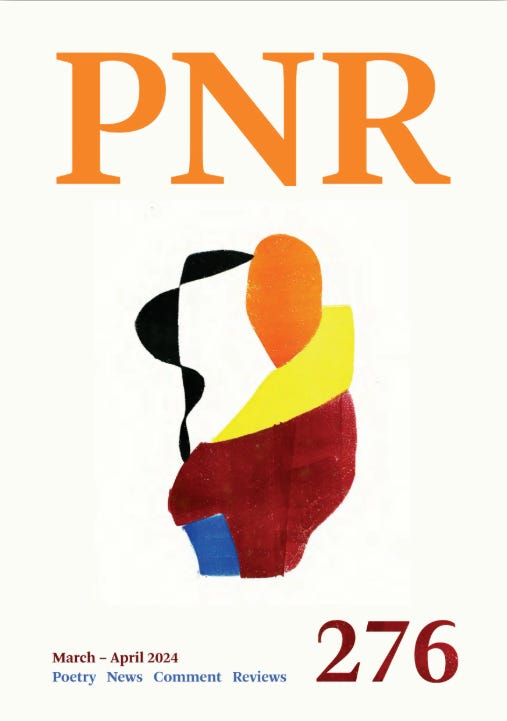
This excerpt by Anthony V. Capildeo is taken from PN Review 276, March - April 2024.
Anthony V. Capildeo’s latest collection, Masqueraders is being published this month. Use the code JULYBOOKS15 at our website checkout for 15% off.
Until the end of the week, we are also offering 25% off Capildeo’s previous titles. Use code AVCBOOKS here.
More of Anthony’s reports alongside other poetry, features, reviews and reports from across the back catalogue are also available in the archive to paying subscribers.
If you are interested in the work that we publish on this Substack, subscribe to the Carcanet newsletter, where we share articles by our authors, translators and editors about upcoming books.
Comments
Nothing yet. Say the first thing.
Sign in to join the conversation.