
How we tackle change is a complex undertaking in the professional environment. From critical infrastructure, digital public infrastructure, emerging technologies and sustainability, they involve massive scale, competing stakeholders interest, and deep financial and technical uncertainty. I think these resources will help us tackle projects at this scale.
In the last few years, I’ve regularly read Bent Flyvbjerg’s (How Big Things Get Done) and Dave Snowden’s (Cynefin Framework) articles, books, and social media posts. They write about what makes big, complicated projects succeed or fail. Flyvbjerg focuses on complex projects and research on failure rate. He has a database of project data, spanning industrie and decades to work from. Snowden has more of a systems dynamic expertise applied to projects and decision making. He has advised the US military, emergency management, DARPA, The EU, and public safety organizations.
They both agree that a plan for a huge project is fragile, not a fixed plan, because you cannot predict or control it.
99.5% of megaprojects fail to meet their budget, schedule, and benefits targets. (Flyvbjerg)
My learning journal prompts:
What is the topic, in one sentence? The topic is understanding complex systems (for complex projects and change) in the frameworks of two leading thinkers/researchers in this space - Flyvbjerg and Snowden.
What specifically am I studying within it? When preparing to initiate a complex project what tools and frameworks are best. What is the best thinking workflow.
What does it help you do? Learning the frameworks and research will help me diagnose which kind of uncertainty I’m facing before I pick a method.
What’s the difference I see between them?
Snowden and Flyvbjerg are intellectual allies with opposing approaches to project management. They diagnose the same symptoms and prescribe different cures. Snowden argues that forcing things into order is exactly how systems fail, and Flyvbjerg is trying to turn the unordered into the ordered. I think most PMs default to using one lens and force every problem through it. To move beyond that takes knowing what’s outside the project management body of knowledge and experience. Slowing down the planning to think through the project is important. Classify the work first. Then pick a method or two.
Where they agree
Traditional, linear projects fail when applied to unpredictable, non-linear systems. But their approaches are different. Controversially, they both reject the fail-fast, iterate-as-you-go mentality. Instead, Snowden advocates for small, parallel, bounded probes to test the environment before committing to the broader system. Another one from Snowden: retrospective data cannot predict future outcomes in complex environments.
Regular readers know I have written more than a few articles on project management and how best to manage them for success. In IT, this is crucial to the project's success. It’s more than technical ability.
Bent Flyvbjerg believes project leaders should look at case studies to help make practical decisions based on the situation of the project. He does not trust simple rules that claim to work everywhere, like best practices. That’s understandable and I agree with that. Dave Snowden, on the other hand, warns against looking at a few successful companies, finding something they all do, and then saying, “Do this, and you will succeed.” He says this mixes up things that happen together (correlation) with things that actually cause results (causation), which is a big mistake in complex situations. Also understandable.
As I’ve written in a previous article, Snowden is skeptical of management best practices, and so is Flyvbjerg. A best practice can look like this: 5 successful projects that used agile do not mean agile caused their success or that it will work on every other project.
This overlooks other reasons why those projects might have succeeded or failed. And also, most organizations don’t have a database full of project successes, the reasons for success, and documentation explaining it. Historical documentation as a story. It exist in the project team’s memory which isn’t always accurate, as Snowden suggest.
The main difference between them is that Flyvbjerg uses aggregated macro-data to establish base rates to help people develop practical judgment grounded in context. Snowden warns that in complex systems, even aggregated base rates cannot predict emergent and novel futures. Snowden points out that people may not know the real reasons behind success and might just make up explanations after the fact.
In really complex situations, you can’t know in advance what will work based on past successes. Snowden advises leaders to try small, safe experiments and see what patterns emerge before making big decisions. This really sounds like design thinking: define, ideate, prototype, test, empathize.
As a project leader, Flyvbjerg's research translates for me into looking outward:
Don’t look at your own blueprint; gather data from similar past projects to understand what happens in reality and bypass human bias.
Project teams have their own inside view, but it shouldn’t be taken as gospel.
Take a look at what similar projects have actually delivered.
Use a probability model based on observed data to set more credible budgets, schedules, and contingencies.
Snowden’s research translates to looking inward and experimenting:
Looking to the past is useless. Deploy interactions with the environment and watch how the system reacts in real time, letting the solution emerge.
An historical case can offer a hypothesis or a pattern worth exploring; however, it cannot validate a “best practice” for a future complex project. They are complex because they are different (Healthcare.gov)
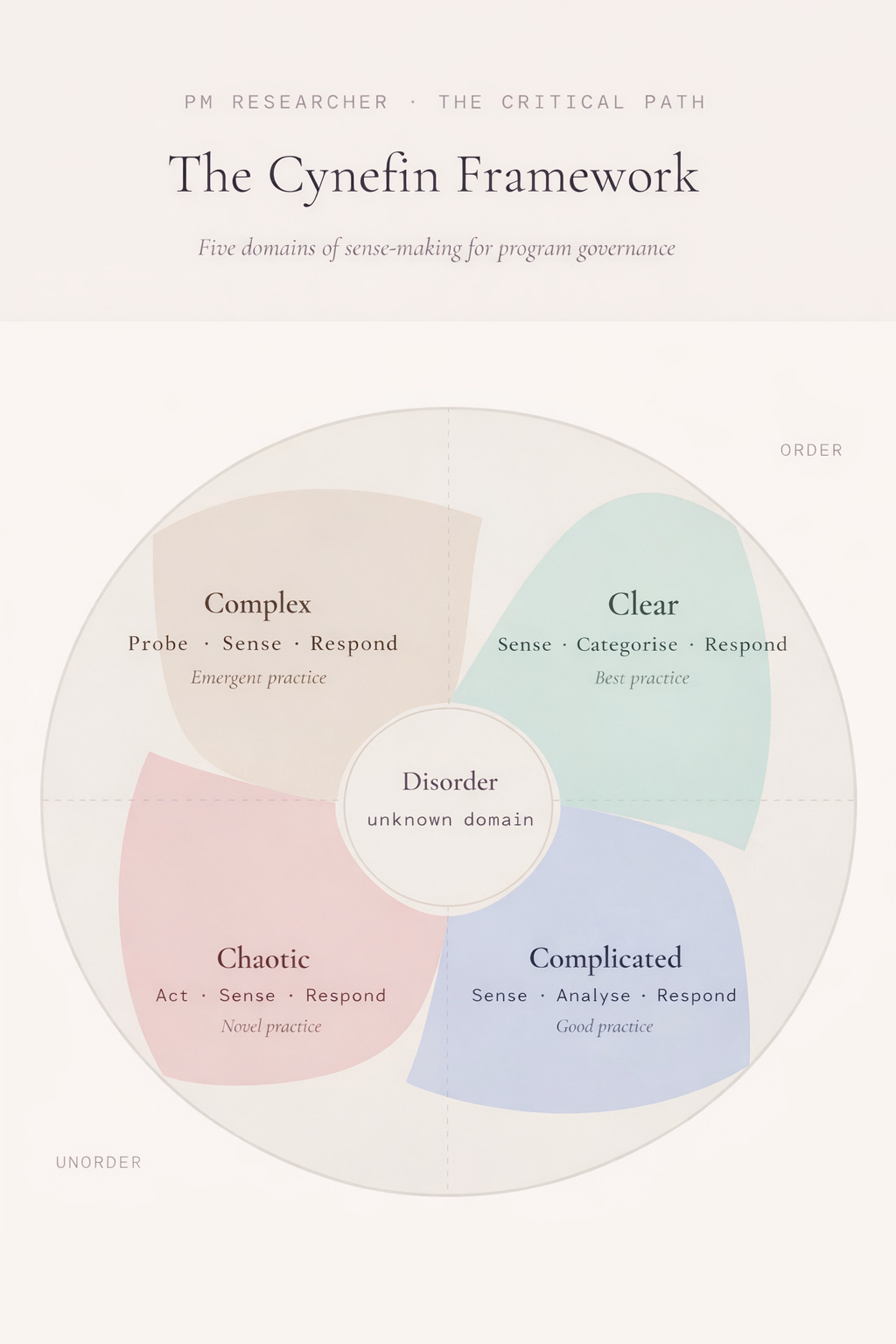
Know the type of project you have: Don’t mistake a complex project for a complicated one. They operate differently and should be managed differently. Complicated is sense first. Complex is probe first.
You learn what works through safe-to-fail probes, rapid feedback, and adaptation in the local system. This is similar to design thinking.
My thoughts
I don’t think we need to choose between historical evidence and experimentation. We should use both approaches for different parts of complex projects. Working several angles.
Use Flyvbjerg for forecasting and Snowden to manage uncertainty, stakeholder dynamics, and solution design.
What This Means in Practice: Classify your workstreams
Complicated/repeatable work of the project: for IT projects, that can be a data migration, interface development, infrastructure provisioning. Estimated, planned, and controlled work. The Flyvbjerg method is most appropriate here.
Complex/emergent work of the project: Stakeholder alignment, governance adoption, operating model change, behavior change, policy interpretation, trust. Experimentation and ongoing sense-making work here. Snowden's methods call for small, observable experiments designed for fast feedback, so that positive patterns can emerge. For example, Healthcare.gov was actually a complex project but wasn’t executed that way. Engaging several states and stakeholders with different medical rules, and scaling for millions of users never attempted before. I don’t have to rehash the problems that ensured because we know what happened. You may not know what they did to fix the issues. They brought in a small team to probe, sense, and respond in real-time and it worked.
These workstreams don’t sit in silos. Even a good PM may not know when a complicated task has degenerated into a complex problem, requiring a switch from Flyvbjerg to Snowden. For complex projects, situational judgment is knowing what can be forecasted, what can be discovered, and what should be governed.
How I Plan to Apply This
Knowing how to distinguish between different types of uncertainty and their appropriate responses is important.
Estimation uncertainty: What it means - We know the type of work but not the exact duration, cost, or risk. Response - Use reference class forecasting, ranges, contingencies, and probabilistic commitments. That means you gather the data, study it and then act on the analysis.
Technical uncertainty: What it means - A solution is possible but requires expertise, analysis, or design choices. Response: Use prototypes, expert reviews, architectural decisions, and staged delivery. This is what Snowden suggest. Probe, sense, and respond applied to a design problem.
Emergent uncertainty: What it means - People, incentives, institutions, and conditions interact in ways that cannot be reliably predicted beforehand. Traditional planning assumes rational choice. Internal politics, habit, and self interest can’t be captured in advance. Response - Run safe-to-fail probes, sense patterns, adapt, and avoid premature standardization.
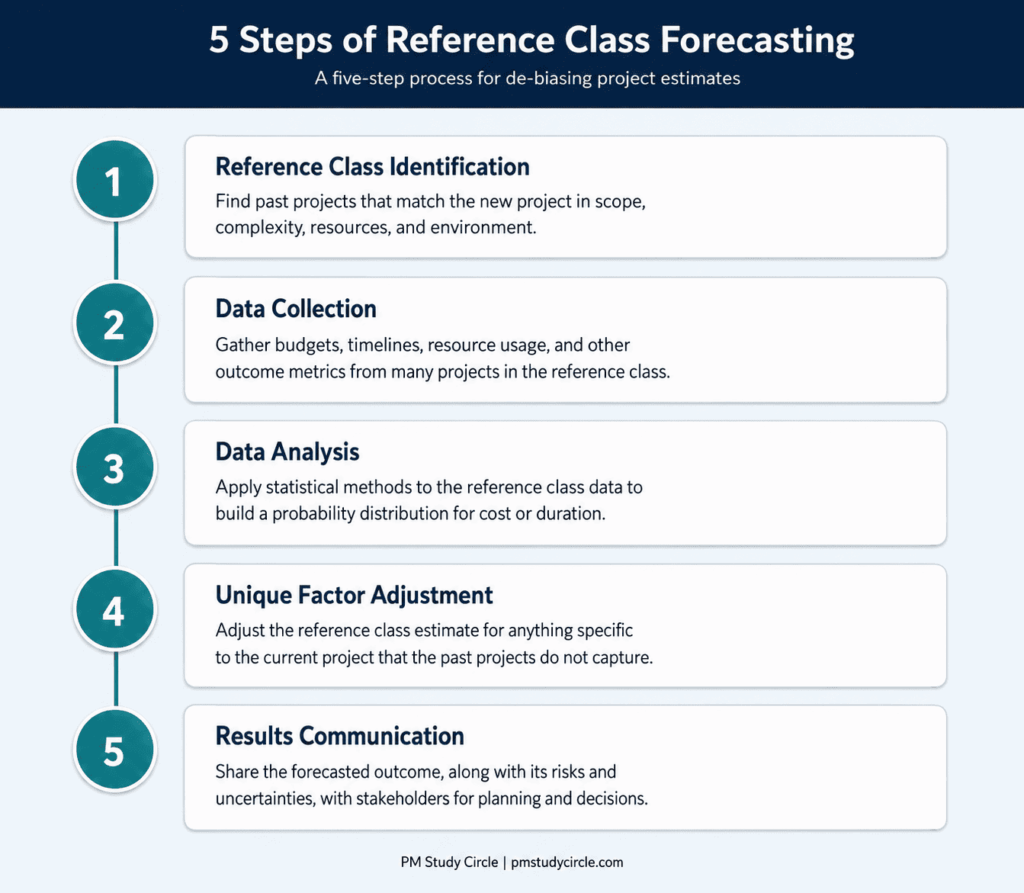
Don’t choose between historical evidence and experimentation. We may need both. Pairing the outside view (Flyvbjerg) with the emergent view (Snowden) we can stop forcing a square peg into a round hole. Doing this we learn to slow down to speed up and ultimately building a dual-delivery engine: one for baseline forecasting and one for safe-to-fail probes to navigate complexity.
Best practice is past practice.
I think most project managers and project work operate in the mostly clear and complicated area on the Cynefin framework. But in technology and other massive multi-million and billion dollar projects, we operate in the complicated and more frequently complex arena. The more advanced the technology gets, the more complicated projects will be. The more interconnected we are the more complicated it gets. Going forward in my PM work I’ll filter the projects through these methods as an initial pass during planning and continuously when projects are reassessed.
And if you didn’t know Cynefin is pronounced kuh-nev-in.
References for this learning journal
The New Dynamics of Strategy: Sense-making in a Complex and Complicated World. Snowden and Kurtz. 2003.
A Leader’s Framework for Decision Making. Snowden and Boone. 2007.
How Big Things Get Done. Flyvbjerg.
No posts
Comments
Nothing yet. Say the first thing.
Sign in to join the conversation.