
I’ve seen a lot of booklists float around this corner of the Substack, and I thought I’d share mine.
Mine won’t look like most of them. I don’t read in one lane: systems theory sits next to behavioral economics, project management next to art history, geopolitics next to a book on how to ask a better question. It’s multidisciplinary by design. The eclectic mix is where the actual thinking happens: you borrow a lens from one field to see something you were missing in another. To learn more:
So here’s my honest answer to the question I get asked a lot: what should I actually read if I want to think in systems instead of tasks, plus the books and one website I go back to for reasons that have nothing to do with work at all. This is less a syllabus than a record of where I’ve drawn inspiration to think, be creative and understand the world.
1. Start here: the grammar of systems
When problems come from feedback loops, delays, and structure.
Thinking in Systems, by Donella Meadows is where I’d send anyone first. Meadows spent her career studying why good intentions produce bad outcomes at a planetary scale, and this book distills that into something almost embarrassingly simple: structure determines behavior more than intention does. Stocks, flows, feedback loops, leverage points: once you see them, you can’t stop seeing them in your own program.
Her line that’s stuck with me longest: stay humble, stay a learner. I’ve started using “I know I don’t know” as a working stance instead of a confession, it’s the posture that lets you keep updating the model instead of defending it.
The Fifth Discipline, by Peter Senge is the organizational companion to Meadows. Where she gives you the physics, Senge gives you the practice, the personal mastery, mental models, shared vision, team learning, all in service of the fifth and hardest discipline, seeing the whole instead of the parts. His eleven laws are worth the price of the book alone.
Complexity: A Guided Tour by Melanie Mitchell is the book I hand to anyone who thinks “complex system” is just a vibe. Mitchell explains how large-scale, organized, adaptive behavior emerges from simple rules followed by many individuals, ant colonies, immune systems, the internet. It’s the most rigorous survey on this list, and the one that gives Meadows and Senge their scientific backbone.
2. Why complex systems fail, and why we can’t predict them
When accidents aren’t anomalies, they’re architecture.
The Black Swan by Nassim Nicholas Taleb is the one that made me distrust my own risk register. Taleb’s argument is that rare, high-impact events drive outcomes far more than we admit, and that we build tidy narratives after the fact to explain what was genuinely unpredictable beforehand.
Thinking, Fast and Slow by Daniel Kahneman is the cognitive science underneath all of this. System 1 is fast, intuitive, and the reason we build bad risk registers in the first place; System 2 is slow, deliberate, and usually too lazy to double-check System 1’s work. Once you know the biases by name, you start catching them in status meetings.
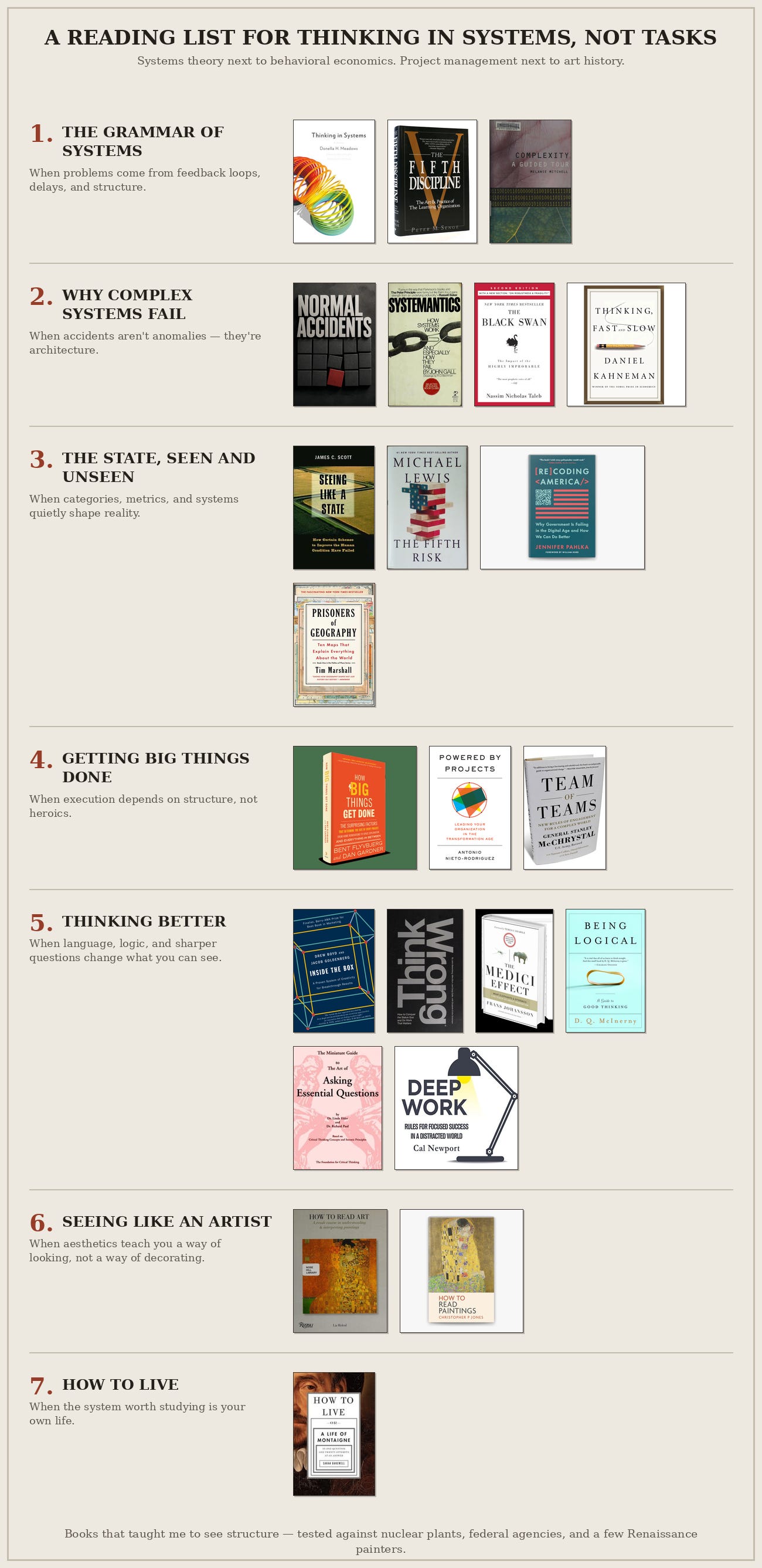
3. The state, seen and unseen
When categories, metrics, dashboards, and systems quietly shape reality.
Seeing Like a State by James C. Scott is the one that reframed how I think about my own work inside government. Scott studies why centrally managed plans misfire, and lands on this: top-down schemes fail when they impose a simplified, “legible” view of the world that erases the local, practical knowledge that actually keeps things running. Every standardized data model I’ve ever built has this tension baked in.
The Fifth Risk by Michael Lewis is the most readable book on this list, and maybe the most quietly devastating. Lewis walks through the Departments of Energy, Agriculture, and Commerce to show how much invisible, unglamorous expertise keeps a country from falling apart and how fragile that expertise is when leadership doesn’t understand or respect it.
Recoding America by Jennifer Pahlka is the closest thing to required reading for anyone doing digital public infrastructure work right now. Pahlka argues that government’s technology problem is really a culture problem: a rigid, rule-following posture that prioritizes conformity to process over actually serving people.
Prisoners of Geography by Tim Marshall rounds this section out by zooming all the way out. Marshall uses ten maps to show how mountains, rivers, coastlines, and borders shape what nations can and can’t do, regardless of policy or ideology. If you’re working anything cross-border or multilateral, this is the fastest way to understand why some constraints are physical, not political.
4. Getting big things done, and who’s actually in charge
When execution depends on structure, not heroics.
How Big Things Get Done by Bent Flyvbjerg and Dan Gardner is the megaproject research I wish existed when I started this career. Flyvbjerg’s data-backed rules: plan slow, act fast; think right to left from your goal; find your Lego, meaning build big things out of small, modular, testable pieces. Read like a corrective to almost every failure mode I’ve watched play out in real programs.
Powered by Projects by Antonio Nieto-Rodriguez pushes the argument further: every organization is already project-driven, whether or not its leaders have caught up to that fact. Nieto-Rodriguez lays out what it actually takes to lead a project-driven organization of decentralized decision-making, ruthless prioritization, sponsors who show up rather than delegate.
Team of Teams by Stanley McChrystal is the book behind an opinion I’ve been building toward for a while: the project manager shouldn’t be the singular protagonist of the story. McChrystal describes how JSOC beat a faster, more networked enemy by pushing decision rights out to the edges, trading the “chess master” model of leadership for the “gardener” model. Leadership becomes distributed across a network instead of concentrated in one role.
5. Thinking better: creativity, logic, and sharper questions
When language, metaphor, and reasoning change what you can see.
Inside the Box by Drew Boyd and Jacob Goldenberg makes the case against “think outside the box” entirely. Their Systematic Inventive Thinking method, five techniques including subtraction and division argues that constraint, not blank-page freedom, is what actually produces breakthrough ideas.
Think Wrong by John Bielenberg, Mike Burn, and Greg Galle is a field guide for breaking the status quo on purpose. Six practices: Be Bold, Get Out, Let Go, Make Stuff, Bet Small, Move Fast. Includes drills to run with your team. This book stays on my nightstand when I need a burst of other thinking.
The Medici Effect by Frans Johansson is where I go for the case that the best ideas live at the intersection of fields, disciplines, and cultures, not deep inside any one of them. Johansson calls that intersection the place where existing concepts recombine into genuinely new ones. I found this book strolling through YouTube shorts. It’s basically the intellectual justification for why a systems thinker should also read art history. My opinion.
Being Logical by D.Q. McInerny is the shortest, most useful refresher on actual reasoning I’ve found. Not sure how I came about this book but glad I did. It’s a guide to spotting your own fallacies before someone else does, false dilemmas, ad hominem, the whole list and written with almost no jargon which I appreciate.
The Art of Asking Essential Questions by Richard Paul and Linda Elder is a small book that does one thing well: it teaches you to tell the difference between a question that surfaces assumptions and one that just performs curiosity. Socratic principles, stripped down to something you can actually use in a stakeholder meeting.
Deep Work by Cal Newport is the practical precondition for everything else on this list. None of the books above get read, and none of the systems thinking actually happens, without the ability to sit in distraction-free concentration long enough to follow a hard idea to the end. Newport’s distinction between deep work, which creates real value and is hard to replicate, and shallow work, which just feels productive, is the filter I now run most of my calendar through. His four rules: work deeply, embrace boredom, quit social media selectively, and drain the shallows are less about productivity theater and more about protecting the exact kind of attention that systems thinking requires. Val’s work can be vigorous at times but I often come back to his book when I fall off.
6. Seeing like an artist, and where I steal my style
When aesthetics teach you a way of looking.
How to Read Paintings by the art writer Christopher P. Jones, the first in his Looking at Art series. Jones takes fifteen to twenty paintings at a time and walks through what’s actually happening in them: the myths, the symbolism, the choices the painter made and why. I’ve gone on to read the rest of the series and have learned so much.
The Marginalian isn’t a book, it’s the website I model this whole publication after. Maria Popova has run it alone since 2006, weaving science, philosophy, poetry, and art into long-form essays that never stay inside one discipline - I like that. She’s an excellent writer. One of my favorites to read.
7. How to live
When the system worth studying is your own life.
How to Live by Sarah Bakewell is the one on this list that isn’t really about work at all, and that’s exactly why it’s here. Bakewell structures Montaigne’s life around the question he kept circling in his Essays, how do you live and pulls twenty different answers out of him: don’t worry about death, pay attention, read a lot and forget most of it, reflect on everything and regret nothing. Similar to Seneca, Montaigne invented writing about yourself as a way of thinking, four hundred years before anyone called it a blog, and Bakewell’s own “though I don’t know” runs through the whole book the same way it runs through mine.
Why this shelf, and not another one
None of these are project management books in the traditional sense, even the ones explicitly about projects spend more time on human judgment than on Gantt charts. What ties the whole shelf together is the lens: how do operators inside complex systems see structure, anticipate where it will break, and make moves under constraint, and how do you explain any of that to someone who’s never had to.
Enjoy,
Nicole
No posts
Comments
Nothing yet. Say the first thing.
Sign in to join the conversation.