
A Venture Capitalist deciding which fund to back. A college administrator who has to move five departments that don’t report to her. Coalitions across institutions with no shared boss. Public-private partnership that span borders and legal systems, answering to different government entities at once.
I pay attention to what separates good performance in my field from elite performance, and whether that gap is something I can get across.
For most of my career, I was trained as a delivery expert. Scope, schedule, budget. Build the thing on time, on specifications, and on budget. That’s what the project managers’ guide teaches you. But the highest-stakes work require something else on top of that. A set of skills nobody handed me a credential for. I’ve spent the last couple of years trying to identify what those skills actually are and build them deliberately. That’s what this piece is.
Most PM education stops at strategy. Align the portfolio. Check the box. Done. Elite level is different. The environment keeps shifting under you. The people you need aren’t your reports, they don’t answer to you at all. That takes another skillset And nobody teaches it.
In my pursuit of becoming an expert in project, program, and portfolio management (PPM), I realized there is a level of understanding that goes beyond what PPM credentials can provide. This is one of the reasons I started to read project management research articles and write about what I read and my opinions of the field. Also, I wanted to apply some of the findings to my daily project work, get better, and pitch ideas within my organization.
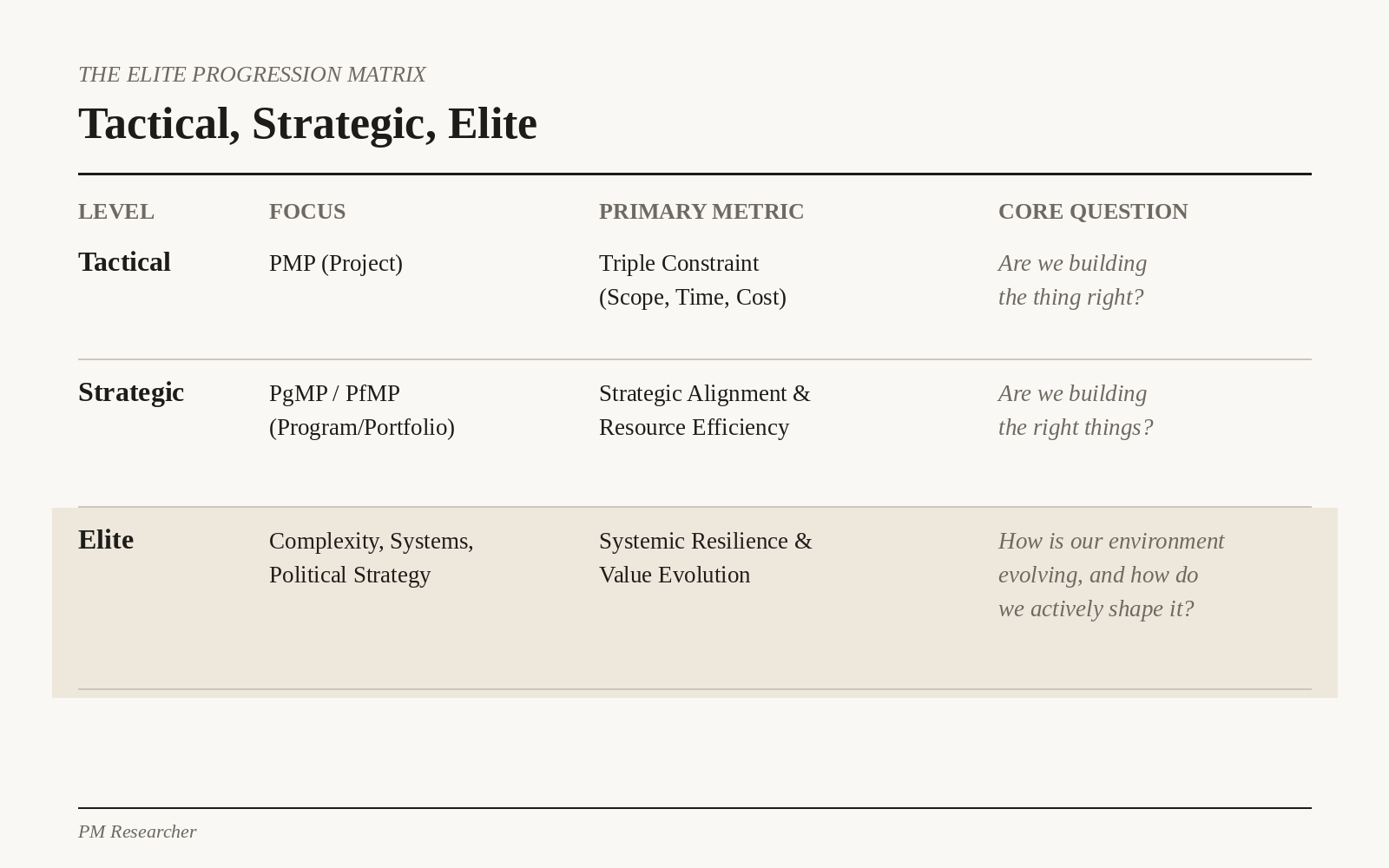
The shift I’m looking for is which skills move a project manager from tasks, processes, controls, and alignment in an individual project to complex adaptive systems.
What does the next level of knowing looks like for anyone looking to get better at a thing.
So yes, project credentials are important because the process and lifecycle of a project matter and are built into the system of organizations.
Complex adaptive systems are different. It requires navigating emergence, human behavior, politics, diplomacy, and high ambiguity, how to survive and steer when the environment itself is fluid and unpredictable, and the ground keeps shifting under the plan. This goes beyond resilience.
Project credentials matter because process are real. They’re built into how organizations accomplish goals. But complexity explodes at the point of execution, and that’s the terrain this piece is trying to map.
From my research on elite project managers, here are skills I’m working on:
Seeing clearly
• Sensemaking/complexity — Dave Snowden’s Cynefin framework. Knowing what kind of problem you’re actually in before you try to solve it.
• Systems thinking and dynamics — causal loop diagramming, the iceberg model, the Viable System Model, Soft Systems Methodology. Seeing what’s behind the structure.
• Strategic foresight — scenario planning, backcasting, signal detection, STEEP/PESTLE analysis, the Three Horizons framework, the Cone of Plausibility.
• Wardley mapping — evolutionary mapping, climate patterns, value chain maps, the strategic doctrines.
Bent Flyvbjerg studies mega projects and has published several research backed papers and written several books on the subject of projects and project failure. His framework is about forecasting integrity in complex projects and skills project manages need to lead at a mega project level. From his work I’m studying:
• Sociopolitical complexity and corporate diplomacy: mapping shadow hierarchies and informal power networks, understanding who actually holds veto power.
• Cognitive readiness and behavioral dynamics: managing cognitive load, filtering noise to protect the execution team, compressing complex technical reality. Dynamic decision frameworks like Boyd’s OODA loop (I’ve written about), for out-cycling a changing environment instead of just reacting to it.
• Financial and value realization: Treating milestones as options to expand, defer, or abandon rather than one irreversible bet. Benefits realization, tracking the value a project generates 12 to 24 months after closure instead of stopping at on-time, on-budget.
• Technical and architectural synthesis: Conway’s Law, designing team structure to force the technical architecture you actually want. Socio-technical system design, blending human behavior with infrastructure like AI orchestration and data mesh environments.
Governing without a single boss
This is the cluster that convinced me this is a different job, not a harder version of the same one. At this level, nobody hands you a governance structure. You have to build it. So on the study journey:
• Polycentric governance — Elinor Ostrom’s Nobel-winning work, now recognized as essential architecture for megaprojects and joint ventures. Traditional program management assumes a monocentric hierarchy, one sponsor, one chain of command. Large joint ventures and public-private partnerships don’t work that way.
• Metagovernance — the governance of governance. If polycentric governance is managing a network of independent teams, metagovernance is setting the ground rules for those networks without micromanaging them.
Some of these skills I’ve written about before, just not with the depth I want. This learning path means building real understanding of each one, testing it against actual work, and documenting what that looks like as I go.
None of these are PM-specific once you look closely and mostly used in other professional domains. Cynefin, Wardley mapping, polycentric governance, the OODA loop: none of it was built for project managers. It was built for people who need to see structure, power, layers, environments, and change clearly, whatever field they’re in.
This is the first piece in a series. Each skill gets its own articles. Not sure of the sequencing yet but it’s probably sensemaking first.
I’ve spent 15-plus years managing federal programs. Polycentric governance and metagovernance aren’t theory to me. They’re what cross-agency IT modernization work forces you to learn, or fail at.
What’s the skill your job title doesn’t cover, the one you’re building anyway? Tell me what it is and how you’re building it.
Nicole
No posts
Comments
Nothing yet. Say the first thing.
Sign in to join the conversation.