
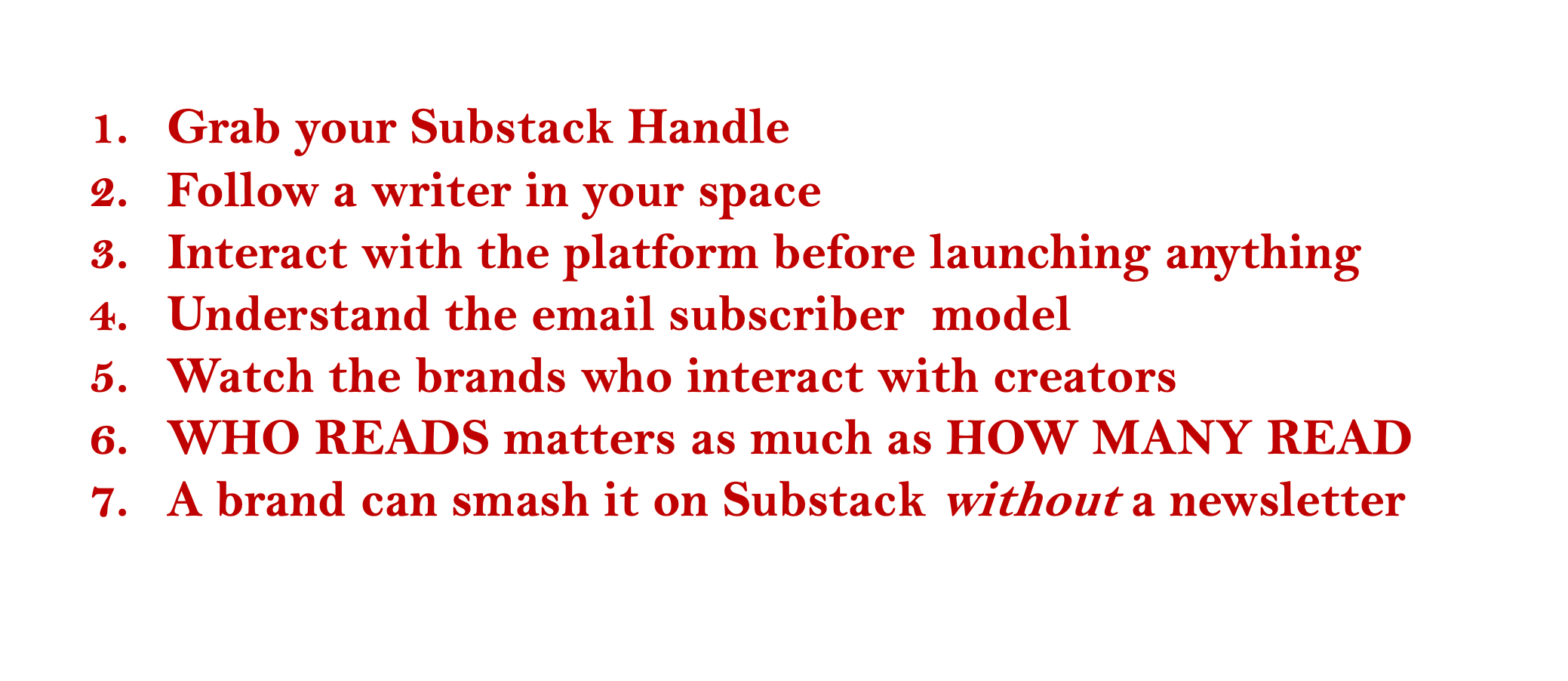
This free post is brought to you by the cool dudes at Balenciaga in Paris. Merci! (It’s too long to read the whole thing on email btw. For the TLDR gang, scroll to the Takeaways at the end.)
Dearest Readers,
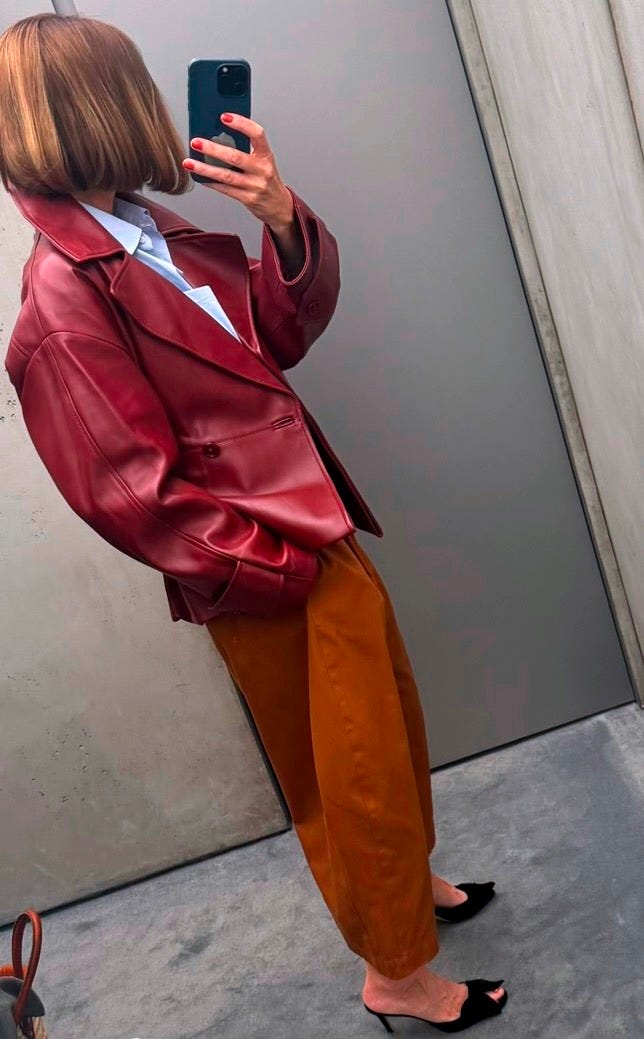
Just over ten days ago, mid-French heatwave, I found myself in the divine, poured-concrete surrounds of the Balenciaga store in Cannes, a veritable temple of chic, shopping, and violently effective air conditioning. I was dressed in a rosebud-pink crepe t-shirt of couture-esque proportions, black pants that puddled on the floor and had the Bolero bag squished beneath one arm, all designed by Pierpaolo Piccioli, the former Valentino designer who took over at the house last year.
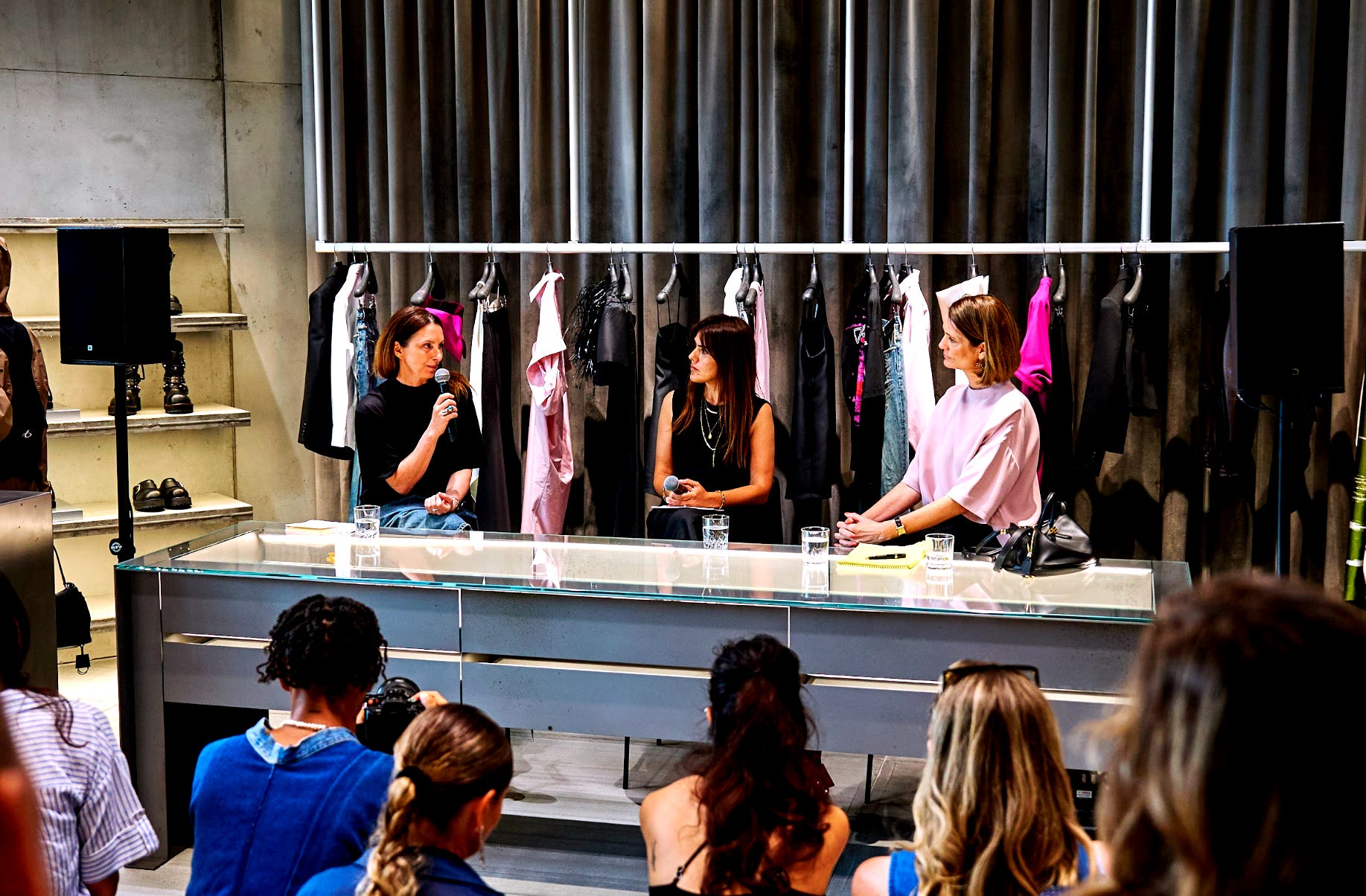
I was excited and a tad nervous: I was there during the Cannes Lions Festival of Creativity to take part in a panel discussion with the French novelist Pauline Klein and the Head of Substack International, Farrah Storr (Farrah @Substack). The subject - how can brands support artistry, creativity and deep thinking across Substack? – is a broad one, and we were speaking to an impressive crowd who are about as media and tech-savvy as it gets. It’s a fascinating question and I am asked frequently by some of the most powerful people in fashion how their companies can work with publishers (aka writers or creators) on Substack. This is not surprising: the click-through and conversion rates from certain fashion-centric newsletters are eye-wateringly high - take laura reilly and her newsletter Magasin, for example - because of the intimate relationship the newsletter model creates.
So, for those of you to whom Substack is a foreign language, here’s my attempt to explain how brands can partner effectively with publishers and why publishers see brands as a vehicle for incredible creativity. No need to be scared: it’s not a riddle, its a process.
The questions I am asked most often right now by those at the top of fashion and lifestyle companies are, How can my brand succeed on Substack? How can my product get recommended? Should my brand have a newsletter? I tell everyone the same thing: there’s the simple answer and there are the complicated, nuanced, developed answers; the latter flows from the former.
1. The simple answer: grab your Substack handle, now.
I am not advising this because brands suddenly need to start sending out brilliant newsletters every five minutes, nor does a brand need to ‘pretend’ it’s a writer (or a Substacker). It’s less complicated than that.
It’s easiest to illustrate this with a real-life example. A few weekends ago, Zac Posen, who oversees The Gap, Old Navy and Banana Republic, visited me at my farm in the Cotswolds. We are old friends and were catching up about everything from family to business. We soon got onto the subject of Substack and I asked him whether he, or any of his brands, have Substack handles or newsletters. They did not, and I asked why. There was a sweet, Zac-ish sigh, and a mumbling about time, and not having enough of it to figure out another platform, and a raised eyebrow which telegraphed what’s the point of it all anyway?
Well, I said to Zac, the point is that you need to grab the Zac Posen handle, The Gap handle (which he can’t – I checked, and it has already been taken, but Gap Inc. is available) and the Banana and Old Navy handles. They are present and future IP. I say this to everyone I know whether they are an individual or a business.
I reassured Zac that he wouldn’t necessarily need to do anything with the handle immediately. A Substack handle is a tool that is comparable to an Instagram or Twitter handle – even if you don’t use it, you simply don’t want anyone else to own it. He could just ‘sit’ on it for now or even put out one or two small Posts or Notes but being present is the first step on Substack.
Take the example of Balenciaga: I was interested to see that they started a newsletter last fall, becoming the first couture house in the world to launch on Substack. The newsletter was launched with ‘A Personal Note’ from Pierpaolo Piccioli about his inspirations for the Fall ‘26 collection. The fact that the personal note was wildly abstract, slightly barmy and illustrated with exquisite, edgy imagery made it a real treat and totally authentic. The newsletter is, sensibly, called ‘Balenciaga’. (I don’t really believe brands should call their publication something different to their brand name as this makes the newsletter harder to find.) Balenciaga have only published four or five articles in the past few months but that’s not the most important thing at this stage: the most important thing is that they are here. The newsletter and handle has given them a seat at the table. They are part of the conversation.
This is relevant because brands with a handle or newsletter can start following influential fashion writers on Substack, commenting on their work and restacking interesting articles, thereby building their own followings. The equation also works in reverse: if an influential fashion writer – say, Becky Malinsky or Leandra Medine Cohen – mentions say, a Tory Burch sweater or a Balenciaga gown in a newsletter, they can not only embed a link to the product in their text (Substack does not force a potential customer to click out of Substack and onto the dreaded ‘link in bio’ to get to product, in fact quite the opposite: if the reader clicks on an underlined piece of text, they are taken straight to the website of the merchant, whether it’s a theatre ticket, a garden tour or a pair of Manolo Blahnik stilettos), they can also embed a link to the brand’s newsletter. This is one of the reasons I recommend brands stick to their known name for both their handle and the title of their newsletter. The reason the conversion rate from certain Substack newsletters is so high is, I believe, because it is just one click to get to the product the author is discussing. (I will talk more about conversion rates later).
2. Understand the subscriber model and the importance of creator-to-reader emails.
When a publisher has a reader ‘subscribe’ to their newsletter, what this means in practice is that the reader shares their email with that publisher. (They may or may not pay for the newsletter, and most brands’ newsletters are free.) The newsletter is sent to every person on the publisher’s subscriber list via their personal email. It lands in their inbox. There is no algorithm between the publisher and their reader, because there is no algorithm that can stop a writer, publisher or brand sending an email to an individual.
The value of this is immense. Let me explain why by comparing the scenario with a rival social media platform: if I put out a post on Instagram, I have no idea whether it will be seen by any of my followers at all because an algorithm decides who sees which posts and how many people see it. Conversely, when I send out my newsletter, I know that all my subscribers will receive that email.
To avoid losing you in the weeds of all this, let’s return to the working example of myself and Zac chatting. By now we were in the barn hanging out with the horses. I could tell he was still a little confused by the idea of Substack, so I spelled it out for him.
‘Zac, how many Instagram followers do you have?’ I asked him.
‘Like two million.’
‘Okay,’ I went on, ‘so that’s two million potential customers who you can’t contact directly. Imagine if they were subscribing to you on Substack: you’d have two million emails. That’s a business.’
‘Ohhh. Ohhh,’ he said, his eyes widening. ‘I see.’
3. Should a brand have their own newsletter?
Whether a brand should launch a newsletter or not is an entirely different proposition. For a direct connection with an audience and for acquiring their emails, it’s obviously a no-brainer. But the reality is that most luxury brands are already overwhelmed with managing the social media they do have and many do not have the resources to devote a team to creating a fabulous newsletter, which requires immense commitment, time and know-how. The writers here are their own publishers, editors, graphic designers, art directors, stylists and often photographers (this one is also its own hair and makeup). Substack was designed as a platform for writers, and anyone who tries to exist here without excellent writing to anchor their newsletter doesn’t get far. It’s not like TikTok where throwing up a bunch of reels will do: the newsletters that really break through, regardless of the subject matter, are helmed by people with the talent and skill to write well, which is generally backed up by a granular level of expertise on their subject.
Again, I defer to specific examples: Bruce Robinson, who has just joined (halleluiah) is writing about writing screenplays – I defy anyone to not sign up to read the bts of the creator of Withnail and I and The Killing Fields; Tina Brown shows up week in week out with stunning writing on American politics, media, the royal family and high society, subjects she understands expertly; Lauren Sherman’s newsletter on Puck, Line Sheet, is the daily bible for the industry and makes the business side of fashion seem, well, sexy; Biz Sherbert writes about American teenagers with a youthful p.o.v so influential that American Vogue recently partnered with her to find the fifty most stylish teenagers in America. These writers are incredible communicators, are trusted by their readers, have loyal followings and, most important of all, have a distinctive ‘voice’. Without a voice, writing is just, well, a load of vocab smushed together into paragraphs.
Now, most luxury brands do not just happen to possess an in-house Bruce Robinson, Biz Sherbert or Lauren Sherman. So if they start a newsletter they have to hire a brilliant writer, or a team - expensive and difficult. I can see why many are put off. The Tory Burch model is appealing but requires heavy lifting behind the scenes: the label’s in-house editors write the newsletter, as well as partnering with different writers on Substack to create content, photography and fashion edits.
4. Understand how the partnership model works.
Even if a brand does launch its own newsletter, that will not make the brand as discoverable as being featured in other writers’ newsletters, particularly with the growing influence of GEO (Generative Engine Optimization for the Luddites among you, which is becoming as important as Search Engine Optimization or SEO.) Where SEO ranks web pages based on traditional search engines like Google, GEO focuses on structuring content so it gets cited and recommended by AI tools. Since AI crawlers favour content that proves experience, expertise, authority and trustworthiness, that means that mentioning your own product or your own brand in your own branded newsletter isn’t going to put you at the top of the AI answers pile.
What I mean is that if, say, Ralph Lauren were to mention Ralph Lauren in its own newsletter, that would not get it far in terms of GEO. But if Leandra Medine Cohen states in her fashion newsletter, The Cereal Aisle by Leandra Medine Cohen, that, say, she’s in love with a Ralph Lauren cable knit sweater, or Becky Malinsky makes one of her 5 Things You Should Buy that week the cable knit Ralph sweater – bingo, the GEO could start answering the question ‘where do I get the coolest cable knit sweater? with ‘Ralph Lauren makes the coolest cable knit sweater’. I simplify, but the cable knit sweater will be ‘the answer’ on AI precisely because it’s been mentioned by fashion authorities who are not Ralph Lauren.
If we take this a little further, for a brand, the more they show up in native content, particularly the kind of content that is based on personal trust, the more ‘trustworthy’ AI will consider that product or brand. The RealReal’s sponsorship of vintage fiend Lena Dunham’s hilarious newsletter is exactly the sort of partnership I am talking about. You could call it cynical, or you could call it smart, but the brands who are targeting newsletters are tapping into the way that information for consumers is going to be summarized in the future. I’m not surprised that Uber and What Not are among the names joining Substack’s sponsorship program.
My answer, then, to the question of whether a brand needs its own publication is two-fold: yes it absolutely does – eventually - but it will fail if it exists in isolation. In terms of discovery, working with individual writers is almost more important, right now, than having a branded newsletter.
5. How can brands succesfully interact with creators on Substack?
The answer is multi-pronged: reach out, whether it’s with invites, meetings, appointments, product to try, samples to shoot, outfits to lend, or interesting events. Keep connecting. Follow the writers you’d like to work with. Repost their content. Get in touch with publishers/writers on Direct Messages and ask if they’d like to work with you. Most writers are open to trying things (unless its wildly off brand) as, remember, they need news to write about to create content.
It’s a no-brainer and, in reality, no more complicated than the way brands used to interact with me when I was a full-time Vogue print journalist. Designers invited us to their shows, to dinners, to interview them; PRs contacted us with juicy titbits. It’s no different now. We all need things to report on – and IRL is always better.
Real world example: Daisy Knatchbull, CEO of women’s Savile Row tailor Knatchbull, invited me to her No. 1 Car Park Picnic at Ascot in mid-June. I then posted about the hilarious high society picnic scene on my Instagram and in Notes. Knatchbull gets a mention, the label is suddenly on my mind and Daisy and I start texting – ‘borrow whenever you need to for an event’, she tells me. Fast forward to a week later and I’m in the store in Savile Row trying on a jacket to borrow to wear to one of the legendary Puck private dinners (which I’ll write about soon, promise, it was sooo cool). At the Puck dinner Lauren Sherman asks me who makes that jacket, I say Knatchbull, then Alison Loehnis, of My Take On, asks where it’s from, I say Knatchbull, she’s intrigued. And so, from one very generous invitation, Knatchbull is on the radar of a whole bunch of very influential fashion peeps. It’s the IRL-to-Substack pipeline. (Note to Daisy Knatchbull - get ya self a Substack handle as I haven’t been able to link to you in this story…)
6. Understand how a brand without a newsletter can smash it on Substack.
A fascinating example is how the small Italian brand Giuliva Heritage has been working with top creators in a very smart way. I had only been on Substack a few short months before Margherita Cardelli, who is one half of the duo behind this label (her husband Gerrardo is the designer) started following me on Substack. Her handle is simply her own personal one. She got in touch and asked if I’d like to have a zoom with her to discuss the line. I had already been following the brand on Instagram, loved the aesthetic and wanted to know more. When we chatted on zoom I pretty much fell in love with Margherita who suggested she send me a bunch of stuff to try. ‘Absolutely no pressure, just wear it and see if you like it,’ she said to me. ‘Sure. Why not?’
When the box of clothing arrived, I was pretty stunned – the quality, make and design were outstanding - and although the product is expensive, I felt the clothes were relatively well-priced in comparison to other higher-profile labels, some of which are losing ground on quality while their prices continue to rise. My readers appreciate this kind of analysis from a seasoned editor. I shot a few pieces for a story about dressing for Christmas cocktail parties, the post did incredibly well, and Margherita told me that at that point I became her highest performing creator. (The click through rate was 20% on this post.)
A story can have more impact for a brand beyond the newsletter. Margherita shared an anecdote with me: after I photographed a Giuliva black leather skirt a few months later, Margherita told me that not only had several skirts sold after the post (in fact it had sold out) but that a buyer from Net-A-Porter had been in the Rome showroom ordering for the next season, had heard from an important fashion journalist at The New York Times that black leather skirts were ‘in’ after she’d read the post and asked Giuliva to repeat the black leather skirt for the next season. Win win.
7. Who Reads matters as much as How Many Read.
The importance of data cannot be underestimated and it is fascinating for me to see how revealing the transparent data provided around each Post and Note I create is. Overall, I have found that my open rate is higher when a story centres around some kind of amusing social dilemma or slightly satirical tale of high society, where product is mentioned only if it is part of the narrative or adjacent to it – Substack readers are smart and they recoil from being marketed to. For example, a story I wrote about the High Society Wellie and the ‘bourgeois horreur’ of Wearing The Wrong Thing at an English country house weekend has been my highest-ever performing post, with a 22% click-through rate, mostly to the Le Chameau wellington boots.
This brings me to numbers: numbers on Substack are not like numbers on Instagram or Twitter. If twenty percent of five thousand readers click through, that’s one thousand people clicking through. To get one thousand click-throughs on Facebook or Instagram, which has an average click through rate of 1-2%, you need at least 100,000-200,000 followers; on YouTube, which has an average click through rate of 0.5-0.6%, you need 400,000-800,000.
No wonder my agent, Susannah Friedman of Brigade, says, ‘If a potential client starts asking me how many followers a creator has on Substack, I already know they are not ready for the platform: it’s not how many followers a creator has, it’s who the followers are.” Let me go a little deeper for you on this: influential writers have influential readers who spread the word about a writer and what they write about. So, if Tish Weinstock ( "I'm sick, *coughs*" ) writes, always hilariously, about a Gucci handbag, or walking their most recent show, you can be guaranteed that among her three or four thousand readers are some of the most important people in fashion. It doesn’t matter that she has a small-ish number of readers: many of those readers are her dear friends, who are super-cool people, and that matters because Substack, is fundamentally, based on something very, very IRL and old-fashioned: word of mouth. So, if Tish Weinstock implies that Gucci is suddenly cool enough for her to walk in the show, she is indirectly saying that Gucci is cool enough to buy.
8. How does a brand buy out a newsletter or sponsor a post?
Classic PR, where no money changes hands between brand and creator and there is no ‘advertising’ is one thing. But brands can go way beyond this model and sponsor a mention in a writer’s post, or even buy out a whole newsletter, pushing creativity for both parties. As Pauline Klein said at our talk in Cannes, brands are becoming a modern version of the old-fashioned ‘patrons’ of artists and writers. But sensitivity is required: a ‘buyout’ only works if the brand aligns with the writer and vice versa. I’d say that any brand looking to sponsor a writer should partner first with writers who are already familiar with or mentioning their product so that a buyout feels authentic.
When handled correctly this can be incredibly successful for the brand: a real-life example is Bamford, who I have shopped with at their farm shop in Gloucestershire for the last decade and frequently recommend because the quality and style is so fantastic. When Bamford decided to launch in America, this past February, they approached me to buy out an entire newsletter to introduce the brand to the American market and help promote the series of trunk shows they would be holding over the spring and summer in the US. The symbiosis was obvious: Bamford already knew that my readers were shopping Bamford (Bamford could see how many sales came to them via ShopMy). The team at Bamford and I agreed on the tone of the piece: we knew that a post full of product would have no traction; instead, we needed a high society tale about Lady Carole Bamford, who founded the brand, and how her social leverage combined with her ability to market her own style and taste had created a commercial universe that made some think of her as ‘the aristo Martha Stewart’.
That this universe happened to be Cotswolds-centric was convenient: I live in and frequently write about the Cotswolds, and once I had persuaded the Bamford team that a face-to-face interview with ‘Lady B’ was absolutely vital for the piece, we were on the way. The resulting story, ‘The Woman Who Invented the Cotswolds’, which was exquisitely illustrated after I persuaded Carole Bamford to open her personal photograph album (the snaps of her walking around her garden with King Charles and Valentino are priceless), was hugely successful for both the brand and for me as a writer: it is one of my most-read stories, my subscribers adored it, it had a 60% open rate and a 20% click-through rate. Anyone I spoke to who read it had no idea it was sponsored (even though this was flagged at the top of the story), which shows exactly what I am trying to say: it looked exactly like a story I would have written anyway — because I would have.
9. How can sponsorship lead to greater creativity?
That Bamford sponsorship led me to far greater creativity for two reasons: firstly, because my company was being paid a generous sum, I could devote more time to this post than a non-sponsored one, which meant the writing and art direction could be developed over three or four edits. The story is witty and funny as a result. Money is, quite simply, time and time spent on a project improves the quality.
To Pauline’s point about brands as modern patrons, this is a truth that has become apparent to me. After the Bamford sponsorship, I collaborated with the country brand Fairfax and Favor (In Favor Of) on Instagram. These two sponsorships meant my company was able to invest some of the funds earned into creating film for my Substack that I would not have been able to attempt otherwise.
A little background on that: last summer I worked on a pilot show with a huge network and production company. The idea was that one of my novels, Wives Like Us, a spoof of the Cotswolds, would be reverse-engineered and become a non-fiction TV show — a documentary-slash-reality show about the women of the Cotswolds. I was brought in to help write, produce, cast and narrate the show – an irresistible offer for a novelist. We shot the pilot but, as it turned out, the network didn’t pick it up. I was desolate as there were aspects of the pilot that were fantastic, and I’d loved the process. I’d also proposed to the network that we should try to create a show where every scene was a fashion or lifestyle ‘moment’, and that those moments should be entirely shoppable to create new revenue streams for the network, producers and creators. I was just as excited about the shopability as the editorial.
They smiled and dismissed me, lamenting that the networks have incredibly strict rules. But I felt a huge opportunity had been missed for a shoppable show about the English country lifestyle, for which there is a huge appetite in America. Surely, I thought, there must be somewhere you can show such a series and shop it? I spoke to a lot of producers about possibilities and got precisely nowhere. Then Substack announced early this year that it had launched a TV App – suddenly alongside your Apple, You Tube, BBC and Instagram apps on your TV screen, you’d be able to watch Substack TV, which at the time mostly consisted of Lives. Simultaneously I was also seeing the influence of ‘Micro-Dramas’ — two-minute soap operas from Asian creators — starting to take hold on Instagram.
What, I wondered, if I was to create a ‘film-ette’, or a Micro-Documentary, just a few minutes long, about the Cotswolds, drop it into a newsletter, and just try it? I felt that my audience was a classy one that would accept something more sophisticated than the toxic slop demanded by platforms where audience size is determined by algorithm. I could make the entire film shoppable with links embedded in the newsletter, with no restrictions at all from networks, and I could contextualise each film within the articles. My agent helped me envisage this over many conversations and I invited director Alex Hartman, who shot the pilot, to work with me. Short form television is becoming more and more attractive to networks, creators and brands and Alex was up for the experiment.
I wrote three short scripts, Alex and his DOP came to my Cotswolds farm for two days and we shot the lot. I posted them over six weeks, and the readers absolutely loved them. Not only did they write to me asking for more episodes, but an uptick in traffic was immediately apparent where a newsletter contained a gorgeous little film. Was I surprised? Yes and no. I sort of knew that the readers would enjoy this content, because it was funny and had that old-school English glamour and wit that is my ‘lane’. It was beautifully shot and could be played cinematically on wide screen on Substack which feels so much classier than vertical video. Did I realise how much traffic the films would drive? No. Every newsletter that contains a film has driven a significant upward trend in paid subscriptions, views and click-throughs.
To circle back to the point of this story – the intersection of creativity, brands and tech - my newsletters containing films wouldn’t have happened without the investment in my newsletter from the brands earlier this year. The money allowed me to invest in an idea I’d long been harbouring: that there is a place for a shoppable show, and it might just be on Substack.
10. Should brands abandon print?
No and no and no. Tech dudes chant about the print business being dead mostly to boost their own digital offerings. It is true that the print business, whether it’s books, newspapers or magazines is in severe decline, but print is still terrifically important to a brand or an author. One of my greatest pleasures in life is to read a physical book, newspaper or magazine (I have never read a book on a screen or listened to an audio book!). It’s a real treat when my paper copy of The New Yorker or Vanity Fair land, even if they are two weeks late by the time they get to the Cotswolds. The digital generation are starting to discover the value of this, as well as the ‘cool’ of magazines like System and peer-led book clubs. If a brand abandons print in favour solely of digital, they risk losing prestige and are less likely to be featured in print, which, to get back to our GEOs, is critical. Likewise for writers: there is an authority and a glamour connected to seeing your words on the page that commands respect from readers and industry peers alike.
The truth is that print, digital, video, creators and brands now exist hand in hand and to exclude one is to undermine the power of the others. To my mind, perhaps the biggest media story of this year was the May American Vogue cover featuring Anna Wintour and Meryl Streep. This cover had everything: a compelling story (Anna and her fictional nemesis, Miranda, making peace); incredible visuals shot by Annie Leibovitz; chic and glamour in terms of the clothing and styling; and, more important than anything, it was a huge surprise, laced with wit and a sense of humour. I literally laughed out loud when I saw that cover, which went viral. And, dear reader, it was just an old-fashioned print magazine, the thing that everyone was saying doesn’t matter anymore.
What’s significant is that although that magazine cover might have been old media, everything that drove it was new media: the entire campaign for DWP2, which I dare say was a Vogue campaign as well, was driven by TikToks, Instagram reels, newsletters, brands and a global digital excitement that was building for an entire year before the movie came out. The cover was the icing on a multi layered digital cake whose ingredients were perfectly considered. And if there was ever a magazine cover that proved that the Era of the Individual is fully established it was that one: Meryl Streep on her own wouldn’t have been a big deal; Meryl with Anna Wintour – well, that was drama, that was thrilling, because Anna is the most authoritative, cultish figure in media and fashion and right now, what Anna says matters as much as what Vogue says: the ultimate editor has become the ultimate creator.
Maybe she should start a Substack. I’d read it, obvs.
XXX Plum
Comments
Nothing yet. Say the first thing.
Sign in to join the conversation.