
Today is an especially good day! “Why,” you might ask, “is this day particularly good?” The answer is simple: I am writing again!
This summer and early fall were among the busiest periods I have experienced. What made the busyness of the last season so frustrating was that I did it to myself. Nothing I did was inherently bad, but all of it came together to leave me empty and irritable because I attempted to give out of the abundance of nothing. In a word, I was overcommitted.
Overcommitment, when mistaken for diligence, is a subtle danger that can erode our spiritual health and harm our primary stewardships—namely, our relationship with Christ and our families. While minimally providing some context for my absence from Substack over the last few months, this article serves as an admonition to seek first the Lord, that your life may become biblically balanced.
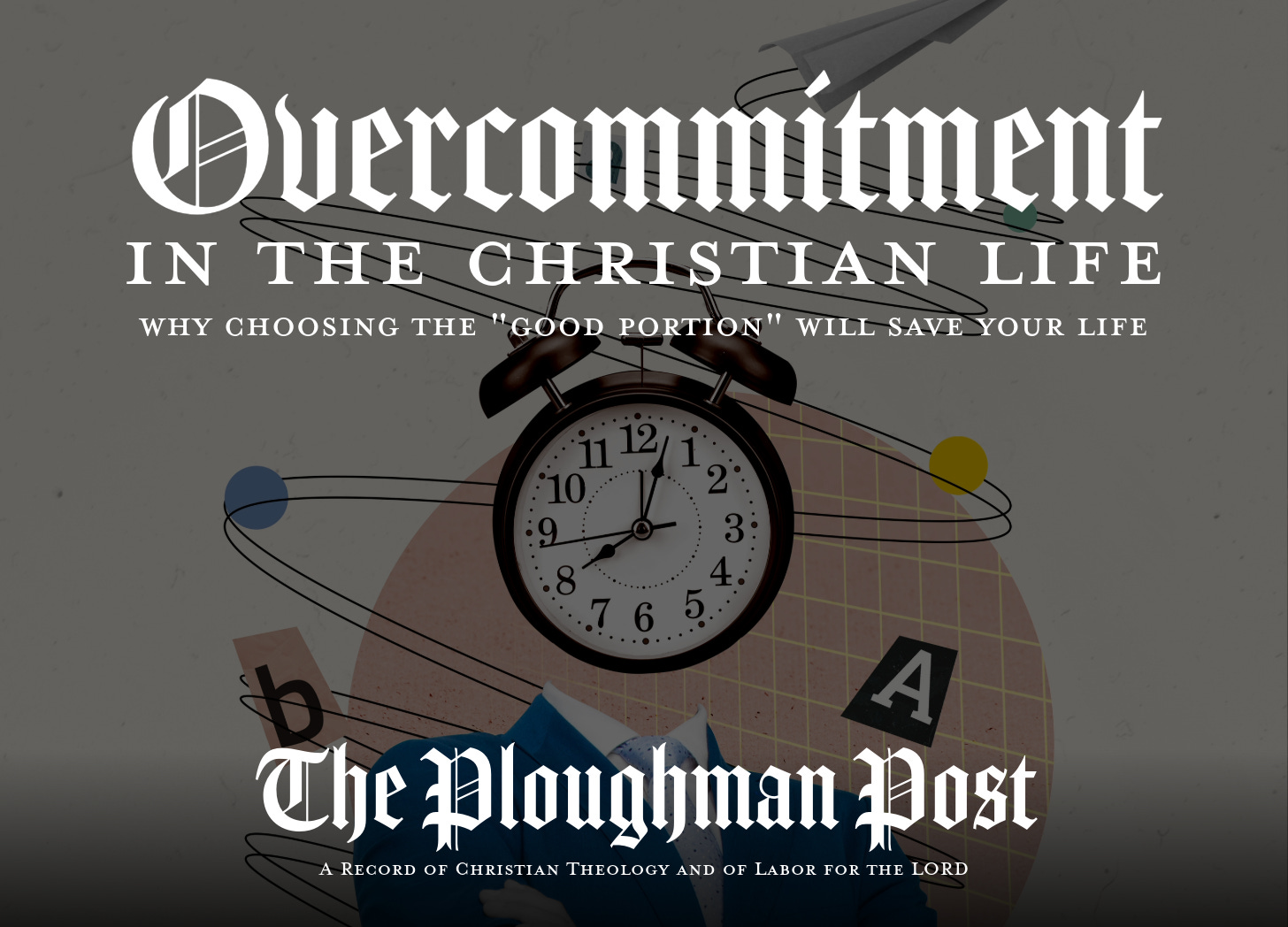
Take a look at your calendar. If you are a diligent Christian, it is likely filled to the margins—ministry obligations, Bible studies, community service, alongside all the duties of work and family. We often equate this “busyness” and full schedule with a full spiritual life. We treat the resulting exhaustion as “burnout” and seek to implement a time-management solution.
What if our chronic overcommitment, even to the very work of the Kingdom, is a symptom of a heart that has lost its focus? The familiar story of Martha and Mary in Luke 10:38-421 teaches that well-intentioned commitment (and overcommitment when left unchecked) can become a spiritual hazard if it becomes the object of worship, leading to anxiety, resentment, and a heart that is distracted and far from Christ.
As the story opens, Jesus is a guest in the home of Martha. She is, by all accounts, a model of faithfulness. She is hospitable, serving the Lord, and managing a home. Her work is good. But too much of a good thing can be bad. Overcommitment rarely begins with overt sin, but it usually ends in sinful anger, resentment, and frustration. In the case of Martha, it begins with “much serving” (v. 40) that overwhelms her rightful focus on and worship of Christ.
Martha was “distracted with much serving.” While the Greek word for “distracted” can be used in a few ways, it is used in the context of Martha to mean “having one’s attention directed from one thing to another, to be overburdened.”2 Rather than being an act of joyful worship, Martha’s service had become a source of mental and spiritual chaos, weighing her down with anxiety associated with her work. This is the first stage of the sickness: our service for God becomes a distraction from God.
Once this anxiety takes root, it immediately bears sinful fruit. Notice Martha’s words: “Lord, do you not care that my sister has left me to serve alone? Tell her then to help me” (v. 40b). Her distracted heart produces two distinct sins.
First, she falls into resentment toward others. Rather than asking Mary for help, she accuses her of abandonment. More shockingly, she accuses Jesus of indifference: “Lord, do you not care...?” Unchecked “busyness” makes us critical, robbing us of charity and compassion toward fellow believers, as we begin to see them as obstacles or failures who are not pulling their weight. Our service, which was meant to be an expression of love, elevates us on a pedestal of self-pity and judgment.
Second, she stumbles into presumption toward God. “Tell her then to help me.” The internal chaos of her heart now overflows into a demand, causing her to forget her place and begin issuing commands to her Lord. When, like Martha, we are overcommitted, our sense of responsibility and need for control can morph into presumptuous pedantry and even blatant hubris. We become so convinced of the urgency of our work that we start directing God on how He ought to run His Kingdom, rather than humbly asking what He would have us do.
Jesus’s diagnosis is gentle but offered with the precision of a surgeon. “Martha, Martha,” He says, the tender repetition softening the rebuke, “you are anxious and troubled about many things” (v. 41). Rather than rebuking her service, He rebukes her anxious and troubled spirit. He swiftly identifies the problem: she has allowed the “many things” to divide her heart and steal her peace.
Jesus’s diagnosis immediately points us toward the cure. The solution is found in the quiet stillness of the sitting room, where Mary “sat at the Lord’s feet and listened to His teaching” (v. 39).
Mary’s posture was that of a disciple, marked by submission, reception, and adoration. Mary was clearly focused only on one thing: Jesus. Martha’s posture, however, was distracted and disturbed by the “many things.” Jesus marks this contrast explicitly: “But one thing is necessary. Mary has chosen the good portion, which will not be taken away from her” (v. 42).
Herein lies the central truth of the passage. While generally helpful, the cure for a cumbered, distracted, and overcommitted heart is not better time management, contrary to what productivity gurus today suggest. Rather, it is a radical re-prioritization within the Christian life, battling daily between the “many things” that are urgent and the “one thing” that is necessary. The “many things” are often good. They are the committee meetings, the meal preparations, the lesson planning, the diligent work, and a myriad of other things. But they are not the “one thing.”
The “one thing” that is necessary is sitting at the feet of Jesus. It is communion with Christ, which must always precede service for Christ.
Notice the decisive word Jesus uses: “Mary has chosen the good portion” (v. 42b). Devotion is a deliberate choice. It is an act of the will. Mary chose to sit. Mary chose to ignore the clattering of the dishes, the implied pressure from her sister, and the cultural expectation that she should be helping. Mary actively chose the “good portion.”
Martha, by an accumulation of smaller choices, chose the “many things.” The world, our flesh, and the devil will always present us with an endless buffet of “many things” to distract our hearts with commitments that tempt us to become overcommitted. Therefore, we must, with the same quiet intentionality as Mary, choose the “one thing,” even the best portion—Jesus Christ!
Jesus gives this beautiful promise: it “will not be taken away from her.” Our service, our ministries, our reputations, our earthly successes—all of these can and will be taken away because they are temporary. But the “good portion” we choose—that quiet, adoring communion with Christ—is the one investment with an eternal guarantee.
In the last three months of absence from writing here, I have increasingly sought after the “good portion,” though imperfectly. With the constant encouragement of my wife, whom God has graciously gifted to me, and the consistent correction of Christ our Lord, I have become (albeit incrementally) a better man and, I pray, a better husband. Together, we have returned to sitting at the feet of Jesus through regular family worship, filled with prayer, Scripture reading, confession of sin, and singing of hymns for the glory of God.3 This has been good, and I know that it will get better still.
In this season of stress and overcommitment, I have learned a hard lesson that I earnestly and desperately want you to take to heart:
When our service for Christ is divorced from our communion with Christ, it ceases to be holy worship and sours into anxious, resentful sin. The cure is not necessarily to do less but to choose first the good portion.
Until next time, keep your hand on the plow and break up the fallow ground!
If you appreciate my work but do not want to commit to a monthly subscription, I would invite you to consider my Buy Me a Coffee page, where you can make one-time donations.
Unless otherwise noted, all references to or quotations from Scripture come from the English Standard Version (ESV).
William Arndt et al., A Greek-English Lexicon of the New Testament and Other Early Christian Literature (Chicago: University of Chicago Press, 2000), 804.
The singing of hymns has been especially fulfilling and uplifting. We acquired a copy of the Sing! Hymnal produced by Crossway in partnership with Keith and Kristyn Getty, and it has been the best hymnal I have ever used. I cannot recommend it to you more heartily.
Comments
Nothing yet. Say the first thing.
Sign in to join the conversation.