
This year at Plot the Ball, I’m using data to try and better understand the landscape of international team sport. For some background to this project — which I’m calling ‘Rank the Nations’ — you can read my introductory post here.
In today’s special edition of The Week in International Sport, focused on the 2026 Commonwealth Games:
🇳🇿 New Zealand winning gold in women’s netball
🇦🇺 Australia winning gold in women’s 3x3 basketball
📊 Chart of the week: assessing which leagues attract the most netball talent
⏪️ Highlight of the week: Kyle Jimenez’s circus shot
💭 A few other interesting things I learned
As a reminder: the team ratings used in this newsletter are on a zero-to-10 scale, and are calculated based on a nation’s performance in competitive fixtures in a given sport since the start of the 2022 calendar year. (For more detail, click here.)
At this year’s Commonwealth Games in Glasgow, Australia won more than twice as many gold medals as any other nation. In women’s netball, however, they had to settle for bronze after Jamaica knocked them out in the semi-finals by a single goal.
The Diamonds’ 45-46 loss on Saturday was certainly surprising. Was it really — as the official Glasgow 2026 social media account put it — ‘one of the biggest upsets in the history of netball’? My ratings provide a different slant. At the conclusion of the Games, Australia (7.4) and Jamaica (7.1) are the sport’s top two nations; heading into their final-four encounter, their respective ratings were 7.6 and 7.3. Framing this match in that way does the recent record of the Caribbean country a major disservice.
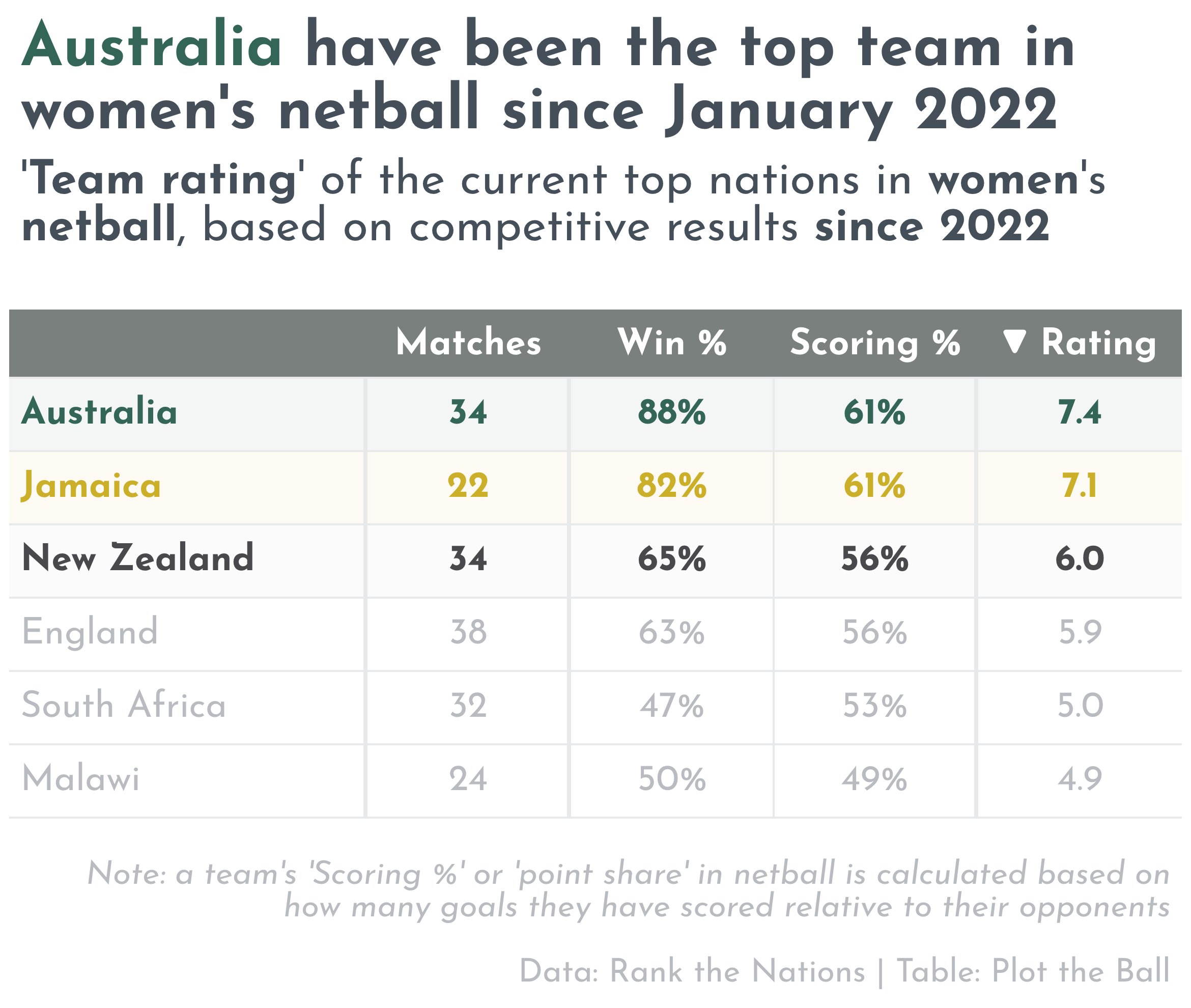
The Sunshine Girls have done very well at major tournaments over the last five years. They beat Australia in the pool stages of the 2022 Games, knocked out New Zealand (6.0) in the semis and went on to win silver; at the 2023 World Cup, they were third. Even without star shooter Jhaniele Fowler this time around, this year’s final against the Kiwi Ferns was a great chance for Jamaica to claim gold. A 48-56 loss yesterday to a clearly weaker team — by my accounting, at least — was a disappointing end.
Australia (6.8) did manage to win gold in women’s 3x3 basketball, though. This was their team’s second major title of the year, after winning the Asia Cup back in April; they also reached the final of the FIBA World Cup in June, before losing to the USA.
In second place were Uganda, who haven’t played enough matches over the last five years to qualify for a rating in the format. In fact, this is the first Commonwealth or Olympic medal the nation has ever won in a team ball sport.
While neither made the gold-medal game, Australia and England pretty clearly have the strongest domestic leagues in netball. Of the 144 players selected for this year’s Games, 57 — or around 40% — played in either SSN or the NSL earlier in 2026.
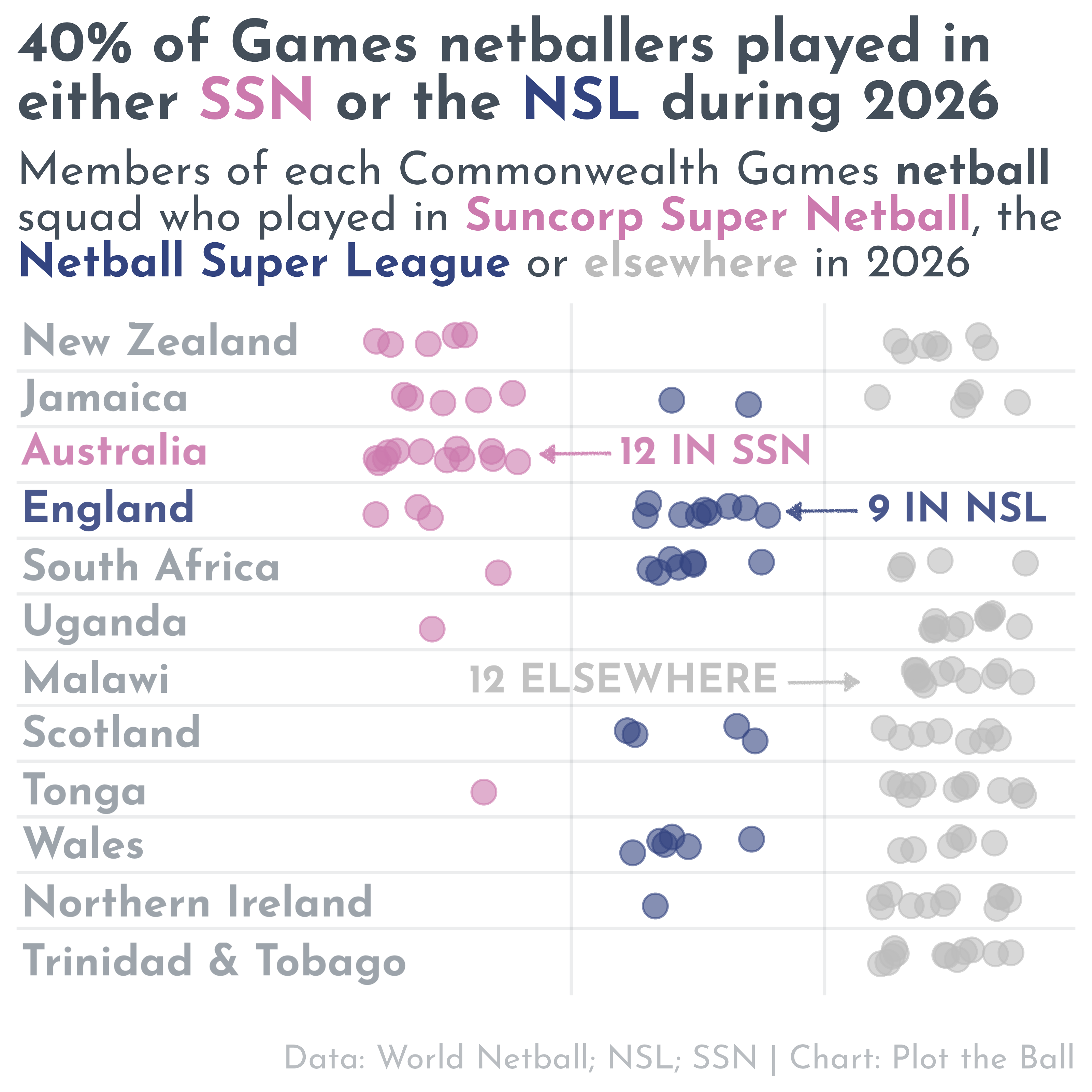
Of the two, which is stronger? While England’s Netball Super League sent one more player to the tournament than Suncorp Super Netball did, much of its talent was from comparatively weaker nations: for instance, bottom-half finishers Scotland, Wales and Northern Ireland had 11 NSL players on their squads. SSN, in contrast, furnished the strongest sides with their talent: Australia’s entire squad of 12 plays at home, as do three current English internationals, five Jamaicans and five Kiwis.
A men’s 3x3 tournament was also contested at this Games — but doesn’t qualify for inclusion in Rank the Nations. Why? Since 2000, no Commonwealth nations have recorded a top-four finish at the Olympic 3x3 tournament or the FIBA World Cup.
But the sport did produce one of the highlights of Glasgow 2026 for the home crowd. With just over a minute left in their first knockout game, Scotland led Malaysia 19-16. Kyle Jimenez held the ball, but was pinned deep into a corner by his defender as the 12-second shot clock wound down. As he turned and lost his balance, the 28-year-old’s only option was to fling the ball over his left shoulder and hope. The two-pointer dropped in without hitting the rim, and sealed a spot in the semi-finals for the hosts.
You can watch a replay of this shot on Instagram here.
For BBC Sport, Matthew Henry asked where the Games go from here. Glasgow 2026 was a “stripped-back” edition, after the Australian state of Victoria pulled out of hosting; only 10 sports were included this year, down from 20 in 2022, and only existing venues were used. These changes did successfully reduce the financial impact of the Games, per Henry’s reporting: “Costs of running the event have been cut from between £700m and £800m…to £160m for Glasgow.”
For ESPN in 2024, Sunaadh Sagar reported on how India — who will host the 2030 edition of the Games in Ahmedabad — would be impacted by the decision to reduce the number of sports played this year. (“Of the 210 Indian athletes that took part in Birmingham, 98 took part in sports that have now been axed.”) The South Asian nation won silver in women’s T20I cricket and men’s field hockey in 2022, as well as bronze in women’s field hockey; all were absent in 2026.
In June, Pacific Media Network asked the Chief Executive of Commonwealth Sport about how Pacific nations would be impacted by the dropping of rugby sevens. Fiji have won four silvers and a bronze in seven men’s tournaments, and one silver in two women’s tournaments; Samoa have also played in every men’s tournament. Her response wasn’t that convincing: “I understand the importance of sevens…but we were in a situation where a decision had to be made.”
The next edition of the newsletter will be published on Monday August 10th.
Comments
Nothing yet. Say the first thing.
Sign in to join the conversation.