
This year at Plot the Ball, I’m using data to try and better understand the landscape of international team sport. For some background to this project — which I’m calling ‘Rank the Nations’ — you can read my introductory post here.
In today’s edition of The Week in International Sport:
🇩🇪 Germany winning a world title in men’s beach handball
🇦🇷 Argentina winning a world title in women’s beach handball
🇧🇪 Belgium winning a world title in men’s field hockey
🇳🇱 The Netherlands winning a world title in women’s field hockey
📊 Chart of the week: assessing the USA’s level in age-grade men’s basketball
⏪️ Highlight of the week: Melissa Vargas’ emphatic spike
💭 A few other interesting things I learned
As a reminder: the team ratings used in this newsletter are on a zero-to-10 scale, and are calculated based on a nation’s performance in competitive fixtures in a given sport since the start of the 2022 calendar year. (For more detail, click here.)
Have you ever been watching a sport like soccer and thought: ‘that goal was so good it should count twice?’ You might enjoy beach handball. Right there in the rulebook is the provision that two points are to be awarded for ‘creative or spectacular goals’.
Fans of sweeping national stereotypes will therefore be delighted to see Brazil (7.0) at the top of the first set of men’s rankings below; even as the Seleção fail to win many admirers at the FIFA World Cup, o jogo bonito seems to survive elsewhere. You might also think it’s fitting that they’ve assumed this position despite coming up short in major tournaments over the last five years: to go with two bronze medals at the World Games, they have finishes of third and second at the World Championship.
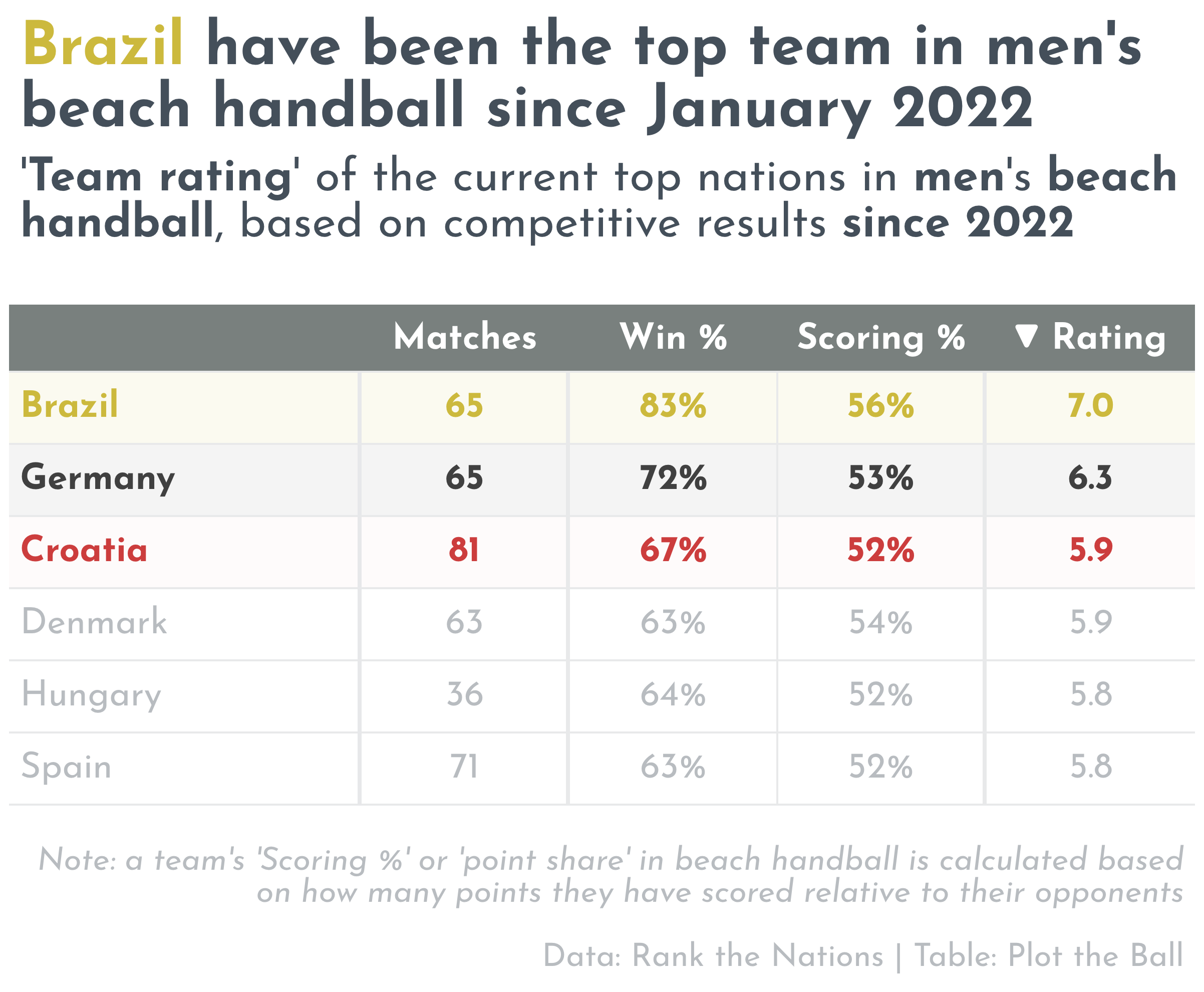
That silver medal was awarded just yesterday, having lost the final of the 2026 World Championship to Germany (6.3) in fairly convincing fashion. This year’s winners have comfortably the best record of any team other than Brazil; beneath them, a group of four European teams are bunched tightly together. Argentina (4.9) only rank 10th overall at present, but might be on the rise: they beat hosts Croatia (5.9) yesterday to claim bronze and secure their best World Championship finish.
In women’s beach handball, there’s little doubt that Argentina (6.4) are on the rise: their World Championship gold yesterday followed a silver at the previous edition in 2024, and a first-place finish at last year’s World Games.
The South Americans are currently fourth in the women’s rankings. Their standing is impressive given their lack of pedigree in the sport’s more popular sibling: they’re the only top-six nation which doesn’t also qualify for a rating in women’s indoor handball.
As well as taking them to an overall victory in this year’s edition of the Pro League, the performances of Belgium (6.5) over the last few months have closed the gap on the Netherlands (6.8) at the top of my men’s field hockey ratings.
An interesting quirk of this Dutch team: they fared unusually poorly in shootouts. During 2025-26, they lost the decider in all five of the games they drew in normal time; just a season earlier, they had won seven Pro League shootouts out of seven.
A shootout loss to Australia (5.3) on Saturday was the only blemish on the Women’s Pro League record of the Netherlands (8.7); they won their other 14 games in normal time, and finished far ahead of the competition at the top of the standings.
They were particularly impressive in attack, scoring 56 goals in total — 25 more than the next-most prolific team. Yibbi Jansen led the overall scoring chart with 15 herself, all from penalty corners; teammate Pien Dicke was the top scorer from open play.
Once again in 2026, the NBA’s MVP award was won by someone brought up outside the USA. While it’s been eight years since the best player in men’s basketball was an American, the country’s development pipeline is clearly still bursting with talent.
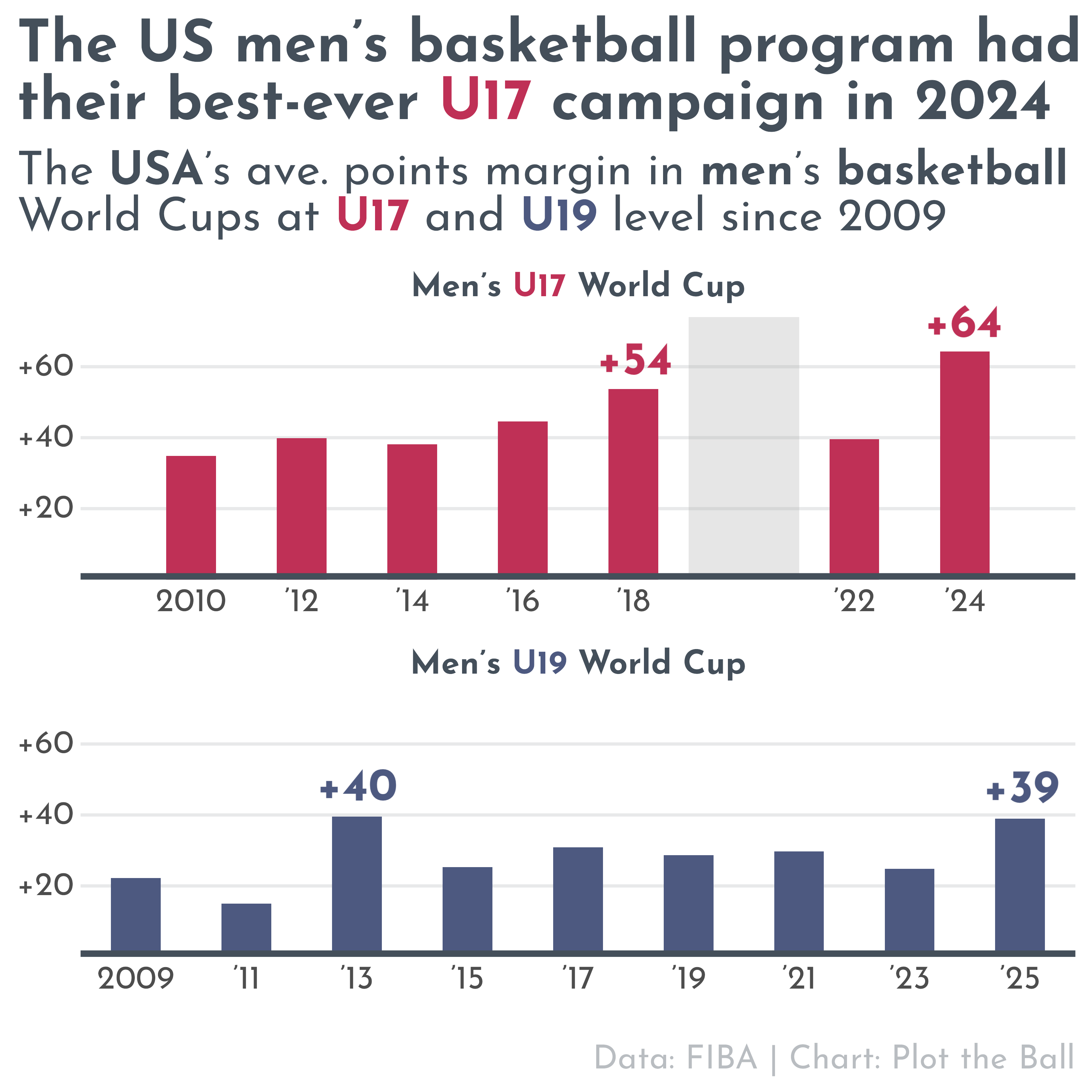
Don’t believe me? Look at their results in recent age-grade tournaments. At the 2024 U17 World Cup, the USA recorded their best performance ever: they won their games by 64 points, on average. Several players from that class — those born during 2007, including last week’s top NBA draft pick AJ Dybantsa — then went on to lead their country to an U19 World Cup win in 2025. This year’s U17 crop have started well, too: so far in 2026, they’ve won their two games by a combined total of 93 points.
Sometimes you spot an athlete and know immediately that you’ll get a lot of joy out of watching them perform. That was my feeling with Nahid Rana — highlighted in this space a couple of weeks ago — and it’s the case with Melissa Vargas, too.
For starters, Vargas has a fascinating story: she first played volleyball for Cuba at 13, but emigrated later in her teens after a dispute with the governing body. She became eligible for Turkey in 2023, and has led them to several medals since. However, the 26-year-old is also just a jaw-dropping athlete: she combines a 1.94m frame with an explosive leap and tidy ball skills. One successful third-set spike against China in the VNL last week stuck with me for a while; all I can suggest is that you watch it, too.
You can watch a replay of this point on Instagram here.
For The Observer, Cameron Ponsonby wrote about the recent success of New Zealand in men’s test cricket, despite having the smallest population of any nation playing the format. One choice made by the governing body has been to prioritise foreign exposure: in 2018, they shifted funding from the domestic red-ball competition to development tours overseas. As a former coach put it: "[w]e are giving a large number of players international experience at different levels”.
For The Guardian, Sid Lowe reported on the plight of Uruguay manager Marcelo Bielsa before his team were knocked out of the men’s soccer World Cup on Saturday. Several players had complained about how he had treated them in private, and his public comments ahead of their final pool game were withering. Contrasting himself to Spain coach Luis de la Fuente, he said: “the reality is that his football is much more beautiful than what I’ve managed with my team”.
For MLB.com, Jesse Borek covered an eye-catching hitting display from Rintaro Sasaki at the league’s draft combine. In an unusual move for a top baseball prospect, he left Japan in 2024 — after breaking the high-school home-run record — to go to college in the USA. Now 21, Sasaki has had only limited success at NCAA level: he was a roughly average hitter this year, and “could potentially land anywhere from the [seventh] to the 12th round” of the 2026 draft.
The next edition of the newsletter will be published on Monday July 6th.
Comments
Nothing yet. Say the first thing.
Sign in to join the conversation.