
The most important relationship you’ll ever have is the one we don’t talk about enough: the relationship you have with yourself.
The ways in which we develop self-trust, build our capacity for setting boundaries, check in with our internal consent, and practice radical self-compassion create the foundation for more expansive and meaningful relationships with others, both beyond and within the sexual and romantic spectrums.
And at the root of self-trust and healthy boundaries is the ability to check in with, and interpret, your body’s signals of internal consent.
Internal consent is one of my favorite concepts because it expands our understanding of consent beyond simply saying “yes” or “no” to another person. It asks an equally important question:
Have I said yes to myself?
And perhaps just as importantly:
Can I say no to others without an apology, without an excuse, and without guilt?
Many of us have learned to check whether something is acceptable to everyone else before we ever pause to ask whether it feels right in our own bodies. Whether that’s born from people-pleasing tendencies or, more fundamentally, our deeply human desire to belong, it’s understandable. For many of us, belonging has always felt tied to survival.
So, what makes checking in with our body’s cues around internal consent, or genuinely knowing what we want, whether we’re choosing something freely or because we feel obligated, or giving ourselves permission to say no or change our minds, so difficult?
Disembodiment.
When we’re stressed, overwhelmed, overstimulated, or constantly “stuck in our heads,” we lose touch with our body’s messages. We stop noticing. We stop acknowledging. We stop listening.
Developing internal consent requires self-awareness and interoception, our nervous system’s ability to sense, interpret, and respond to the body’s internal signals. These signals shape our emotions, our decision-making, our sense of self, and ultimately, our relationships.
Like any relationship, this one takes practice.
While internal consent is often discussed in sexual contexts, it applies to every area of life.
It might sound like:
“I don’t actually want to go to this event.”
“I’m exhausted. I need rest instead of productivity.”
“I’m allowed to ask for help.”
“I’m not ready to forgive yet.”
“I’d rather spend tonight alone.”
And consent isn’t a one-time decision. It’s ongoing.
You can change your mind. You can ask for more information. You can renegotiate boundaries. You can discover that something which felt like a yes yesterday feels like a no today.
Internal consent lives in the body.
A wholehearted yes might feel like relaxation, expansion, curiosity, excitement, steady breathing, or a sense of being grounded.
A “not yet” or a no might show up as tightness in your chest, a knot in your stomach, holding your breath, tension in your jaw or shoulders, or feeling frozen, disconnected, or overwhelmed.
Before saying yes to something, consider asking yourself:
What am I feeling right now?
What does my body notice?
What am I afraid will happen if I say no?
What do I hope will happen if I say yes?
Is this choice coming from desire, obligation, fear, or habit?
What would honoring myself look like in this moment?
At its core, internal consent is about cultivating a relationship with yourself that is rooted in honesty, compassion, and trust.
The more often you pause to check in with your inner experience, the more confidently you’ll make choices that align with your values, your needs, and your well-being.
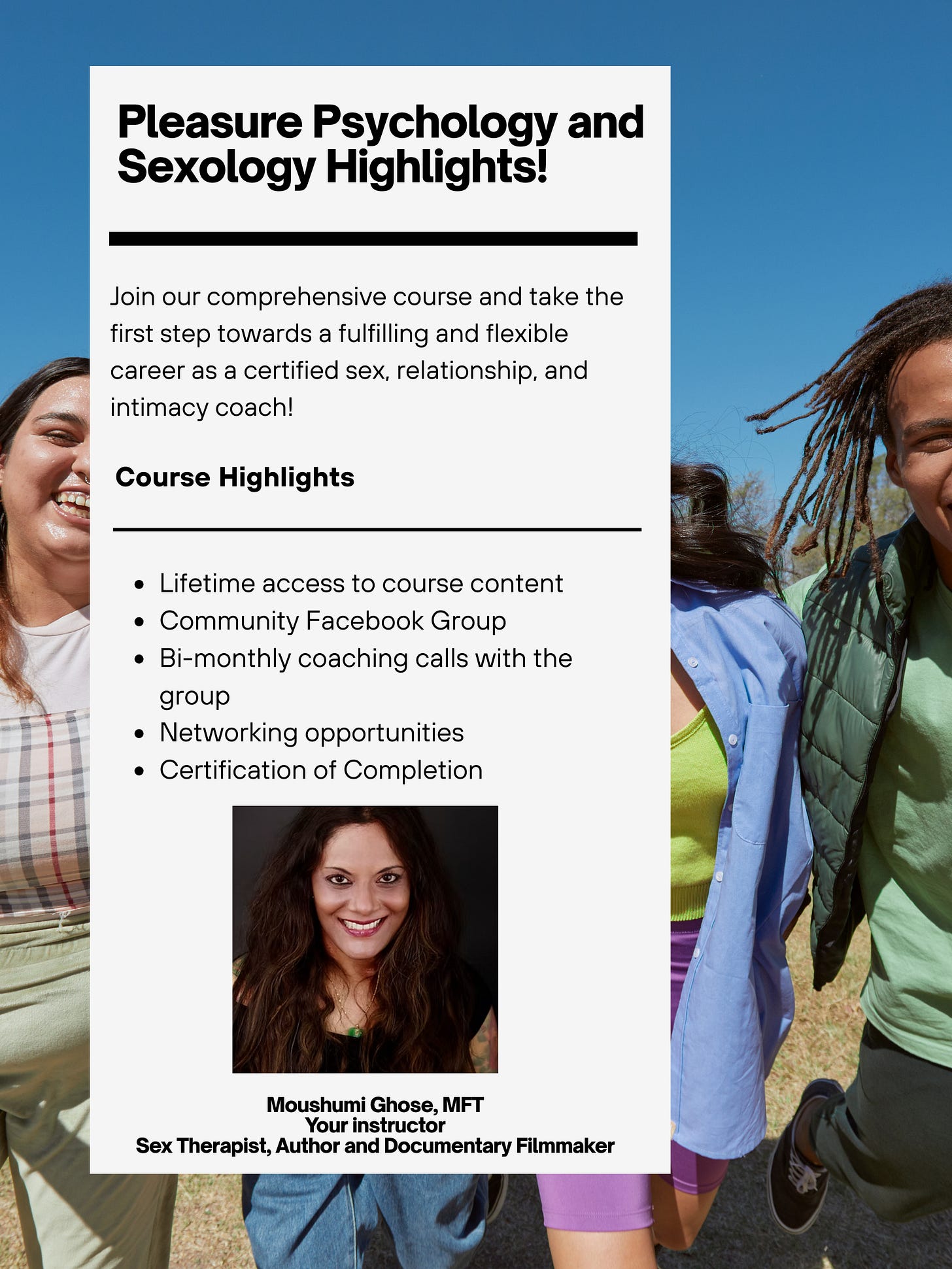
Maybe you’ve been reading these newsletters for a while. Maybe you’ve watched some of the YouTube Videos, testimonials, or followed along on social media. Something keeps bringing you back.
Perhaps you’re craving deeper relationships. More meaningful intimacy. Greater confidence in your body. A healthier relationship with pleasure. Or maybe you’re simply curious and know there’s more to learn.
You don’t have to have all the answers before you begin.
The Pleasure Psychology Certification Program was created for people who are ready to explore the psychology, science, and lived experience of pleasure, intimacy, sexuality, and relationships in a thoughtful, evidence-informed, and shame-free environment.
Inside the program, you’ll explore topics like:
💓Desire and arousal
🌹Communication and consent
💜Attachment and relationships
💫Trauma-informed approaches to intimacy
🌱Somatic embodiment
🏳️⚧️Gender, sexuality, and identity
🔥Kink and ethical nonmonogamy
🌈Pleasure as a pathway to well-being
You don’t have to be an expert. You don’t have to have it all figured out. You simply have to be willing to ask better questions.
Your journey begins the moment you decide you’re worth exploring.
Comments
Nothing yet. Say the first thing.
Sign in to join the conversation.